
Effects of Processing Condition on Critical Current Density
- Slides: 1
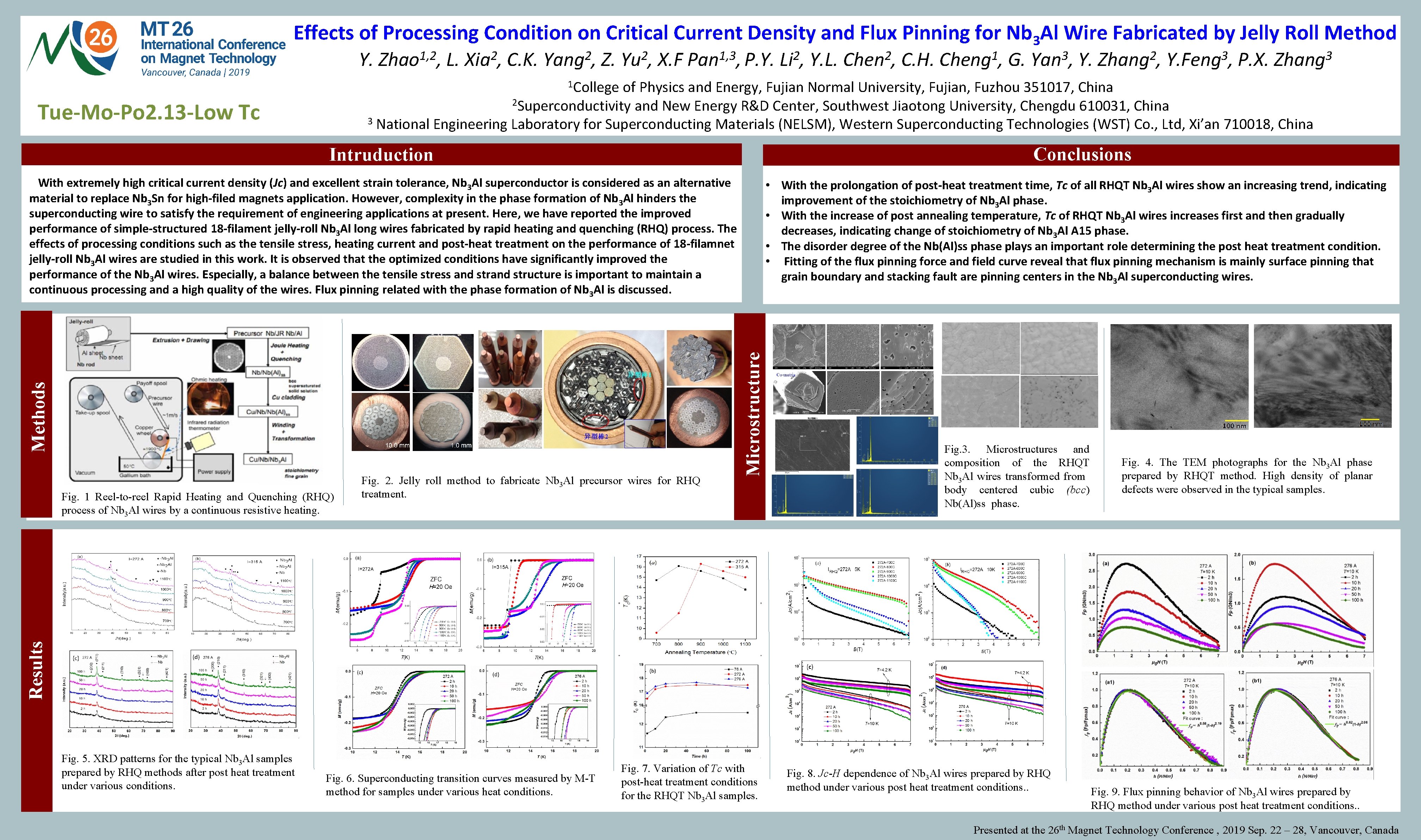
Effects of Processing Condition on Critical Current Density and Flux Pinning for Nb 3 Al Wire Fabricated by Jelly Roll Method Y. 1, 2 Zhao , L. 2 Xia , C. K. 2 Yang , Z. 2 Yu , X. F 1, 3 Pan , P. Y. 2 Li , Y. L. 2 Chen , C. H. 1 Cheng , G. 3 Yan , Y. 2 Zhang , 3 Y. Feng , P. X. 3 Zhang 1 College of Physics and Energy, Fujian Normal University, Fujian, Fuzhou 351017, China 2 Superconductivity and New Energy R&D Center, Southwest Jiaotong University, Chengdu 610031, China 3 National Engineering Laboratory for Superconducting Materials (NELSM), Western Superconducting Technologies (WST) Co. , Ltd, Xi’an 710018, China Tue-Mo-Po 2. 13 -Low Tc Conclusions Intruduction Fig. 3. Microstructures and composition of the RHQT Nb 3 Al wires transformed from body centered cubic (bcc) Nb(Al)ss phase. Fig. 4. The TEM photographs for the Nb 3 Al phase prepared by RHQT method. High density of planar defects were observed in the typical samples. Results Fig. 1 Reel-to-reel Rapid Heating and Quenching (RHQ) process of Nb 3 Al wires by a continuous resistive heating. Fig. 2. Jelly roll method to fabricate Nb 3 Al precursor wires for RHQ treatment. • With the prolongation of post-heat treatment time, Tc of all RHQT Nb 3 Al wires show an increasing trend, indicating improvement of the stoichiometry of Nb 3 Al phase. • With the increase of post annealing temperature, Tc of RHQT Nb 3 Al wires increases first and then gradually decreases, indicating change of stoichiometry of Nb 3 Al A 15 phase. • The disorder degree of the Nb(Al)ss phase plays an important role determining the post heat treatment condition. • Fitting of the flux pinning force and field curve reveal that flux pinning mechanism is mainly surface pinning that grain boundary and stacking fault are pinning centers in the Nb 3 Al superconducting wires. Microstructure Methods With extremely high critical current density (Jc) and excellent strain tolerance, Nb 3 Al superconductor is considered as an alternative material to replace Nb 3 Sn for high-filed magnets application. However, complexity in the phase formation of Nb 3 Al hinders the superconducting wire to satisfy the requirement of engineering applications at present. Here, we have reported the improved performance of simple-structured 18 -filament jelly-roll Nb 3 Al long wires fabricated by rapid heating and quenching (RHQ) process. The effects of processing conditions such as the tensile stress, heating current and post-heat treatment on the performance of 18 -filamnet jelly-roll Nb 3 Al wires are studied in this work. It is observed that the optimized conditions have significantly improved the performance of the Nb 3 Al wires. Especially, a balance between the tensile stress and structure is important to maintain a continuous processing and a high quality of the wires. Flux pinning related with the phase formation of Nb 3 Al is discussed. Fig. 5. XRD patterns for the typical Nb 3 Al samples prepared by RHQ methods after post heat treatment under various conditions. Fig. 6. Superconducting transition curves measured by M-T method for samples under various heat conditions. Fig. 7. Variation of Tc with post-heat treatment conditions for the RHQT Nb 3 Al samples. Fig. 8. Jc-H dependence of Nb 3 Al wires prepared by RHQ method under various post heat treatment conditions. . Fig. 9. Flux pinning behavior of Nb 3 Al wires prepared by RHQ method under various post heat treatment conditions. . Presented at the 26 th Magnet Technology Conference , 2019 Sep. 22 – 28, Vancouver, Canada