
Effects of Pollution on Visibility and the Earths
Effects of Pollution on Visibility and the Earth’s Radiation Balance John G. Watson (john. watson@dri. edu) Judith C. Chow Desert Research Institute Reno, NV, USA Presented at: The Workshop on Air Quality Management, Measurement, Modeling, and Health Effects University of Zagreb, Croatia 24 May 2007
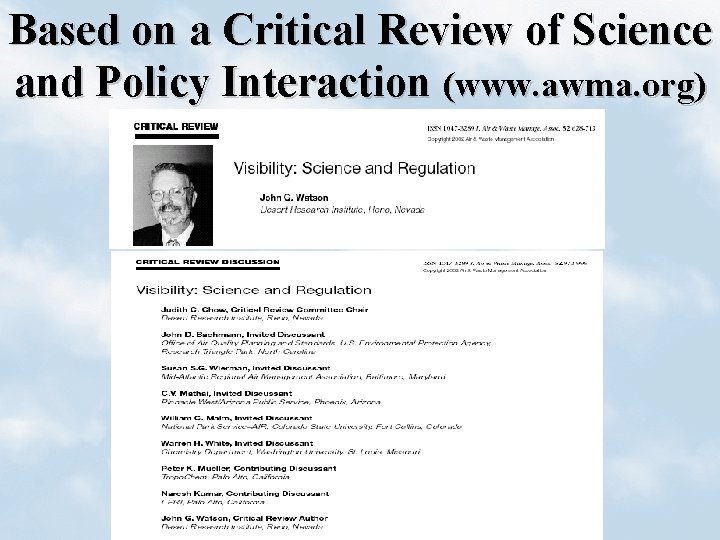
Based on a Critical Review of Science and Policy Interaction (www. awma. org)
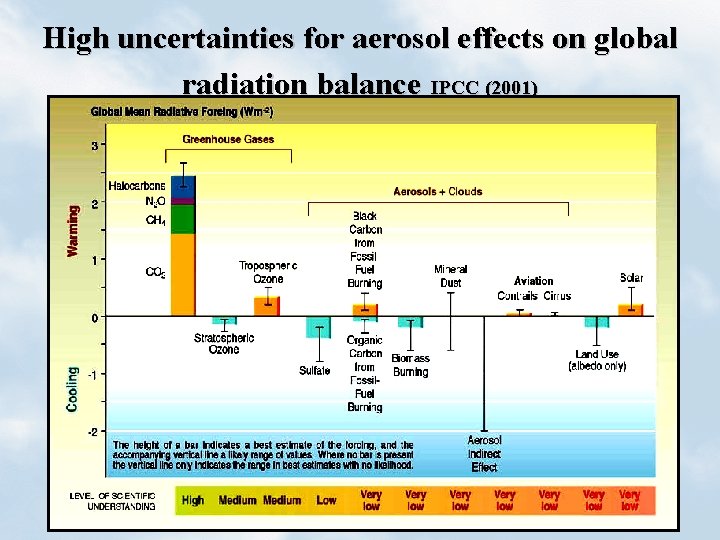
High uncertainties for aerosol effects on global radiation balance IPCC (2001)
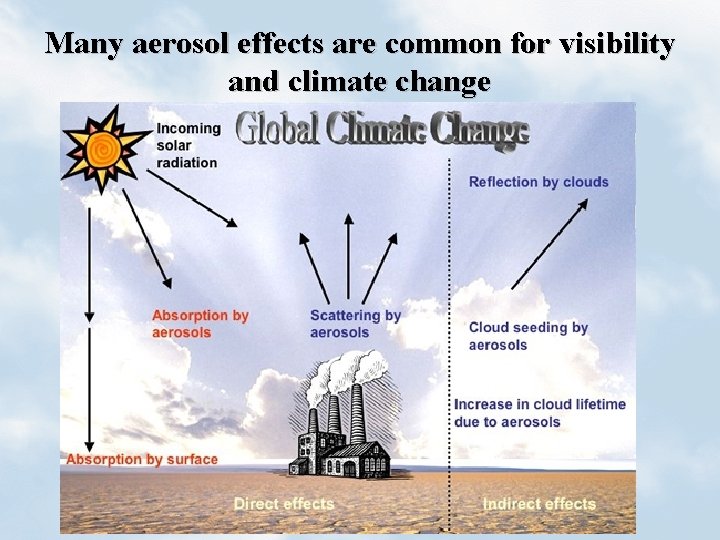
Many aerosol effects are common for visibility and climate change

Questions · What is poor visibility or “haze”? · Why is visibility important? · What causes haze? · How is haze quantified? · How can haze be measured? · How can visibility be improved?

What is haze? · Haze is the visually perceived degradation of humanly appreciated views caused by polluting particles and gases.
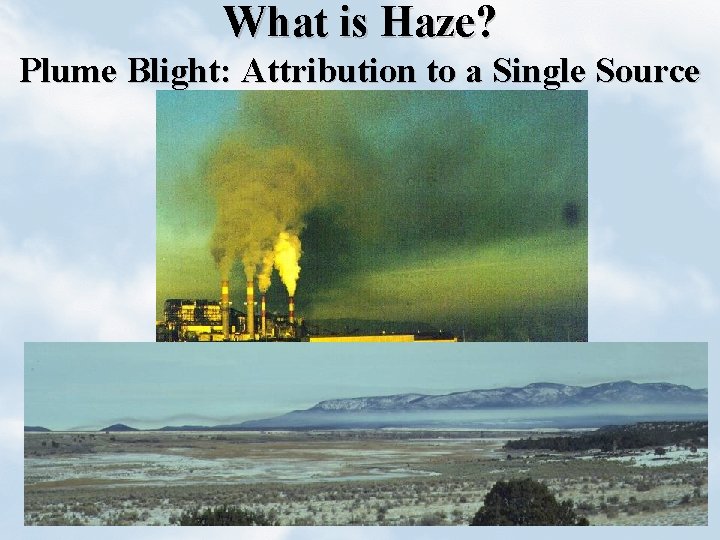
What is Haze? Plume Blight: Attribution to a Single Source
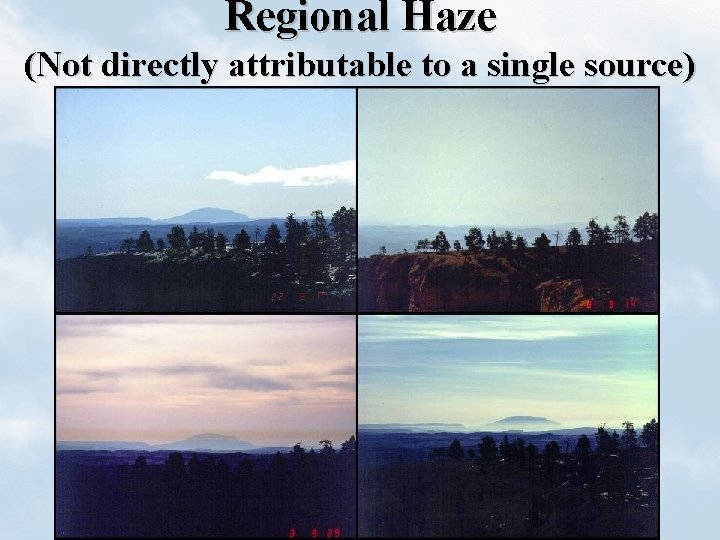
Regional Haze (Not directly attributable to a single source)
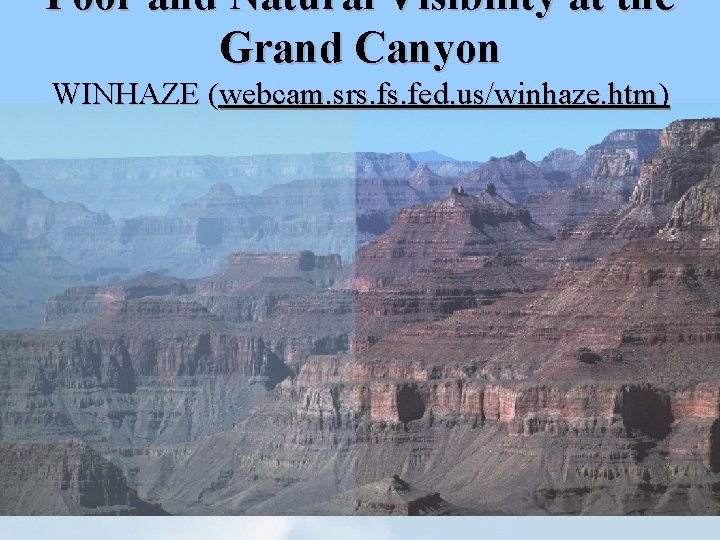
Poor and Natural Visibility at the Grand Canyon WINHAZE (webcam. srs. fed. us/winhaze. htm)
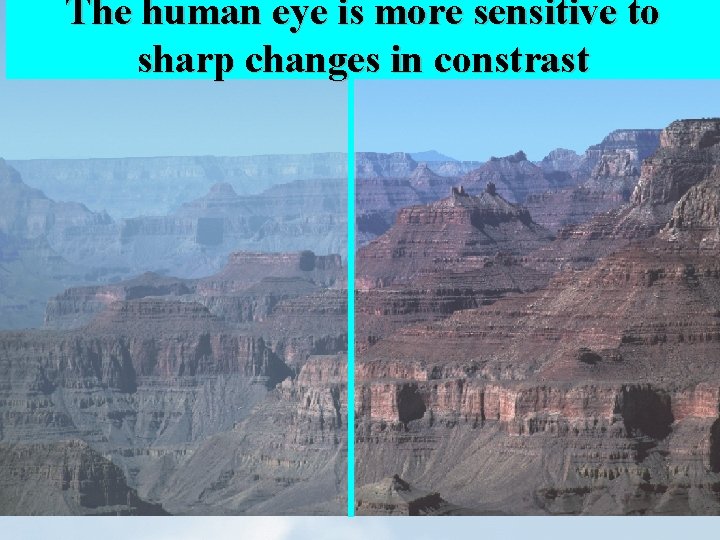
The human eye is more sensitive to sharp changes in constrast
Why is haze important? · Poor visibility is the most publicly accessible indicator of air pollution. · Haze is associated with adverse pollution levels that affect public health. · Tourists and homeowners pay much for highly prized views. · The same pollutants that affect haze also affect global radiation balance.
What causes haze? · Particles and gases that remove light from a sight path and scatter light into a sight path, thereby obscuring the contrast of a target with background air.
Particles and gases in the air scatter and absorb light
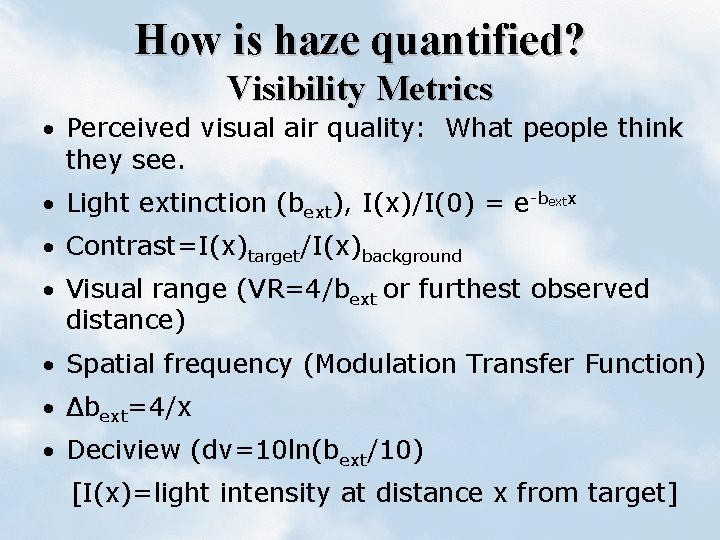
How is haze quantified? Visibility Metrics · Perceived visual air quality: What people think they see. · Light extinction (bext), I(x)/I(0) = e-bextx · Contrast=I(x)target/I(x)background · Visual range (VR=4/bext or furthest observed distance) · Spatial frequency (Modulation Transfer Function) · Δbext=4/x · Deciview (dv=10 ln(bext/10) [I(x)=light intensity at distance x from target]
How is haze quantified? Other considerations · Long-term averages (e. g. , annual, seasonal). · Averages of highest and lowest values (e. g. , poorest 20%, lowest 20%). · Frequencies above a threshold. · Willingness to pay or be paid.

How can haze be measured? · Human observations – viewing targets at various distances · Photographs – measuring distance to targets or visual enjoyment · Contrast transmittance – teleradiometers measure intensity of target and background) · Sight path extinction – transmissometers measure light removed from a path · Point extinction – nephelometers for particle scattering, aethalometers for particle absorption, NOx analyzer for gas absorption, elevation for clear air scattering · Chemical extinction – weighted sum of major chemical components in fine and coarse particles
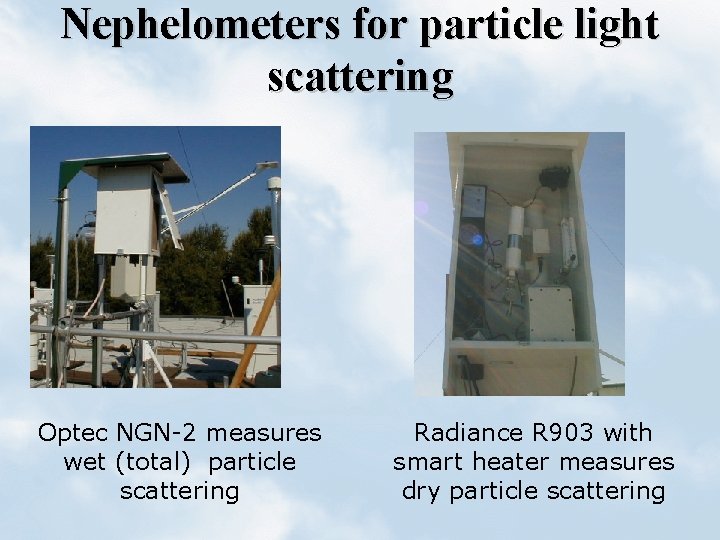
Nephelometers for particle light scattering Optec NGN-2 measures wet (total) particle scattering Radiance R 903 with smart heater measures dry particle scattering
Temporal variability of particle scattering at nearby sites
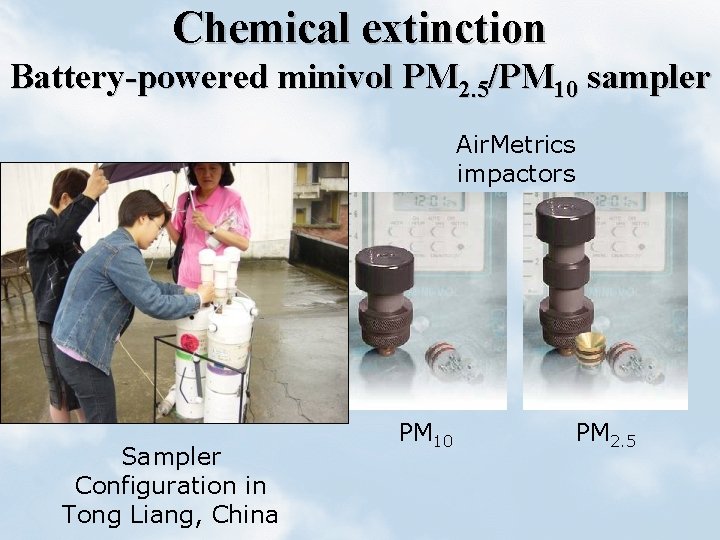
Chemical extinction Battery-powered minivol PM 2. 5/PM 10 sampler Air. Metrics impactors Sampler Configuration in Tong Liang, China PM 10 PM 2. 5
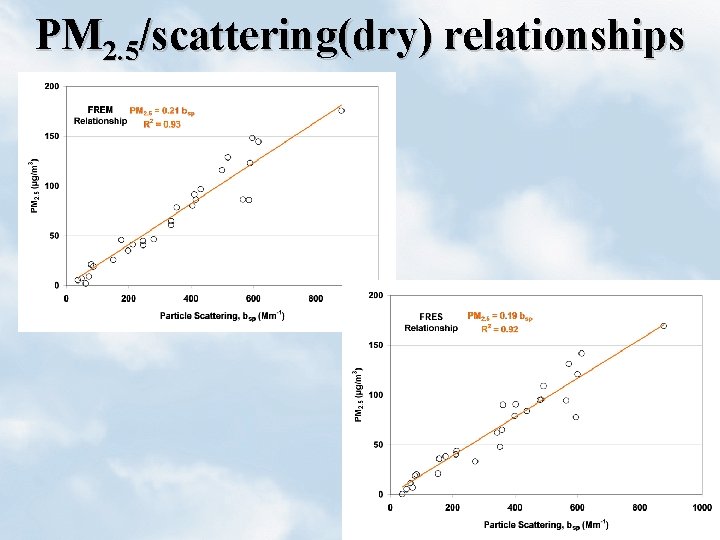
PM 2. 5/scattering(dry) relationships

Chemical Extinction bext (Mm-1) = Σdry extinction efficiency (m 2/g) x humidity multiplier x species concentration (µg/m 3) = 3 x f(RH) x (NH 4)2 SO 4 + 3 x f(RH) x NH 4 NO 3 + 4 x Organics + 10 x Soot + 1 x Soil + 0. 6 x Coarse Mass + 10 (Clear Air Scattering) f(RH)=extinction efficiency increase with RH dv=10 ln(bext/10)
Extinction efficiencies assume size distribution, pure substances, and spherical particles
Scattering efficiency depends on RH, assuming an initial size distribution. High RH measurements are inaccurate
Chemical extinction equals measured extinction
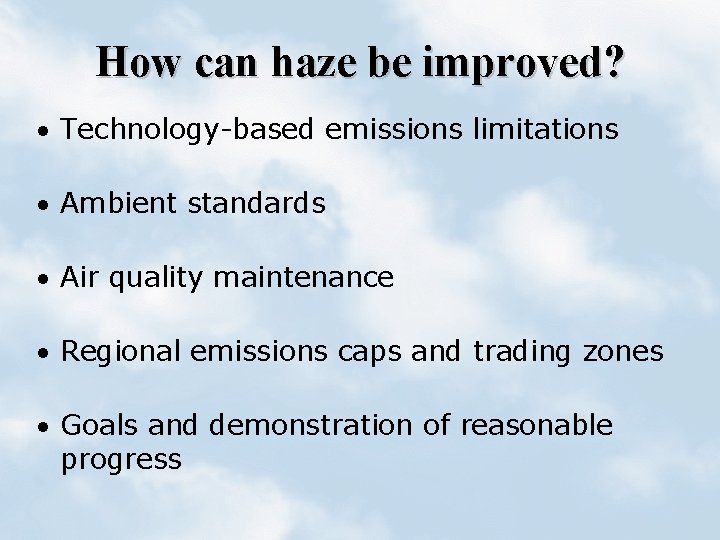
How can visibility be improved? · Quantify where and when poor visibility occurs · Measure PM 2. 5 chemical components · Determine sources of PM 2. 5 components · Separate natural from manmade contributions · Reduce emissions from manmade emitters
US Regional Haze Rule · Sets ten year goals along line between baseline and “natural visibility conditions” · Uses IMPROVE aerosol measurements to monitor progress · Attains natural visibility conditions by 2065 · Uses deciview as indicator of haze · Uses 2000 -2004 as baseline · Allows Regional Planning Organizations (RPOs) to develop regional emissions strategies (e. g. , emissions trading)
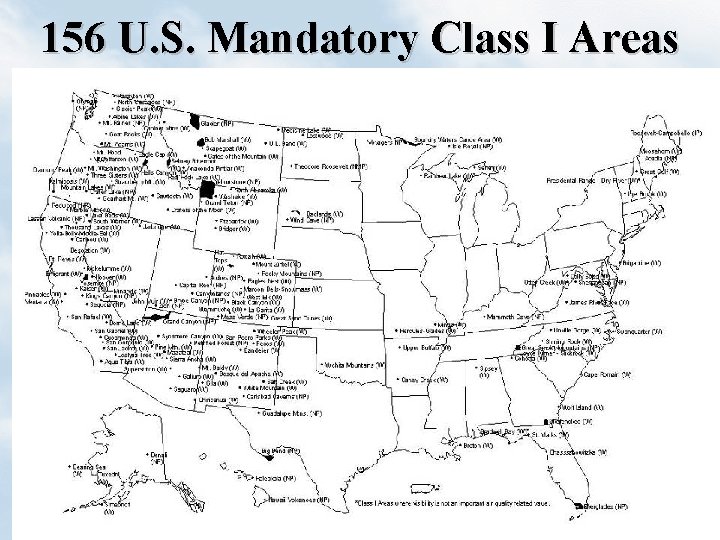
156 U. S. Mandatory Class I Areas

Reasonable Progress Glide Path
Chemical Contributions to Extinction Average of Highest 20% bext, 1995 -1999
How can haze be improved? · Technology-based emissions limitations · Ambient standards · Air quality maintenance · Regional emissions caps and trading zones · Goals and demonstration of reasonable progress
Trends in 20% highest bext (Mm-1) 1988 -1999
Comparison with Natural Conditions
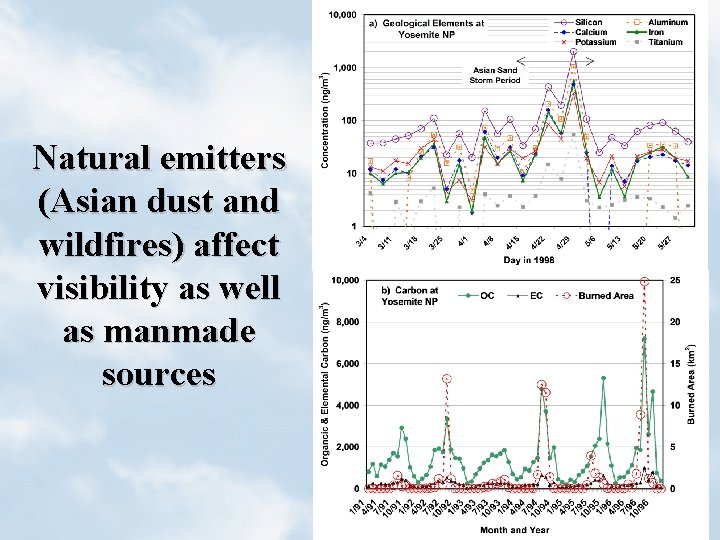
Natural emitters (Asian dust and wildfires) affect visibility as well as manmade sources
Conclusions · Haze is the most publicly accessible evidence of air pollution · Poor visibility is related to all other pollution problems · Haze is best quantified in terms of contributions from different types of pollution · Progress is tracked through long-term measurements · Much of our current knowledge of regional haze comes from PM monitoring with chemical speciation and special studies within its framework · Each of the aerosol components can be quantified reasonably accurately, with the exception of organic and elemental carbon · Haze improvements will result in general emission reductions that also mitigate against global warming
- Slides: 34