
Effects of Overpressure Conditions on the Porosity of
- Slides: 1
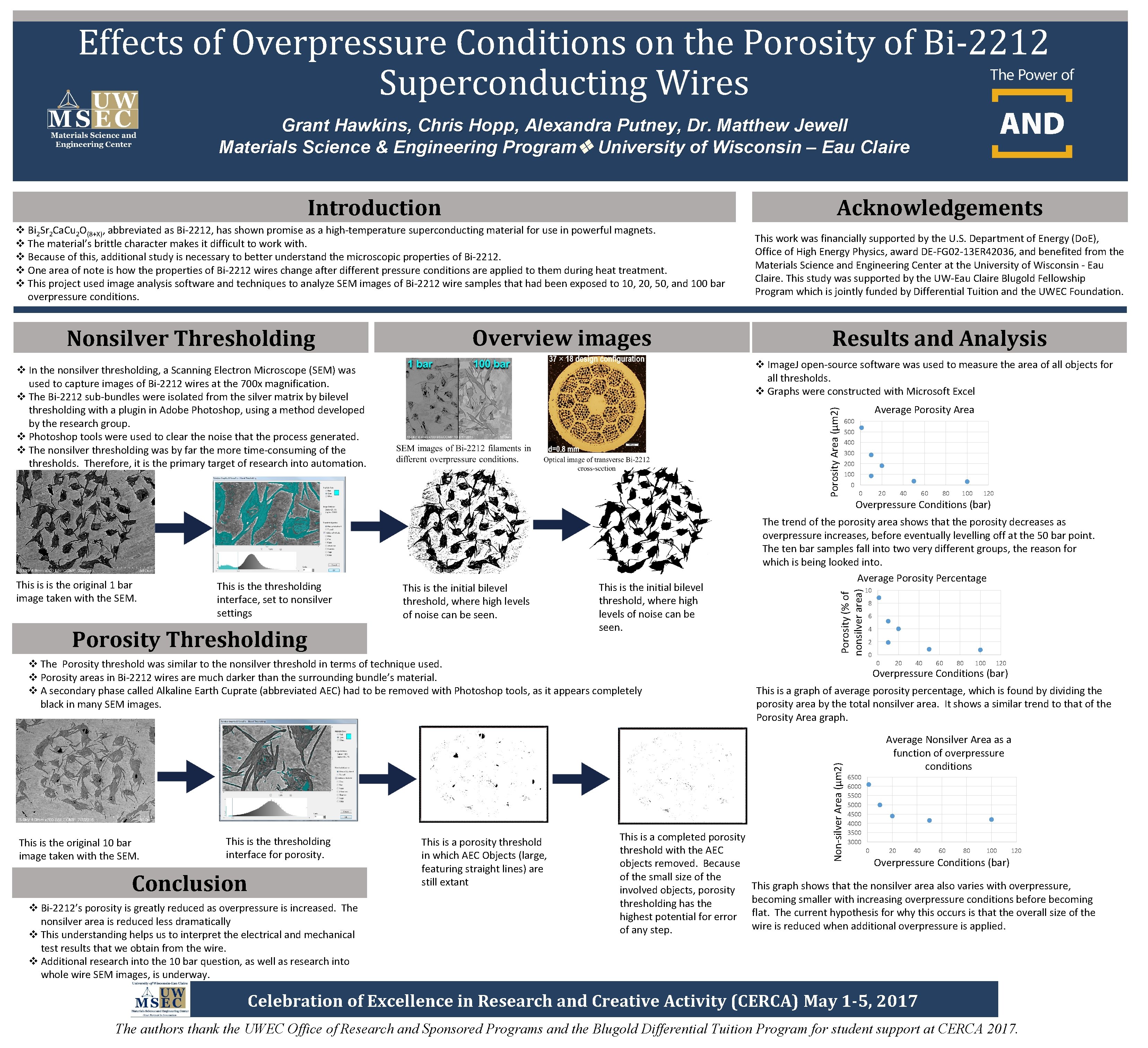
Effects of Overpressure Conditions on the Porosity of Bi-2212 Superconducting Wires Grant Hawkins, Chris Hopp, Alexandra Putney, Dr. Matthew Jewell Materials Science & Engineering Program University of Wisconsin – Eau Claire Introduction Acknowledgements v Bi 2 Sr 2 Ca. Cu 2 O(8+X), abbreviated as Bi-2212, has shown promise as a high-temperature superconducting material for use in powerful magnets. v The material’s brittle character makes it difficult to work with. v Because of this, additional study is necessary to better understand the microscopic properties of Bi-2212. v One area of note is how the properties of Bi-2212 wires change after different pressure conditions are applied to them during heat treatment. v This project used image analysis software and techniques to analyze SEM images of Bi-2212 wire samples that had been exposed to 10, 20, 50, and 100 bar overpressure conditions. Nonsilver Thresholding Overview images This work was financially supported by the U. S. Department of Energy (Do. E), Office of High Energy Physics, award DE-FG 02 -13 ER 42036, and benefited from the Materials Science and Engineering Center at the University of Wisconsin - Eau Claire. This study was supported by the UW-Eau Claire Blugold Fellowship Program which is jointly funded by Differential Tuition and the UWEC Foundation. Results and Analysis v Image. J open-source software was used to measure the area of all objects for all thresholds. v Graphs were constructed with Microsoft Excel Porosity Area (μm 2) v In the nonsilver thresholding, a Scanning Electron Microscope (SEM) was used to capture images of Bi-2212 wires at the 700 x magnification. v The Bi-2212 sub-bundles were isolated from the silver matrix by bilevel thresholding with a plugin in Adobe Photoshop, using a method developed by the research group. v Photoshop tools were used to clear the noise that the process generated. v The nonsilver thresholding was by far the more time-consuming of the thresholds. Therefore, it is the primary target of research into automation. Average Porosity Area 600 500 400 300 200 100 0 0 20 40 60 80 100 120 Overpressure Conditions (bar) This is the initial bilevel threshold, where high levels of noise can be seen. Porosity Thresholding This is the initial bilevel threshold, where high levels of noise can be seen. v The Porosity threshold was similar to the nonsilver threshold in terms of technique used. v Porosity areas in Bi-2212 wires are much darker than the surrounding bundle’s material. v A secondary phase called Alkaline Earth Cuprate (abbreviated AEC) had to be removed with Photoshop tools, as it appears completely black in many SEM images. This is the original 10 bar image taken with the SEM. This is the thresholding interface for porosity. Conclusion v Bi-2212’s porosity is greatly reduced as overpressure is increased. The nonsilver area is reduced less dramatically v This understanding helps us to interpret the electrical and mechanical test results that we obtain from the wire. v Additional research into the 10 bar question, as well as research into whole wire SEM images, is underway. This is a porosity threshold in which AEC Objects (large, featuring straight lines) are still extant This is a completed porosity threshold with the AEC objects removed. Because of the small size of the involved objects, porosity thresholding has the highest potential for error of any step. Porosity (% of nonsilver area) This is the thresholding interface, set to nonsilver settings 10 8 6 4 2 0 0 20 40 60 80 100 120 Overpressure Conditions (bar) This is a graph of average porosity percentage, which is found by dividing the porosity area by the total nonsilver area. It shows a similar trend to that of the Porosity Area graph. Non-silver Area (μm 2) This is is the original 1 bar image taken with the SEM. The trend of the porosity area shows that the porosity decreases as overpressure increases, before eventually levelling off at the 50 bar point. The ten bar samples fall into two very different groups, the reason for which is being looked into. Average Porosity Percentage Average Nonsilver Area as a function of overpressure conditions 6500 6000 5500 5000 4500 4000 3500 3000 0 20 40 60 80 100 120 Overpressure Conditions (bar) This graph shows that the nonsilver area also varies with overpressure, becoming smaller with increasing overpressure conditions before becoming flat. The current hypothesis for why this occurs is that the overall size of the wire is reduced when additional overpressure is applied. Celebration of Excellence in Research and Creative Activity (CERCA) May 1 -5, 2017 Wisconsin Science & Technology Symposium (WSTS) – August 2 & 3, 2016 The authors thank the UWEC Office of Research and Sponsored Programs and the Blugold Differential Tuition Program for student support at CERCA 2017.