
Effects of Osmosis on Water Balance Osmosis is
Effects of Osmosis on Water Balance • Osmosis is the diffusion of water across a selectively permeable membrane • The direction of osmosis is determined only by a difference in total solute concentration • Water diffuses across a membrane from the region of lower solute concentration to the region of higher solute concentration
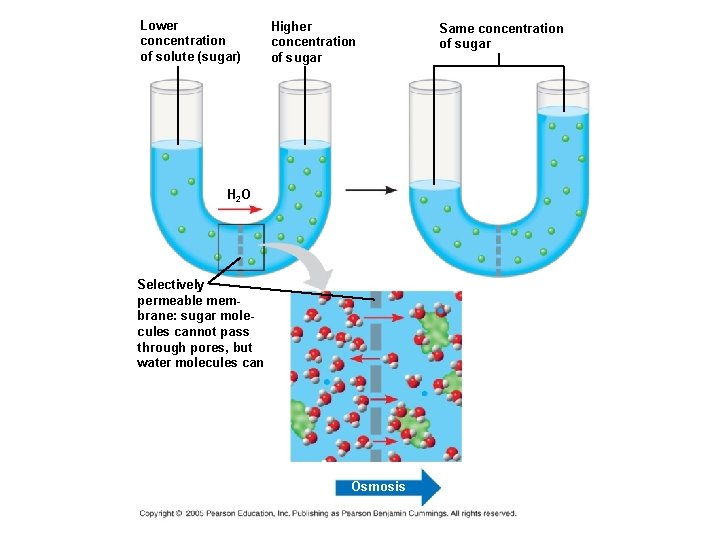
Lower concentration of solute (sugar) Higher concentration of sugar H 2 O Selectively permeable membrane: sugar molecules cannot pass through pores, but water molecules can Osmosis Same concentration of sugar
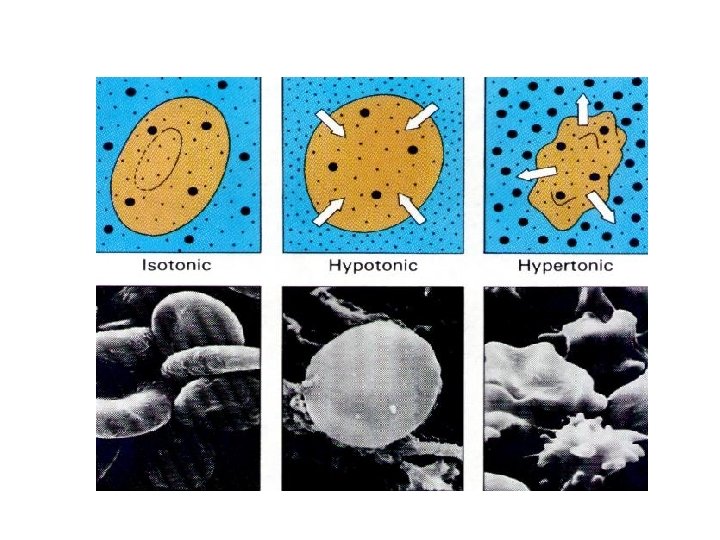
Water Balance of Cells Without Walls • Tonicity is the ability of a solution to cause a cell to gain or lose water • Isotonic solution: solute concentration is the same as that inside the cell; no net water movement across the plasma membrane • Hypertonic solution: solute concentration is greater than that inside the cell; cell loses water • Hypotonic solution: solute concentration is less than that inside the cell; cell gains water
• Animals and other organisms without rigid cell walls have osmotic problems in either a hypertonic or hypotonic environment • To maintain their internal environment, such organisms must have adaptations for osmoregulation, the control of water balance • The protist Paramecium, which is hypertonic to its pond water environment, has a contractile vacuole that acts as a pump
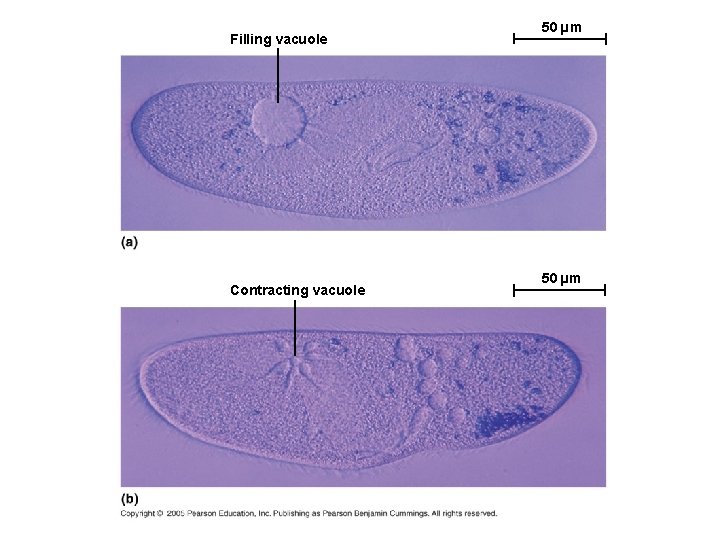
Filling vacuole Contracting vacuole 50 µm
Water Balance of Cells with Walls • Cell walls help maintain water balance • A plant cell in a hypotonic solution swells until the wall opposes uptake; the cell is now turgid (firm) • If a plant cell and its surroundings are isotonic, there is no net movement of water into the cell; the cell becomes flaccid (limp), and the plant may wilt • In a hypertonic environment, plant cells lose water; eventually, the membrane pulls away from the wall, a usually lethal effect called plasmolysis
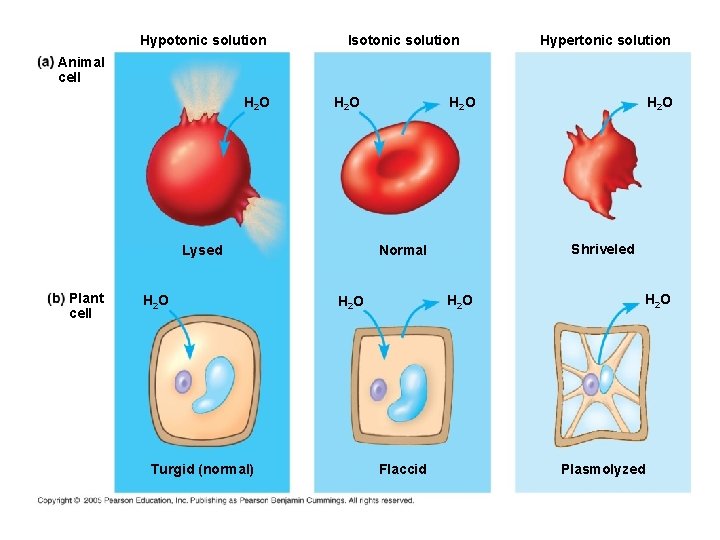
Hypotonic solution Isotonic solution Hypertonic solution Animal cell H 2 O Turgid (normal) H 2 O Flaccid H 2 O Shriveled Normal Lysed Plant cell H 2 O Plasmolyzed
- Slides: 8