
Effects of Mixing on Ammonia Oxidation in Combustion
Effects of Mixing on Ammonia Oxidation in Combustion Environments at Intermediate Temperatures Joseph Grcar 1 Peter Glarborg 2 John Bell 1 Marcus Day 1 Antonio Loren 2 Anker Jensen 2 1 Center for Computational Science and Engineering Lawrence Berkeley National Laboratory Berkeley, CA 94720 USA 2 Department of Chemical Engineering Technical University of Denmark 2800 Lyngby, Denmark
Outline Flame Background Experiment Plug Flow Predictions DNS Predictions Zwieterung Predictions Conclusions
Ammonia in Flames • Biomass releases nitrogen compounds as: – Ammonia – Hydrogen cyanide • Fuel-bound nitrogen oxidizes to N 2 or NO • NO selectivity varies with flame type: Diffusion flames: Selectivity declines with more Ammonia Premixed flames: Linear response – Sarofim et al. , AICh. E Symp. Series (1975) – Sullivan et al. , Combust. Flame (2002)
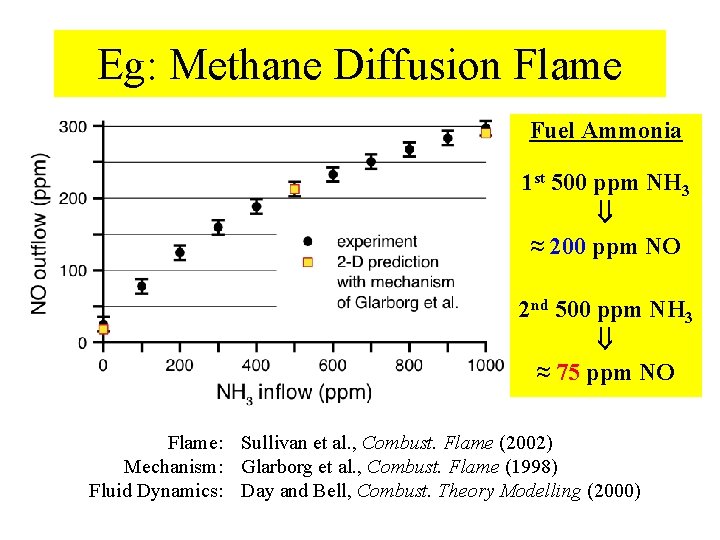
Eg: Methane Diffusion Flame Fuel Ammonia 1 st 500 ppm NH 3 ≈ 200 ppm NO 2 nd 500 ppm NH 3 ≈ 75 ppm NO Flame: Sullivan et al. , Combust. Flame (2002) Mechanism: Glarborg et al. , Combust. Flame (1998) Fluid Dynamics: Day and Bell, Combust. Theory Modelling (2000)
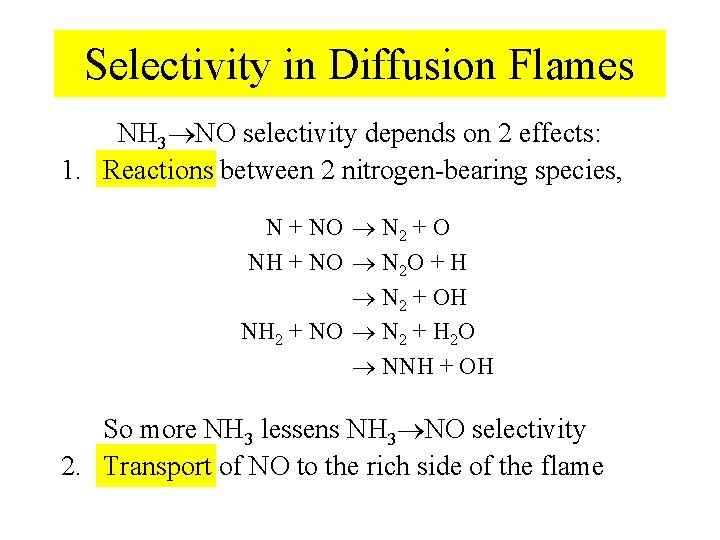
Selectivity in Diffusion Flames NH 3 NO selectivity depends on 2 effects: 1. Reactions between 2 nitrogen-bearing species, N + NO N 2 + O NH + NO N 2 O + H N 2 + OH NH 2 + NO N 2 + H 2 O NNH + OH So more NH 3 lessens NH 3 NO selectivity 2. Transport of NO to the rich side of the flame
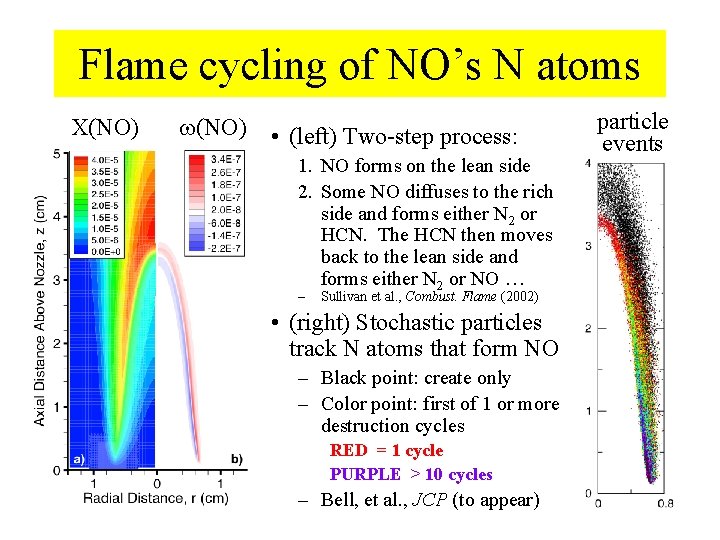
Flame cycling of NO’s N atoms X(NO) • (left) Two-step process: 1. NO forms on the lean side 2. Some NO diffuses to the rich side and forms either N 2 or HCN. The HCN then moves back to the lean side and forms either N 2 or NO … – Sullivan et al. , Combust. Flame (2002) • (right) Stochastic particles track N atoms that form NO – Black point: create only – Color point: first of 1 or more destruction cycles RED = 1 cycle PURPLE > 10 cycles – Bell, et al. , JCP (to appear) particle events
Outline Flame Background Experiment Plug Flow Predictions DNS Predictions Zwieterung Predictions Conclusions
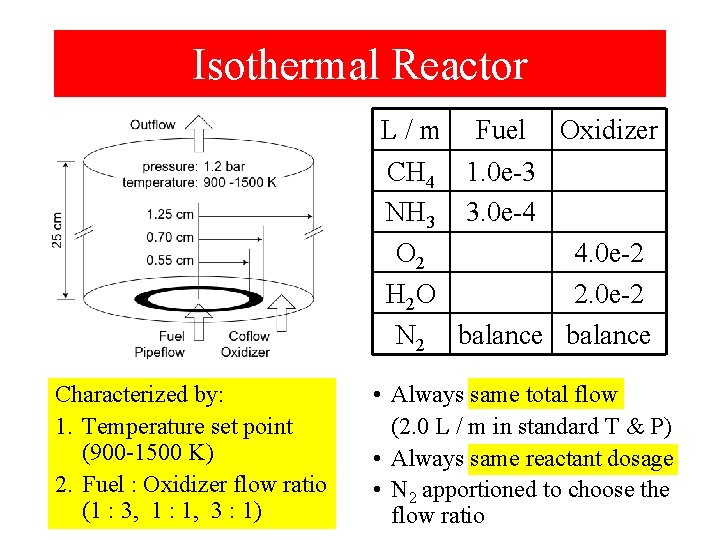
Isothermal Reactor L / m Fuel Oxidizer CH 4 1. 0 e-3 NH 3 3. 0 e-4 O 2 4. 0 e-2 H 2 O 2. 0 e-2 N 2 balance Characterized by: 1. Temperature set point (900 -1500 K) 2. Fuel : Oxidizer flow ratio (1 : 3, 1 : 1, 3 : 1) • Always same total flow (2. 0 L / m in standard T & P) • Always same reactant dosage • N 2 apportioned to choose the flow ratio
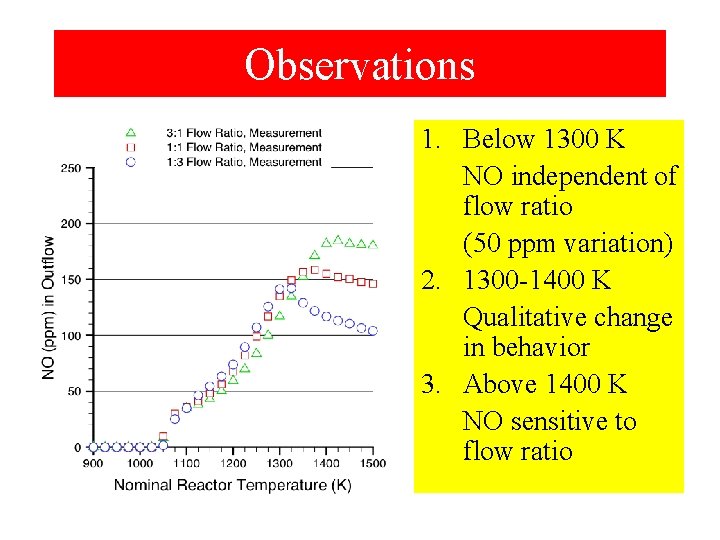
Observations 1. Below 1300 K NO independent of flow ratio (50 ppm variation) 2. 1300 -1400 K Qualitative change in behavior 3. Above 1400 K NO sensitive to flow ratio
Outline Flame Background Experiment Plug Flow Predictions DNS Predictions Zwieterung Predictions Conclusions

Plug Flow Model • Mechanism of Glarborg, Alzueta, Dam-Johansen, and Miller, Combust. Flame (1998) • Chemkin’s SENKIN by Lutz, et al. (1987) – Premixed inflow so no flow ratio dependence (residence time is 1. 274 s per 1000 K) • “Good” agreement with experiment up to 1300 K – 60 ppm variation at highest experimental flow ratio Conclude: reactor has premixed reaction zone below 1300 K.
Outline Flame Background Experiment Plug Flow Predictions DNS Predictions Zwieterung Predictions Conclusions
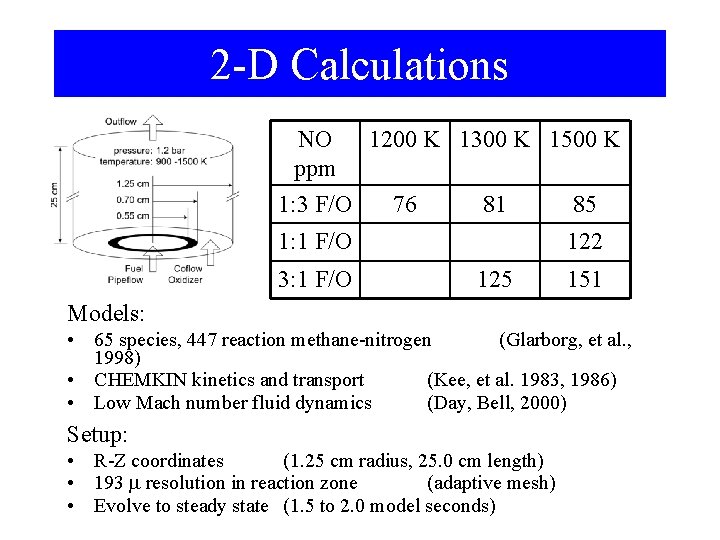
2 -D Calculations NO ppm 1: 3 F/O 1200 K 1300 K 1500 K 76 81 1: 1 F/O 3: 1 F/O 85 122 125 151 Models: • 65 species, 447 reaction methane-nitrogen (Glarborg, et al. , 1998) • CHEMKIN kinetics and transport (Kee, et al. 1983, 1986) • Low Mach number fluid dynamics (Day, Bell, 2000) Setup: • R-Z coordinates (1. 25 cm radius, 25. 0 cm length) • 193 resolution in reaction zone (adaptive mesh) • Evolve to steady state (1. 5 to 2. 0 model seconds)
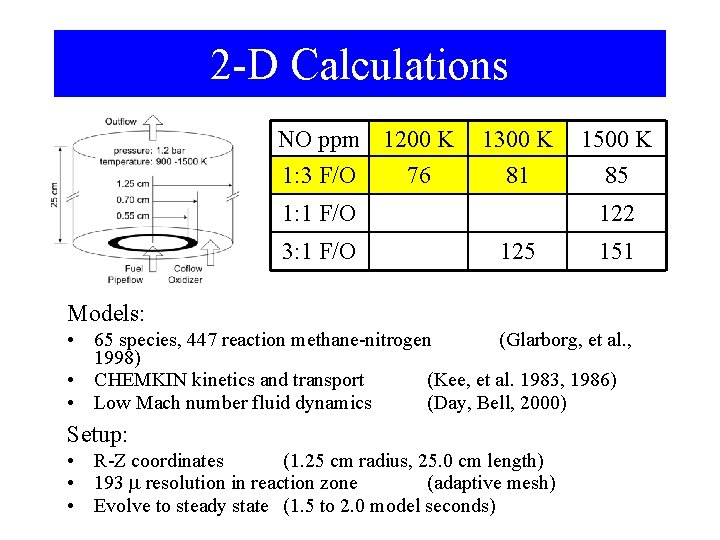
2 -D Calculations NO ppm 1200 K 1: 3 F/O 76 1300 K 1500 K 81 85 1: 1 F/O 3: 1 F/O 122 125 151 Models: • 65 species, 447 reaction methane-nitrogen (Glarborg, et al. , 1998) • CHEMKIN kinetics and transport (Kee, et al. 1983, 1986) • Low Mach number fluid dynamics (Day, Bell, 2000) Setup: • R-Z coordinates (1. 25 cm radius, 25. 0 cm length) • 193 resolution in reaction zone (adaptive mesh) • Evolve to steady state (1. 5 to 2. 0 model seconds)
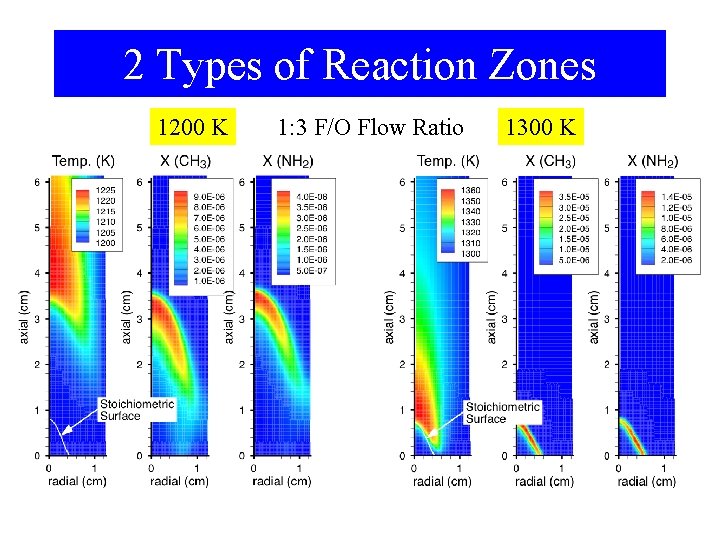
2 Types of Reaction Zones 1200 K 1: 3 F/O Flow Ratio 1300 K
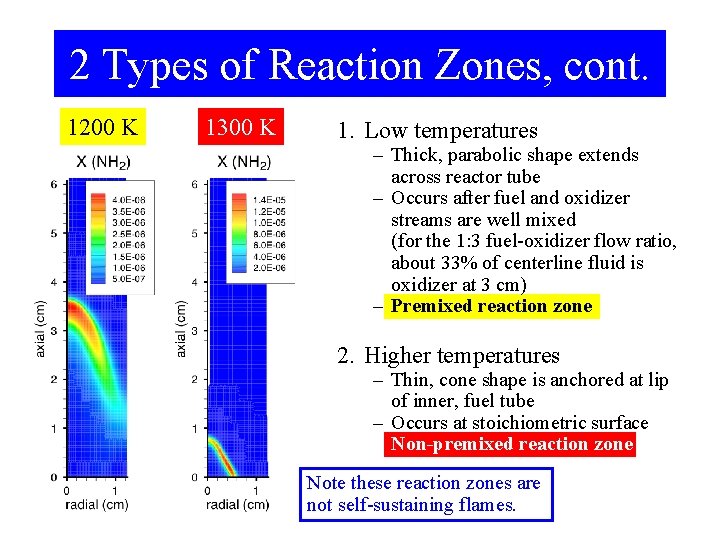
2 Types of Reaction Zones, cont. 1200 K 1300 K 1. Low temperatures – Thick, parabolic shape extends across reactor tube – Occurs after fuel and oxidizer streams are well mixed (for the 1: 3 fuel-oxidizer flow ratio, about 33% of centerline fluid is oxidizer at 3 cm) – Premixed reaction zone 2. Higher temperatures – Thin, cone shape is anchored at lip of inner, fuel tube – Occurs at stoichiometric surface – Non-premixed reaction zone Note these reaction zones are not self-sustaining flames.
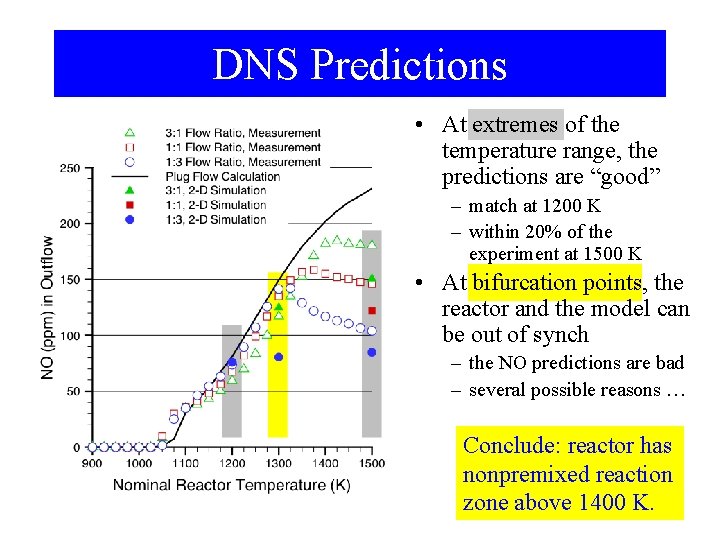
DNS Predictions • At extremes of the temperature range, the predictions are “good” – match at 1200 K – within 20% of the experiment at 1500 K • At bifurcation points, the reactor and the model can be out of synch – the NO predictions are bad – several possible reasons … Conclude: reactor has nonpremixed reaction zone above 1400 K.
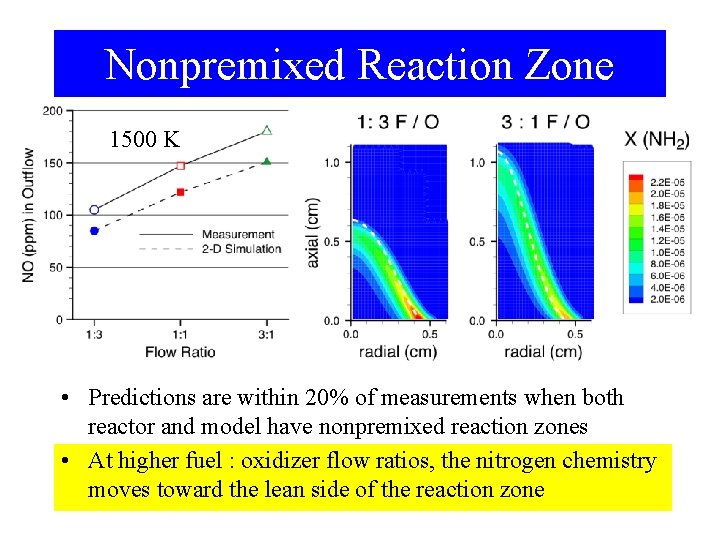
Nonpremixed Reaction Zone 1500 K • Predictions are within 20% of measurements when both reactor and model have nonpremixed reaction zones • At higher fuel : oxidizer flow ratios, the nitrogen chemistry moves toward the lean side of the reaction zone
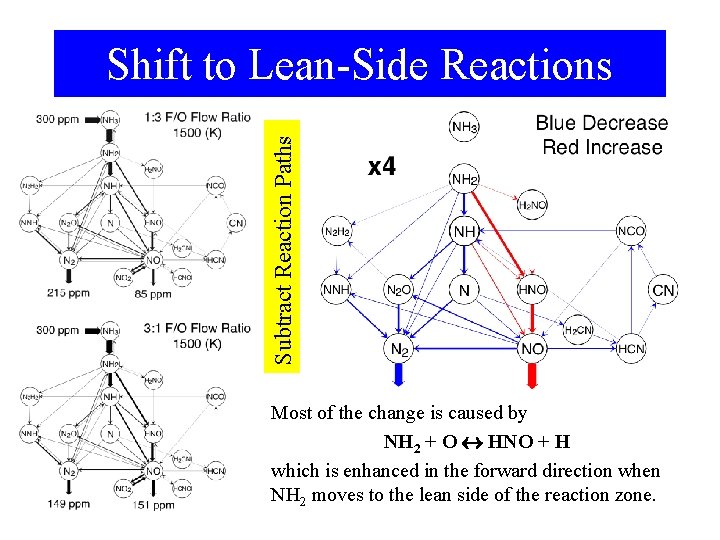
Subtract Reaction Paths Shift to Lean-Side Reactions Most of the change is caused by NH 2 + O HNO + H which is enhanced in the forward direction when NH 2 moves to the lean side of the reaction zone.
Outline Flame Background Experiment Plug Flow Predictions DNS Predictions Zwieterung Predictions Conclusions
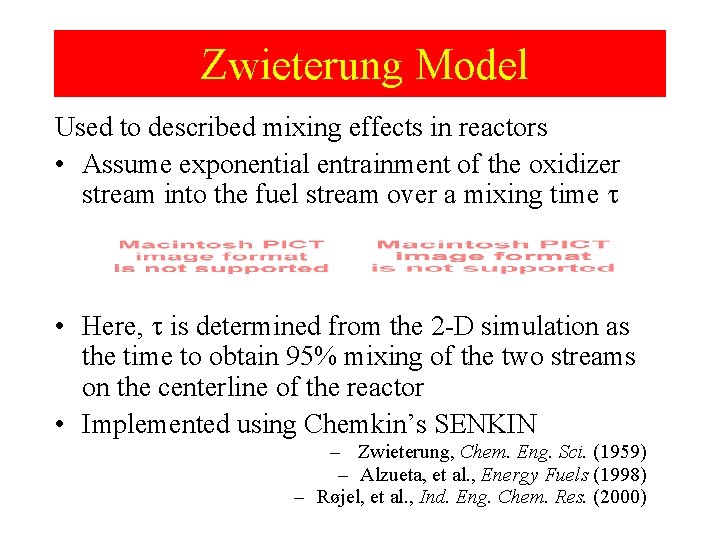
Zwieterung Model Used to described mixing effects in reactors • Assume exponential entrainment of the oxidizer stream into the fuel stream over a mixing time • Here, is determined from the 2 -D simulation as the time to obtain 95% mixing of the two streams on the centerline of the reactor • Implemented using Chemkin’s SENKIN – Zwieterung, Chem. Eng. Sci. (1959) – Alzueta, et al. , Energy Fuels (1998) – Røjel, et al. , Ind. Eng. Chem. Res. (2000)
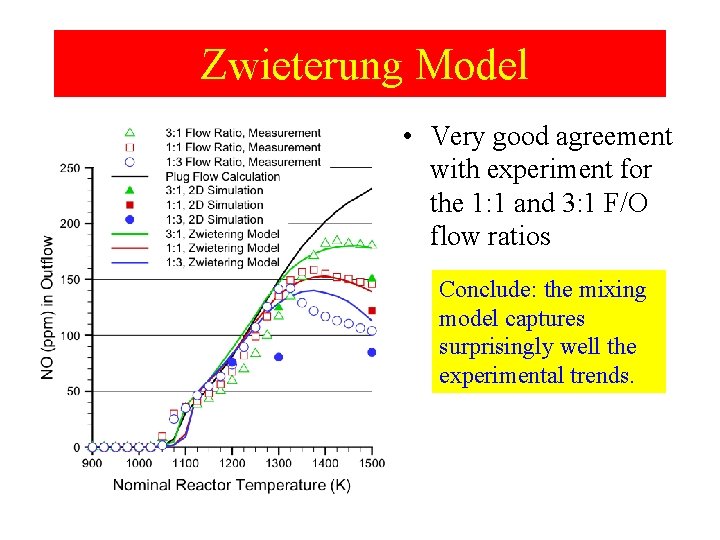
Zwieterung Model • Very good agreement with experiment for the 1: 1 and 3: 1 F/O flow ratios Conclude: the mixing model captures surprisingly well the experimental trends.
Outline Flame Background Experiment Plug Flow Predictions DNS Predictions Zwieterung Predictions Conclusions
Conclusions • Laminar flow reactor bifurcates between stable premixed and stable nonpremixed reaction zones – Bifurcations determined by temperature – Nonpremixed reaction zone moderates NO production from NH 3 • As in flames, NO production at intermediate temperatures is sensitive to mixing • Inexpensive 2 -D DNS simulations can be used to visualize complex mixing in laminar flow reactors – All calculations were done on desktop personal computers • Entrainment models can be constructed to correctly predict reactor behavior
Conclusions • Laminar flow reactor bifurcates between stable premixed and stable nonpremixed reaction zones – Bifurcations determined by temperature – Nonpremixed reaction zone moderates NO production from NH 3 • As in flames, NO production at intermediate temperatures is sensitive to mixing • Inexpensive 2 -D DNS simulations can be used to visualize complex mixing in laminar flow reactors – All calculations were done on desktop personal computers • Entrainment models can be constructed to correctly predict reactor behavior Contact author regarding collaborative use of the 2 -D DNS software.
- Slides: 25