
EFFECTS OF GRAPHICAL WEATHER INFORMATION VERSUS TEXTUAL WEATHER





- Slides: 22
EFFECTS OF GRAPHICAL WEATHER INFORMATION VERSUS TEXTUAL WEATHER INFORMATION ON SITUATION AWARENESS IN METEOROLOGY STEFAN MELENDEZ ANDREW R. DATTEL CHRISTOPHER HERBSTER DEBBIE SCHAUM ANDEY BABIN EMBRY-RIDDLE AERONAUTICAL UNIVERSITY
Introduction
Introduction Before a flight, pilots gather weather information Self-briefing and/or professional weather briefer (Casner, Murphy, Neville, & Neville, 2012) Aviationweather. gov provides weather products in graphical and text form Pilots need to interpret symbols and abbreviations Would one type be better than the other? Kharb, Samanta, Jindal, and Singh (2013)found that people prefer visual to verbal learning Could this have an effect on the way we look at weather information?
Review of Relevant Literature
Situation Awareness Definition Factors for SA: Weather conditions Traffic Flight conditions Locations for potential emergency landings Navigation aids, etc. This study focused on the meteorological aspect of SA, or, Situation Awareness in Meteorology (SAM)
Importance of conducting research on SAM Continued VFR (Visual Flight Rules) flight into IMC (instrument meteorological conditions) is one leading causes of fatal accidents in the general aviation industry. This accounted for 27% of fatalities in general aviation accidents. (AOPA, 1996) Weather-related mishaps have the highest fatality rate of any kind (AOPA, 2009) The NTSB mentioned “Identifying and Communicating Hazardous Weather” in their 2014 Most Wanted List.
Previous Research A study showed that VFR flight into IMC conditions primarily involved inexperienced pilots. (Detwiler, Holcomb, Boquet, Wiegmann, & Shappell, 2005) The way people learn varies from person to person. VARK Model (Fleming & Mills, 1992) Study showed that 61% of medical students had multimodal preferences (Kharb, Samanta, Jindal, & Singh, 2013).
Previous Research cont. Endsley (1995) found that 88% of major airline accidents involved problems with lack of SA. Some pilots brief themselves on weather rather than contacting a professional weather briefer. (Casner, Murphy, Neville, & Neville, 2012).
Methodology
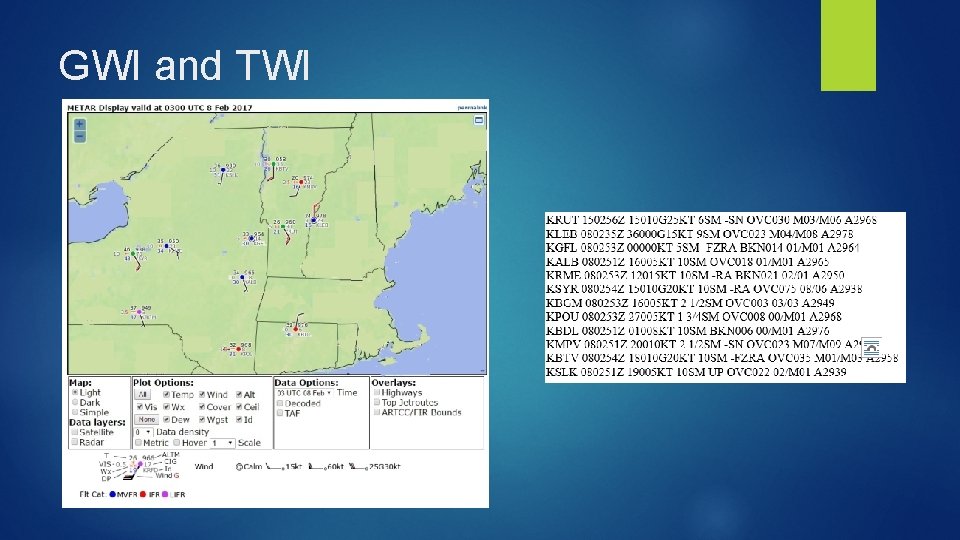
GWI and TWI
Participants 20 Participants SONA Systems recruitment E-mails (ETA messages) Posted flyers
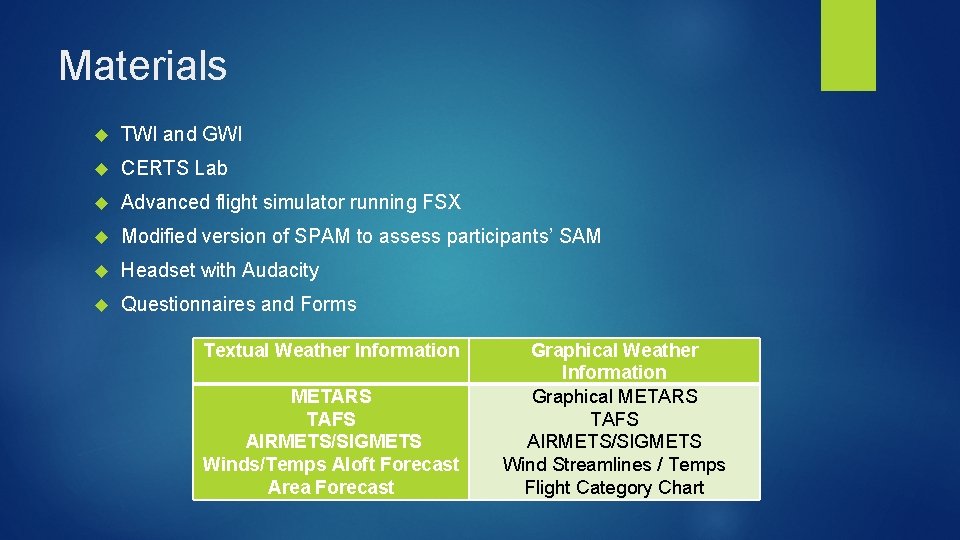
Materials TWI and GWI CERTS Lab Advanced flight simulator running FSX Modified version of SPAM to assess participants’ SAM Headset with Audacity Questionnaires and Forms Textual Weather Information METARS TAFS AIRMETS/SIGMETS Winds/Temps Aloft Forecast Area Forecast Graphical Weather Information Graphical METARS TAFS AIRMETS/SIGMETS Wind Streamlines / Temps Flight Category Chart
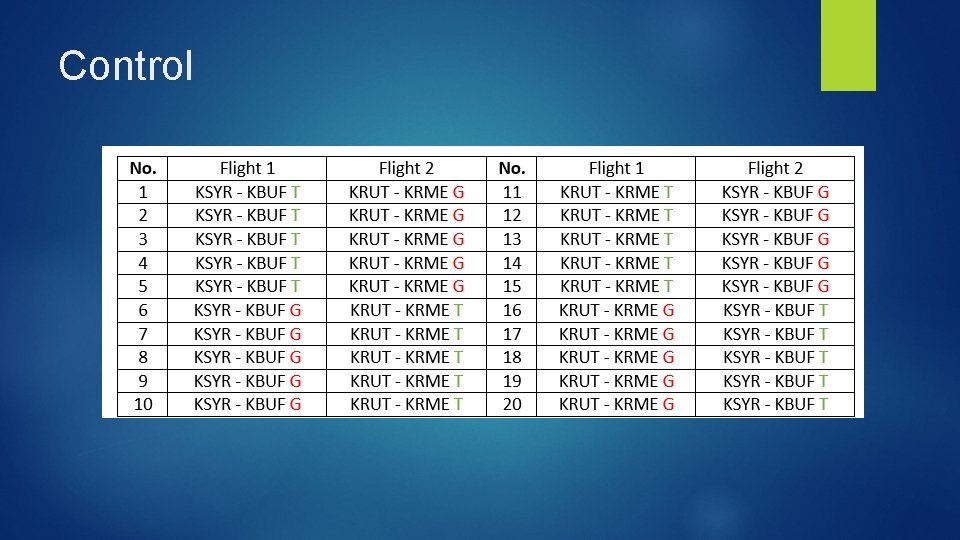
Control
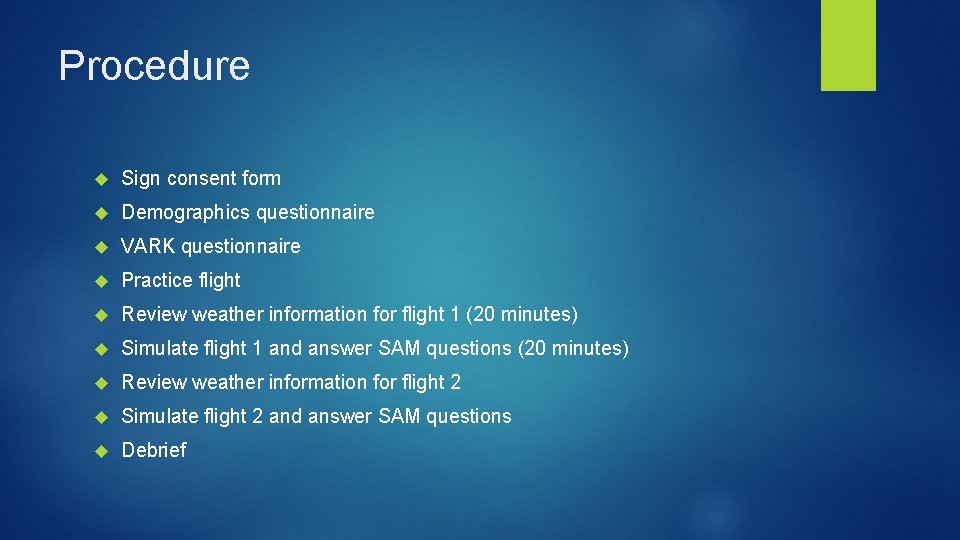
Procedure Sign consent form Demographics questionnaire VARK questionnaire Practice flight Review weather information for flight 1 (20 minutes) Simulate flight 1 and answer SAM questions (20 minutes) Review weather information for flight 2 Simulate flight 2 and answer SAM questions Debrief
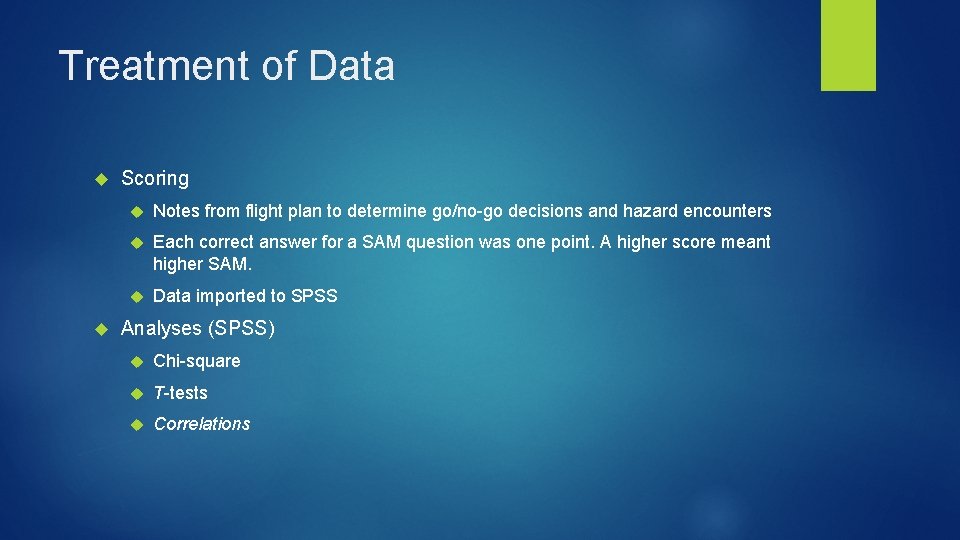
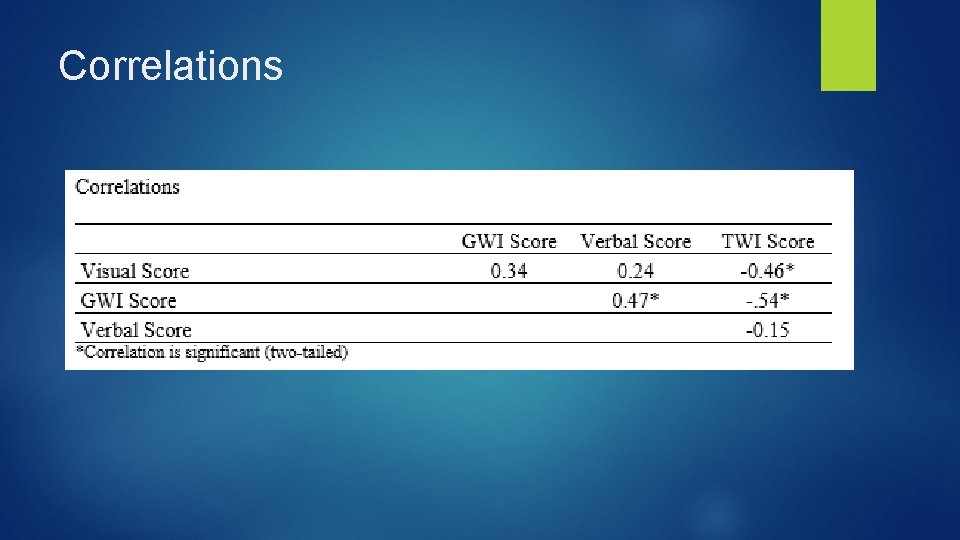
Treatment of Data Scoring Notes from flight plan to determine go/no-go decisions and hazard encounters Each correct answer for a SAM question was one point. A higher score meant higher SAM. Data imported to SPSS Analyses (SPSS) Chi-square T-tests Correlations
Results
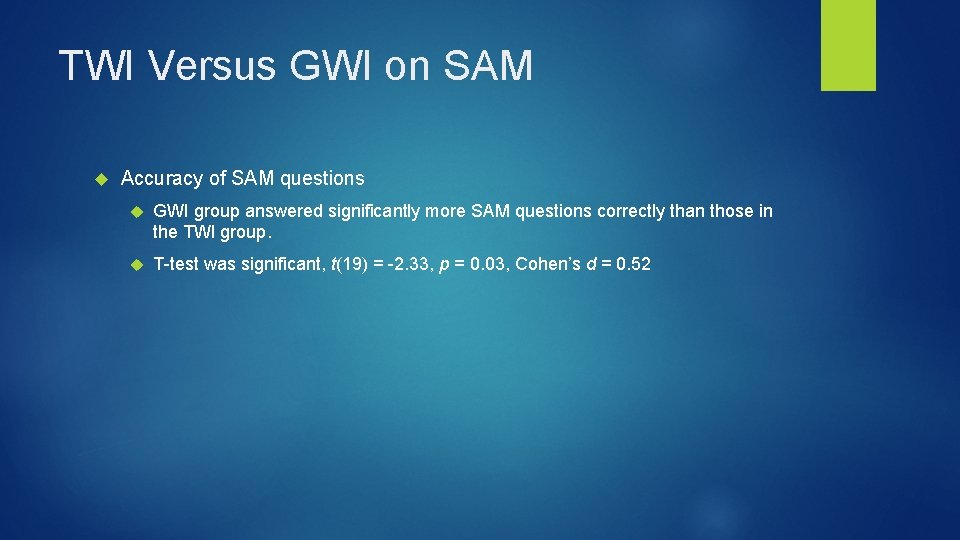
TWI Versus GWI on SAM Accuracy of SAM questions GWI group answered significantly more SAM questions correctly than those in the TWI group. T-test was significant, t(19) = -2. 33, p = 0. 03, Cohen’s d = 0. 52
Correlations
Discussion, Conclusions, and Recommendations
Discussion Go/No-Go decisions and hazard encounters SAM question scores Learning styles and SAM scores correlations Using two VARK measures versus all four What each VARK score represents VARK Visual and TWI Score (negative) VARK Verbal and GWI Score (positive) TWI and GWI Score (negative) Final thoughts on correlations
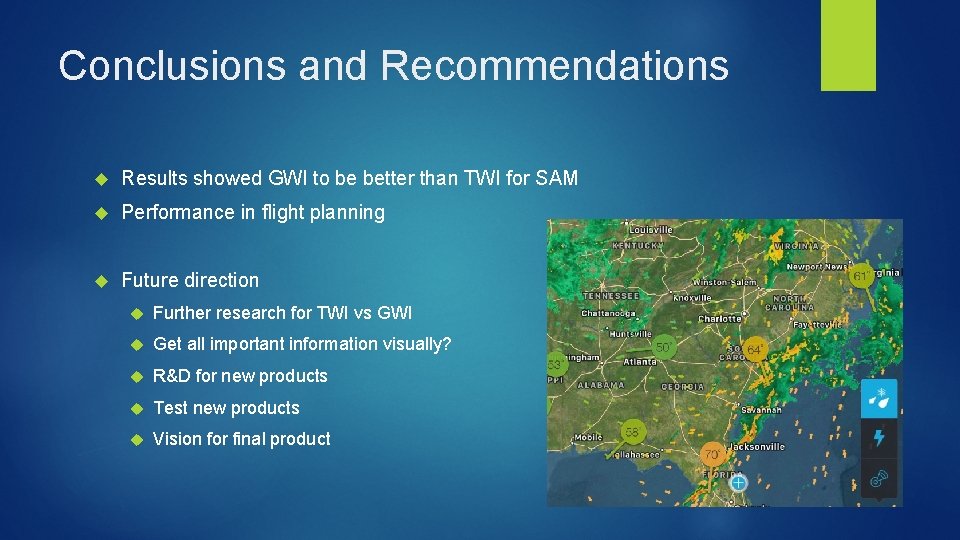
Conclusions and Recommendations Results showed GWI to be better than TWI for SAM Performance in flight planning Future direction Further research for TWI vs GWI Get all important information visually? R&D for new products Test new products Vision for final product
Acknowledgements Dr. Alan Stolzer Dr. Haydee Cuevas Amber Davis Nicola O’Toole Thanks!