
Effects of Foreign Involvement in the American Revolution
- Slides: 1
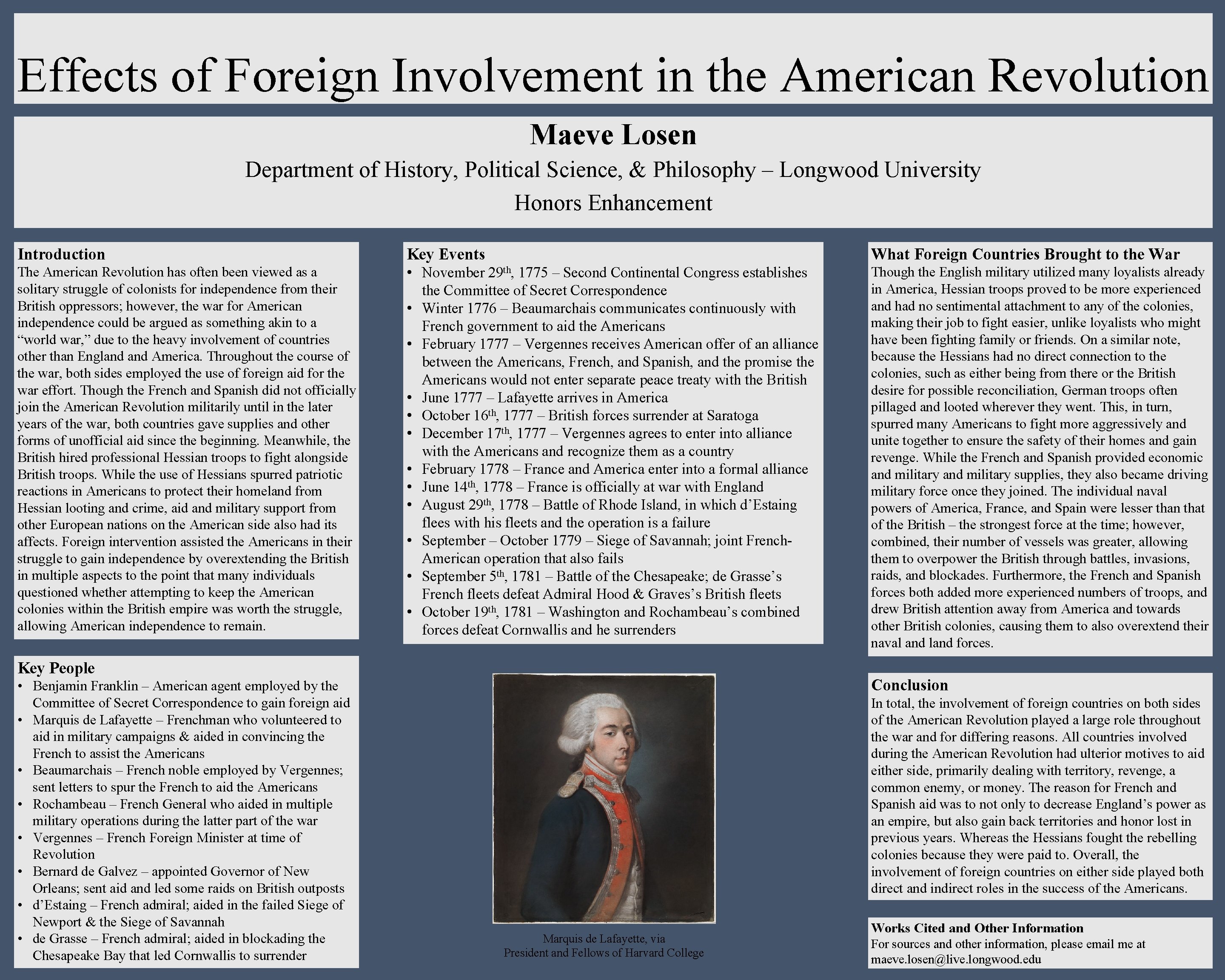
Effects of Foreign Involvement in the American Revolution Maeve Losen Department of History, Political Science, & Philosophy – Longwood University Honors Enhancement Introduction Key Events What Foreign Countries Brought to the War The American Revolution has often been viewed as a solitary struggle of colonists for independence from their British oppressors; however, the war for American independence could be argued as something akin to a “world war, ” due to the heavy involvement of countries other than England America. Throughout the course of the war, both sides employed the use of foreign aid for the war effort. Though the French and Spanish did not officially join the American Revolution militarily until in the later years of the war, both countries gave supplies and other forms of unofficial aid since the beginning. Meanwhile, the British hired professional Hessian troops to fight alongside British troops. While the use of Hessians spurred patriotic reactions in Americans to protect their homeland from Hessian looting and crime, aid and military support from other European nations on the American side also had its affects. Foreign intervention assisted the Americans in their struggle to gain independence by overextending the British in multiple aspects to the point that many individuals questioned whether attempting to keep the American colonies within the British empire was worth the struggle, allowing American independence to remain. • November 29 th, 1775 – Second Continental Congress establishes the Committee of Secret Correspondence • Winter 1776 – Beaumarchais communicates continuously with French government to aid the Americans • February 1777 – Vergennes receives American offer of an alliance between the Americans, French, and Spanish, and the promise the Americans would not enter separate peace treaty with the British • June 1777 – Lafayette arrives in America • October 16 th, 1777 – British forces surrender at Saratoga • December 17 th, 1777 – Vergennes agrees to enter into alliance with the Americans and recognize them as a country • February 1778 – France and America enter into a formal alliance • June 14 th, 1778 – France is officially at war with England • August 29 th, 1778 – Battle of Rhode Island, in which d’Estaing flees with his fleets and the operation is a failure • September – October 1779 – Siege of Savannah; joint French. American operation that also fails • September 5 th, 1781 – Battle of the Chesapeake; de Grasse’s French fleets defeat Admiral Hood & Graves’s British fleets • October 19 th, 1781 – Washington and Rochambeau’s combined forces defeat Cornwallis and he surrenders Though the English military utilized many loyalists already in America, Hessian troops proved to be more experienced and had no sentimental attachment to any of the colonies, making their job to fight easier, unlike loyalists who might have been fighting family or friends. On a similar note, because the Hessians had no direct connection to the colonies, such as either being from there or the British desire for possible reconciliation, German troops often pillaged and looted wherever they went. This, in turn, spurred many Americans to fight more aggressively and unite together to ensure the safety of their homes and gain revenge. While the French and Spanish provided economic and military supplies, they also became driving military force once they joined. The individual naval powers of America, France, and Spain were lesser than that of the British – the strongest force at the time; however, combined, their number of vessels was greater, allowing them to overpower the British through battles, invasions, raids, and blockades. Furthermore, the French and Spanish forces both added more experienced numbers of troops, and drew British attention away from America and towards other British colonies, causing them to also overextend their naval and land forces. Key People • Benjamin Franklin – American agent employed by the Committee of Secret Correspondence to gain foreign aid • Marquis de Lafayette – Frenchman who volunteered to aid in military campaigns & aided in convincing the French to assist the Americans • Beaumarchais – French noble employed by Vergennes; sent letters to spur the French to aid the Americans • Rochambeau – French General who aided in multiple military operations during the latter part of the war • Vergennes – French Foreign Minister at time of Revolution • Bernard de Galvez – appointed Governor of New Orleans; sent aid and led some raids on British outposts • d’Estaing – French admiral; aided in the failed Siege of Newport & the Siege of Savannah • de Grasse – French admiral; aided in blockading the Chesapeake Bay that led Cornwallis to surrender Conclusion In total, the involvement of foreign countries on both sides of the American Revolution played a large role throughout the war and for differing reasons. All countries involved during the American Revolution had ulterior motives to aid either side, primarily dealing with territory, revenge, a common enemy, or money. The reason for French and Spanish aid was to not only to decrease England’s power as an empire, but also gain back territories and honor lost in previous years. Whereas the Hessians fought the rebelling colonies because they were paid to. Overall, the involvement of foreign countries on either side played both direct and indirect roles in the success of the Americans. Marquis de Lafayette, via President and Fellows of Harvard College Works Cited and Other Information For sources and other information, please email me at maeve. losen@live. longwood. edu