
Effects of Facetlevel Personality on Cognitive Ability in
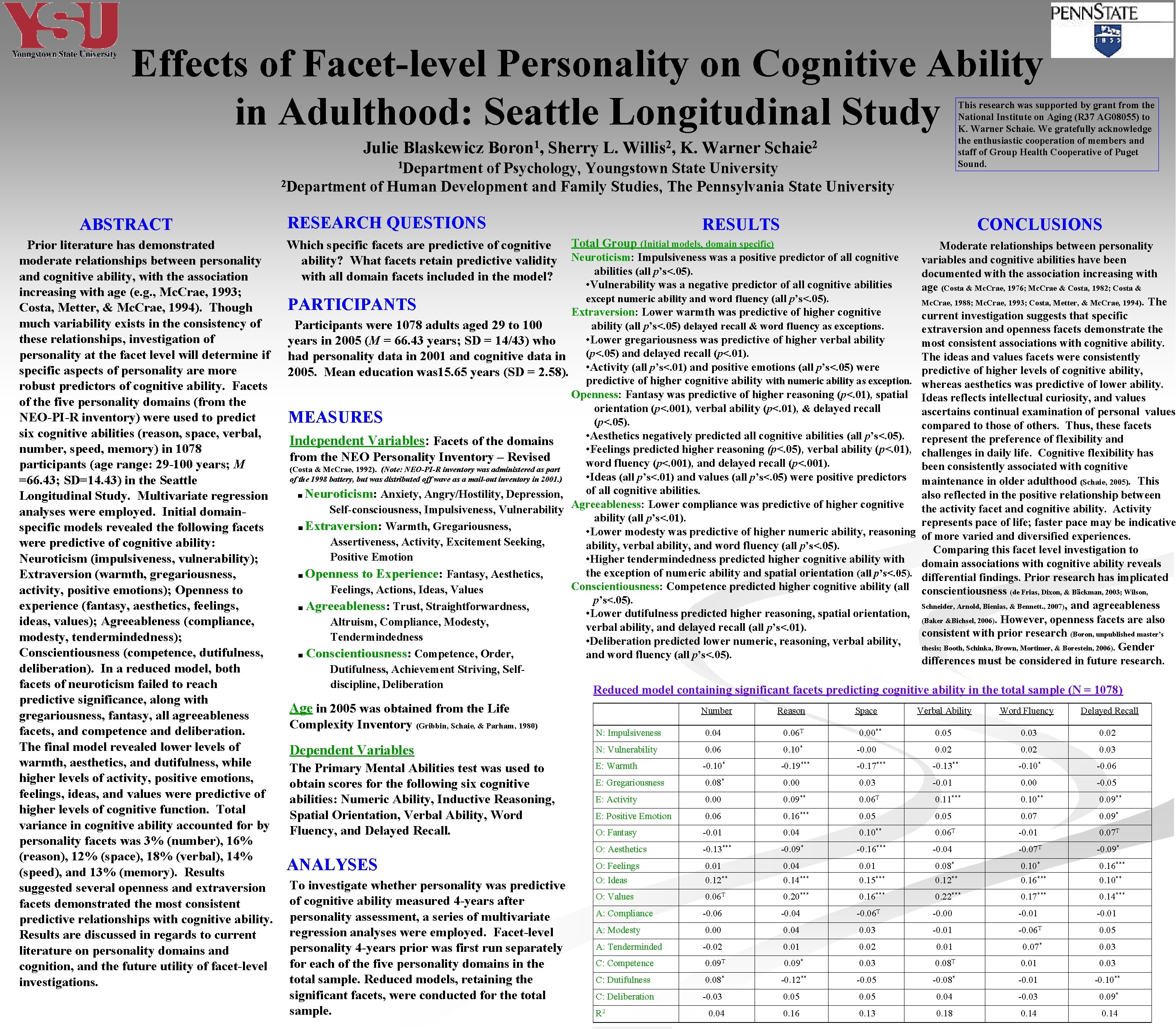
Effects of Facet-level Personality on Cognitive Ability in Adulthood: Seattle Longitudinal Study This research was supported by grant from the National Institute on Aging (R 37 AG 08055) to K. Warner Schaie. We gratefully acknowledge the enthusiastic cooperation of members and staff of Group Health Cooperative of Puget Sound. Julie Blaskewicz Boron 1, Sherry L. Willis 2, K. Warner Schaie 2 1 Department of Psychology, Youngstown State University 2 Department of Human Development and Family Studies, The Pennsylvania State University ABSTRACT Prior literature has demonstrated moderate relationships between personality and cognitive ability, with the association increasing with age (e. g. , Mc. Crae, 1993; Costa, Metter, & Mc. Crae, 1994). Though much variability exists in the consistency of these relationships, investigation of personality at the facet level will determine if specific aspects of personality are more robust predictors of cognitive ability. Facets of the five personality domains (from the NEO-PI-R inventory) were used to predict six cognitive abilities (reason, space, verbal, number, speed, memory) in 1078 participants (age range: 29 -100 years; M =66. 43; SD=14. 43) in the Seattle Longitudinal Study. Multivariate regression analyses were employed. Initial domainspecific models revealed the following facets were predictive of cognitive ability: Neuroticism (impulsiveness, vulnerability); Extraversion (warmth, gregariousness, activity, positive emotions); Openness to experience (fantasy, aesthetics, feelings, ideas, values); Agreeableness (compliance, modesty, tendermindedness); Conscientiousness (competence, dutifulness, deliberation). In a reduced model, both facets of neuroticism failed to reach predictive significance, along with gregariousness, fantasy, all agreeableness facets, and competence and deliberation. The final model revealed lower levels of warmth, aesthetics, and dutifulness, while higher levels of activity, positive emotions, feelings, ideas, and values were predictive of higher levels of cognitive function. Total variance in cognitive ability accounted for by personality facets was 3% (number), 16% (reason), 12% (space), 18% (verbal), 14% (speed), and 13% (memory). Results suggested several openness and extraversion facets demonstrated the most consistent predictive relationships with cognitive ability. Results are discussed in regards to current literature on personality domains and cognition, and the future utility of facet-level investigations. RESEARCH QUESTIONS Which specific facets are predictive of cognitive ability? What facets retain predictive validity with all domain facets included in the model? RESULTS CONCLUSIONS Total Group (Initial models, domain specific) Neuroticism: Impulsiveness was a positive predictor of all cognitive abilities (all p’s<. 05). • Vulnerability was a negative predictor of all cognitive abilities except numeric ability and word fluency (all p’s<. 05). PARTICIPANTS Extraversion: Lower warmth was predictive of higher cognitive Participants were 1078 adults aged 29 to 100 ability (all p’s<. 05) delayed recall & word fluency as exceptions. • Lower gregariousness was predictive of higher verbal ability years in 2005 (M = 66. 43 years; SD = 14/43) who (p<. 05) and delayed recall (p<. 01). had personality data in 2001 and cognitive data in • Activity (all p’s<. 01) and positive emotions (all p’s<. 05) were 2005. Mean education was 15. 65 years (SD = 2. 58). predictive of higher cognitive ability with numeric ability as exception. Openness: Fantasy was predictive of higher reasoning (p<. 01), spatial orientation (p<. 001), verbal ability (p<. 01), & delayed recall MEASURES (p<. 05). • Aesthetics negatively predicted all cognitive abilities (all p’s<. 05). Independent Variables: Facets of the domains • Feelings predicted higher reasoning (p<. 05), verbal ability (p<. 01), from the NEO Personality Inventory – Revised word fluency (p<. 001), and delayed recall (p<. 001). (Costa & Mc. Crae, 1992). (Note: NEO-PI-R inventory was administered as part • Ideas (all p’s<. 01) and values (all p’s<. 05) were positive predictors of the 1998 battery, but was distributed off wave as a mail-out inventory in 2001. ) of all cognitive abilities. ■ Neuroticism: Anxiety, Angry/Hostility, Depression, Agreeableness: Lower compliance was predictive of higher cognitive Self-consciousness, Impulsiveness, Vulnerability (all p’s<. 01). ■ Extraversion: Warmth, Gregariousness, • Lower modesty was predictive of higher numeric ability, reasoning Assertiveness, Activity, Excitement Seeking, ability, verbal ability, and word fluency (all p’s<. 05). Positive Emotion • Higher tendermindedness predicted higher cognitive ability with the exception of numeric ability and spatial orientation (all p’s<. 05). ■ Openness to Experience: Fantasy, Aesthetics, Conscientiousness: Competence predicted higher cognitive ability (all Feelings, Actions, Ideas, Values p’s<. 05). ■ Agreeableness: Trust, Straightforwardness, • Lower dutifulness predicted higher reasoning, spatial orientation, Altruism, Compliance, Modesty, verbal ability, and delayed recall (all p’s<. 01). Tendermindedness • Deliberation predicted lower numeric, reasoning, verbal ability, ■ Conscientiousness: Competence, Order, and word fluency (all p’s<. 05). Dutifulness, Achievement Striving, Selfdiscipline, Deliberation Moderate relationships between personality variables and cognitive abilities have been documented with the association increasing with age (Costa & Mc. Crae, 1976; Mc. Crae & Costa, 1982; Costa & Mc. Crae, 1988; Mc. Crae, 1993; Costa, Metter, & Mc. Crae, 1994). The current investigation suggests that specific extraversion and openness facets demonstrate the most consistent associations with cognitive ability. The ideas and values facets were consistently predictive of higher levels of cognitive ability, whereas aesthetics was predictive of lower ability. Ideas reflects intellectual curiosity, and values ascertains continual examination of personal values compared to those of others. Thus, these facets represent the preference of flexibility and challenges in daily life. Cognitive flexibility has been consistently associated with cognitive maintenance in older adulthood (Schaie, 2005). This also reflected in the positive relationship between the activity facet and cognitive ability. Activity represents pace of life; faster pace may be indicative of more varied and diversified experiences. Comparing this facet level investigation to domain associations with cognitive ability reveals differential findings. Prior research has implicated conscientiousness (de Frias, Dixon, & Bäckman, 2003; Wilson, Schneider, Arnold, Bienias, & Bennett. , 2007), and agreeableness (Baker &Bichsel, 2006). However, openness facets are also consistent with prior research (Boron, unpublished master’s thesis; Booth, Schinka, Brown, Mortimer, & Borestein, 2006). Gender differences must be considered in future research. Reduced model containing significant facets predicting cognitive ability in the total sample (N = 1078) Age in 2005 was obtained from the Life Complexity Inventory (Gribbin, Schaie, & Parham, 1980) Number Reason Space Verbal Ability Word Fluency Delayed Recall N: Impulsiveness 0. 04 0. 06 T 0. 00** 0. 05 0. 03 0. 02 Dependent Variables N: Vulnerability 0. 06 0. 10* -0. 00 0. 02 0. 03 The Primary Mental Abilities test was used to obtain scores for the following six cognitive abilities: Numeric Ability, Inductive Reasoning, Spatial Orientation, Verbal Ability, Word Fluency, and Delayed Recall. E: Warmth -0. 10* -0. 19*** -0. 17*** -0. 13** -0. 10* -0. 06 E: Gregariousness 0. 08* 0. 00 0. 03 -0. 01 0. 00 -0. 05 E: Activity 0. 00 0. 09** 0. 06 T 0. 11*** 0. 10** 0. 09** E: Positive Emotion 0. 06 0. 16*** 0. 05 0. 07 0. 09* O: Fantasy -0. 01 0. 04 0. 10** 0. 06 T -0. 01 0. 07 T O: Aesthetics -0. 13*** -0. 09* -0. 16*** -0. 04 -0. 07 T -0. 09* O: Feelings 0. 01 0. 04 0. 01 0. 08* 0. 10* 0. 16*** O: Ideas 0. 12** 0. 14*** 0. 15*** 0. 12** 0. 16*** 0. 10** O: Values 0. 06 T 0. 20*** 0. 16*** 0. 22*** 0. 17*** 0. 14*** A: Compliance -0. 06 -0. 04 -0. 06 T -0. 00 -0. 01 A: Modesty 0. 00 0. 04 0. 03 -0. 01 -0. 06 T 0. 05 A: Tenderminded -0. 02 0. 01 0. 07* 0. 03 C: Competence 0. 09 T 0. 09* 0. 03 0. 08 T 0. 01 0. 03 C: Dutifulness 0. 08* -0. 12** -0. 05 -0. 08* -0. 01 -0. 10** C: Deliberation -0. 03 0. 05 0. 04 -0. 03 0. 09* 0. 04 0. 16 0. 13 0. 18 0. 14 ANALYSES To investigate whether personality was predictive of cognitive ability measured 4 -years after personality assessment, a series of multivariate regression analyses were employed. Facet-level personality 4 -years prior was first run separately for each of the five personality domains in the total sample. Reduced models, retaining the significant facets, were conducted for the total sample. R 2
- Slides: 1