
Effects of environment and lifestyle on aging AS
- Slides: 39
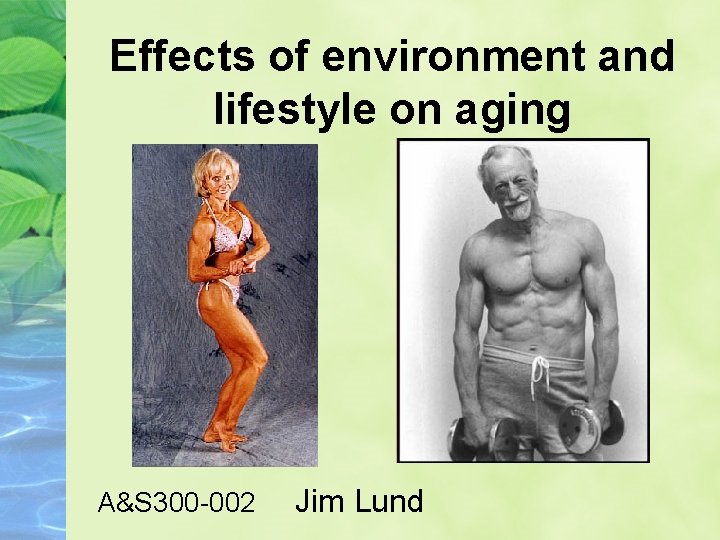
Effects of environment and lifestyle on aging A&S 300 -002 Jim Lund
Healthy aging Interaction between: • Genes • The environment • Lifestyle factors • Diet • Physical activity.
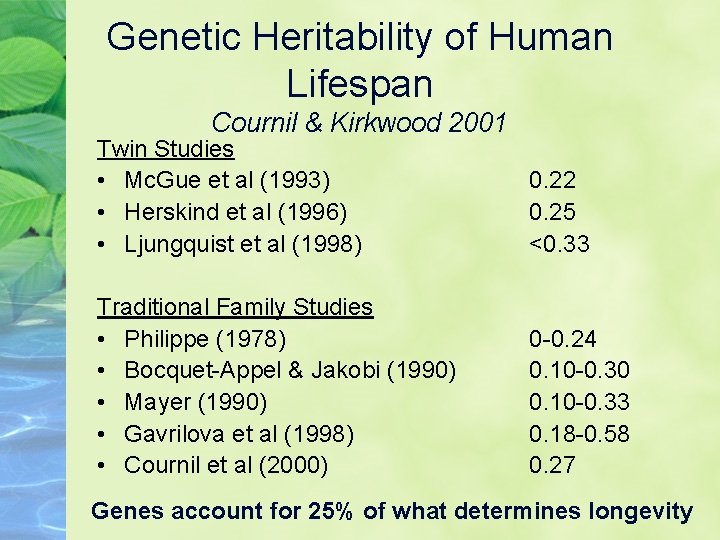
Genetic Heritability of Human Lifespan Cournil & Kirkwood 2001 Twin Studies • Mc. Gue et al (1993) • Herskind et al (1996) • Ljungquist et al (1998) 0. 22 0. 25 <0. 33 Traditional Family Studies • Philippe (1978) • Bocquet-Appel & Jakobi (1990) • Mayer (1990) • Gavrilova et al (1998) • Cournil et al (2000) 0 -0. 24 0. 10 -0. 30 0. 10 -0. 33 0. 18 -0. 58 0. 27 Genes account for 25% of what determines longevity
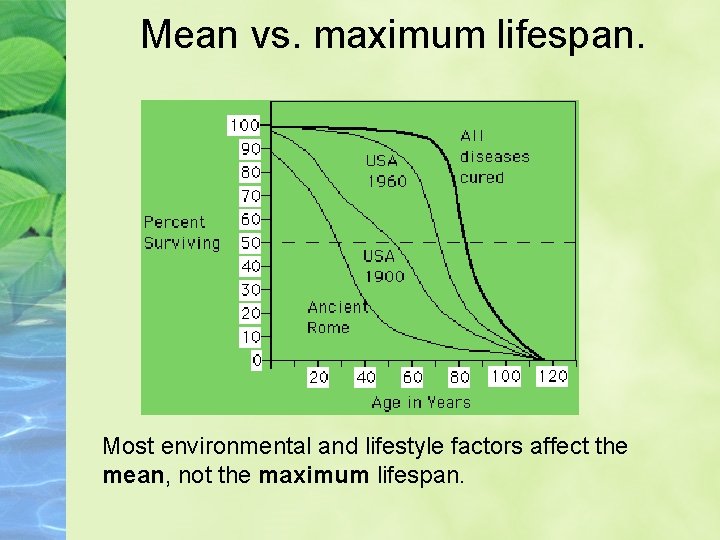
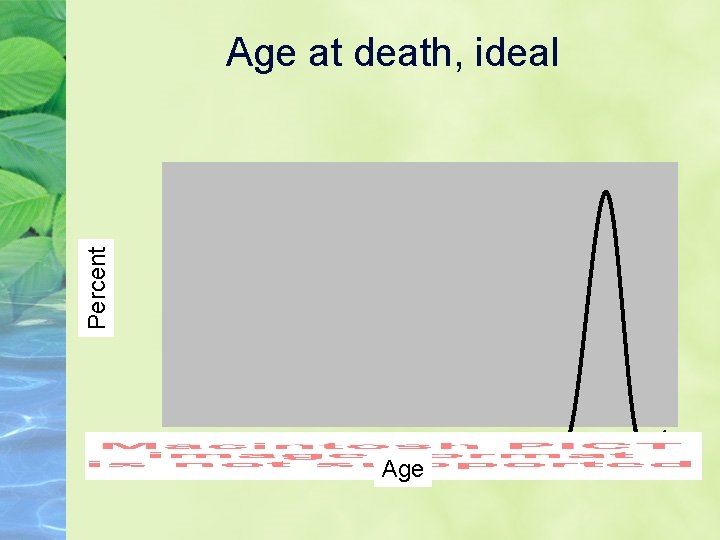
Mean vs. maximum lifespan. Most environmental and lifestyle factors affect the mean, not the maximum lifespan.
Percent Age at death, current Age
Percent Age at death, ideal Age
“Successful Ageing is defined as the ability to maintain low risk of disease or disability, high mental & physical function, and active engagement with life. ” Mac. Arthur Foundation Study
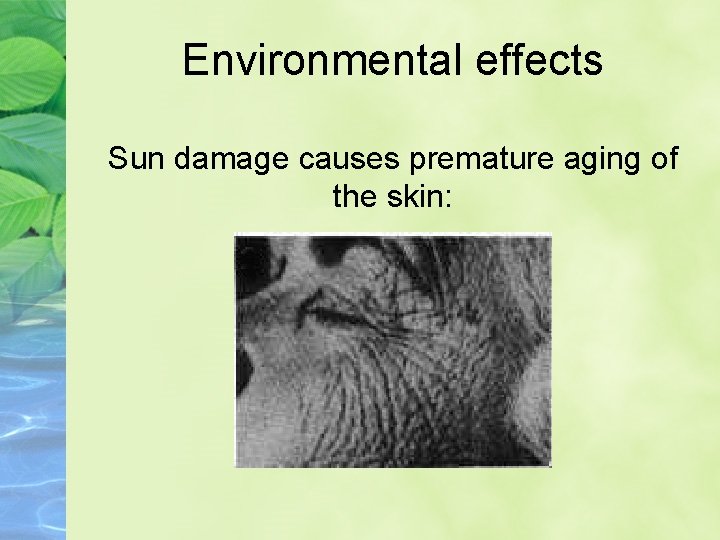
Environmental effects Sun damage causes premature aging of the skin:
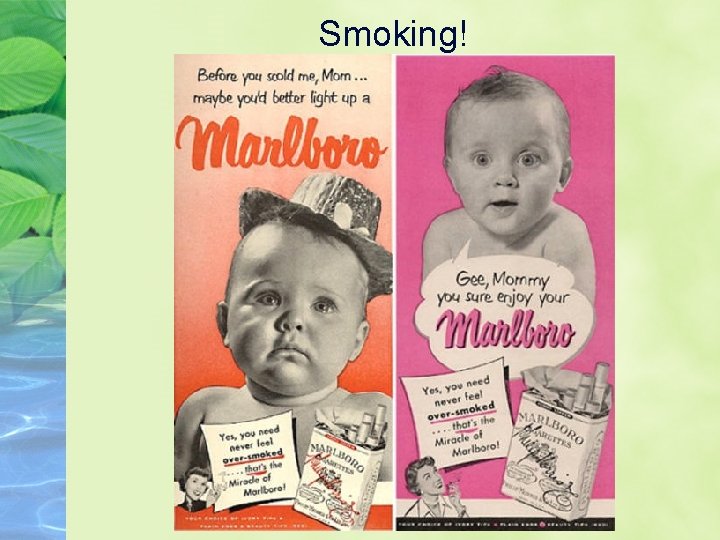
Smoking!
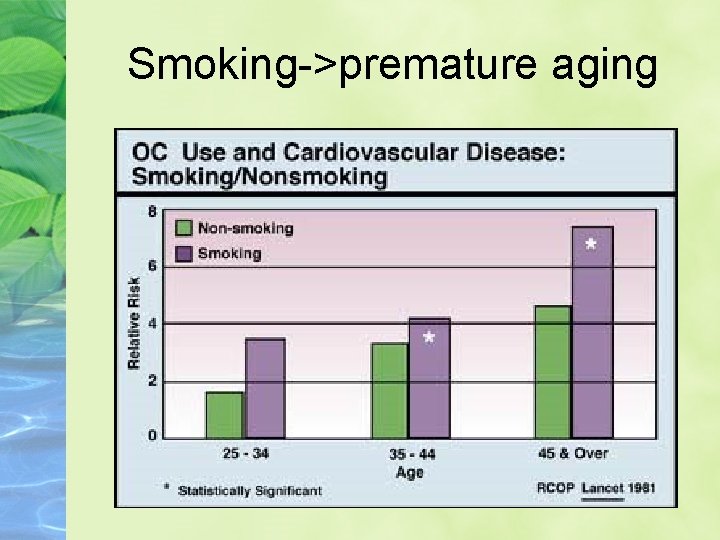
Smoking->premature aging
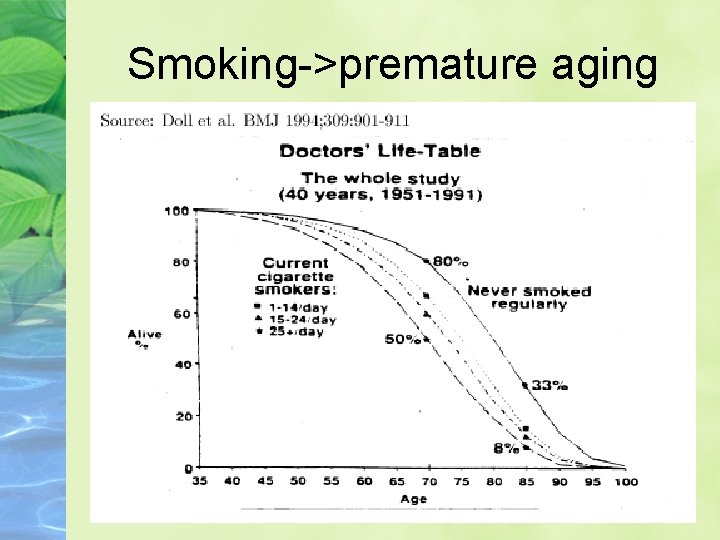
Smoking->premature aging
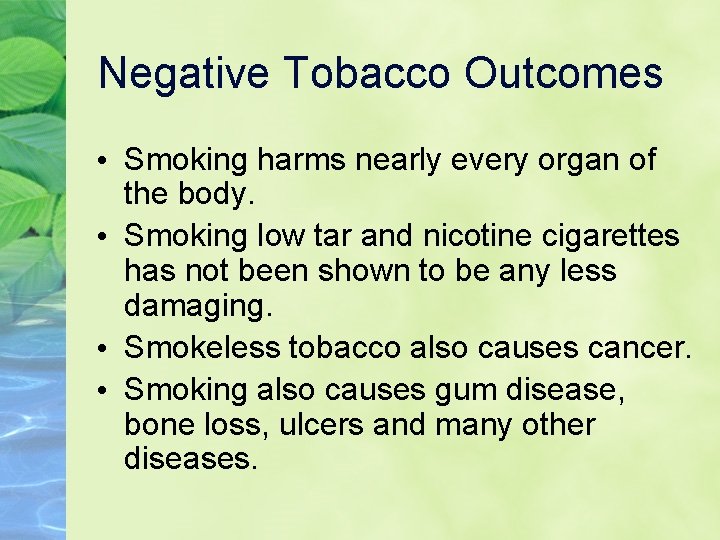
Negative Tobacco Outcomes • Smoking harms nearly every organ of the body. • Smoking low tar and nicotine cigarettes has not been shown to be any less damaging. • Smokeless tobacco also causes cancer. • Smoking also causes gum disease, bone loss, ulcers and many other diseases.
Benefits of Quitting Tobacco • Quitting has immediate as well as long term health benefits. • Health and survival of smokers who quit begins to trend toward that of non-smokers. • Quitting improves the health of those around you.
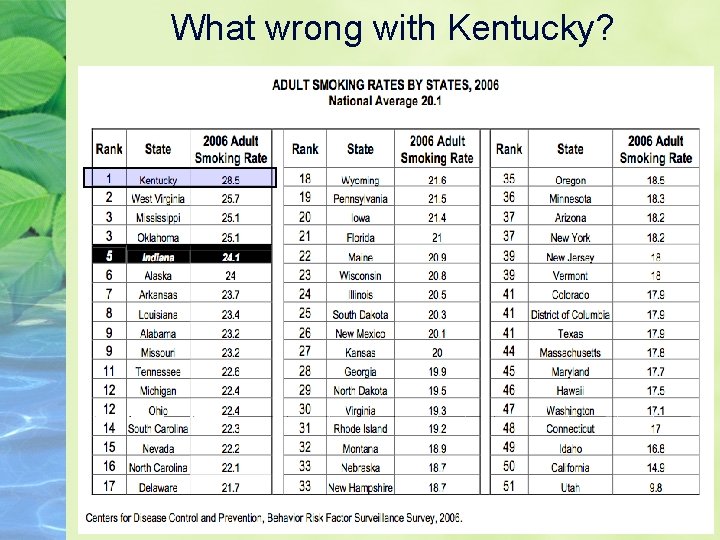
What wrong with Kentucky?
Other environmental factors • Work environment toxins: • Particulates, asbestos (lungs). • Chemical toxins (liver, kidney). • Environmental toxins • Heavy metals • Lead, mercury (brain) • Smog, particulates (lungs).
Successful Ageing concerns itself with: • How you can maximise function as you age • Minimising the ‘period of morbidity’ • A risk-management strategy for one’s own well-being • Healthspan in relation to lifespan • Successful Aging is not a denial of the ageing process
Emerging research data concludes: • As we grow older, the influence of environmental factors on our health become more important, and the influence of genetic factors becomes less important. • Our course in older age is not predetermined. • The frailty of old age is essentially avoidable and largely reversible. Harvard Medical School Report 2001
These signs of ageing are often accepted as ‘usual’ in the mature individual, however, research has now established these ‘usual’ conditions are caused in large part by our pathology – how we live – and not only by our biology – our genes.
The 1% Rule • Old consensus view: after age 25, we lose 1% per year in aerobic capacity, strength, speed and other physical attributes. • This is not necessarily the case, activity, exercise, and diet have strong effects on function, the decline in many physical parameters can be halted or slowed.
Poor Lifestyle Choices Sedentary lifestyle. Poor food choices. Use of alcohol. Use of tobacco products. Lack of understanding of consequences. Lack of motivation to change.
Cycle of De-conditioning • Higher level of fatigue and pain with aging. • May lead to decrease in physical activity. • Result is downward spiral in fitness and increase in health problems.
Negative Outcomes: Hypokinetic Diseases • • Heart Disease Stroke Diabetes Osteoporosis
Benefits of Physical Activity • Can make a substantial difference in a person’s life, regardless of age or disability • Add life to one’s years rather than adding years to one’s life
Benefits of Physical Activity Can make a substantial difference in a person’s life, regardless of age or disability • • Decrease blood pressure Increase strength, CV endurance Increase balance Increase lung and breathing function Improve immune function Reduce depression and anxiety Control obesity
Components of Physical Fitness • • Muscle strength and endurance Flexibility Body composition Cardiovascular endurance
Fatigue And Rest • Fatigue is a side effect of many chronic conditions. • Fatigue can also be caused by depression, stress, medications or weakness. • A common response to fatigue is rest. • When fatigue is caused by depression, stress, or weakness, exercise will alleviate the fatigue and rest will only increase it. • Once a person starts exercising, s/he will gain confidence in their ability to control their symptoms.
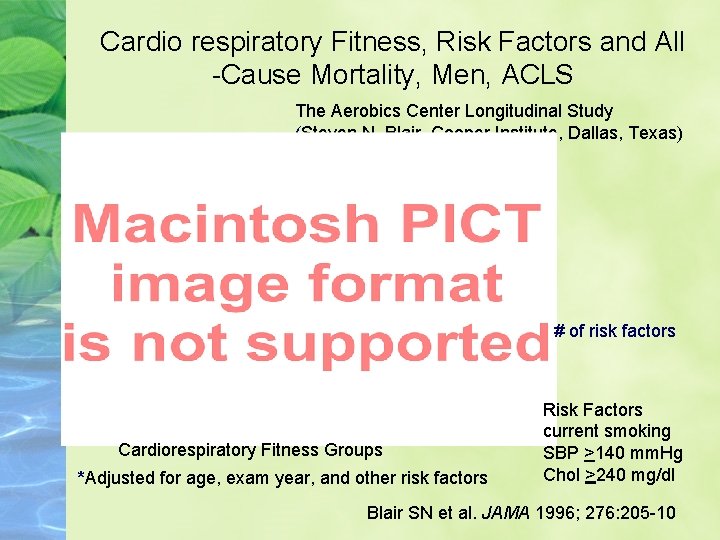
Cardio respiratory Fitness, Risk Factors and All -Cause Mortality, Men, ACLS The Aerobics Center Longitudinal Study (Steven N. Blair, Cooper Institute, Dallas, Texas) # of risk factors Cardiorespiratory Fitness Groups *Adjusted for age, exam year, and other risk factors Risk Factors current smoking SBP >140 mm. Hg Chol >240 mg/dl Blair SN et al. JAMA 1996; 276: 205 -10
Obesity • An obese 20 -year-old man may have his life expectancy cut by as many as 13 years compared with normal-weight people • For an obese 20 -year-old woman, the reduction is 8 years, concludes the study based on three decades of data from US mortality studies. • Women obese at the age of 40 lost 7. 1 years of life, while obese men lost 5. 8 years, study of the medical records of 3500 US adults. • Being overweight at 40, rather than obese, shortens life expectancy by around three years. • Worse for smokers, with overweight adults dying seven years before their non-smoking counterparts, and obese smokers dying 13 to 14 years earlier (Annals of Internal Medicine).
The dominant effect of fitness over other risk factors, and its apparent effect as an antidote for other risk factors, makes physical fitness perhaps the single most important thing an older person can do to remain healthy. (Mac. Arthur Foundation Study)
Cognitive ability • Cognitive ability is not one function. • Research indicates 2 areas of change in cognitive performance as we age: • Speed of processing information • Certain types of memory.
Cognitive Function More than 50% of decline of cognitive function in older age is determined by genetic factors (more than other functions). However, this still leaves considerable influence for lifestyle factors.
Research has established the following as direct contributors to maintaining cognitive function: • • • Learning Physical Activity Self-Efficacy Complex Environments Mild Stress Nutrition
Cancer Arises from a variety of factors: • Family history/genetics (1 -5%) • Environmental causes • i. e. Smoking-30% of all cancer deaths in USA • Dietary factors (poor nutrition-1/3 of all cancer deaths in US) • Lifestyle choices • Lack of exercise, diet, exposure to toxins-cigarettes
Lifestyle and cancer • Diet: • • • Poor diet is an equivalent risk compared to tobacco. High fiber & vegetables reduces risk for ten cancers Red meat increases risk of certain cancers. Salt increases risk of stomach cancer Total fat intake linked to hormone related cancers lung/colorectal and breast (Note: risk is with animal not vegetable fats and most studies now show that breast cancer risk not increased with increased fat intake-olive oil reduces breast cencer risk: (Martin-Moreno et al 1994; Trichopoulou et al 1995) • Alcohol • Synergistic with alcohol in cancer of upper digestive tract • Implicated in risk for breast, liver and colon cancers
Lifestyle and cancer • Exercise decreases risk for colon, breast and prostate CA’s • 30 minutes brisk exercise/daily decreases incidence of certain CA’s by 15% (colon in specific) (Cancer causes and control 1996; 1997) • Poverty • Considered a significant carcinogen • Confounded by increased use of tobacco, alcohol, poor diets. (Bal 1992)
“No one is terrified about growing old in itself, but the terror is in becoming clinically dependant. ” Prof. Suresh Rattan, DSc, Ph. D. Research Professor, University of Aarhus, Denmark
Successful aging: middle age, 1 st 1/2 Maintain desirable weight Optimal nutrition. Regular exercise. Regular health checkups, treat conditions as appropriate. • Avoid toxic exposures. • •
Successful aging: middle age, 2 nd 1/2 • Optimal nutrition. • Women: Ca and vit D supplements. • Men: a diet that prevents cardiovascular disease • Regular exercise. • Regular health checkups to catch serious problems early. • Men: prostate screening. • Women: mamograms. • Manage chronic disease conditions. • Avoid toxic exposures. • Remain socially engaged.
Successful aging: old age • Optimal nutrition including supplements. • Continue exercise as possible. • Regular health surveillance and problem management. • Emphasis on maintenance of function (social, physical, psychological. • More near term interventions: diabetes, CV disease, immunizations. • Continue education. • Remain socially engaged.