
Effects of ECH on Toroidal Rotation KSTAR Experiments


- Slides: 30
Effects of ECH on Toroidal Rotation: KSTAR Experiments, Intrinsic Torque Modeling and Gyrokinetic Stability Analyses a, b. Y. J. Shi, b. W. H. Ko , a. J. M. Kwon, a, c. P. H. Diamond, b. S. G. Lee, a. S. H. Koh, d. L. Wang, a. S. Yi, e. K. Ida, b. L. Terzolo, b. S. W. Yoon, b. K. D. Lee, b. J. H. Lee, b. Y. U. Nam, b. Y. S. Bae, b. Y. K. Oh, b. J. G. Kwak, f. M. Bitter, f. K. W. Hill, g. O. D. Gurcan , h. T. S. Hahm a WCI Center for Fusion Theory, NFRI, Daejeon, Korea National Fusion Research Institute, Daejeon, Korea b C CMTFO and CASS, University of California, San Diego, USA Huazhong University of Science and Technology, Wuhan, China e. National Institute of Fusion Sciences, Toki, Japan f. Princeton Plasma Physics Laboratory, Princeton, NJ, USA g. Laboratoire de Physique des Plasmas, Ecole Polytechnique, CNRS, Palaiseau Cedex, France h. Seoul National University, Seoul, Korea d 24 th IAEA Fusion Energy Conference 8 -13 October 2012, San Diego, USA
Outline I. Motivation II. Rotation diagnostics on KSTAR III. Experimental results: Effects of ECH on toroidal rotation on KSTAR IV. Analyses and Interpretation of the effect of onaxis ECH for H-mode plasma : ITG TEM transition V. Summary and future plans 2
Motivation ØTorodial rotation physics is relevant to the L H transition, ITB formation and RWM stabilization. NBI torque is not practical for ITER, and future devices. ØSpontaneous rotation phenomena found in all plasmas. Related phenomena include rotation reversals and some transport bifurcations. ØPhysical mechanism of intrinsic torque generation involves broken symmetry in turbulence ⇒‘residual’ stress ⇒ intrinsic torque density ØResidual stress related mode properties ⇒ possible flip upon ITG TEM ØRelated phenomena: OH reversal (see Rice, this session) ECH induced counter torque 3
Outline I. Motivation and Introduction II. Rotation diagnostics on KSTAR III. Experimental results: Effects of ECH on toroidal rotation on KSTAR IV. Analyses and Interpretation of the effect of onaxis ECH for H-mode plasma : ITG TEM transition V. Summary and future plans 4
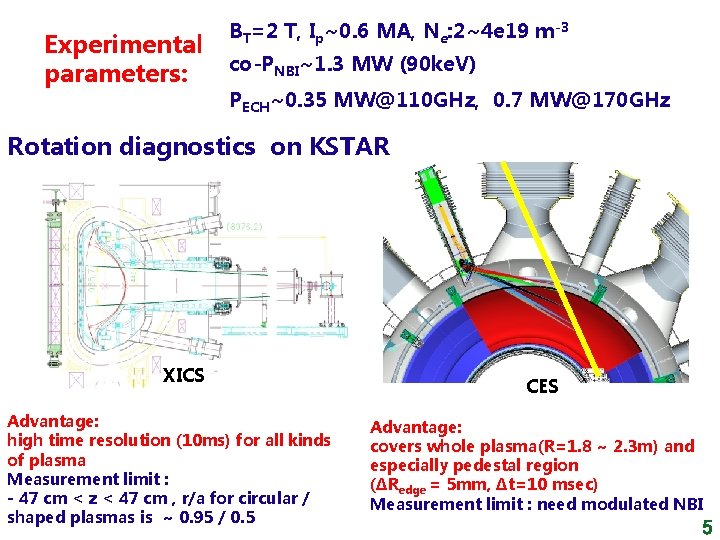
Experimental parameters: BT=2 T, Ip~0. 6 MA, Ne: 2~4 e 19 m-3 co-PNBI~1. 3 MW (90 ke. V) PECH~0. 35 MW@110 GHz, 0. 7 MW@170 GHz Rotation diagnostics on KSTAR XICS Advantage: high time resolution (10 ms) for all kinds of plasma Measurement limit : - 47 cm < z < 47 cm , r/a for circular / shaped plasmas is ~ 0. 95 / 0. 5 CES Advantage: covers whole plasma(R=1. 8 ~ 2. 3 m) and especially pedestal region (ΔRedge = 5 mm, Δt=10 msec) Measurement limit : need modulated NBI 5
Outline I. Motivation II. Experimental setup on KSTAR III. Experimental results: Effects of ECH on toroidal rotation on KSTAR IV. Analyses and Interpretation the effect of on-axis ECH for H-mode plasma : ITG TEM transition V. Summary and future plans 6
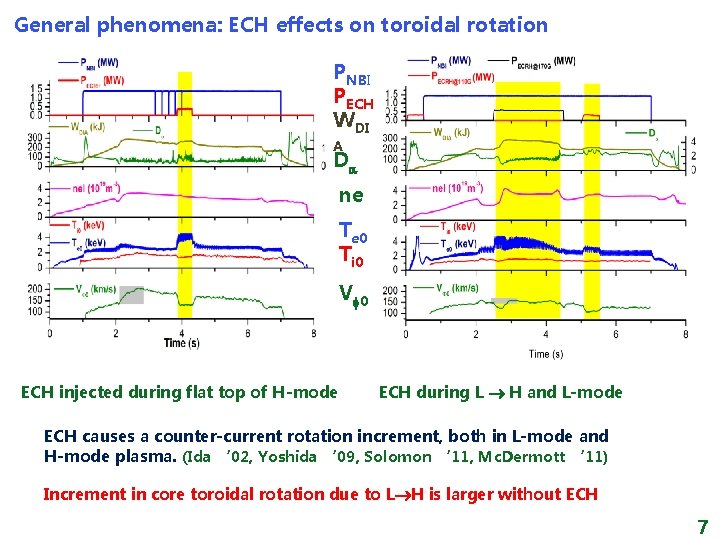
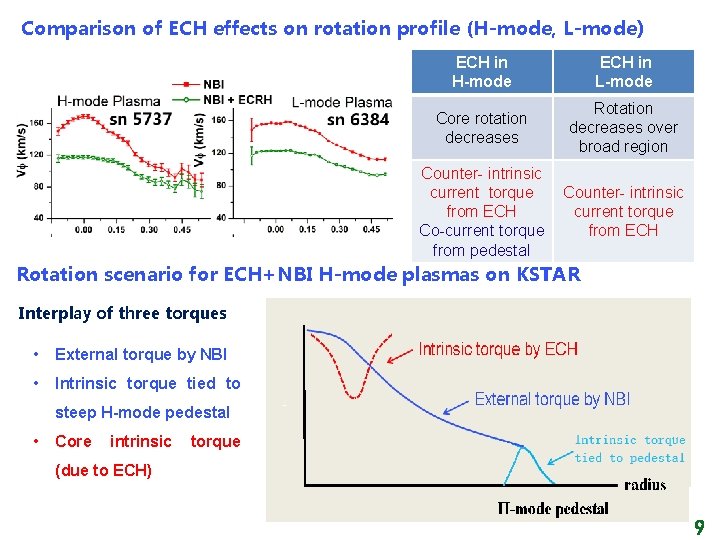
General phenomena: ECH effects on toroidal rotation PNBI PECH WDI A D ne Te 0 Ti 0 V 0 ECH injected during flat top of H-mode ECH during L H and L-mode ECH causes a counter-current rotation increment, both in L-mode and H-mode plasma. (Ida ‘ 02, Yoshida ‘ 09, Solomon ‘ 11, Mc. Dermott ‘ 11) Increment in core toroidal rotation due to L H is larger without ECH 7
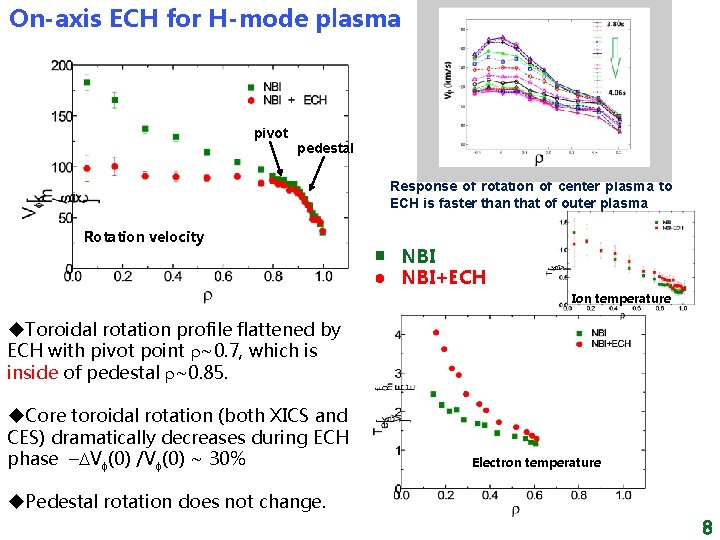
On-axis ECH for H-mode plasma pivot pedestal Response of rotation of center plasma to ECH is faster than that of outer plasma Rotation velocity NBI+ECH Ion temperature u. Toroidal rotation profile flattened by ECH with pivot point ~0. 7, which is inside of pedestal ~0. 85. u. Core toroidal rotation (both XICS and CES) dramatically decreases during ECH phase – V (0) /V (0) ~ 30% Electron temperature u. Pedestal rotation does not change. 8
Comparison of ECH effects on rotation profile (H-mode, L-mode) ECH in H-mode ECH in L-mode Core rotation decreases Rotation decreases over broad region Counter- intrinsic current torque from ECH Co-current torque from pedestal Counter- intrinsic current torque from ECH Rotation scenario for ECH+NBI H-mode plasmas on KSTAR Interplay of three torques • External torque by NBI • Intrinsic torque tied to steep H-mode pedestal • Core intrinsic torque (due to ECH) 9
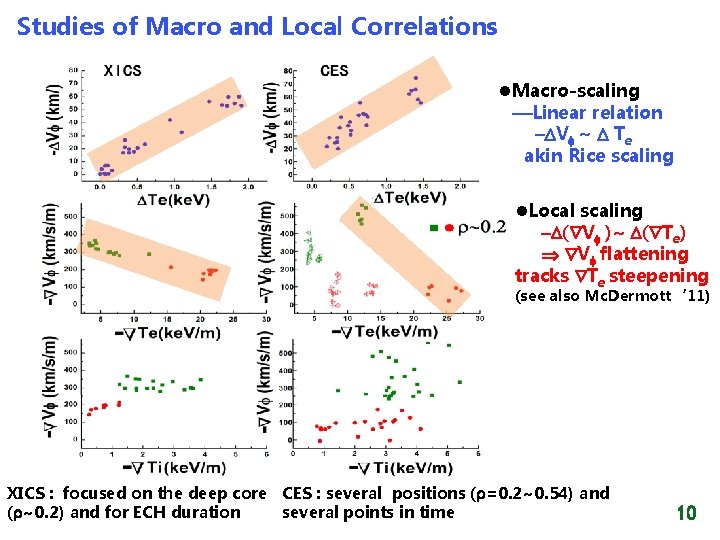
Studies of Macro and Local Correlations l. Macro-scaling Linear relation – V ~ Te akin Rice scaling l. Local scaling – ( V )~ ( Te) V flattening tracks Te steepening (see also Mc. Dermott‘ 11) XICS : focused on the deep core CES : several positions ( =0. 2~0. 54) and ( ~0. 2) and for ECH duration several points in time 10
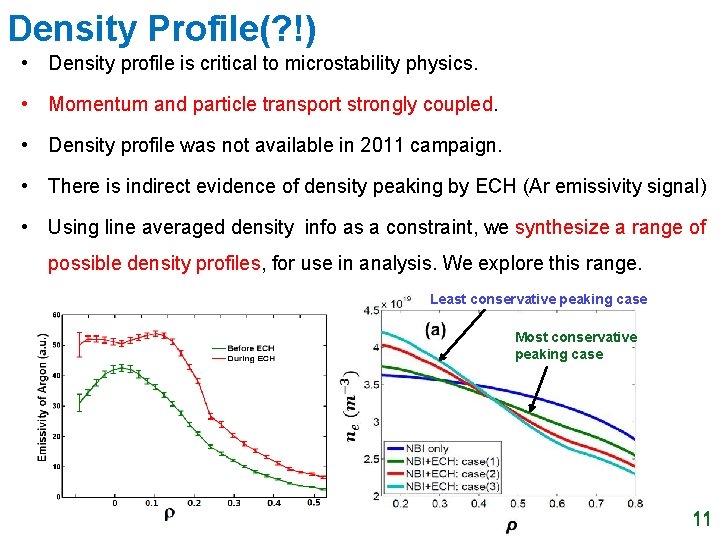
Density Profile(? !) • Density profile is critical to microstability physics. • Momentum and particle transport strongly coupled. • Density profile was not available in 2011 campaign. • There is indirect evidence of density peaking by ECH (Ar emissivity signal) • Using line averaged density info as a constraint, we synthesize a range of possible density profiles, for use in analysis. We explore this range. Least conservative peaking case Most conservative peaking case 11
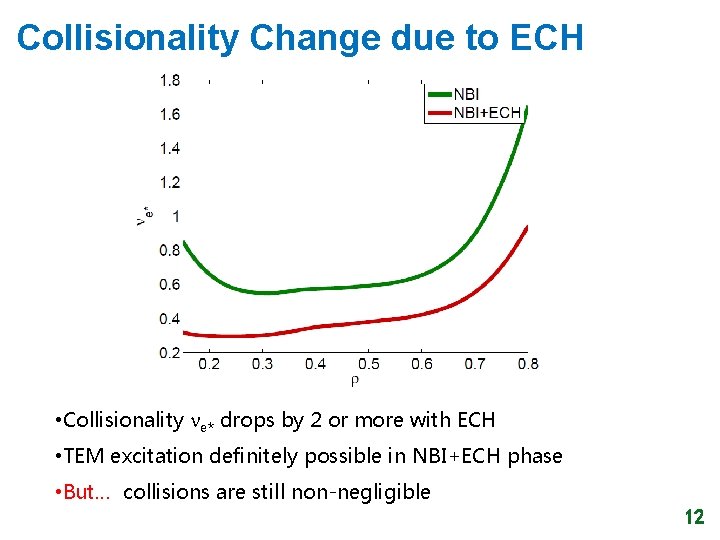
Collisionality Change due to ECH • Collisionality e* drops by 2 or more with ECH • TEM excitation definitely possible in NBI+ECH phase • But… collisions are still non-negligible 12
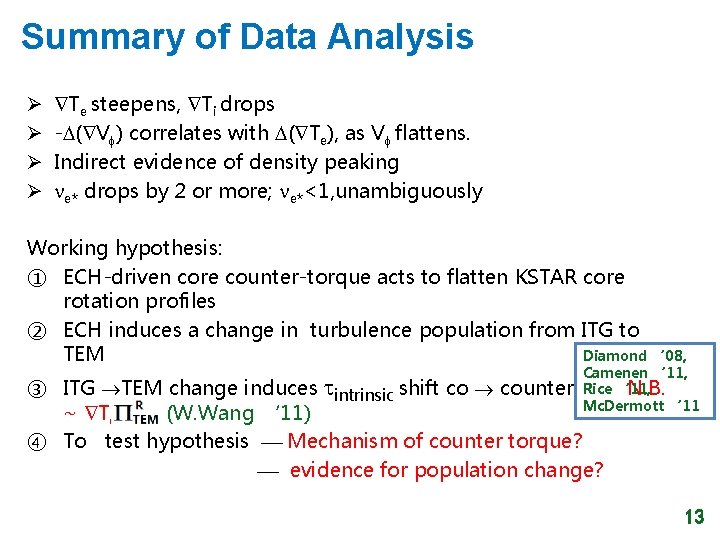
Summary of Data Analysis Ø Ø Te steepens, Ti drops - ( V ) correlates with ( Te), as V flattens. Indirect evidence of density peaking e* drops by 2 or more; e*<1, unambiguously Working hypothesis: ① ECH-driven core counter-torque acts to flatten KSTAR core rotation profiles ② ECH induces a change in turbulence population from ITG to Diamond ‘ 08, TEM Camenen ‘ 11, Rice ‘ 11, N. B. Mc. Dermott ‘ 11 ③ ITG TEM change induces intrinsic shift co counter ~ Te , n (W. Wang ‘ 11) ④ To test hypothesis Mechanism of counter torque? evidence for population change? 13
Outline I. Motivation and Introduction II. Rotation diagnostics on KSTAR III. Experimental results: Effects of ECH on toroidal rotation on KSTAR IV. Analyses and Interpretation of the effect of onaxis ECH for H-mode plasma : ITG TEM transition V. Summary and future plans 14
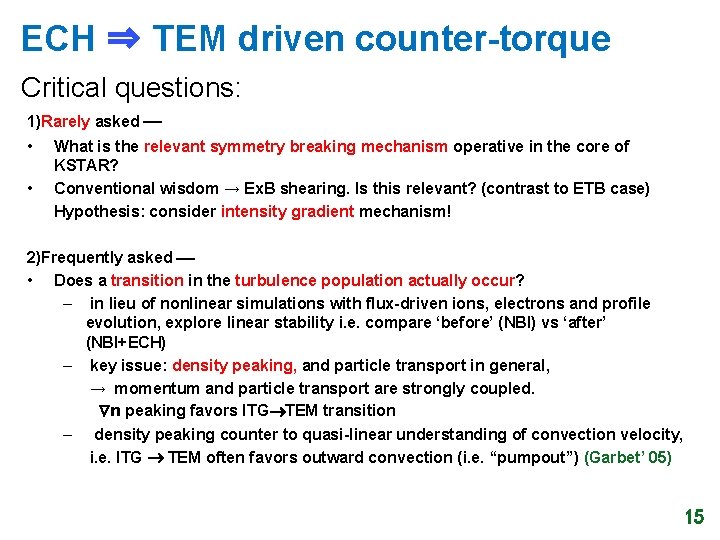
ECH ⇒ TEM driven counter-torque Critical questions: 1)Rarely asked • • What is the relevant symmetry breaking mechanism operative in the core of KSTAR? Conventional wisdom → Ex. B shearing. Is this relevant? (contrast to ETB case) Hypothesis: consider intensity gradient mechanism! 2)Frequently asked • Does a transition in the turbulence population actually occur? – in lieu of nonlinear simulations with flux-driven ions, electrons and profile evolution, explore linear stability i. e. compare ‘before’ (NBI) vs ‘after’ (NBI+ECH) – key issue: density peaking, and particle transport in general, → momentum and particle transport are strongly coupled. n peaking favors ITG TEM transition – density peaking counter to quasi-linear understanding of convection velocity, i. e. ITG TEM often favors outward convection (i. e. “pumpout”) (Garbet’ 05) 15
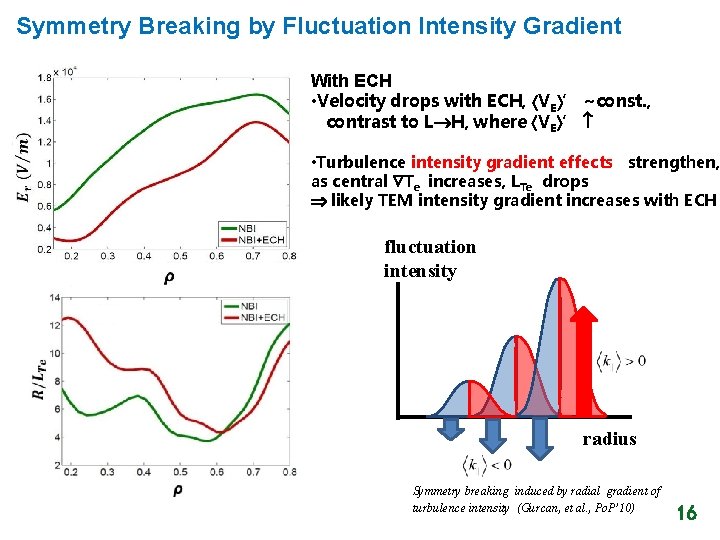
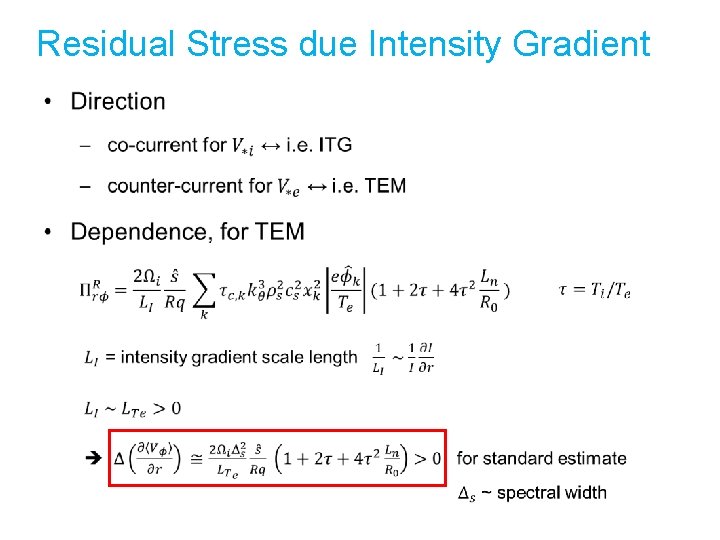
Symmetry Breaking by Fluctuation Intensity Gradient With ECH • Velocity drops with ECH, VE ’ ~const. , contrast to L H, where VE ’ • Turbulence intensity gradient effects strengthen, as central Te increases, LTe drops likely TEM intensity gradient increases with ECH fluctuation intensity radius Symmetry breaking induced by radial gradient of turbulence intensity (Gurcan, et al. , Po. P’ 10) 16
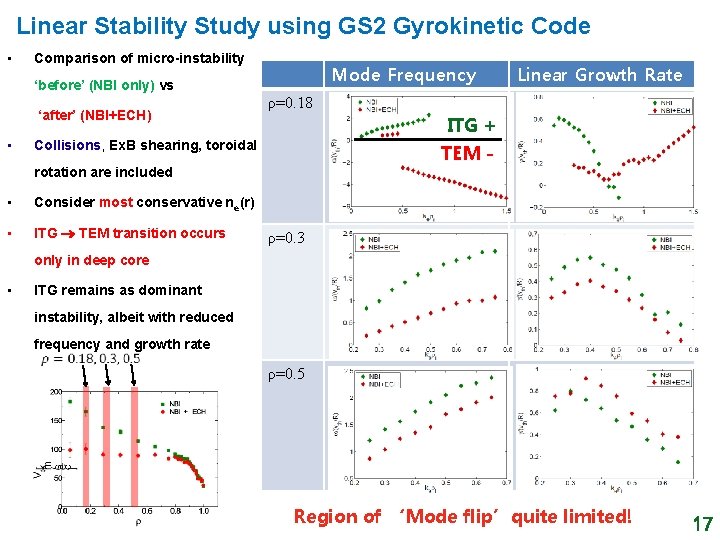
Linear Stability Study using GS 2 Gyrokinetic Code • Comparison of micro-instability Mode Frequency ‘before’ (NBI only) vs ‘after’ (NBI+ECH) • Linear Growth Rate ρ=0. 18 ITG + Collisions, Ex. B shearing, toroidal TEM - rotation are included • Consider most conservative ne(r) • ITG TEM transition occurs ρ=0. 3 only in deep core • ITG remains as dominant instability, albeit with reduced frequency and growth rate ρ=0. 5 Region of ‘Mode flip’quite limited! 17
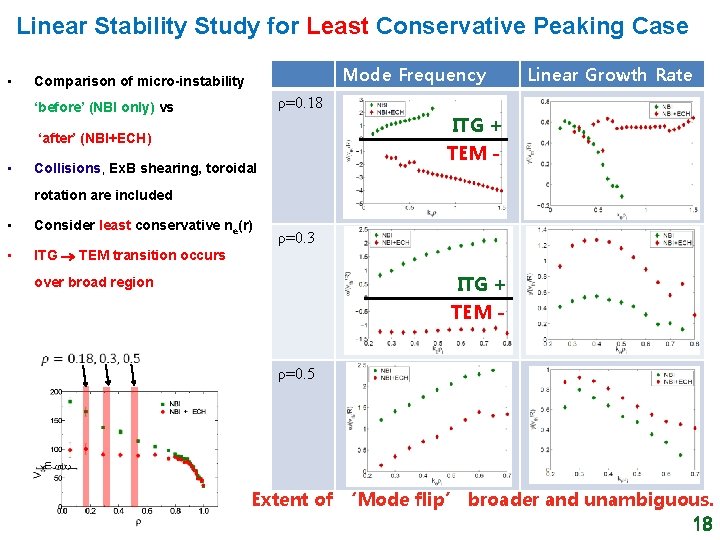
Linear Stability Study for Least Conservative Peaking Case • Mode Frequency Comparison of micro-instability ρ=0. 18 ‘before’ (NBI only) vs ITG + ‘after’ (NBI+ECH) • Linear Growth Rate TEM - Collisions, Ex. B shearing, toroidal rotation are included • Consider least conservative ne(r) • ITG TEM transition occurs ρ=0. 3 ITG + over broad region TEM ρ=0. 5 Extent of ‘Mode flip’ broader and unambiguous. 18
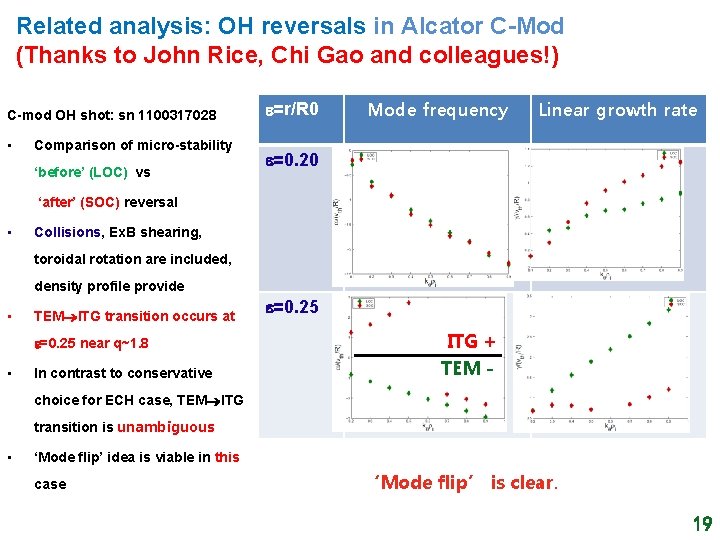
Related analysis: OH reversals in Alcator C-Mod (Thanks to John Rice, Chi Gao and colleagues!) C-mod OH shot: sn 1100317028 • Comparison of micro-stability ‘before’ (LOC) vs =r/R 0 Mode frequency Linear growth rate =0. 20 ‘after’ (SOC) reversal • Collisions, Ex. B shearing, toroidal rotation are included, density profile provide • TEM ITG transition occurs at =0. 25 near q~1. 8 • In contrast to conservative =0. 25 ITG + TEM - choice for ECH case, TEM ITG transition is unambiguous • ‘Mode flip’ idea is viable in this case ‘Mode flip’ is clear. 19
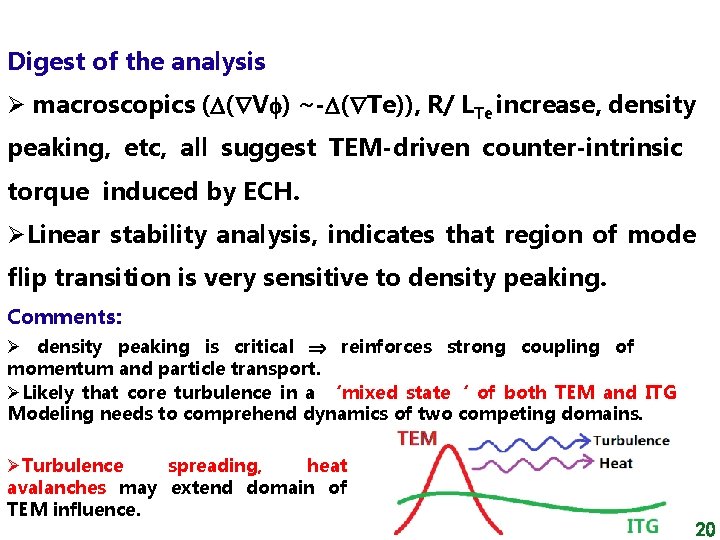
Digest of the analysis Ø macroscopics ( ( V ) ~- ( Te)), R/ LTe increase, density peaking, etc, all suggest TEM-driven counter-intrinsic torque induced by ECH. ØLinear stability analysis, indicates that region of mode flip transition is very sensitive to density peaking. Comments: Ø density peaking is critical reinforces strong coupling of momentum and particle transport. ØLikely that core turbulence in a ‘mixed state‘ of both TEM and ITG Modeling needs to comprehend dynamics of two competing domains. ØTurbulence spreading, heat avalanches may extend domain of TEM influence. 20
Outline I. Motivation and Introduction II. Experimental setup on KSTAR III. Experimental results: Effects of ECH on toroidal rotation on KSTAR IV. Analyses and Interpretation for the effect of onaxis ECH for H-mode plasma : ITG TEM transition V. Summary and future plans 21
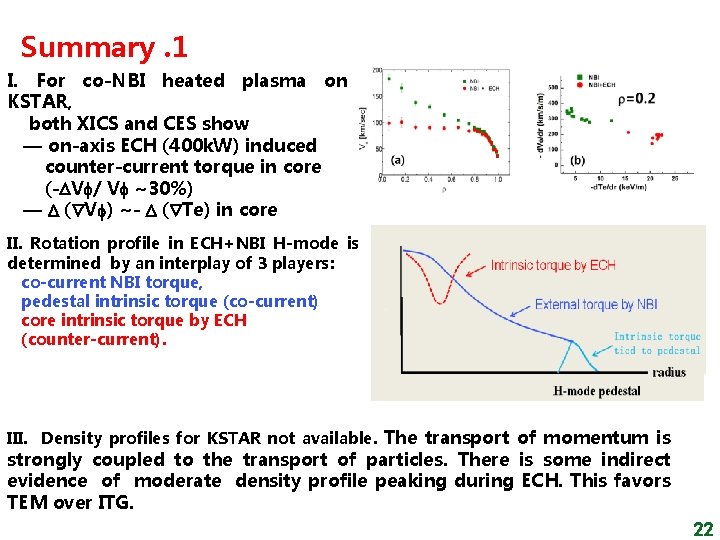
Summary. 1 I. For co-NBI heated plasma on KSTAR, both XICS and CES show — on-axis ECH (400 k. W) induced counter-current torque in core (- V / V ~30%) — ( V ) ~- ( Te) in core II. Rotation profile in ECH+NBI H-mode is determined by an interplay of 3 players: co-current NBI torque, pedestal intrinsic torque (co-current) core intrinsic torque by ECH (counter-current). III. Density profiles for KSTAR not available. The transport of momentum is strongly coupled to the transport of particles. There is some indirect evidence of moderate density profile peaking during ECH. This favors TEM over ITG. 22
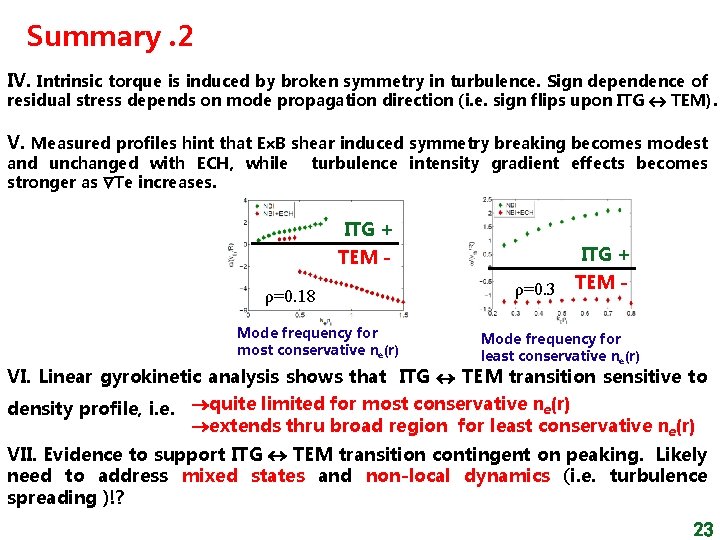
Summary. 2 IV. Intrinsic torque is induced by broken symmetry in turbulence. Sign dependence of residual stress depends on mode propagation direction (i. e. sign flips upon ITG TEM). V. Measured profiles hint that E B shear induced symmetry breaking becomes modest and unchanged with ECH, while stronger as Te increases. turbulence intensity gradient effects becomes ITG + TEM ρ=0. 18 Mode frequency for most conservative ne(r) ρ=0. 3 TEM - Mode frequency for least conservative ne(r) VI. Linear gyrokinetic analysis shows that ITG TEM transition sensitive to density profile, i. e. quite limited for most conservative ne(r) extends thru broad region for least conservative ne(r) VII. Evidence to support ITG TEM transition contingent on peaking. Likely need to address mixed states and non-local dynamics (i. e. turbulence spreading )!? 23
Future plans Experimental aspects I. Coordinated experimental studies of particle transport. Obtain density profile. II. Scans with higher ECH power, broader range of PECH/PNBI; transport analysis (including momentum) III. BES fluctuation studies, coordinated with macroscopics intensity profile? plasma frame propagation direction? Are flips of frequency centroid observed? IV. Explore counter-NBI H-mode + ECH ala’ Solomon, understanding of the interaction of multiple torques. i. e. Does remaining intrinsic counter torque due ECH match result of transport analysis? V. Comparison with OH reversals 24
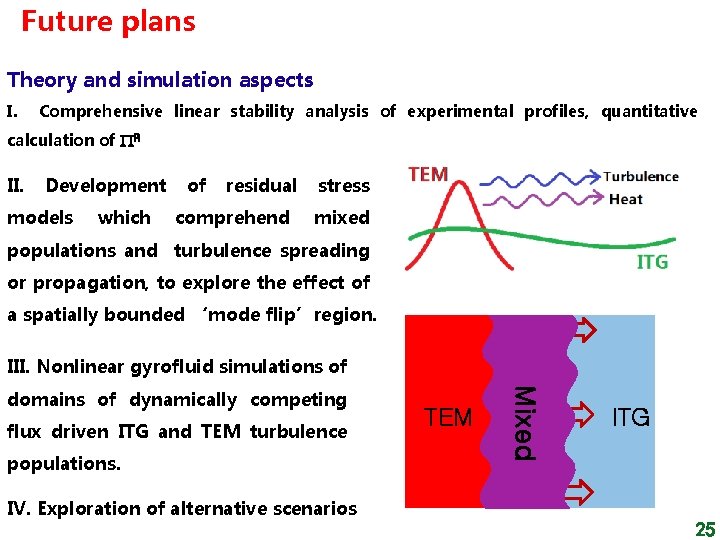
Future plans Theory and simulation aspects I. Comprehensive linear stability analysis of experimental profiles, quantitative calculation of R II. Development models which of residual comprehend stress mixed populations and turbulence spreading or propagation, to explore the effect of a spatially bounded ‘mode flip’region. III. Nonlinear gyrofluid simulations of flux driven ITG and TEM turbulence populations. IV. Exploration of alternative scenarios TEM Mixed domains of dynamically competing ITG 25
Thank you for your attention! 26
BACK UP 27
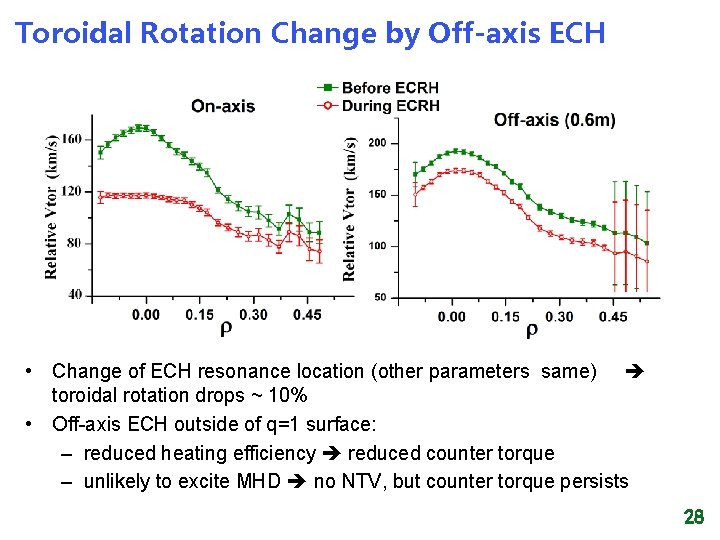
Toroidal Rotation Change by Off-axis ECH • Change of ECH resonance location (other parameters same) toroidal rotation drops ~ 10% • Off-axis ECH outside of q=1 surface: – reduced heating efficiency reduced counter torque – unlikely to excite MHD no NTV, but counter torque persists 28
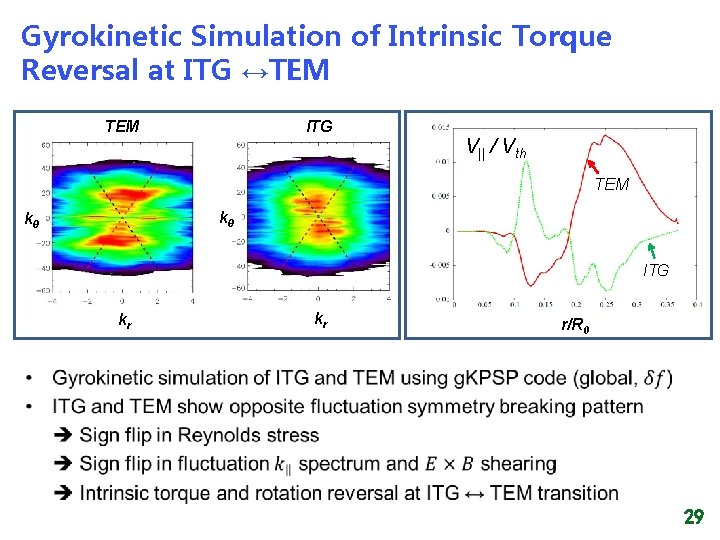
Gyrokinetic Simulation of Intrinsic Torque Reversal at ITG ↔TEM ITG V|| / Vth TEM kθ kθ ITG kr kr r/R 0 • 29
Residual Stress due Intensity Gradient •