
Effects of Buprenorphine and Hepatitis C on Liver
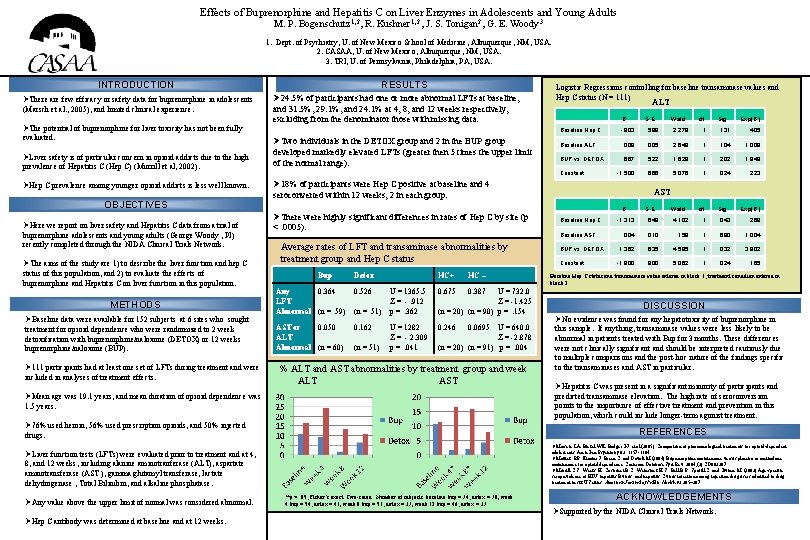
Effects of Buprenorphine and Hepatitis C on Liver Enzymes in Adolescents and Young Adults M. P. Bogenschutz 1, 2, R. Kushner 1, 2, J. S. Tonigan 2, G. E. Woody 3 1. Dept. of Psychiatry, U. of New Mexico School of Medicine, Albuquerque, NM, USA. 2. CASAA, U. of New Mexico, Albuquerque, NM, USA. 3. TRI, U. of Pennsylvania, Philadelphia, PA, USA. INTRODUCTION ØThere are few efficacy or safety data for buprenorphine in adolescents (Marsch et al. , 2005), and limited clinical experience. ØThe potential of buprenorphine for liver toxicity has not been fully RESULTS Ø 24. 5% of participants had one or more abnormal LFTs at baseline, Baseline Hep C ØTwo individuals in the DETOX group and 2 in the BUP group ØLiver safety is of particular concern in opioid addicts due to the high prevalence of Hepatitis C (Hep C) (Murrill et al, 2002). developed markedly elevated LFTs (greater then 5 times the upper limit of the normal range). ØHep C prevalence among younger opioid addicts is less well known. Ø 18% of participants were Hep C positive at baseline and 4 ØHere we report on liver safety and Hepatitis C data from a trial of buprenorphine adolescents and young adults (George Woody , PI) recently completed through the NIDA Clinical Trials Network. ØThe aims of the study are 1) to describe the liver function and hep C status of this population, and 2) to evaluate the effects of buprenorphine and Hepatitis C on liver function in this population. METHODS ØBaseline data were available for 152 subjects at 6 sites who sought treatment for opioid dependence who were randomized to 2 week detoxification with buprenorphine/naloxone (DETOX) or 12 weeks buprenorphine/naloxone (BUP). Ø 111 participants had at least one set of LFTs during treatment and were included in analyses of treatment effects. ALT and 31. 5%, 29. 1%, and 24. 1% at 4, 8, and 12 weeks respectively, excluding from the denominator those with missing data. evaluated. OBJECTIVES Logistic Regressions controlling for baseline transaminase values and Hep C status (N = 111) Baseline ALT BUP vs. DETOX Constant B S. E. df Sig. -. 903 . 598 2. 279 1 . 131 . 405 . 008 . 005 2. 649 1 . 104 1. 008 . 667 . 522 1. 629 1 . 202 1. 948 -1. 500 . 666 5. 076 1 . 024 . 223 <. 0005). Baseline Hep C Baseline AST Average rates of LFT and transaminase abnormalities by treatment group and Hep C status Bup Detox Any 0. 364 LFT Abnormal (n = 59) 0. 526 AST or 0. 050 ALT Abnormal (n = 60) 0. 162 (n = 51) HC+ HC – U = 1365. 5 Z = -. 912 p = . 362 0. 675 0. 387 U = 1282 Z = - 2. 309 p = . 041 0. 246 U = 732. 0 Z = -1. 425 (n = 20) (n = 90) p = . 154 0. 0695 U = 640. 0 Z = -2. 878 (n = 20) (n = 91) p = . 004 % ALT and AST abnormalities by treatment group and week ALT AST Exp(B) AST seroconverted within 12 weeks, 2 in each group. ØThere were highly significant differences in rates of Hep C by site (p Wald BUP vs. DETOX Constant B S. E. -1. 313 . 648 Wald df Sig. Exp(B) 4. 102 1 . 043 . 269 . 004 . 010 . 159 1 . 690 1. 004 1. 362 . 635 4. 595 1 . 032 3. 902 -1. 800 5. 062 1 . 024 . 165 Baseline Hep C status and transaminase value entered in block 1, treatment condition entered in block 2. DISCUSSION ØNo evidence was found for any hepatotoxicity of buprenorphine in this sample. If anything, transaminase values were less likely to be abnormal in patients treated with Bup for 3 months. These differences were not clinically significant and should be interpreted cautiously due to multiple comparisons and the post-hoc nature of the findings specific to the transaminases and AST in particular. ØHepatitis C was present in a significant minority of participants and predicted transaminase elevation. The high rate of seroconversion points to the importance of effective treatment and prevention in this population, which could include longer-term agonist treatment. ØMean age was 19. 1 years, and mean duration of opioid dependence was 1. 5 years. Ø 76% used heroin, 56% used prescription opioids, and 50% injected REFERENCES drugs. ØMarsch, LA, Bickel WK, Badger GJ, et al (2005) Comparison of pharmacological treatments for opioid-dependent adolescents. Arch Gen Psychiatry 62, 1157 -1164. ØMattick, RP, Kimber J, Breen C, and Davoli M (2004) Buprenorphine maintenance versus placebo or methadone maintenance for opioid dependence, Cochrane Database Syst Rev. 2004; (3): CD 002207. ØMurrill C. S. , Weeks H. , Castrucci B. C. , Weinstock H. S. , Bell B. P. , Spruill C. and Gwinn, M. (2002) Age-specific seroprevalence of HIV, hepatitis B virus, and hepatitis C virus infection among injection drug users admitted to drug treatment in six US cities, American Journal of Public Health 92, 385– 387. ØLiver function tests (LFTs) were evaluated prior to treatment and at 4, 8, and 12 weeks, including alanine aminotranferase (ALT), aspartate aminotransferase (AST ), gamma glutamyl transferase, lactate dehydrogenase , Total Bilirubin, and alkaline phosphatase. ØAny value above the upper limit of normal was considered abnormal. ØHep C antibody was determined at baseline and at 12 weeks. * p <. 05, Fisher’s exact. Two-sided. Number of subjects: baseline bup = 74, detox = 78; week 4 bup = 54, detox = 41; week 8 bup = 51, detox = 37; week 12 bup = 46, detox = 37. ACKNOWLEDGEMENTS ØSupported by the NIDA Clinical Trials Network.
- Slides: 1