
Effects of awareness of White Privilege and Perceived





- Slides: 33
Effects of awareness of White Privilege and Perceived Efficacy on White Americans’ Attitudes By: Sadie Hamilton
Outline • White Privilege • Efficacy • Background Information • Present Research Results and Discussion
White Privilege? “unearned advantages and benefits, often invisible to the dominant group, afforded to Whites. . . ” (Case, 2007).
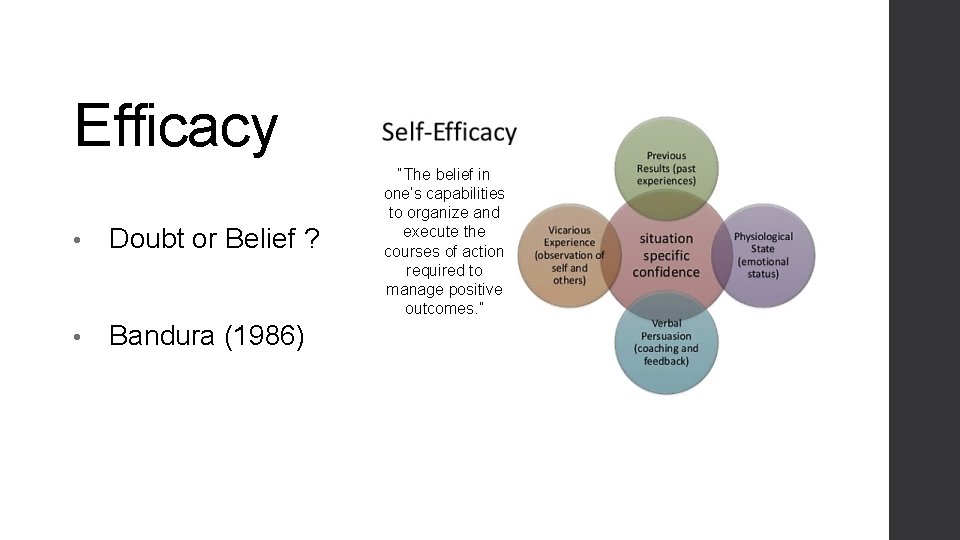
Efficacy • Doubt or Belief ? • Bandura (1986) “The belief in one’s capabilities to organize and execute the courses of action required to manage positive outcomes. ”
Background Information
Boatright-Horowitz et al. (2013) Participants were Exposed to Mc. Intosh’s List of White Privilege
Maybe I am privileged After exposure: • Higher ratings for the existence of racism • Social justice promoting organizations
• More statements for experiencing WP means being informed and shown examples helped students understand WP. • Taking action against racism.
Present Research Explores the effects of heightened White privilege awareness and efficacy on participants’ attitudes toward African Americans
Goals • Methods of Intervention • Colleges, High Schools, Places of Employment, HR
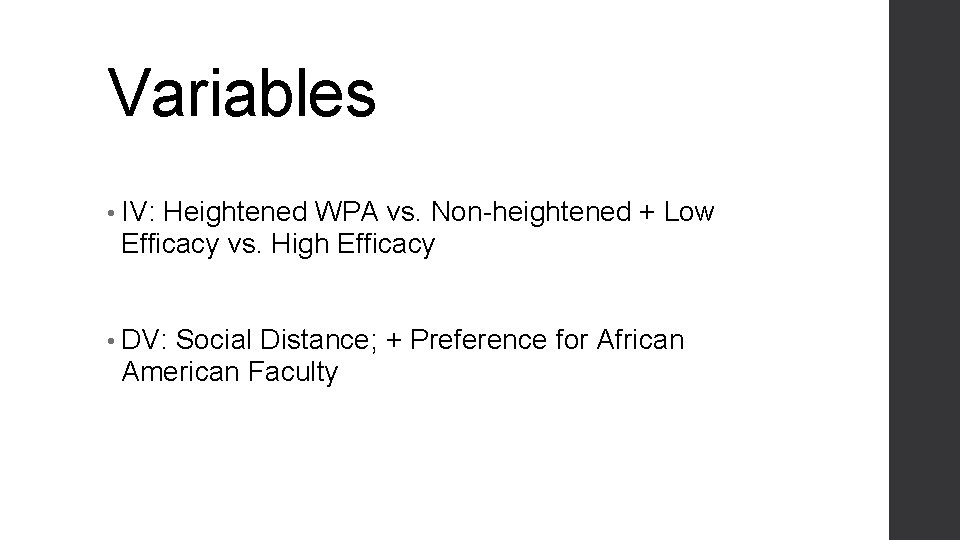
Variables • IV: Heightened WPA vs. Non-heightened + Low Efficacy vs. High Efficacy • DV: Social Distance; + Preference for African American Faculty
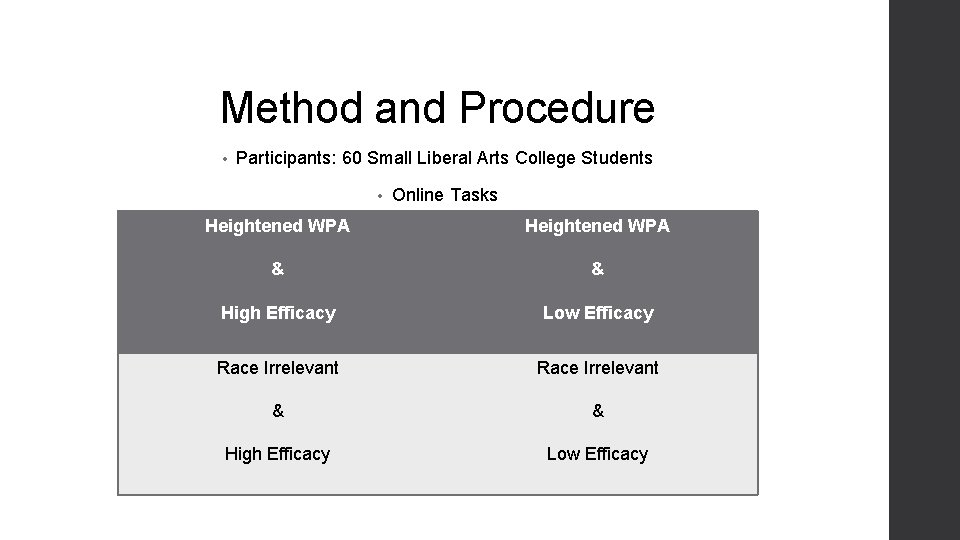
Method and Procedure • Participants: 60 Small Liberal Arts College Students • Online Tasks Heightened WPA & & High Efficacy Low Efficacy Race Irrelevant & & High Efficacy Low Efficacy
Materials Priming • Passages used by Stewart et al. (2012) 1. Lack of African American Faculty on Campus. 2. Race Irrelevant Topic
Materials Priming 2 • High Efficacy: 95% Chance • Low Efficacy: 5% Chance
Materials Support for African American Faculty Ratings on a Likert Scale: (1= I would not like more to 5= I would very much like more)
Materials Social Distance Scale used by Stewart et al. (2012) • 14 Statements “I would be willing to have a Black American person as my” – friend/roommate/co-worker.
Materials Efficacy Measure • “How likely are you to join student organizations or participate in campus events that focus on reducing racism? ” Boatright-Horowitz (2013)
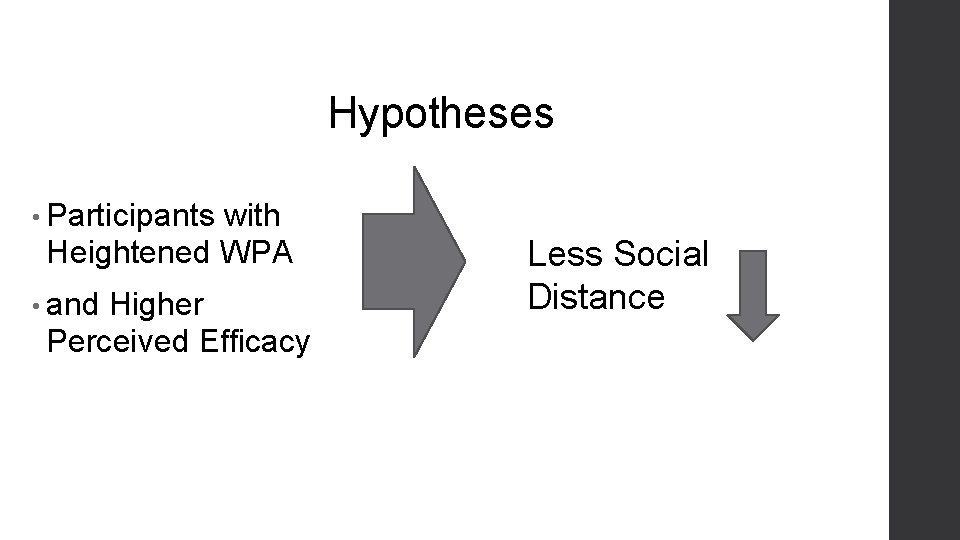
Hypotheses • Participants with Heightened WPA • and Higher Perceived Efficacy Less Social Distance
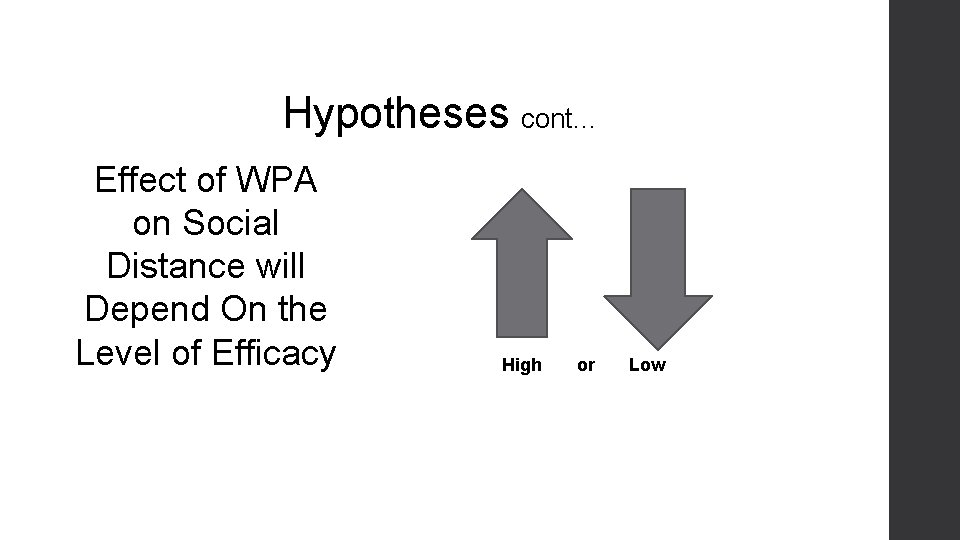
Hypotheses cont… Effect of WPA on Social Distance will Depend On the Level of Efficacy High or Low
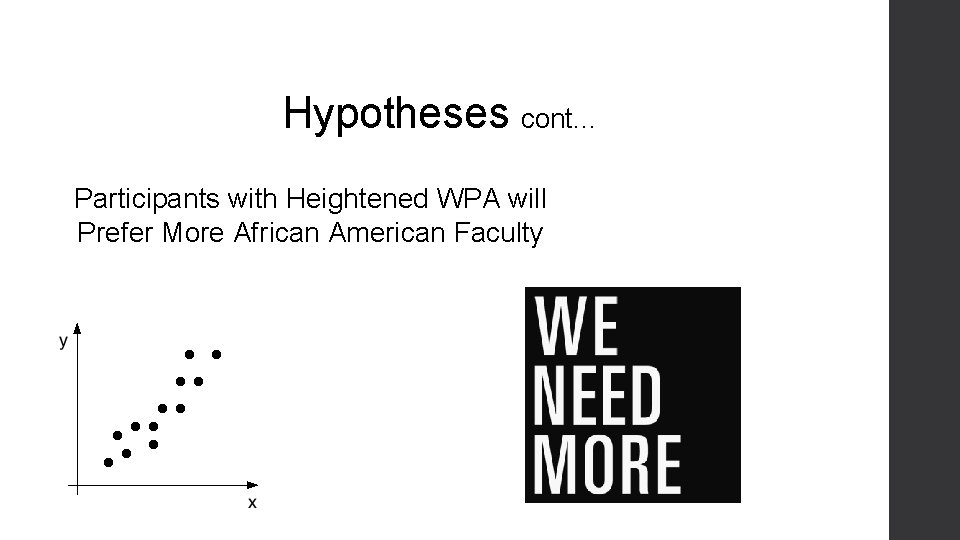
Hypotheses cont… Participants with Heightened WPA will Prefer More African American Faculty
Results and Discussion
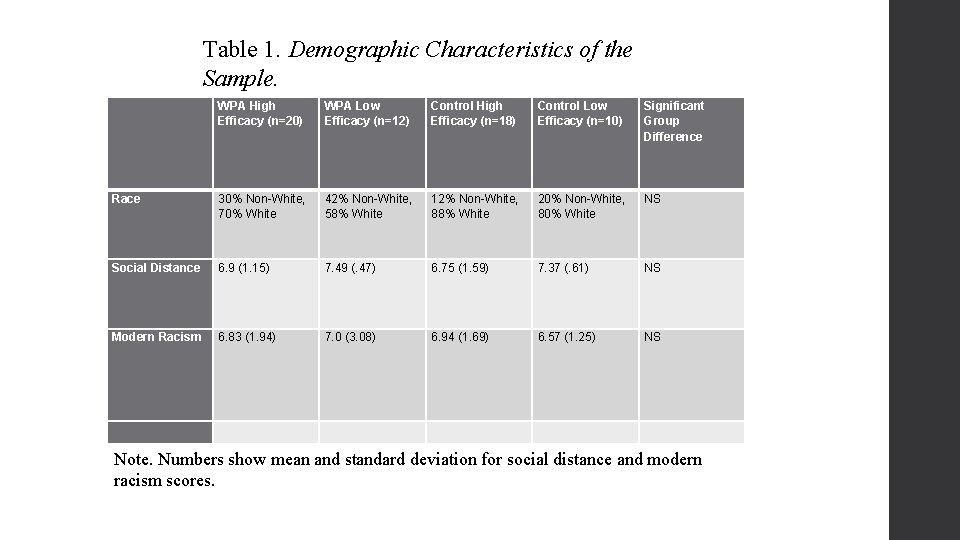
Table 1. Demographic Characteristics of the Sample. WPA High Efficacy (n=20) WPA Low Efficacy (n=12) Control High Efficacy (n=18) Control Low Efficacy (n=10) Significant Group Difference Race 30% Non-White, 70% White 42% Non-White, 58% White 12% Non-White, 88% White 20% Non-White, 80% White NS Social Distance 6. 9 (1. 15) 7. 49 (. 47) 6. 75 (1. 59) 7. 37 (. 61) NS Modern Racism 6. 83 (1. 94) 7. 0 (3. 08) 6. 94 (1. 69) 6. 57 (1. 25) NS Note. Numbers show mean and standard deviation for social distance and modern racism scores.
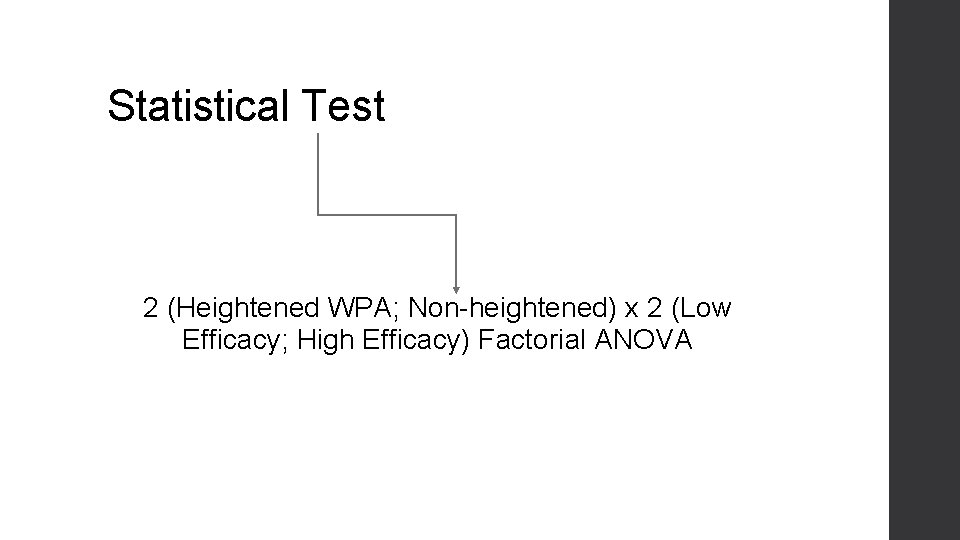
Statistical Test 2 (Heightened WPA; Non-heightened) x 2 (Low Efficacy; High Efficacy) Factorial ANOVA
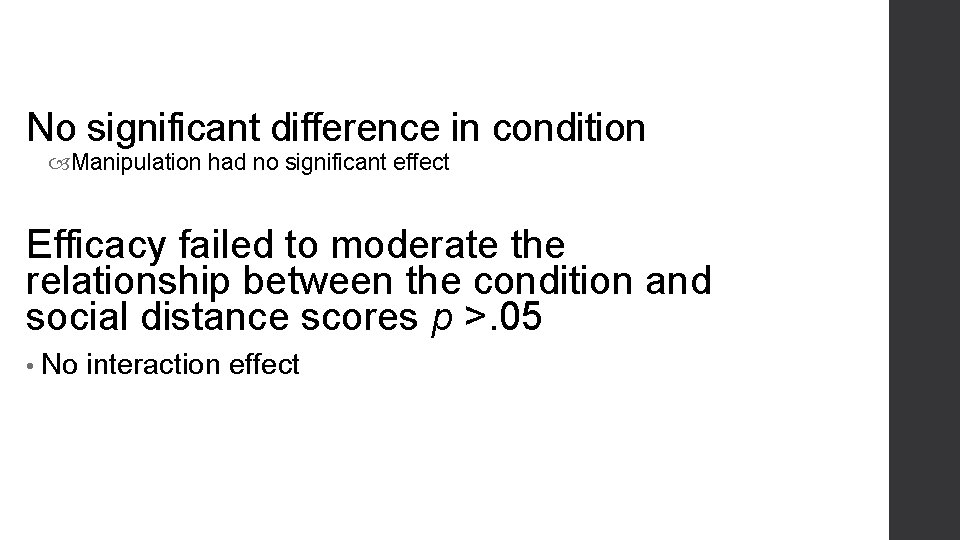
No significant difference in condition Manipulation had no significant effect Efficacy failed to moderate the relationship between the condition and social distance scores p >. 05 • No interaction effect
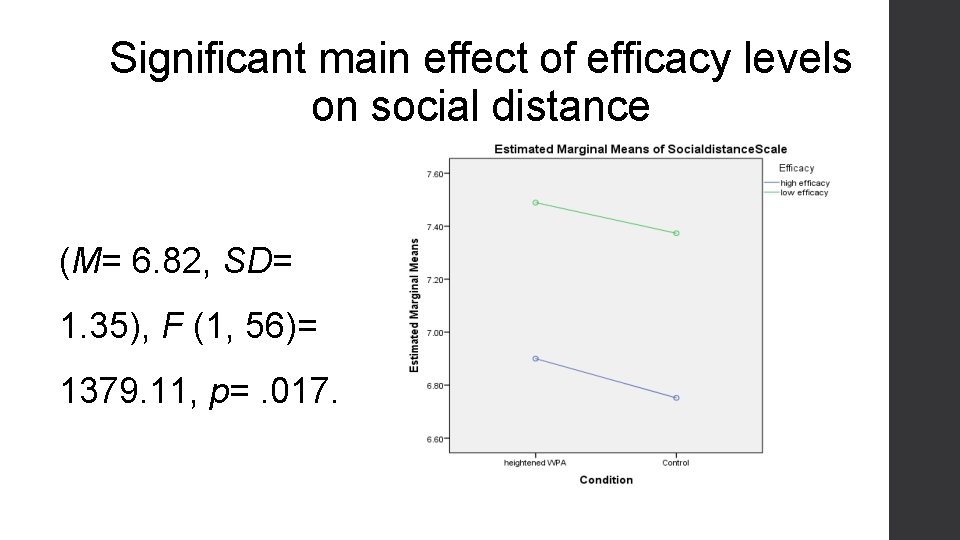
Significant main effect of efficacy levels on social distance (M= 6. 82, SD= 1. 35), F (1, 56)= 1379. 11, p=. 017.
Trends showed that control groups had higher social distance scores • Race content of experimental condition Defensive reactions?
A positive correlation was found between social distance score and preference for African American faculty, r (58) =. 55, p <. 001
A significant correlation was found between modern racism scores and racial groups r= (56) =. 277, p<. 001 • Minority participants reported that more racism exists today compared to White participants Life experience?
What Does All of It Mean?
Information, Understanding, Efficacy, and Change
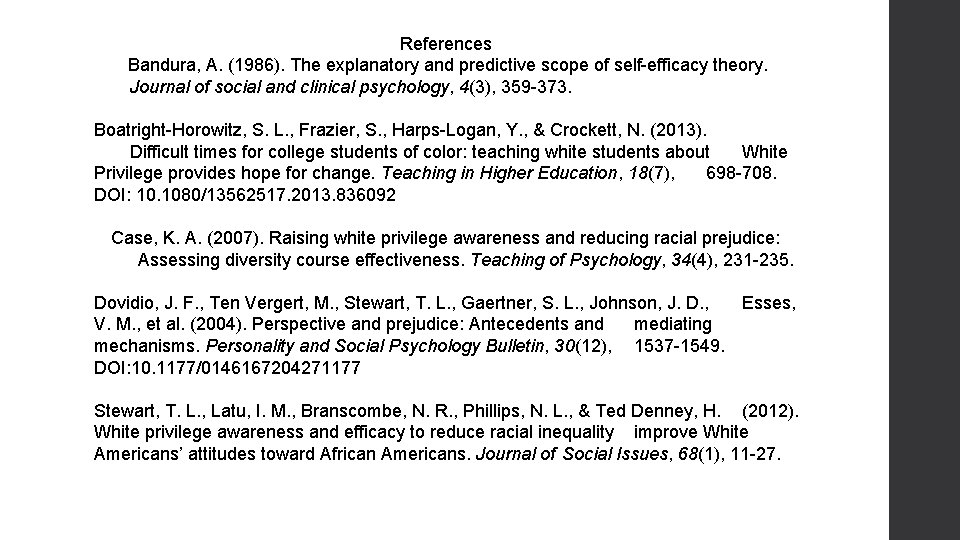
References Bandura, A. (1986). The explanatory and predictive scope of self-efficacy theory. Journal of social and clinical psychology, 4(3), 359 -373. Boatright-Horowitz, S. L. , Frazier, S. , Harps-Logan, Y. , & Crockett, N. (2013). Difficult times for college students of color: teaching white students about White Privilege provides hope for change. Teaching in Higher Education, 18(7), 698 -708. DOI: 10. 1080/13562517. 2013. 836092 Case, K. A. (2007). Raising white privilege awareness and reducing racial prejudice: Assessing diversity course effectiveness. Teaching of Psychology, 34(4), 231 -235. Dovidio, J. F. , Ten Vergert, M. , Stewart, T. L. , Gaertner, S. L. , Johnson, J. D. , Esses, V. M. , et al. (2004). Perspective and prejudice: Antecedents and mediating mechanisms. Personality and Social Psychology Bulletin, 30(12), 1537 -1549. DOI: 10. 1177/0146167204271177 Stewart, T. L. , Latu, I. M. , Branscombe, N. R. , Phillips, N. L. , & Ted Denney, H. (2012). White privilege awareness and efficacy to reduce racial inequality improve White Americans’ attitudes toward African Americans. Journal of Social Issues, 68(1), 11 -27.
Questions?
Effects of awareness of White Privilege and Perceived Efficacy on White Americans’ Attitudes By: Sadie Hamilton