
Effects of Aging on Aircraft Parts Study DLA


- Slides: 29
Effects of Aging on Aircraft Parts Study DLA Contract - WBS 2. 7. 1 Leonard F. Bosma Logistics Management Institute William A. Hetzner Altarum 23 October 2003
Agenda · Purpose · Participants · Tasks and Schedule · Hypotheses · Challenges · Methodology · Very Preliminary Results · Discussion 9/11/2021 2
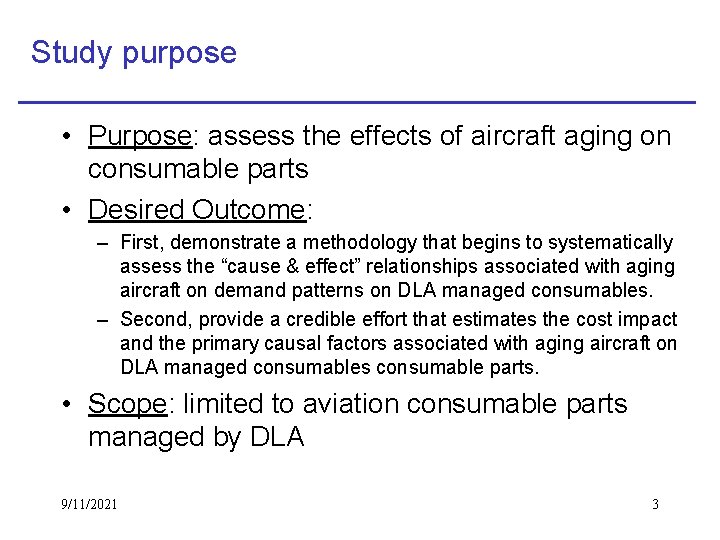
Study purpose • Purpose: assess the effects of aircraft aging on consumable parts • Desired Outcome: – First, demonstrate a methodology that begins to systematically assess the “cause & effect” relationships associated with aging aircraft on demand patterns on DLA managed consumables. – Second, provide a credible effort that estimates the cost impact and the primary causal factors associated with aging aircraft on DLA managed consumables consumable parts. • Scope: limited to aviation consumable parts managed by DLA 9/11/2021 3
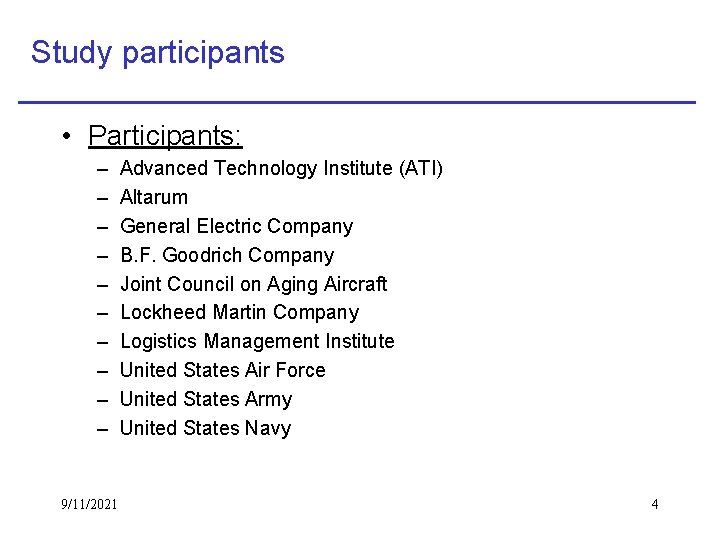
Study participants • Participants: – – – – – 9/11/2021 Advanced Technology Institute (ATI) Altarum General Electric Company B. F. Goodrich Company Joint Council on Aging Aircraft Lockheed Martin Company Logistics Management Institute United States Air Force United States Army United States Navy 4
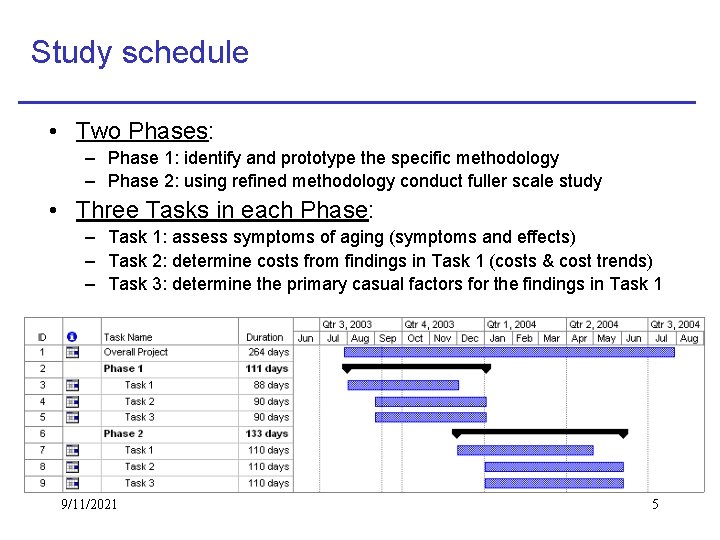
Study schedule • Two Phases: – Phase 1: identify and prototype the specific methodology – Phase 2: using refined methodology conduct fuller scale study • Three Tasks in each Phase: – Task 1: assess symptoms of aging (symptoms and effects) – Task 2: determine costs from findings in Task 1 (costs & cost trends) – Task 3: determine the primary casual factors for the findings in Task 1 9/11/2021 5
Four Major Potentially Testable Hypotheses • Hypothesis 1: As aircraft age, they experience increased demand for consumable parts • Hypothesis 2: As aircraft age, they experience greater price increases for consumable parts • Hypothesis 3: As aircraft age, they experience longer procurement cycles for consumable parts • Hypothesis 4: As aircraft age, they experience declining availability for consumable parts 9/11/2021 6
Hypothesis 1: As aircraft age, they experience increased demand for consumable parts • Increasing number of Program Modifications (MODS) and Engineering Change Proposals (ECPs) • Increased scheduled and unscheduled maintenance due to corrosion issues, fatigue factors and safety of flight concerns • Diminished skill sets and inadequate training of personnel doing maintenance • “Longer-life” parts reaching the end of their natural life • Cumulative effects of repeated multiple overhauls and repairs of an aircraft and its many repairable components 9/11/2021 7
Hypothesis 2: As aircraft age, they experience greater price increases for consumable parts • Parts support is provided by fewer vendors • Parts experience unusual demand patterns • Parts inventory is increasingly made up of newer (younger) parts that are generally more expensive • Parts that are getting older require materials or manufacturing processes that, while available, are increasingly more difficult to operate and sustain 9/11/2021 8
Hypothesis 3: As aircraft age, they experience longer procurement cycles for consumable parts • Supplier parts support is provided by fewer vendors • Supplier parts support experiences declining availability of technical data, and engineering expertise • Supplier parts support experiences the loss (or obsolescence) of manufacturing and design tools, fixtures and processes used to design and build aircraft parts • Supplier parts support experience increased incidences of disappearing vendors which then requires qualification of new vendors 9/11/2021 9
Hypothesis 4: As aircraft age, they experience declining availability for consumable parts • More parts experience unusual demand patterns • More parts experience longer procurement cycles thereby increasing non-availability 9/11/2021 10
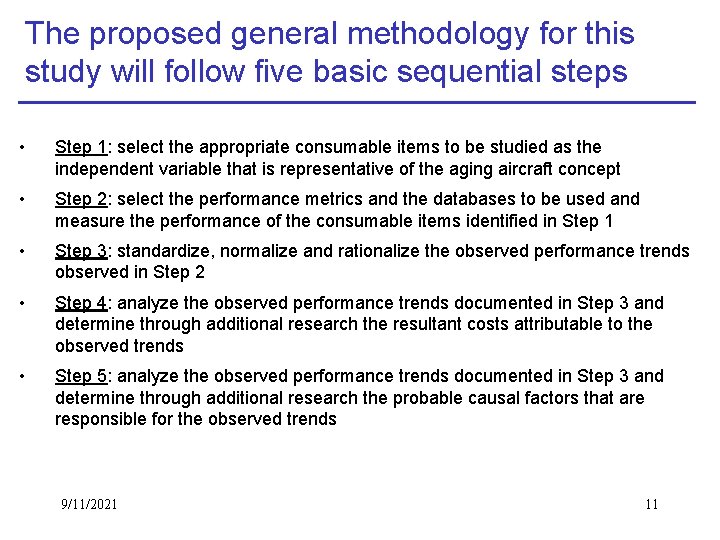
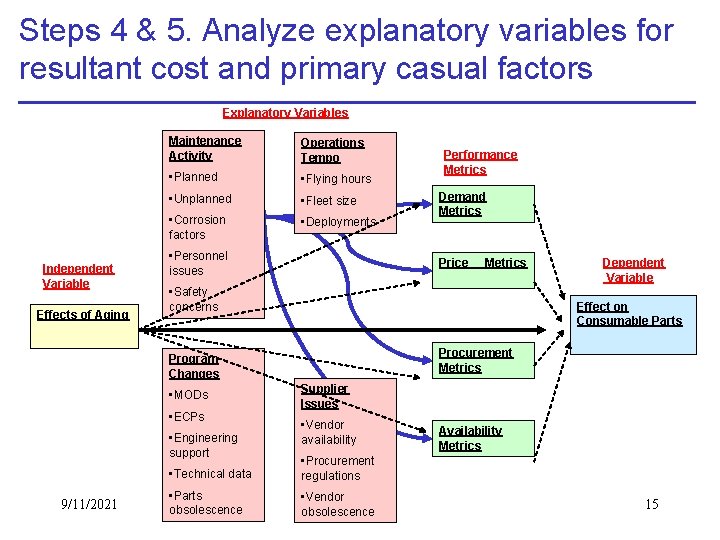
The proposed general methodology for this study will follow five basic sequential steps • Step 1: select the appropriate consumable items to be studied as the independent variable that is representative of the aging aircraft concept • Step 2: select the performance metrics and the databases to be used and measure the performance of the consumable items identified in Step 1 • Step 3: standardize, normalize and rationalize the observed performance trends observed in Step 2 • Step 4: analyze the observed performance trends documented in Step 3 and determine through additional research the resultant costs attributable to the observed trends • Step 5: analyze the observed performance trends documented in Step 3 and determine through additional research the probable causal factors that are responsible for the observed trends 9/11/2021 11
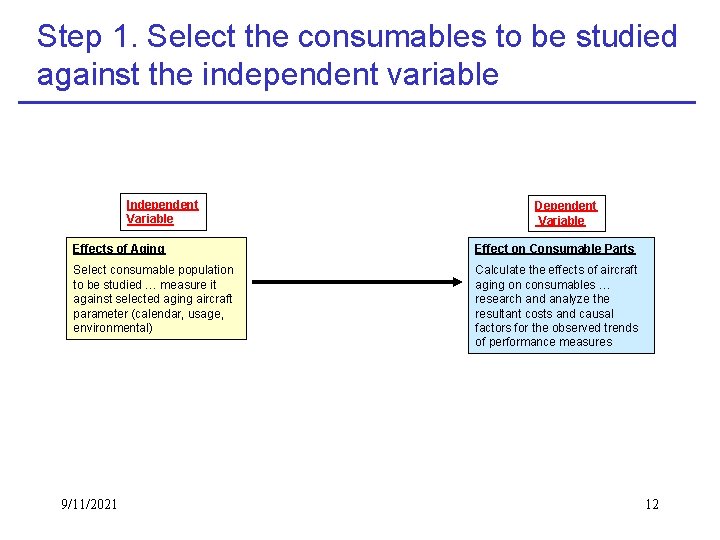
Step 1. Select the consumables to be studied against the independent variable Independent Variable Dependent Variable Effects of Aging Effect on Consumable Parts Select consumable population to be studied … measure it against selected aging aircraft parameter (calendar, usage, environmental) Calculate the effects of aircraft aging on consumables … research and analyze the resultant costs and causal factors for the observed trends of performance measures 9/11/2021 12
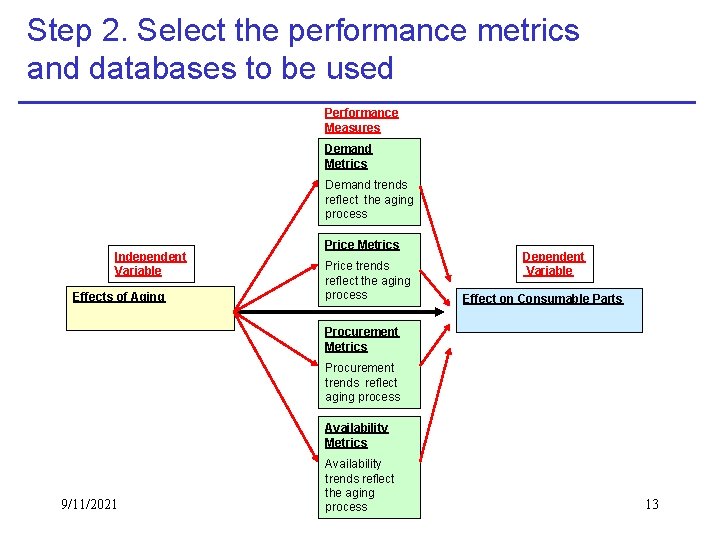
Step 2. Select the performance metrics and databases to be used Performance Measures Demand Metrics Demand trends reflect the aging process Independent Variable Effects of Aging Price Metrics Price trends reflect the aging process Dependent Variable Effect on Consumable Parts Procurement Metrics Procurement trends reflect aging process Availability Metrics 9/11/2021 Availability trends reflect the aging process 13
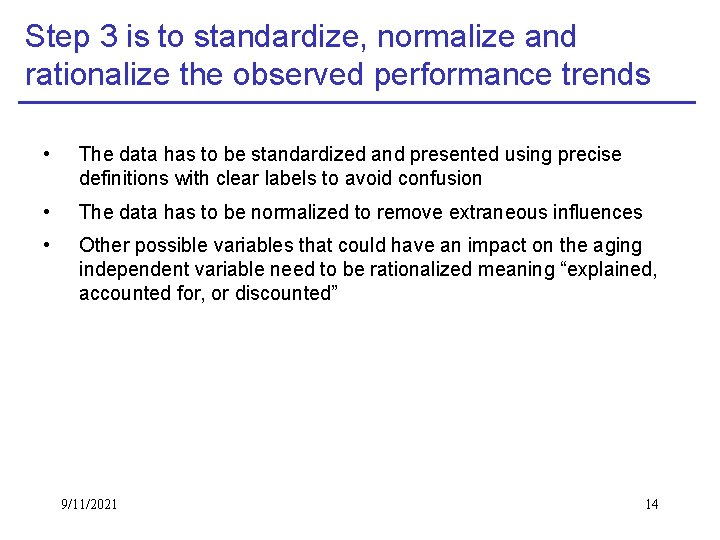
Step 3 is to standardize, normalize and rationalize the observed performance trends • The data has to be standardized and presented using precise definitions with clear labels to avoid confusion • The data has to be normalized to remove extraneous influences • Other possible variables that could have an impact on the aging independent variable need to be rationalized meaning “explained, accounted for, or discounted” 9/11/2021 14
Steps 4 & 5. Analyze explanatory variables for resultant cost and primary casual factors Explanatory Variables Independent Variable Effects of Aging Maintenance Activity Operations Tempo • Planned • Flying hours • Unplanned • Fleet size • Corrosion factors • Deployments • Personnel issues Demand Metrics Price Metrics • Safety concerns • MODs • ECPs • Engineering support Dependent Variable Effect on Consumable Parts Procurement Metrics Program Changes 9/11/2021 Performance Metrics Supplier Issues • Vendor availability • Technical data • Procurement regulations • Parts obsolescence • Vendor obsolescence Availability Metrics 15
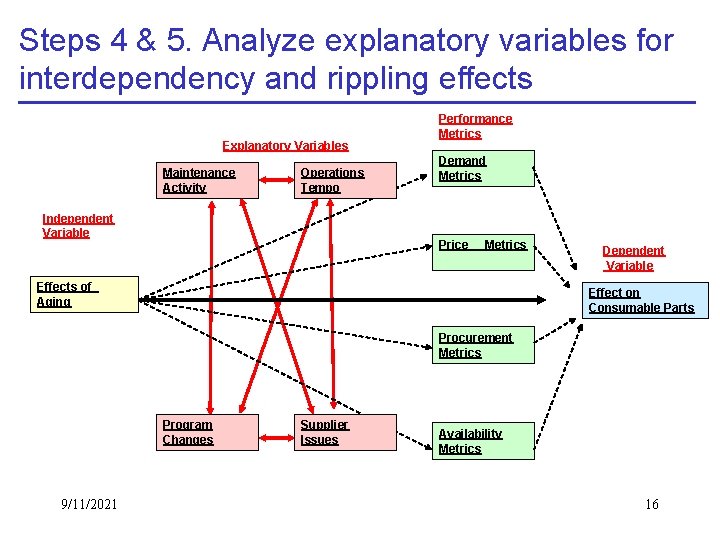
Steps 4 & 5. Analyze explanatory variables for interdependency and rippling effects Explanatory Variables Maintenance Activity Operations Tempo Independent Variable Performance Metrics Demand Metrics Price Metrics Effects of Aging Dependent Variable Effect on Consumable Parts Procurement Metrics Program Changes 9/11/2021 Supplier Issues Availability Metrics 16
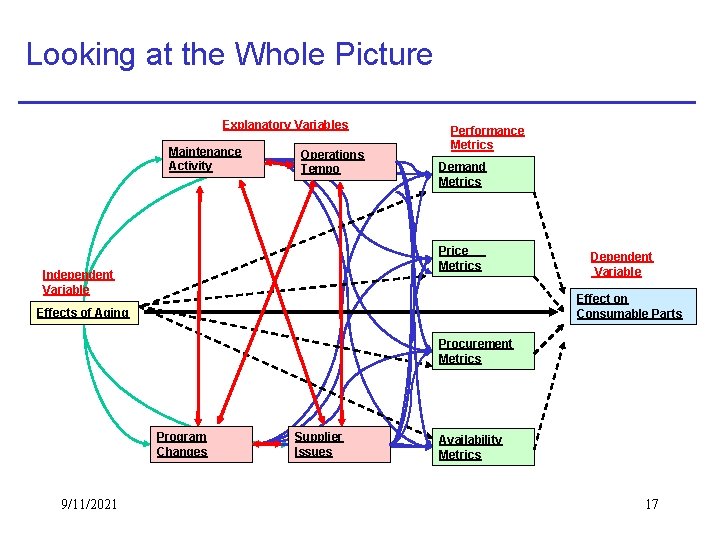
Looking at the Whole Picture Explanatory Variables Maintenance Activity Operations Tempo Performance Metrics Demand Metrics Price Metrics Independent Variable Dependent Variable Effect on Consumable Parts Effects of Aging Procurement Metrics Program Changes 9/11/2021 Supplier Issues Availability Metrics 17
Three Study Challenges 1. Understanding the precise relationship using quantifiable measures (metrics) 2. Determining the “real” age of aircraft as they get progressively older 3. Avoiding unwarranted and generalized conclusions about DLA consumables 9/11/2021 18
Understanding the precise relationship as measured by metrics is difficult • Metrics by themselves, are often misleading without proper controls and explanations • Cause and effect relationships are difficult to establish because other variables also may effect the relationship • Because DLA consumable demand is aggregated, it is difficult to establish relationships 9/11/2021 19
Determining the “real” age of aircraft as they get progressively older is difficult • Aircraft periodically go through overhaul, Programmed Depot Maintenance (PDM) and/or Service Life Extension Program (SLEP) that renew the airframe • Aircraft are made up with multiple reparable parts (engines, gearboxes, electronics) that are repaired, replaced, updated and moved from one aircraft to another in “depot maintenance” and in normal base/squadron maintenance • Aircraft experience MODS and ECPs that replace older parts with newer parts (both an hypothesis and a difficulty) 9/11/2021 20
Avoiding unwarranted and generalized conclusions about DLA consumables • Generalized statements about consumables should not be made be unless the statements are supported by the facts • DLA manages over 1. 2 million consumable parts … what is true for one group of parts is often not true for another group • Examples of the many ways to examine consumable populations are provided below – Different products (fluids, electronics, hardware) – Different manufacturers (Lockheed, General Electric, B. F. Goodrich) – Different aircraft types and models (C-130, H-60, F-22) – Different price categories (expensive vs. cheap) – Different customers (depots, bases, services) – Different combinations of the above categories 9/11/2021 21
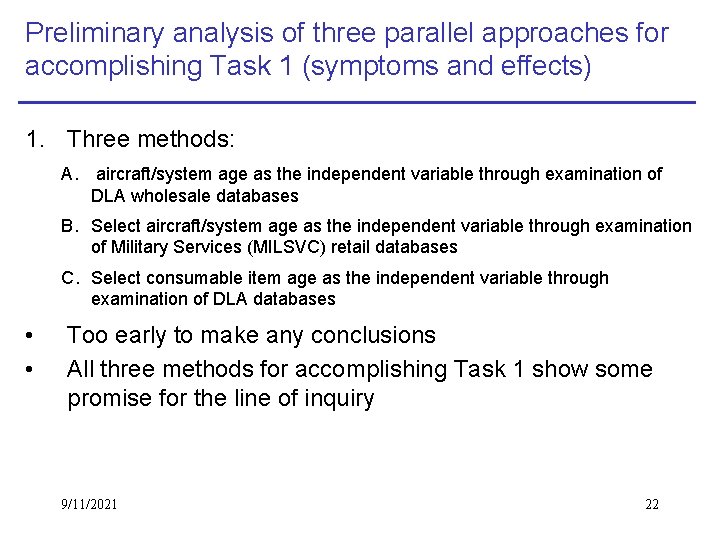
Preliminary analysis of three parallel approaches for accomplishing Task 1 (symptoms and effects) 1. Three methods: A. aircraft/system age as the independent variable through examination of DLA wholesale databases B. Select aircraft/system age as the independent variable through examination of Military Services (MILSVC) retail databases C. Select consumable item age as the independent variable through examination of DLA databases • • Too early to make any conclusions All three methods for accomplishing Task 1 show some promise for the line of inquiry 9/11/2021 22
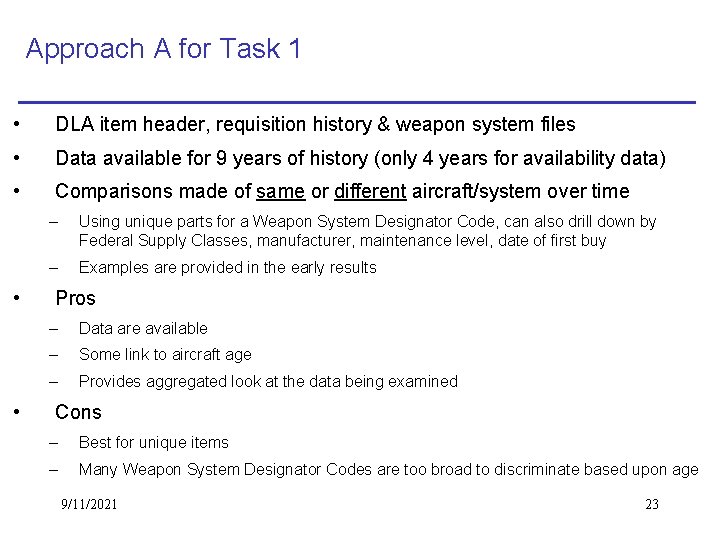
Approach A for Task 1 • DLA item header, requisition history & weapon system files • Data available for 9 years of history (only 4 years for availability data) • Comparisons made of same or different aircraft/system over time • • – Using unique parts for a Weapon System Designator Code, can also drill down by Federal Supply Classes, manufacturer, maintenance level, date of first buy – Examples are provided in the early results Pros – Data are available – Some link to aircraft age – Provides aggregated look at the data being examined Cons – Best for unique items – Many Weapon System Designator Codes are too broad to discriminate based upon age 9/11/2021 23
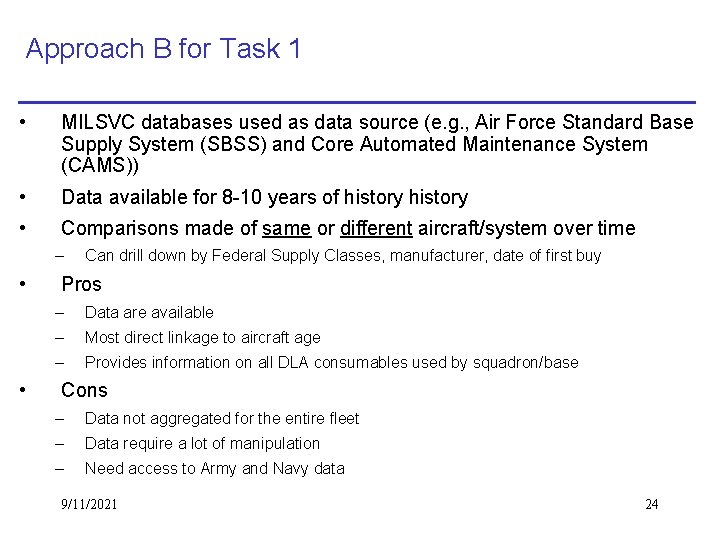
Approach B for Task 1 • MILSVC databases used as data source (e. g. , Air Force Standard Base Supply System (SBSS) and Core Automated Maintenance System (CAMS)) • Data available for 8 -10 years of history • Comparisons made of same or different aircraft/system over time – • • Can drill down by Federal Supply Classes, manufacturer, date of first buy Pros – Data are available – Most direct linkage to aircraft age – Provides information on all DLA consumables used by squadron/base Cons – Data not aggregated for the entire fleet – Data require a lot of manipulation – Need access to Army and Navy data 9/11/2021 24
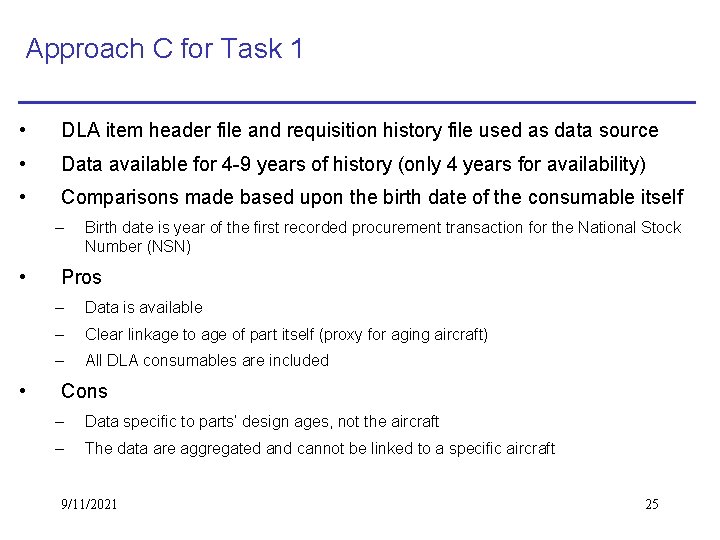
Approach C for Task 1 • DLA item header file and requisition history file used as data source • Data available for 4 -9 years of history (only 4 years for availability) • Comparisons made based upon the birth date of the consumable itself – • • Birth date is year of the first recorded procurement transaction for the National Stock Number (NSN) Pros – Data is available – Clear linkage to age of part itself (proxy for aging aircraft) – All DLA consumables are included Cons – Data specific to parts’ design ages, not the aircraft – The data are aggregated and cannot be linked to a specific aircraft 9/11/2021 25
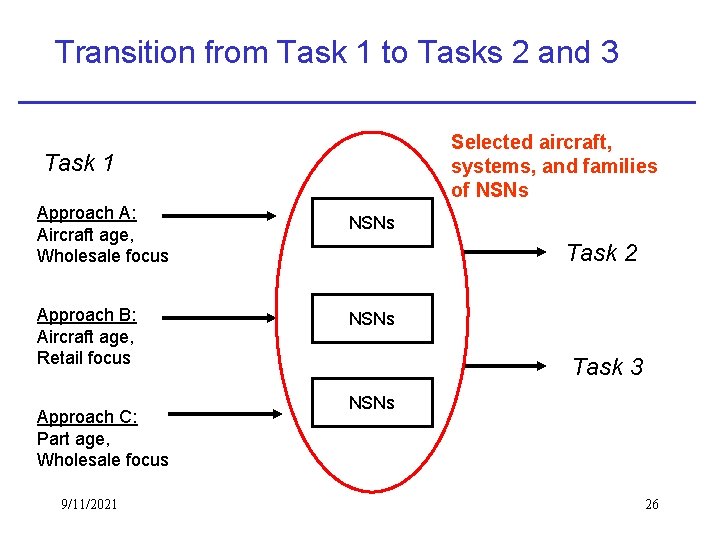
Transition from Task 1 to Tasks 2 and 3 Selected aircraft, systems, and families of NSNs Task 1 Approach A: Aircraft age, Wholesale focus Approach B: Aircraft age, Retail focus Approach C: Part age, Wholesale focus 9/11/2021 NSNs Task 2 NSNs Task 3 NSNs 26
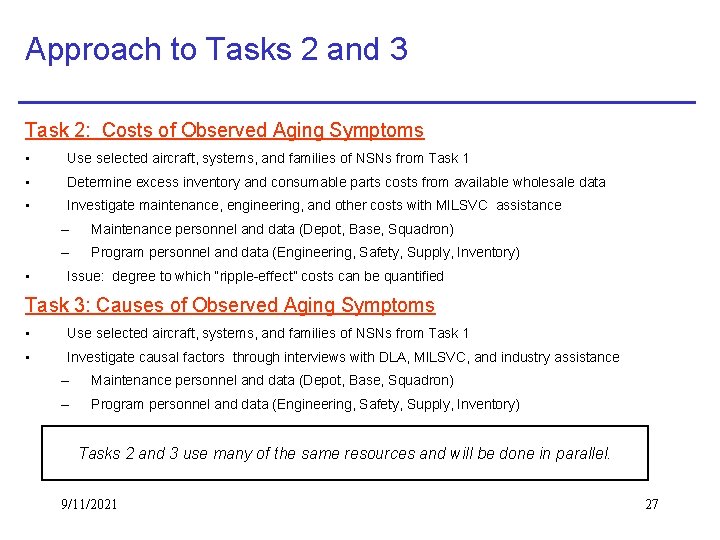
Approach to Tasks 2 and 3 Task 2: Costs of Observed Aging Symptoms • Use selected aircraft, systems, and families of NSNs from Task 1 • Determine excess inventory and consumable parts costs from available wholesale data • Investigate maintenance, engineering, and other costs with MILSVC assistance • – Maintenance personnel and data (Depot, Base, Squadron) – Program personnel and data (Engineering, Safety, Supply, Inventory) Issue: degree to which “ripple-effect” costs can be quantified Task 3: Causes of Observed Aging Symptoms • Use selected aircraft, systems, and families of NSNs from Task 1 • Investigate causal factors through interviews with DLA, MILSVC, and industry assistance – Maintenance personnel and data (Depot, Base, Squadron) – Program personnel and data (Engineering, Safety, Supply, Inventory) Tasks 2 and 3 use many of the same resources and will be done in parallel. 9/11/2021 27
Study expectations • Validated methodology – consistent across services • Credible initial estimate of cost impact and primary causal factors – Cost and cost trends as stated in SOW – Not all ripple effects will be addressed (e. g. , repair hours and repair BOM) • Relatively robust examination of a limited number of aircraft and/or systems • Expectations need to be bounded by resources available 9/11/2021 28
Discussion 9/11/2021 29