
Effects of a Suspended Bottom Boundary Layer on
Effects of a Suspended Bottom Boundary Layer on Sonar Propagation Michael Cornelius June 2004
Purpose n Determine the impact of a suspended bottom boundary layer on the reverberation characteristics of a simulated mine n Determine critical value of volume attenuation that renders mine object undetectable
Relevance n Mine Warfare n Future investigation of bottom boundary layers on acoustic detection
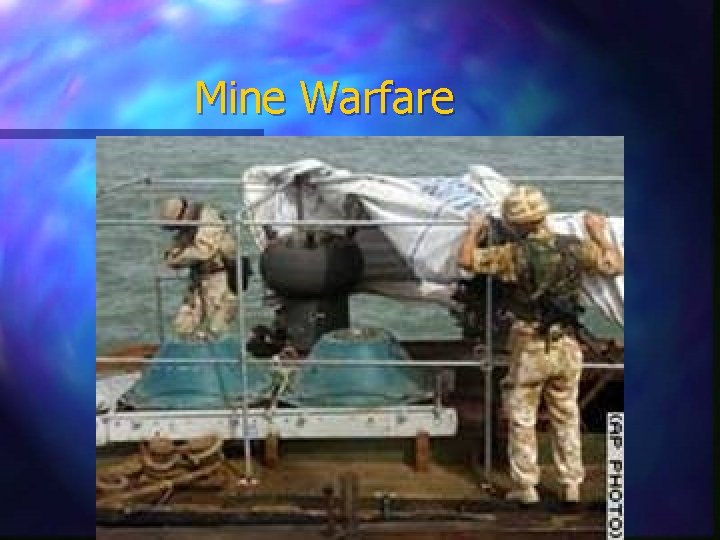
Mine Warfare
CASS/GRAB n Comprehensive Acoustic Simulation System (CASS) n Gaussian Ray Bundle (GRAB) Eigenray model n Navy standard model for active and passive range dependent acoustic propagation, reverberation and signal excess n Frequency range 600 Hz to 100 k. Hz

CASS/GRAB Model Description The CASS model is the range dependent improvement of the Generic Sonar Model (GSM). CASS performs signal excess calculations. n The GRAB model is a subset of the CASS model and its main function is to compute eigenrays and propagation loss as inputs in the CASS signal excess calculations. n
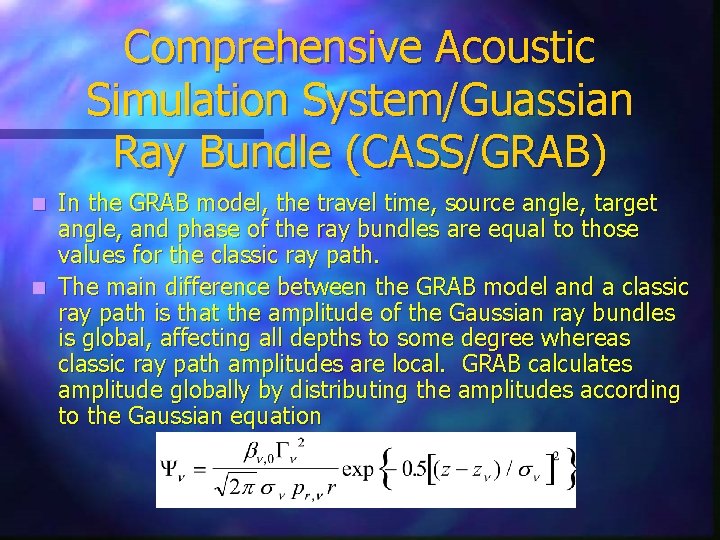
Comprehensive Acoustic Simulation System/Guassian Ray Bundle (CASS/GRAB) In the GRAB model, the travel time, source angle, target angle, and phase of the ray bundles are equal to those values for the classic ray path. n The main difference between the GRAB model and a classic ray path is that the amplitude of the Gaussian ray bundles is global, affecting all depths to some degree whereas classic ray path amplitudes are local. GRAB calculates amplitude globally by distributing the amplitudes according to the Gaussian equation n
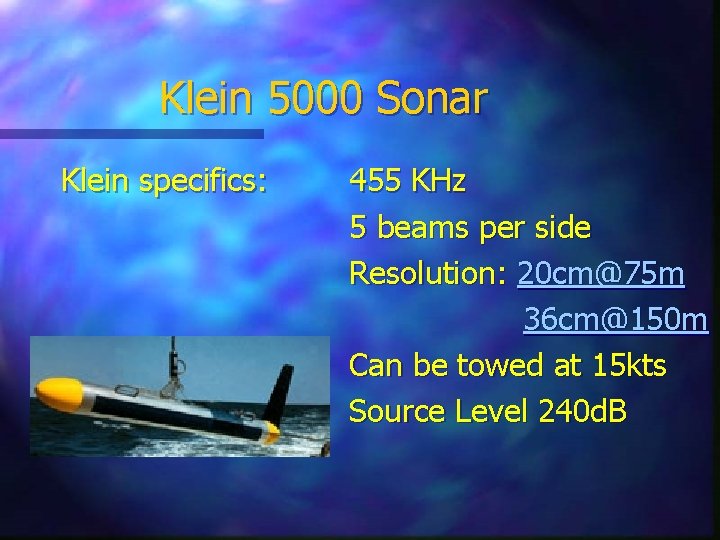
Klein 5000 Sonar Klein specifics: 455 KHz 5 beams per side Resolution: 20 cm@75 m 36 cm@150 m Can be towed at 15 kts Source Level 240 d. B
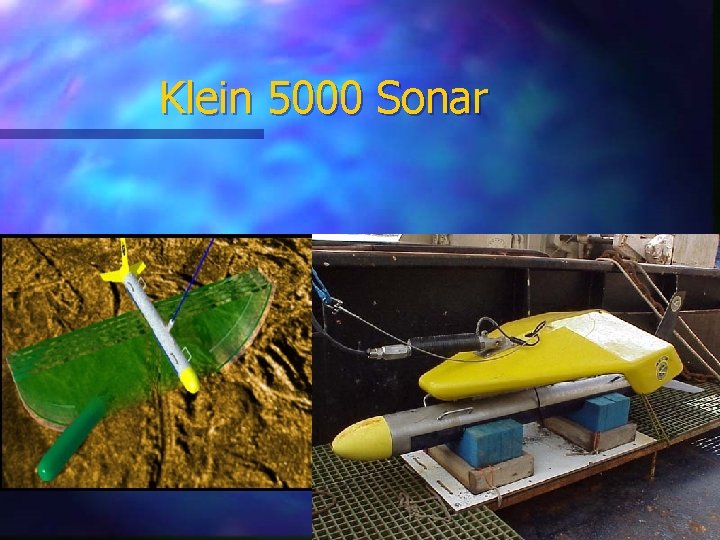
Klein 5000 Sonar
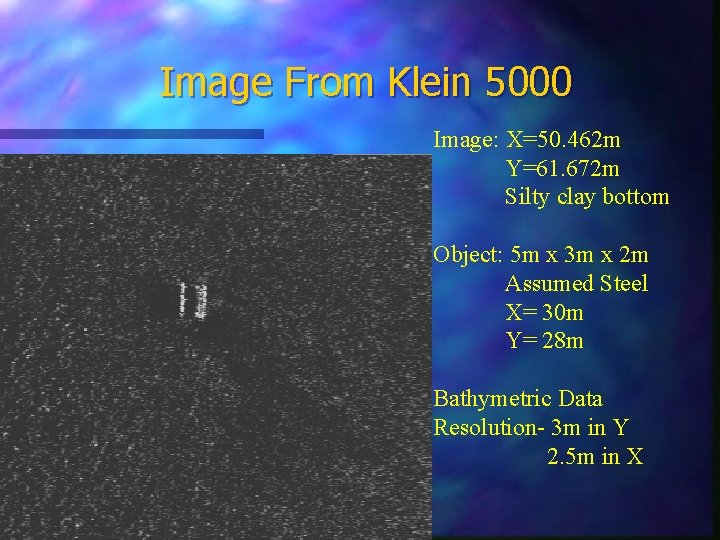
Image From Klein 5000 Image: X=50. 462 m Y=61. 672 m Silty clay bottom Object: 5 m x 3 m x 2 m Assumed Steel X= 30 m Y= 28 m Bathymetric Data Resolution- 3 m in Y 2. 5 m in X
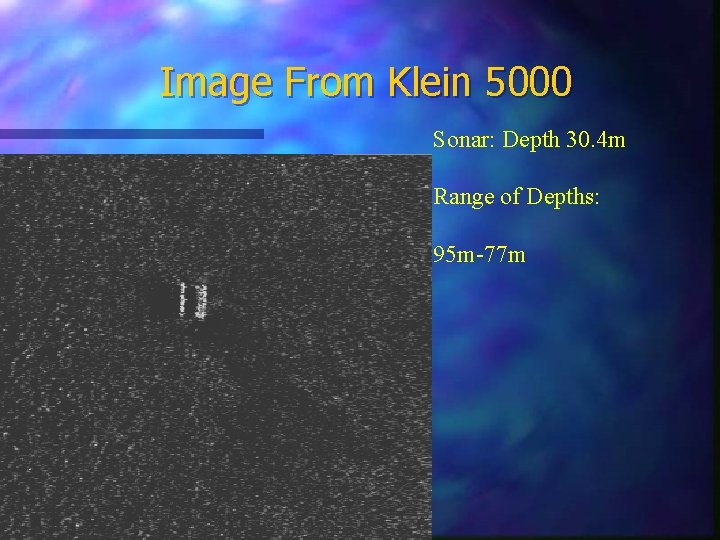
Image From Klein 5000 Sonar: Depth 30. 4 m Range of Depths: 95 m-77 m
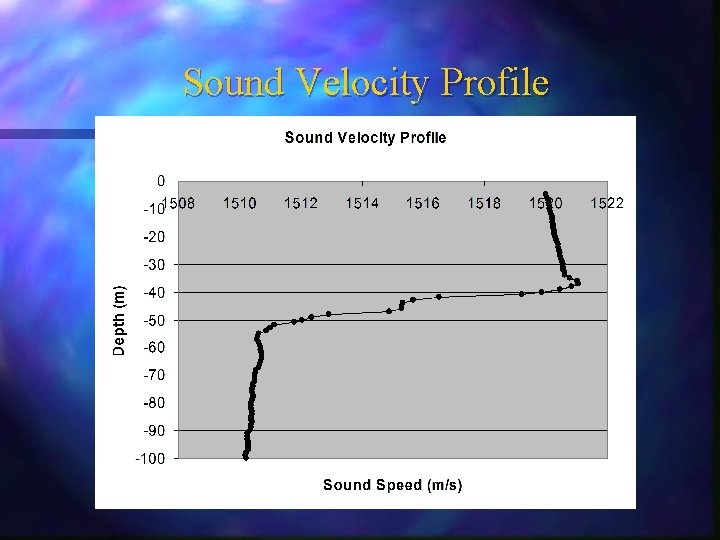
Sound Velocity Profile
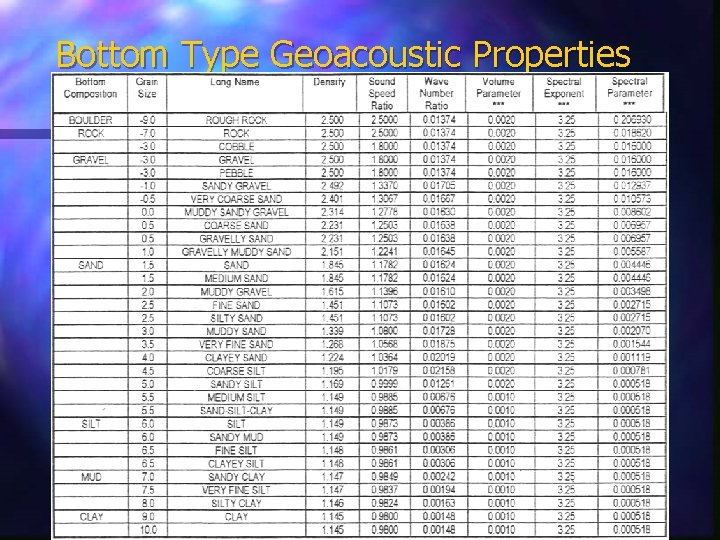
Bottom Type Geoacoustic Properties
n Suspended sediment layer changes the volume scattering strength, …
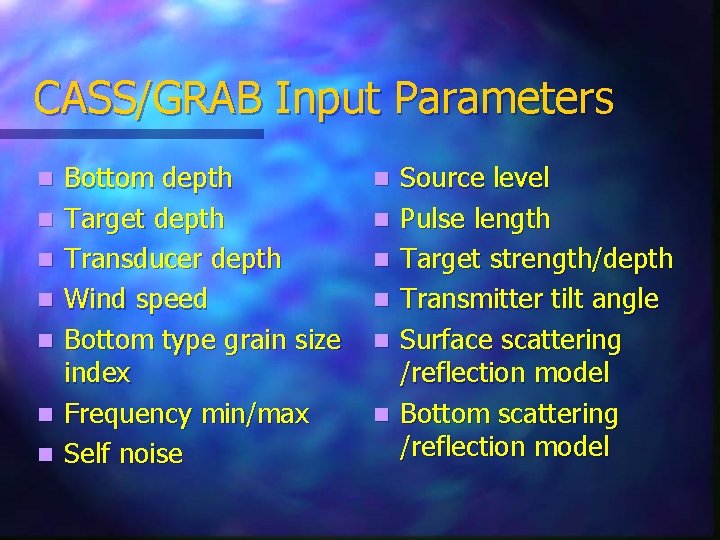
CASS/GRAB Input Parameters n n n n Bottom depth Target depth Transducer depth Wind speed Bottom type grain size index Frequency min/max Self noise n n n Source level Pulse length Target strength/depth Transmitter tilt angle Surface scattering /reflection model Bottom scattering /reflection model
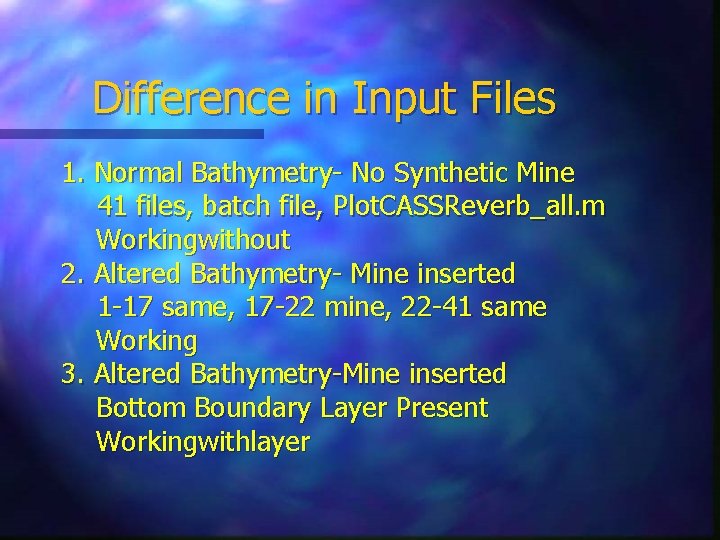
Difference in Input Files 1. Normal Bathymetry- No Synthetic Mine 41 files, batch file, Plot. CASSReverb_all. m Workingwithout 2. Altered Bathymetry- Mine inserted 1 -17 same, 17 -22 mine, 22 -41 same Working 3. Altered Bathymetry-Mine inserted Bottom Boundary Layer Present Workingwithlayer
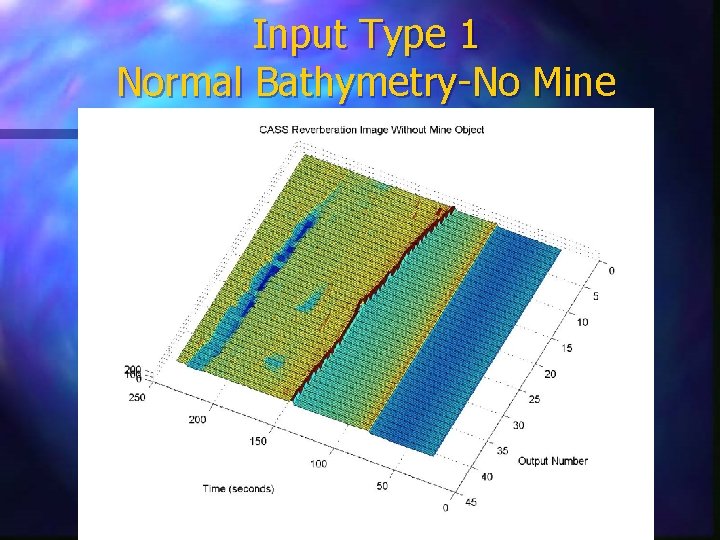
Input Type 1 Normal Bathymetry-No Mine
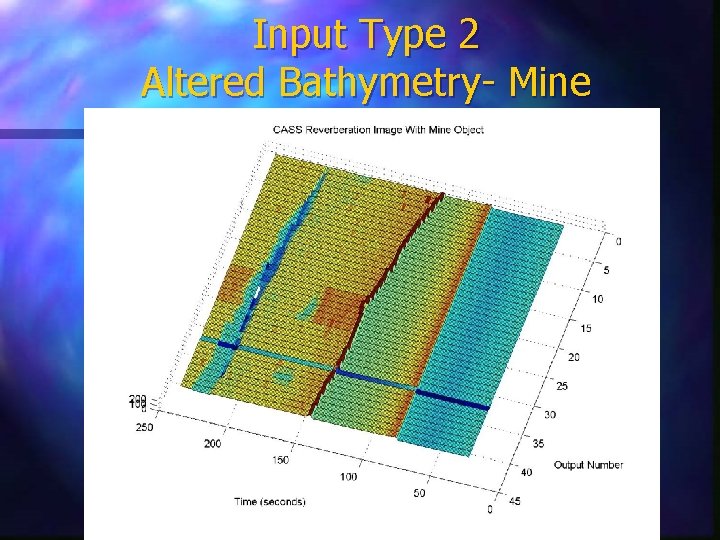
Input Type 2 Altered Bathymetry- Mine
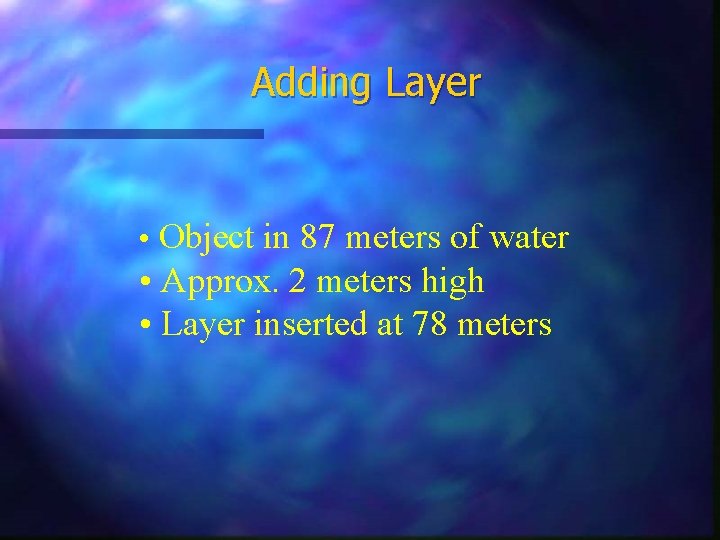
Adding Layer • Object in 87 meters of water • Approx. 2 meters high • Layer inserted at 78 meters
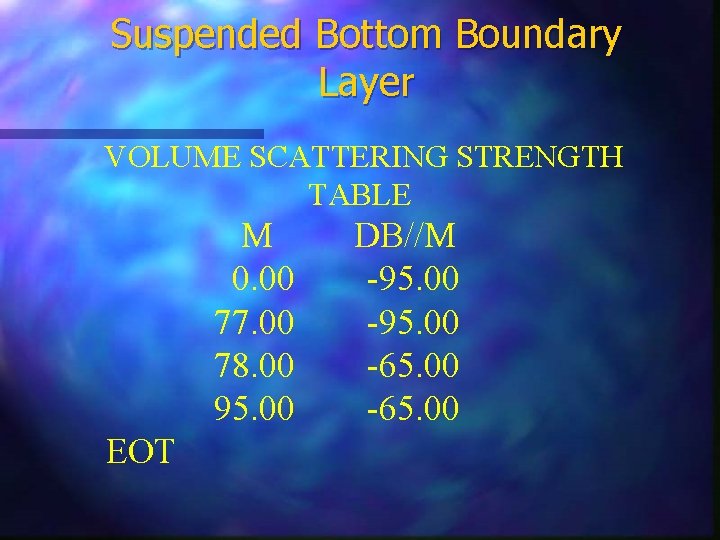
Suspended Bottom Boundary Layer VOLUME SCATTERING STRENGTH TABLE M 0. 00 77. 00 78. 00 95. 00 EOT DB//M -95. 00 -65. 00
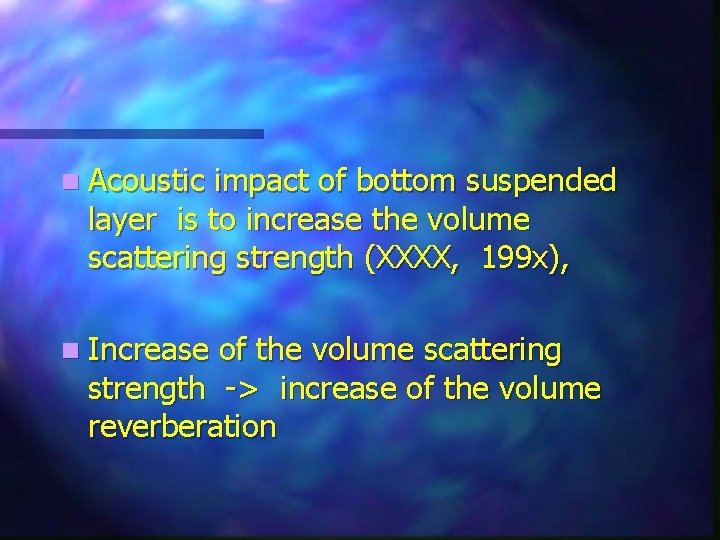
n Acoustic impact of bottom suspended layer is to increase the volume scattering strength (XXXX, 199 x), n Increase of the volume scattering strength -> increase of the volume reverberation
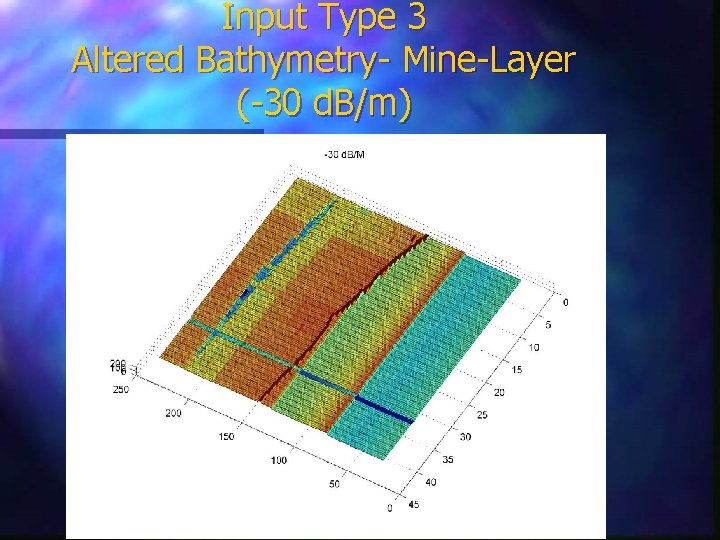
Input Type 3 Altered Bathymetry- Mine-Layer (-30 d. B/m)
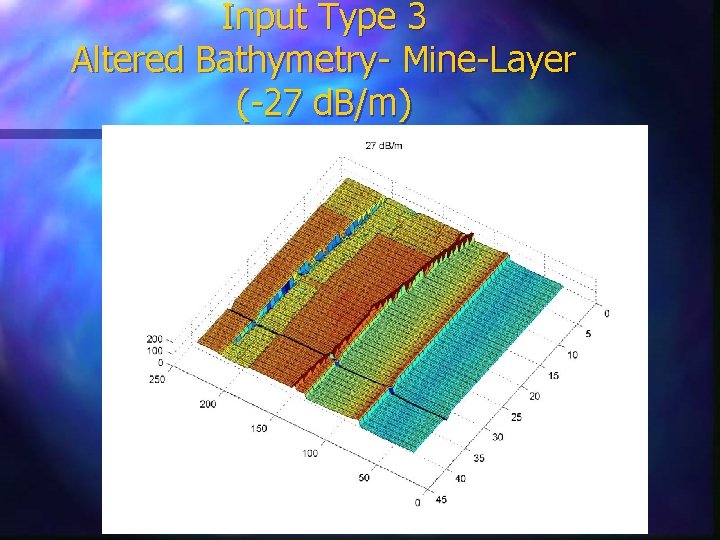
Input Type 3 Altered Bathymetry- Mine-Layer (-27 d. B/m)
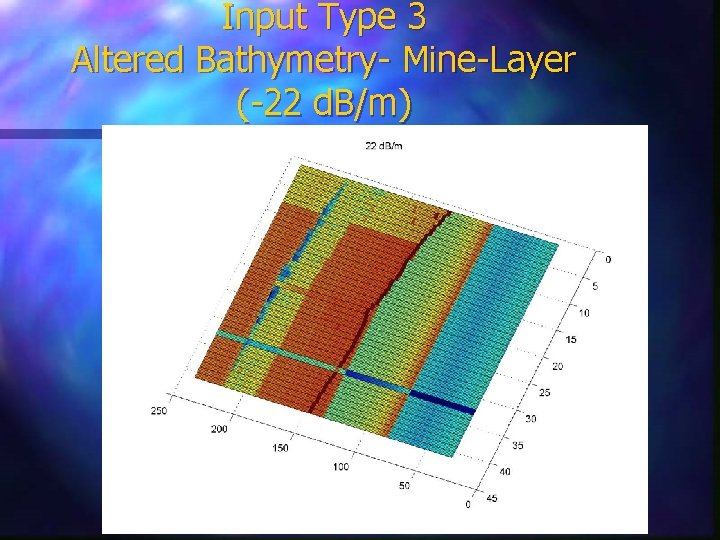
Input Type 3 Altered Bathymetry- Mine-Layer (-22 d. B/m)
Conclusions n. A side scan sonar image can be represented through reverb characteristics. n Labor intensive changing of input files. n Critical values of Volume Scattering Strength for this situation were -30 to -22 d. B/m
Where to Next? n Finer resolution and a more complex object could produce more useful results. n Field measurements of layer to limit assumptions. n Impact of layer on SVP and Volume Attenuation?
- Slides: 26