
Effects of a 6 week sling exercise training
- Slides: 1
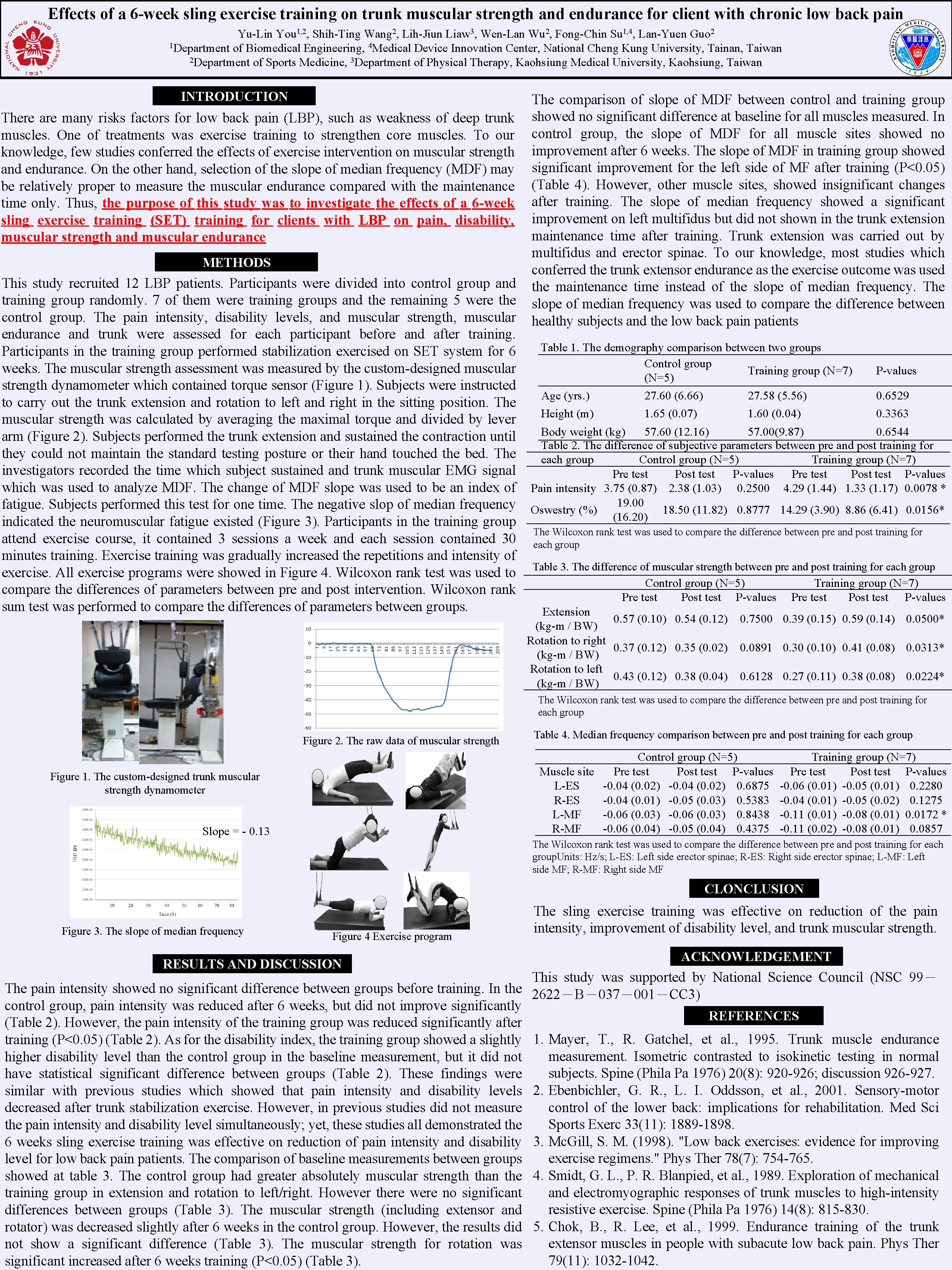
Effects of a 6 -week sling exercise training on trunk muscular strength and endurance for client with chronic low back pain Yu-Lin You 1, 2, Shih-Ting Wang 2, Lih-Jiun Liaw 3, Wen-Lan Wu 2, Fong-Chin Su 1, 4, Lan-Yuen Guo 2 1 Department of Biomedical Engineering, 4 Medical Device Innovation Center, National Cheng Kung University, Tainan, Taiwan 2 Department of Sports Medicine, 3 Department of Physical Therapy, Kaohsiung Medical University, Kaohsiung, Taiwan INTRODUCTION There are many risks factors for low back pain (LBP), such as weakness of deep trunk muscles. One of treatments was exercise training to strengthen core muscles. To our knowledge, few studies conferred the effects of exercise intervention on muscular strength and endurance. On the other hand, selection of the slope of median frequency (MDF) may be relatively proper to measure the muscular endurance compared with the maintenance time only. Thus, the purpose of this study was to investigate the effects of a 6 -week sling exercise training (SET) training for clients with LBP on pain, disability, muscular strength and muscular endurance METHODS This study recruited 12 LBP patients. Participants were divided into control group and training group randomly. 7 of them were training groups and the remaining 5 were the control group. The pain intensity, disability levels, and muscular strength, muscular endurance and trunk were assessed for each participant before and after training. Participants in the training group performed stabilization exercised on SET system for 6 weeks. The muscular strength assessment was measured by the custom-designed muscular strength dynamometer which contained torque sensor (Figure 1). Subjects were instructed to carry out the trunk extension and rotation to left and right in the sitting position. The muscular strength was calculated by averaging the maximal torque and divided by lever arm (Figure 2). Subjects performed the trunk extension and sustained the contraction until they could not maintain the standard testing posture or their hand touched the bed. The investigators recorded the time which subject sustained and trunk muscular EMG signal which was used to analyze MDF. The change of MDF slope was used to be an index of fatigue. Subjects performed this test for one time. The negative slop of median frequency indicated the neuromuscular fatigue existed (Figure 3). Participants in the training group attend exercise course, it contained 3 sessions a week and each session contained 30 minutes training. Exercise training was gradually increased the repetitions and intensity of exercise. All exercise programs were showed in Figure 4. Wilcoxon rank test was used to compare the differences of parameters between pre and post intervention. Wilcoxon rank sum test was performed to compare the differences of parameters between groups. The comparison of slope of MDF between control and training group showed no significant difference at baseline for all muscles measured. In control group, the slope of MDF for all muscle sites showed no improvement after 6 weeks. The slope of MDF in training group showed significant improvement for the left side of MF after training (P<0. 05) (Table 4). However, other muscle sites, showed insignificant changes after training. The slope of median frequency showed a significant improvement on left multifidus but did not shown in the trunk extension maintenance time after training. Trunk extension was carried out by multifidus and erector spinae. To our knowledge, most studies which conferred the trunk extensor endurance as the exercise outcome was used the maintenance time instead of the slope of median frequency. The slope of median frequency was used to compare the difference between healthy subjects and the low back pain patients Table 1. The demography comparison between two groups Control group Training group (N=7) (N=5) Age (yrs. ) 27. 60 (6. 66) 27. 58 (5. 56) P-values Height (m) 0. 3363 1. 65 (0. 07) 1. 60 (0. 04) 0. 6529 Body weight (kg) 57. 60 (12. 16) 57. 00(9. 87) 0. 6544 Table 2. The difference of subjective parameters between pre and post training for each group Control group (N=5) Training group (N=7) Pre test Post test P-values Pain intensity 3. 75 (0. 87) 2. 38 (1. 03) 0. 2500 4. 29 (1. 44) 1. 33 (1. 17) 0. 0078 * 19. 00 Oswestry (%) 18. 50 (11. 82) 0. 8777 14. 29 (3. 90) 8. 86 (6. 41) 0. 0156* (16. 20) The Wilcoxon rank test was used to compare the difference between pre and post training for each group Table 3. The difference of muscular strength between pre and post training for each group Control group (N=5) Pre test Post test P-values Extension 0. 57 (0. 10) 0. 54 (0. 12) (kg-m / BW) Rotation to right 0. 37 (0. 12) 0. 35 (0. 02) (kg-m / BW) Rotation to left 0. 43 (0. 12) 0. 38 (0. 04) (kg-m / BW) Training group (N=7) Pre test Post test P-values 0. 7500 0. 39 (0. 15) 0. 59 (0. 14) 0. 0500* 0. 0891 0. 30 (0. 10) 0. 41 (0. 08) 0. 0313* 0. 6128 0. 27 (0. 11) 0. 38 (0. 08) 0. 0224* The Wilcoxon rank test was used to compare the difference between pre and post training for each group Figure 2. The raw data of muscular strength Table 4. Median frequency comparison between pre and post training for each group Control group (N=5) Muscle site Pre test Post test P-values L-ES -0. 04 (0. 02) 0. 6875 R-ES -0. 04 (0. 01) -0. 05 (0. 03) 0. 5383 L-MF -0. 06 (0. 03) 0. 8438 R-MF -0. 06 (0. 04) -0. 05 (0. 04) 0. 4375 Figure 1. The custom-designed trunk muscular strength dynamometer Slope = - 0. 13 Training group (N=7) Pre test Post test P-values -0. 06 (0. 01) -0. 05 (0. 01) 0. 2280 -0. 04 (0. 01) -0. 05 (0. 02) 0. 1275 -0. 11 (0. 01) -0. 08 (0. 01) 0. 0172 * -0. 11 (0. 02) -0. 08 (0. 01) 0. 0857 The Wilcoxon rank test was used to compare the difference between pre and post training for each group. Units: Hz/s; L-ES: Left side erector spinae; R-ES: Right side erector spinae; L-MF: Left side MF; R-MF: Right side MF CLONCLUSION Figure 3. The slope of median frequency Figure 4 Exercise program RESULTS AND DISCUSSION The sling exercise training was effective on reduction of the pain intensity, improvement of disability level, and trunk muscular strength. ACKNOWLEDGEMENT This study was supported by National Science Council (NSC 99- The pain intensity showed no significant difference between groups before training. In the 2622-B-037-001-CC 3) control group, pain intensity was reduced after 6 weeks, but did not improve significantly REFERENCES (Table 2). However, the pain intensity of the training group was reduced significantly after training (P<0. 05) (Table 2). As for the disability index, the training group showed a slightly 1. Mayer, T. , R. Gatchel, et al. , 1995. Trunk muscle endurance measurement. Isometric contrasted to isokinetic testing in normal higher disability level than the control group in the baseline measurement, but it did not subjects. Spine (Phila Pa 1976) 20(8): 920 -926; discussion 926 -927. have statistical significant difference between groups (Table 2). These findings were similar with previous studies which showed that pain intensity and disability levels 2. Ebenbichler, G. R. , L. I. Oddsson, et al. , 2001. Sensory-motor control of the lower back: implications for rehabilitation. Med Sci decreased after trunk stabilization exercise. However, in previous studies did not measure Sports Exerc 33(11): 1889 -1898. the pain intensity and disability level simultaneously; yet, these studies all demonstrated the 6 weeks sling exercise training was effective on reduction of pain intensity and disability 3. Mc. Gill, S. M. (1998). "Low back exercises: evidence for improving exercise regimens. " Phys Ther 78(7): 754 -765. level for low back pain patients. The comparison of baseline measurements between groups showed at table 3. The control group had greater absolutely muscular strength than the 4. Smidt, G. L. , P. R. Blanpied, et al. , 1989. Exploration of mechanical and electromyographic responses of trunk muscles to high-intensity training group in extension and rotation to left/right. However there were no significant resistive exercise. Spine (Phila Pa 1976) 14(8): 815 -830. differences between groups (Table 3). The muscular strength (including extensor and rotator) was decreased slightly after 6 weeks in the control group. However, the results did 5. Chok, B. , R. Lee, et al. , 1999. Endurance training of the trunk extensor muscles in people with subacute low back pain. Phys Ther not show a significant difference (Table 3). The muscular strength for rotation was 79(11): 1032 -1042. significant increased after 6 weeks training (P<0. 05) (Table 3).