
Effects Effects in Music All music that is
- Slides: 27
Effects
Effects in Music All music that is recorded or amplified relies on effects to enhance certain characteristics of the sound. n Guitarists typically have an array of footactivated effect units in front of them. n These effects are the result of filter combinations. n
Combining Filters n There are two ways to combine filters: – – Parallel Cascade
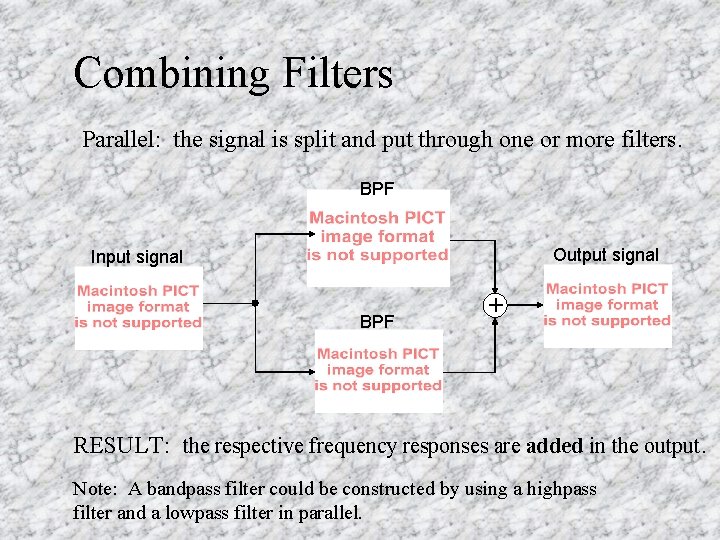
Combining Filters Parallel: the signal is split and put through one or more filters. BPF Output signal Input signal BPF + RESULT: the respective frequency responses are added in the output. Note: A bandpass filter could be constructed by using a highpass filter and a lowpass filter in parallel.
Combining Filters Cascade: the signal is sent through a succession of filters. Input signal BPF Output signal RESULT: the respective frequency responses are multiplied in the output.
Delays n The most basic type of effect is simple delay. – – – Delay > 50 ms: audible echoes Delay < 10 ms: coloration, filtering Between, enhancement, increase in volume
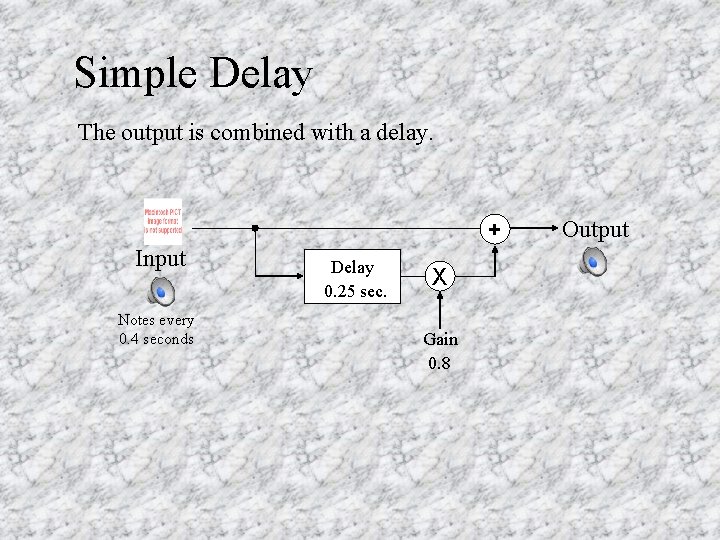
Simple Delay The output is combined with a delay. + Input Notes every 0. 4 seconds Delay 0. 25 sec. X Gain 0. 8 Output
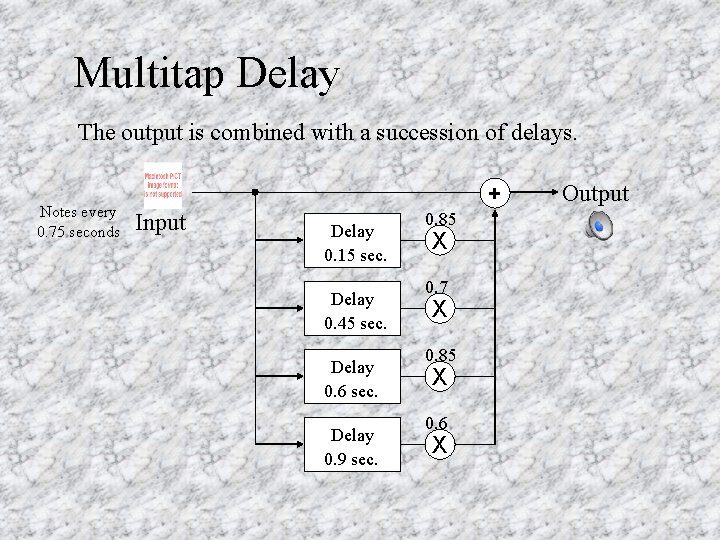
Multitap Delay This is an analogy to plumbing: Picture water flowing through a pipe We can take water from different points along the pipe by inserting taps along its length.
Multitap Delay The output is combined with a succession of delays. Notes every 0. 75 seconds + Input Delay 0. 15 sec. Delay 0. 45 sec. Delay 0. 6 sec. Delay 0. 9 sec. 0. 85 X 0. 7 X 0. 85 X 0. 6 X Output
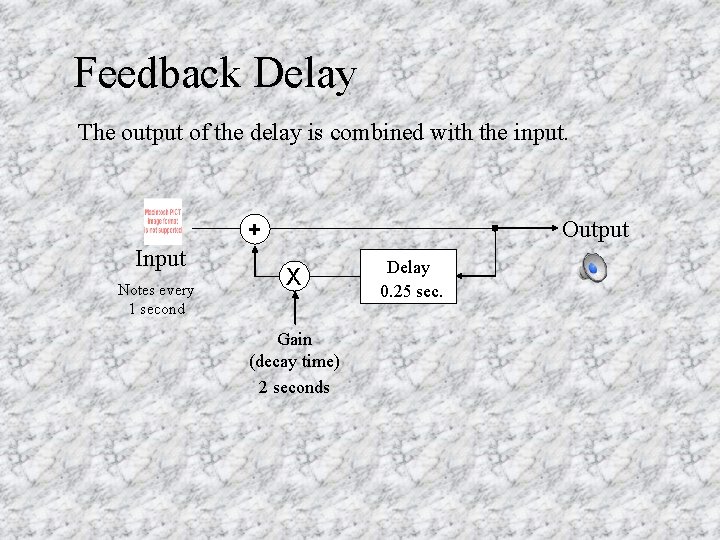
Feedback Delay The output of the delay is combined with the input. Output + Input Notes every 1 second X Gain (decay time) 2 seconds Delay 0. 25 sec.
Delays n Shorter delays lead to two filter types: – – Comb filter Allpass filter
Comb Filter Current sample combined with a delayed sample. Produces a series of spectral peaks and nulls, resembling a comb. The position of the peaks and nulls correspond to the sampling rate (SR) divided by the delay (D).
Feedforward Comb Filter (aka inverted comb filter) Produces peaks at n. SR/D Hz Produces nulls at (2 n - 1)SR/2 D Hz Example: SR = 44100 Hz D = 21 samples SR/D = 2100 Hz The longer the delay, the greater the number of peaks and nulls Positive sum produces peaks at harmonics of SR/D } From 0 Hz to the Nyquist frequency Dry Delay: 15 ms
Feedback Comb Filter Produces peaks at n. SR/D Hz Produces nulls at (2 n - 1)SR/2 D Hz } From 0 Hz to the Nyquist frequency The shape of the spectrum is inverted, producing a ringing at SR/D Hz; the ringing depends on the coefficient b. Example: SR = 44100 Hz D = 21 samples SR/D = 2100 Hz The longer the delay, the greater the number of peaks and nulls Positive sum produces peaks at harmonics of SR/D Dry Delay of 15 ms
Comb Filtering Comb filtering can appear unintentionally, leading to undesirable coloration, if reflections are accidentally mixed with a signal. This is an averaged spectrum of the audio sample. The white line shows the portion without comb filtering, and the red line shows the portion with the comb filtering.
Allpass Filter Combination of feedforward and feedback combs. Steady state passes all frequencies equally, but alters phases. This description might lead to the misunderstanding that an allpass filter has no audible effect. The non-uniform phase response of an allpass filter means that its transient response will alter the phases of the sound’s attack spectrum. Since the attack is the definitive portion of a sound, an allpass filter can audibly color its input signal: there is a ringing at the frequency 1/(delay time), where the delay time is D/SR seconds. In contrast to the delays discussed earlier, allpass filters produce a delay that is frequency-dependent. Frequency-dependent delay is sometimes called dispersion. Dry Allpass filtered
Flange The signal is combined with a feedback comb filter having a short delay time — 1 to 10 ms. The delay time oscillates. Result is a comb filter with oscillating teeth, expanding and compressing. Characterized by a pronounced “whooshing. ”
Chorus Also combines input with an oscillating delay, like a flanger, but: It is typically not a feedback delay. The delay time is longer, typically 20 -30 ms. Due to the longer delay time, the result is not comb filtering, but rather a simulation of human singers, who can never sound at exactly the same time, and thus have a “group” sound. Chorus units often use a multitap delay, with control over the time and gain of each delay.
Phase Shift Another delay effect with modulating delay times, producing “holes” in the spectrum. A generalized example of flanging. Phase shifters use a series (cascade) of allpass filters. The result is gentler than flanging, without the “whoosh. ” Dry signal Phase shifted
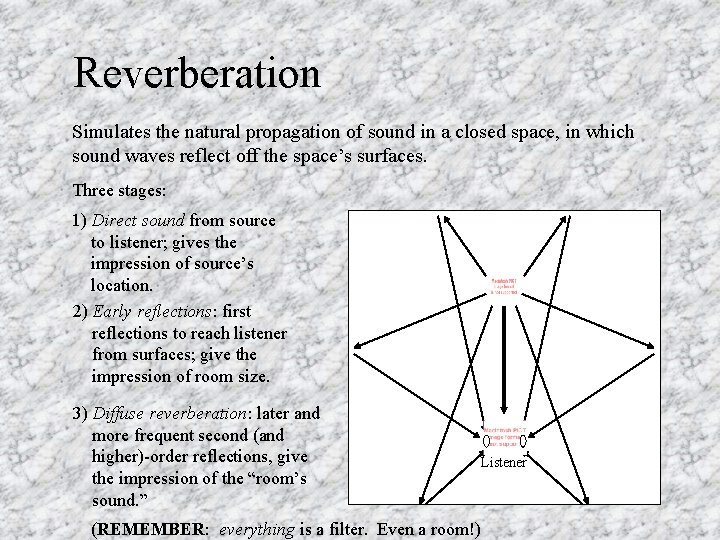
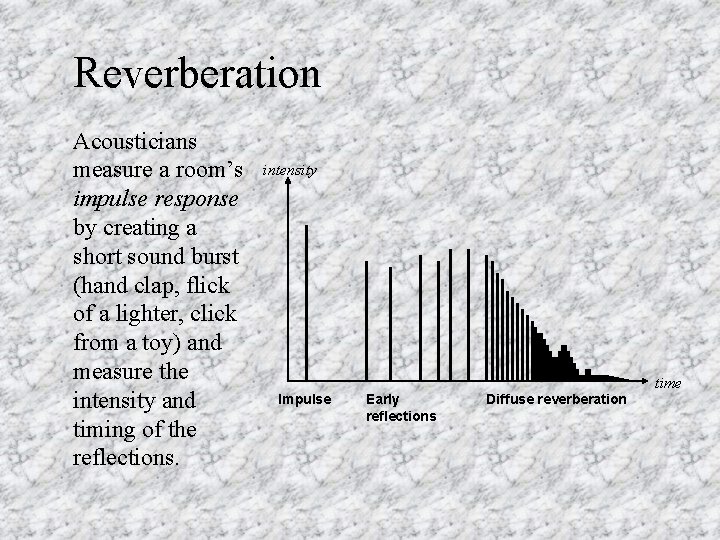
Reverberation Simulates the natural propagation of sound in a closed space, in which sound waves reflect off the space’s surfaces. Three stages: 1) Direct sound from source to listener; gives the impression of source’s location. 2) Early reflections: first reflections to reach listener from surfaces; give the impression of room size. 3) Diffuse reverberation: later and more frequent second (and higher)-order reflections, give the impression of the “room’s sound. ” (REMEMBER: everything is a filter. Even a room!) Listener
Reverberation Acousticians measure a room’s impulse response by creating a short sound burst (hand clap, flick of a lighter, click from a toy) and measure the intensity and timing of the reflections. intensity time Impulse Early reflections Diffuse reverberation
Reverberation As reverberation is an essential component of natural sounds, it is considered an essential effect in recorded and amplified sounds. Analog recordings had three main methods of simulating reverberation. There was not a great deal of control over the reverb parameters, and each had its own distinctive, artificial color. However, many digital reverberators now have settings to imitate these vintage effects. (They simulate the early simulations!)
Analog Reverberation Reverb chamber Audio is played into a highly reflective room; the signal from this room is mixed with the original signal.
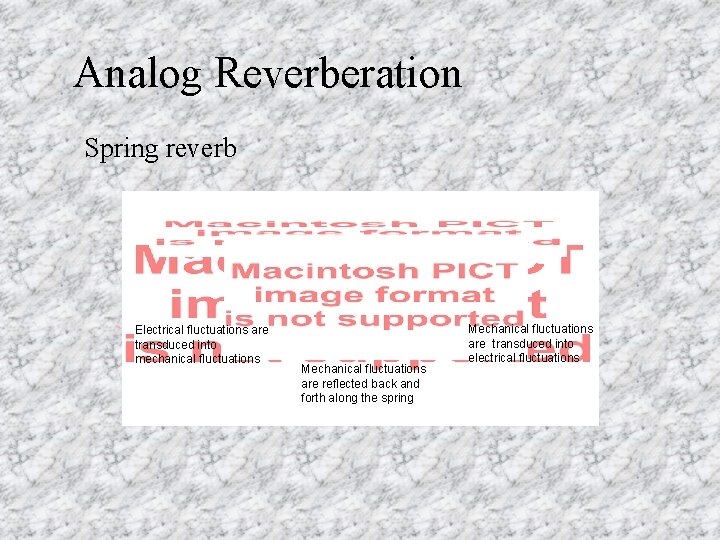
Analog Reverberation Spring reverb Electrical fluctuations are transduced into mechanical fluctuations Mechanical fluctuations are reflected back and forth along the spring Mechanical fluctuations are transduced into electrical fluctuations
Analog Reverberation Plate reverb Transducer converts signal into mechanical vibrations that spread onto a metal plate Transducers on the plate convert the vibrations into a signal that is mixed with the original
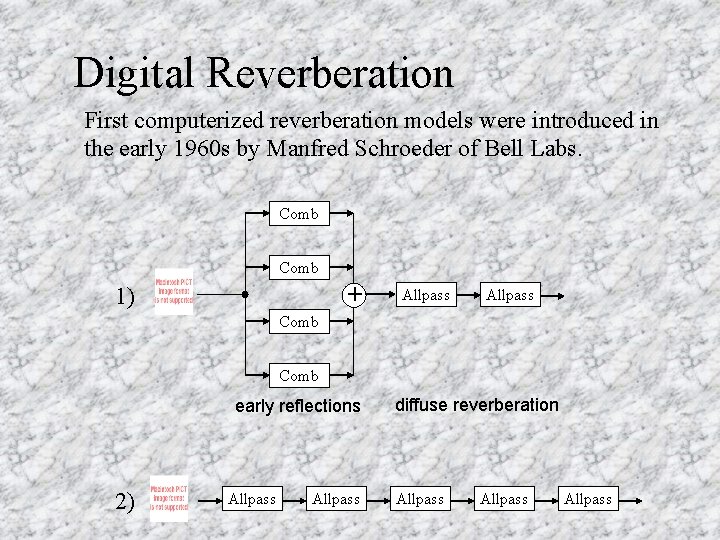
Digital Reverberation First computerized reverberation models were introduced in the early 1960 s by Manfred Schroeder of Bell Labs. Comb + 1) Allpass Comb early reflections 2) Allpass diffuse reverberation Allpass
Digital Reverberation Parallel comb filters and cascaded allpass filters are still considered fundamental building blocks of reverberation algorithms. Companies invest considerable resources into reverberation and other effects products; the precise algorithms they use tend to be highly confidential.