
Effectiveness of Mannitol vs Hypertonic Saline for Intracranial
- Slides: 20
Effectiveness of Mannitol vs Hypertonic Saline for Intracranial Hypertension from Traumatic Brain Injury Capstone Project, MPAS 218 Spring 2020 Jennifer Saephanh 3/26/2020
Disclaimer I, Jennifer Saephanh, have no conflicts of interest or disclosures. Advising was provided by Dr. Rahnea Sunseri and Molly Rentscher.
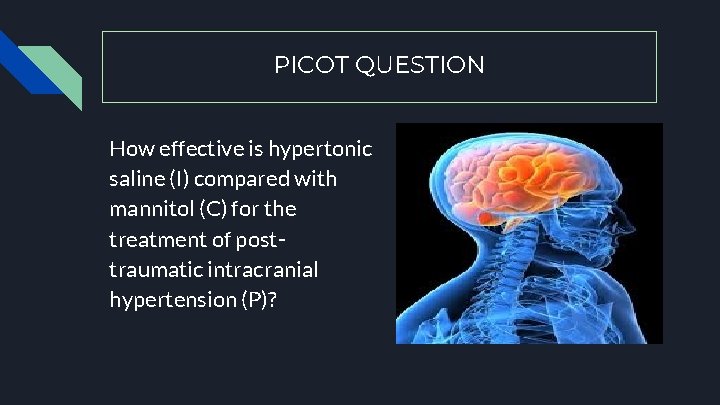
PICOT QUESTION How effective is hypertonic saline (I) compared with mannitol (C) for the treatment of posttraumatic intracranial hypertension (P)?
Key Issues ● Traumatic brain injury (TBI) is one of the leading causes of death and disability ● Identify current management of elevated intracranial pressure (ICP) ● Identify findings from current literature ● Explain factors that preclude definite recommendations of hypertonic saline over mannitol ● Implications for the future
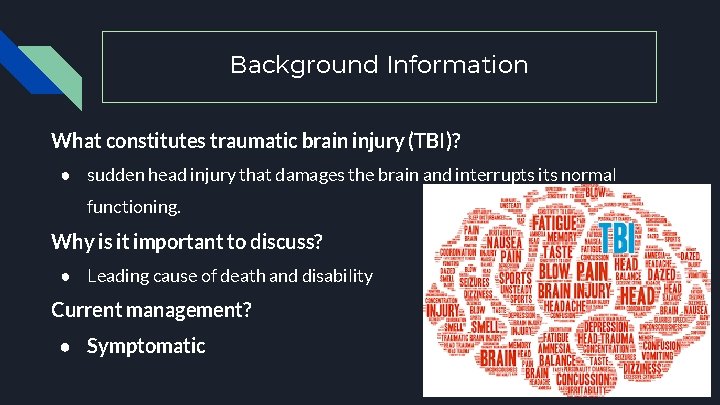
Background Information What constitutes traumatic brain injury (TBI)? ● sudden head injury that damages the brain and interrupts its normal functioning. Why is it important to discuss? ● Leading cause of death and disability Current management? ● Symptomatic
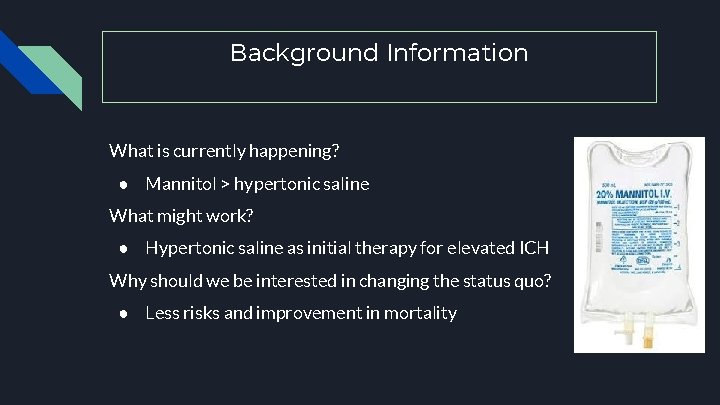
Background Information What is currently happening? ● Mannitol > hypertonic saline What might work? ● Hypertonic saline as initial therapy for elevated ICH Why should we be interested in changing the status quo? ● Less risks and improvement in mortality
Examining the Evidence The available medical literature ● Several studies address this issue ● Most found similar efficacy between both therapies ● Scarce resources on RCT
What does the literature say-part 1 a? -Studies showed both hypertonic saline and mannitol were equally effective ● In a systematic review article by Boone et al. , seven studies including five prospective, randomized trials; one nonrandomized, prospective trial; and one retrospective cohort study all found that both osmolar therapies were effective in reducing ICP ● In a parallel, randomized, control trial by Francony et al. , a total of 20 patients with ICP > 20 mm. Hg received an equimolar dose of 20% MNT or 7. 45% HTS, both were found to be equally effective for reducing ICP in patients with brain injury.
What does the literature say-part 1 b? -Strengths ● Highlighted positive effects of hyperosmolar therapy ○ Mannitol provided better brain circulation ○ Hypertonic saline provided faster resolution of intracranial pressure -Weaknesses ● Highlighted negative effects of hyperosmolar therapy ○ HTS caused elevations of serum sodium and chloride, both adverse effects -Limitations ● No additional factors beside intracranial pressure were considered
What does the literature say-part 2 a? -Evidence of superiority of one agent compared to the other ● ● ● Prospective, randomized, controlled pilot study by Battison et al. evaluated nine patients with ICH -->HTS provided ⇡reduction in ICP and longer duration of effect than MNT Observational study by Shein et al. , 16 children < 18 years old with severe TBI, GCS score < 8 showed most rapid resolution of ICH with HTS compared to other interventions Prospective randomized study by Vialet et al. , participants with refractory post-traumatic ICH were treated with increasing osmotic loads of HTS; failure rate was lower with HTS In RCT, mannitol was compared to otherapies and was found to increased the likelihood of death. In a retrospective study by Dunham et al. beneficial outcomes of larger amounts of 3% saline were associated with complex TBI groups
What does the literature say-part 2 b? Strengths ● Studies point to superiority of hypertonic saline over mannitol Weaknesses ● Long term outcomes were not considered ● Low quality evidence -Limitations ● Small sample sizes ● lack of generalizability
Evidence Summary ● Both hypertonic saline and mannitol are effective in management of ICP ● Those treated with hypertonic saline experience faster resolution of ICP ● Evidence points to hypertonic saline as the better option for management of intracranial pressure but evidence was of poor quality
General conclusion 1 - Hypertonic saline is slowly establishing as the initial treatment for elevated ICP 2 - Hypertonic saline is found to cause elevations in serum sodium and serum chloride thus it may be reserved for patients with hypovolemia or hyponatremia 3 - Mannitol has beneficial effects on brain circulation and may used for patients with cerebral hypoperfusion
Implications for Practice ● Indeterminate in selecting one over the other ● Set parameters for which agent would better in different clinical situations.
Knowledge gaps ● What if there additional/better osmolar therapies to consider? ● What about additional adverse effects affecting morbidity and mortality? ● Will patients with elevated intracranial pressure benefit? ● Will patients be harmed when looking at long term outcomes? ● Are randomized control trials possible with larger sample sizes?
Next steps Future research should include ● Larger, randomized control trials ● Short term/ long term clinical follow up ● Different types of solutions, administration methods, dosage ● Mortality reports
Take-Home points ● Lacking reliable evidence precludes definite recommendations for the use of HTS over MNT. ● HTS may be preferred in patients who are hypovolemic or hyponatremic.
References ● ● ● TBI: Get the facts | concussion | traumatic brain injury | CDC injury center. https: //www. cdc. gov/traumaticbraininjury/get_the_facts. html. Updated 2019. Accessed Nov 21, 2019. Edward R Smith, MD, Sepideh Amin-Hanjani, MD, Michael J Aminoff, MD, DSc, Janet L Wilterdink, MD. Evaluation and management of elevated intracranial pressure in adults. https: //www-uptodate. com. pacificpa. idm. oclc. org/contents/ evaluation-and-management-of-elevated-intracranial-pressure-inadults? search=intracranial%20 hypertension&source=search_result&selected. Title=1~150&usage_type=default&display_rank=1#H 2. Accessed November 16, 2019. Venkatakrishna Rajajee, MBBS, Michael J Aminoff, MD, DSc, Maria E Moreira, MD, Alejandro A Rabinstein, MD, Janet L Wilterdink, MD. Management of acute severe traumatic brain injury. https: //www. uptodate. com. pacificpa. idm. oclc. org/ contents/management-of-acute-severetraumatic-brain injury? search=acute%20 management %20 of%20 severe%20 tbi&source=search_result&selected. Title=2~150&usage_type=default&display_rank=2#H 544422138 Website. Accessed November 16, 2019. Boone MD, Oren-Grinberg A, Robinson TM, Chen CC, Kasper EM. Mannitol or hypertonic saline in the setting of traumatic brain injury: What have we learned? Surgical neurology international. 2015; 6(1): 177. https: //www. ncbi. nlm. nih. gov/pubmed/26673517. doi: 10. 4103/21527806. 170248. Francony G, Fauvage B, Falcon D, et al. Equimolar doses of mannitol and hypertonic saline in the treatment of increased intracranial pressure*. Critical Care Medicine. 2008; 36(3): 795. https: //journals. lww. com/ccmjournal/Abstract/2008/03000/Equimolar_doses_of_mannitol_and_hypertonic_saline. 19. aspx. Accessed Aug 13, 2019. doi: 10. 1097/CCM. 0 B 013 E 3181643 B 41.
References ● ● ● Battison C. Randomized, controlled trial on the effect of a 20% mannitol solution and a 7. 5% saline/6% dextran solution on increased intracranial pressure after brain injury. Critical care medicine. 2005; 33(1). insights. ovid. com. Accessed Dec 23, 2019. Shein SL, Ferguson NM, Kochanek PM, et al. Effectiveness of pharmacological therapies for intracranial hypertension in children with severe traumatic brain injury – results from an automated data collection system time-synched to drug administration. Pediatr Crit Care Med. 2016; 17(3): 236 -245. https: //www. ncbi. nlm. nih. gov/pmc/articles/PMC 4779724/. Accessed Dec 23, 2019. doi: 10. 1097/PCC. 0000000610. Vialet R, Albanèse J, Thomachot L, et al. Isovolume hypertonic solutes (sodium chloride or mannitol) in the treatment of refractory posttraumatic intracranial hypertension: 2 m. L/kg 7. 5% saline is more effective than 2 m. L/kg 20% mannitol. Critical Care Medicine. 2003; 31(6): 1683 -1687. http: //ovidsp. ovid. com/ovidweb. cgi? T=JS&NEWS=n&CSC=Y&PAGE=fulltext&D=ovft&AN=00003246 -200306000 -00012. doi: 10. 1097/01. CCM. 0000063268. 91710. DF. Wakai A, Mc. Cabe A, Roberts I, Schierhout G. Mannitol for acute traumatic brain injury. Cochrane Database of Systematic Reviews. 2013(8). https: //www. cochranelibrary. com/cdsr/doi/10. 1002/14651858. CD 001049. pub 5/full. Accessed Dec 23, 2019. doi: 10. 1002/14651858. CD 001049. pub 5. Dunham CM, Malik RJ, Huang GS, Kohli CM, Brocker BP, Ugokwe KT. Hypertonic saline administration and complex traumatic brain injury outcomes: A retrospective study. International journal of burns and trauma. 2018; 8(3): 40 -53. https: //www. ncbi. nlm. nih. gov/pubmed/30042863.
Thank you