
Effectiveness of Irradiation in Controlling Pathogenic and Spoilage

- Slides: 32
Effectiveness of Irradiation in Controlling Pathogenic and Spoilage Microorganisms in Meats Catherine N. Cutter Department of Food Science Pennsylvania State University
Overview Effect of irradiation on pathogenic and spoilage microorganisms w Effect of irradiation on shelf life of fresh meats w Types of irradiated meat products w Future research needs w
Effect of irradiation on pathogenic and spoilage microorganisms Biological effects of irradiation on microorganisms w Factors affecting irradiation effectiveness against microorganisms w Radiation resistance w
Biological effects of irradiation on microorganisms w Irradiation can directly impair critical cell functions or components (DNA) • Single strand breaks (repairable in most cases) • Double strand breaks (not repairable in most cases)
Biological effects of irradiation on microorganisms w Irradiation can indirectly form radiolytic products/free radicals from water (o. H, o. OH) • o. OH radicals are responsible for 90% of DNA damage
Effect of irradiation on pathogenic and spoilage microorganisms Biological effects of irradiation on microorganisms w Factors affecting irradiation effectiveness against microorganisms w Radiation resistance w
Factors affecting irradiation effectiveness against microorganisms w Growth phase: • Some microorganisms (L. monocytogenes) are more susceptible to irradiation at low doses when irradiated during the logarithmic phase of growth then during the stationary phase
Factors affecting irradiation effectiveness against microorganisms w Type of food • The more complex the food, the greater the competition of the food for the energy and less for the microorganisms • Fat content of ground beef does not change the dose needed to eliminate E. coli O 157: H 7 • C. jejuni was more resistant to irradiation in low fat frozen beef
Factors affecting irradiation effectiveness against microorganisms w Moisture content • The lower the water activity in a food, the less free radicals produced by water--> less DNA damage to microorganisms • Low water activity will reduce the ability of radiation resistant organisms to recover during storage
Factors affecting irradiation effectiveness against microorganisms w Temperature of food • Higher temperatures enhance the lethal effect of irradiation • Microorganism repair mechanisms are impaired at the higher temperatures • Freezing immobilizes and prevents diffusion of free radicals to microorganisms
Factors affecting irradiation effectiveness against microorganisms w Presence of oxygen • Higher oxygen concentration = greater lethal effect of radiation on microorganisms • Anaerobic conditions = less lethal effect of radiation on microorganisms • Storage conditions can enhance recovery of some microorganisms after irradiation
Effect of irradiation on pathogenic and spoilage microorganisms Biological effects of irradiation on microorganisms w Factors affecting irradiation effectiveness against microorganisms w Radiation resistance w
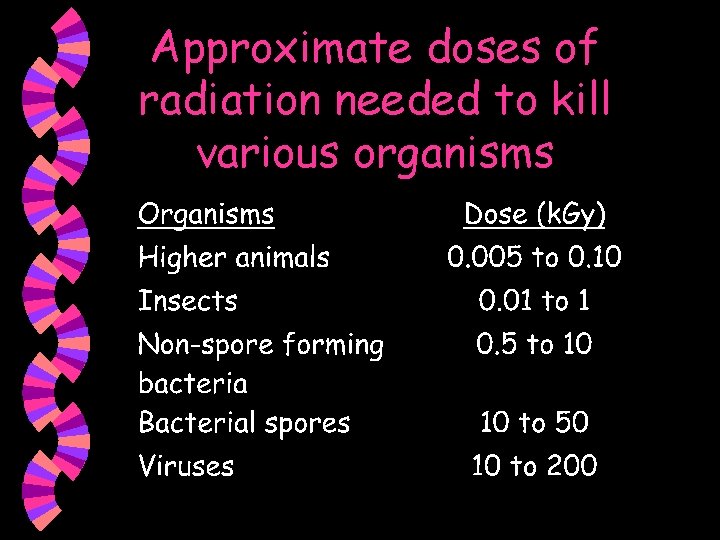
Approximate doses of radiation needed to kill various organisms
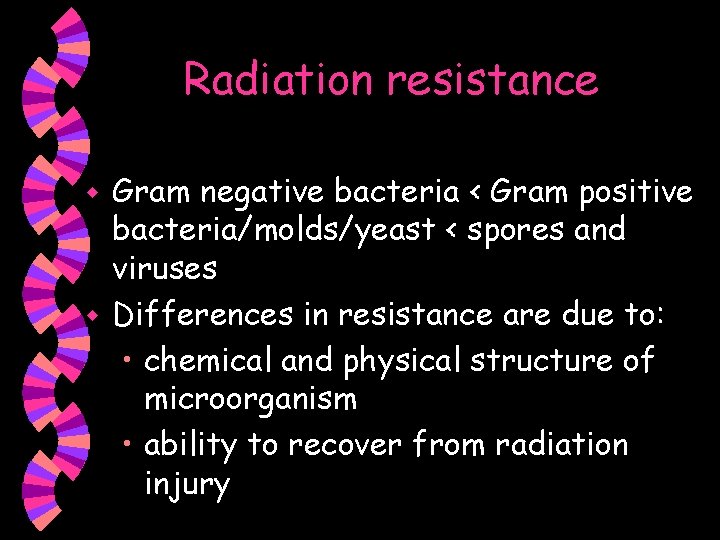
Radiation resistance Gram negative bacteria < Gram positive bacteria/molds/yeast < spores and viruses w Differences in resistance are due to: • chemical and physical structure of microorganism • ability to recover from radiation injury w
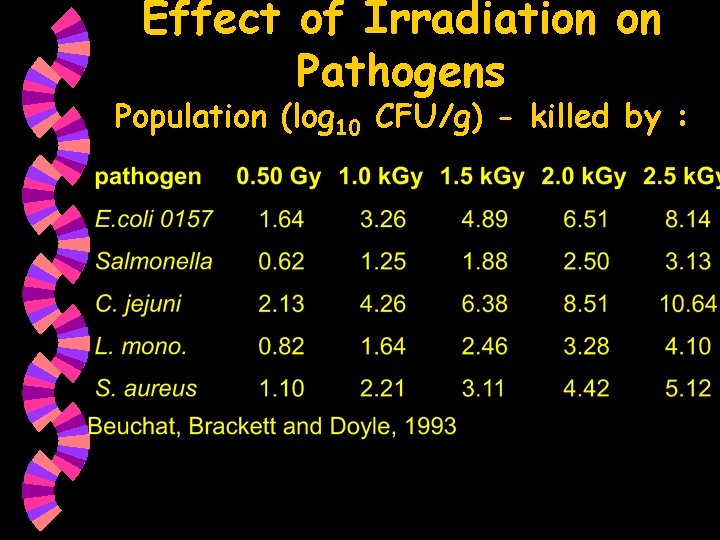
Effect of Irradiation on Pathogens Population (log 10 CFU/g) - killed by :
Radiation resistance Deinococcus radiodurans is highly resistant to irradiation w Acid resistant E. coli O 157: H 7 exhibit radiation resistance w Of pathogens tested in ground beef, jejuni has lowest resistance to irradiation; Salmonella spp. has the highest resistance w
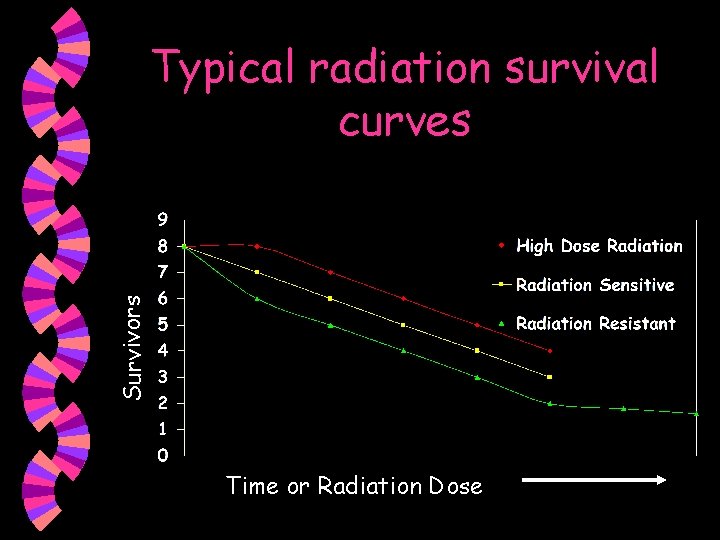
Survivors Typical radiation survival curves Time or Radiation Dose
Radurization Irradiation applied to elicit a substantial reduction in number of spoilage organisms, thereby extending the shelf life of a food 3 -4 times w Applied at dosage of 0. 5 -10 k. Gy w 5 k. Gy will eliminate most spoilage organisms w
Radicidation Irradiation is applied to reduce the number of non-spore forming pathogenic microorganisms (other than viruses) and parasites w Applied at dosage of 3. 0 -10 k. Gy w Improves the hygienic quality of the food w Reduces the risk of public exposure to pathogens w
Radappertization w Irradiation is applied to prepackaged, enzyme-inactivated foods to reduce the number and/or activity of microorganisms (12 -D reduction in C. botulinum spores) w Applied at dosage of 25 -60 k. Gy In the absence of post-processing contamination, no microbial spoilage or toxicity should occur w Shelf stable without refrigeration w
Overview Effect of irradiation on pathogenic and spoilage microorganisms w Effect of irradiation on shelf life of fresh meats w Types of irradiated meat products w Future research needs w
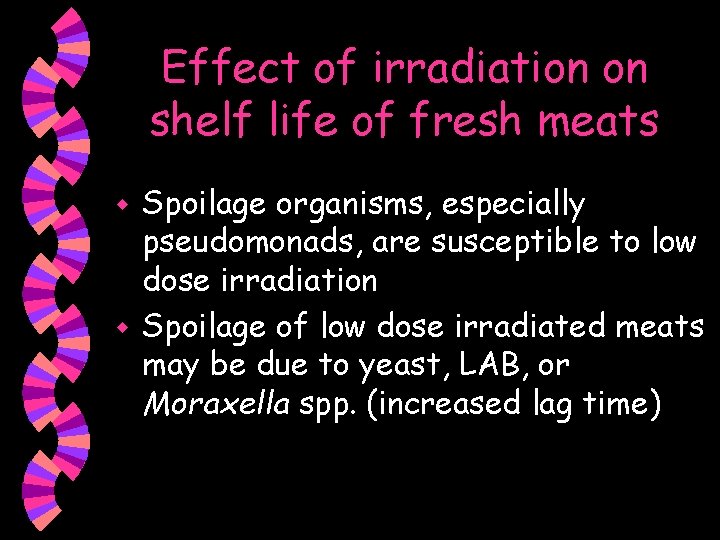
Effect of irradiation on shelf life of fresh meats Spoilage organisms, especially pseudomonads, are susceptible to low dose irradiation w Spoilage of low dose irradiated meats may be due to yeast, LAB, or Moraxella spp. (increased lag time) w
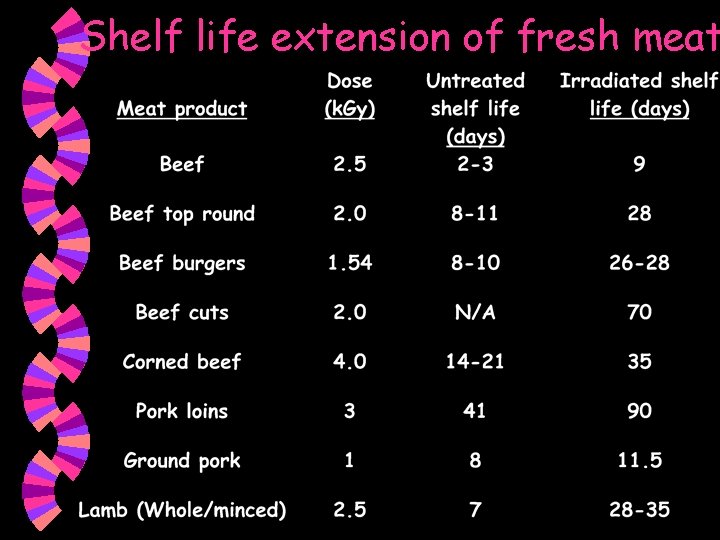
Shelf life extension of fresh meat
Overview Effect of irradiation on pathogenic and spoilage microorganisms w Effect of irradiation on shelf life of fresh meats w Types of irradiated meat products w Future research needs w
Types of meat products approved for irradiation w Refrigerated or frozen, uncooked meat or meat byproducts w Meat from cattle, sheep, swine, or goats, which is skeletal or which is found in the tongue, diaphragm, heart, or esophagus, with or without the accompanying and overlying fat. (It does not include the muscle found in the lips, snout, or ears. )
Types of meat products approved for irradiation w Mechanically deboned meat w Intact or ground meat w Hamburger w Certain defatted beef or pork products
Overview Effect of irradiation on pathogenic and spoilage microorganisms w Effect of irradiation on shelf life of fresh meats w Types of irradiated meat products w Future research needs w
Future research needs Determination of processes (heat, antimicrobials, curing agents, etc. ) that may affect radiation resistance of pathogens in fresh meats w The effect of multi-hurdle approach with irradiation to enhance pathogen reduction or improve shelf life in fresh meats w
Future research needs Determining effects of irradiation on different cooked meat products to inhibit organisms such as LM w Determining effects of atmospheres and packaging regimens on pathogens associated with cooked and fresh meats subjected to low dose irradiation w
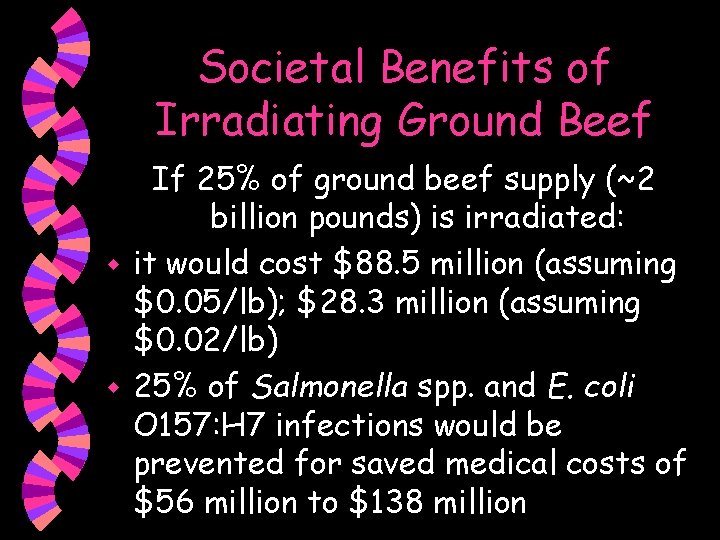
Societal Benefits of Irradiating Ground Beef If 25% of ground beef supply (~2 billion pounds) is irradiated: w it would cost $88. 5 million (assuming $0. 05/lb); $28. 3 million (assuming $0. 02/lb) w 25% of Salmonella spp. and E. coli O 157: H 7 infections would be prevented for saved medical costs of $56 million to $138 million
QUESTIONS?