
Effectively Treating Stereotypy Review of the Current Research




- Slides: 38
Effectively Treating Stereotypy Review of the Current Research Justin Daigle, MA, BCBA, LBA, Clinical Director
WHAT IS STEREOTYPY?
DEFINITION Lewis and Bodfish (1998) defined as: “repetitive and apparently purposeless body movements (e. g. , body rocking), body parts movement (e. g. , hand flapping, head rolling) or use of the body to generate object movement (e. g. , plate spinning, string twirling) Underline added by presenter for emphasis Lewis, M. H. , & Bodfish, J. W. (1998). Repetitive behavior disorders in autism. Mental Retardation and Developmental Disabilities, 80 -89.
DSM - V Autism Spectrum Disorder (299. 00) 1) Persistent deficits in social communication 2) Restricted, repetitive patterns of behavior, interest, or activities American Psychiatric Association. (2013). Diagnostic and statistical manual of mental disorders (5 th ed. ). Washington, DC.
NOT JUST AUTISM • Stereotypy can be found in various other diagnosis outside of Autism. • Found in animals and neuro-typical individuals. • One of the key diagnostic requirements for Autism. Goldman, S. , Wang, C. , Salgado, M. W. , Greene, P. E. , Kim, M. , & Rapin, I. (2008). Motor stereotypies in children with autism and other developmental disorders. Developmental Medicine and Child Neurology, 30 -38.
COMMON EXAMPLES Hand flapping Body rocking Inflexibility Closely followed routines or patterns Prolonged fascination Odd verbalizations
STEREOTYPY Singer (2009) discussed that the definition is too broad, all-inclusive, and not accurate to the complexity of these behaviors. Singer, H. (2009). Motor Stereotypies. Seminars in Pediatric Neurology, 16: 77 -81.
STEREOTYPY This broad definition may be why very little is understood about causality. Singer, H. (2009). Motor Stereotypies. Seminars in Pediatric Neurology, 16: 77 -81.
CURRENT BEHAVIORAL THEORY OF STEREOTYPY Koegel, RL & Covert, A. (1972). The relationship of self-stimulation to learning in autistic children. Journal of Applied Behavior Analysis, 5, 381 -387. Lovaas, OI, Newsom, C. , & Hickman C. (1987). Self-stimulatory behavior and perceptual reinforcement. Journal of Applied Behavior Analysis, 20, 45 -68. Rapp, JT and Vollmer, TR (2005). Stereotypy I: A review of behavioral assessment and treatment. Research in Developmental Disabilities, 26, 527 -547. Rogers, SJ & Ozonoff, S. (2005). Annotation: What do we know about sensory dysfunction in autism? A critical review of the empirical evidence. Journal of Child Psychology and Psychiatry. 46, 1255 -1268.
STEREOTYPY IS NOT… Tics “OCD”-like behaviors “Stimming” (Self-Stimulatory)
FUNCTION
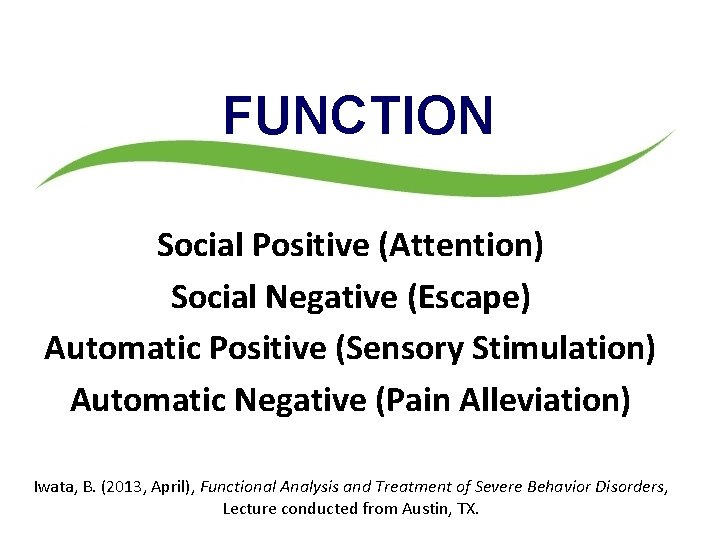
FUNCTION Social Positive (Attention) Social Negative (Escape) Automatic Positive (Sensory Stimulation) Automatic Negative (Pain Alleviation) Iwata, B. (2013, April), Functional Analysis and Treatment of Severe Behavior Disorders, Lecture conducted from Austin, TX.
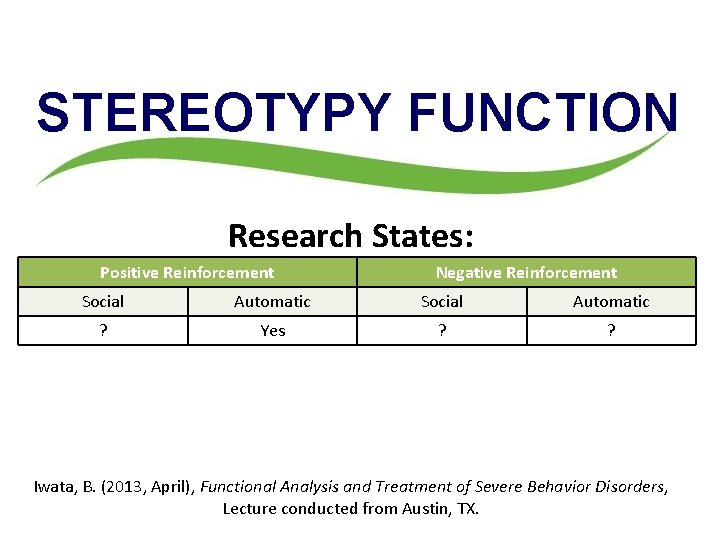
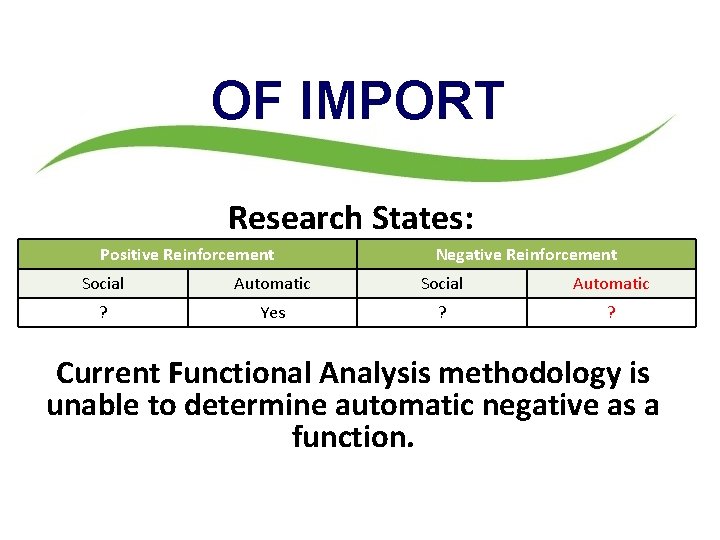
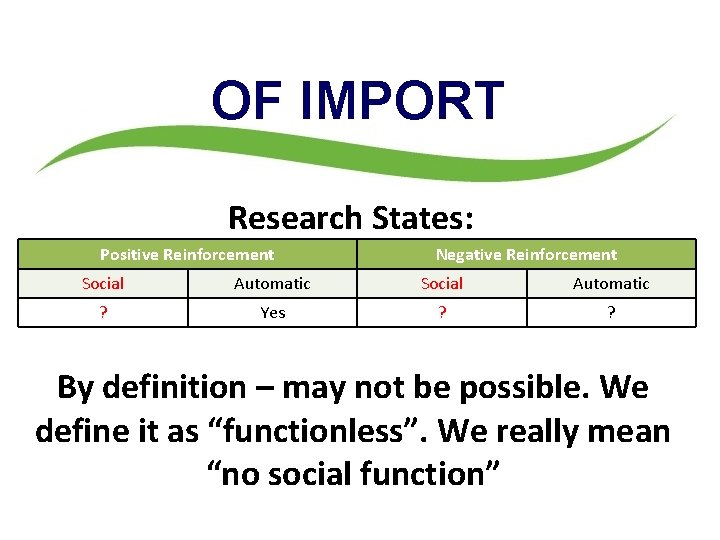
STEREOTYPY FUNCTION Research States: Positive Reinforcement Negative Reinforcement Social Automatic ? Yes ? ? Iwata, B. (2013, April), Functional Analysis and Treatment of Severe Behavior Disorders, Lecture conducted from Austin, TX.
IN PRACTICE There seems to be indications of stereotypy being maintained by social functions; however, few conclusive studies have been published to support this.
OF IMPORT Research States: Positive Reinforcement Negative Reinforcement Social Automatic ? Yes ? ? Current Functional Analysis methodology is unable to determine automatic negative as a function.
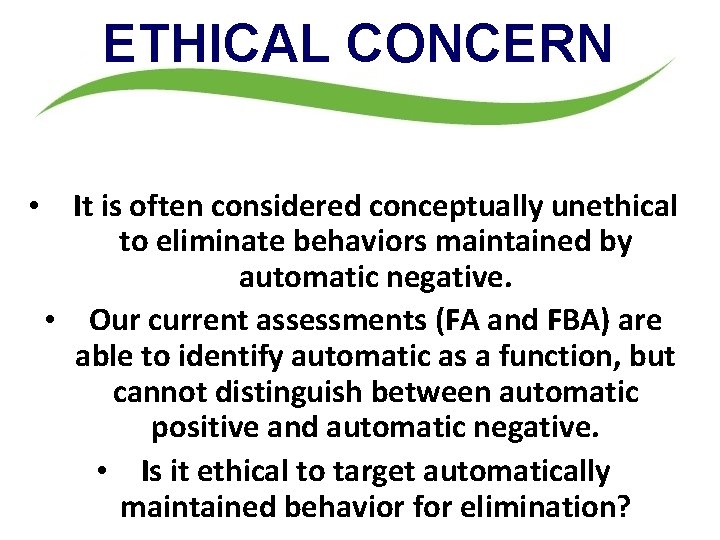
ETHICAL CONCERN • It is often considered conceptually unethical to eliminate behaviors maintained by automatic negative. • Our current assessments (FA and FBA) are able to identify automatic as a function, but cannot distinguish between automatic positive and automatic negative. • Is it ethical to target automatically maintained behavior for elimination?
OF IMPORT Research States: Positive Reinforcement Negative Reinforcement Social Automatic ? Yes ? ? By definition – may not be possible. We define it as “functionless”. We really mean “no social function”
TREATMENT
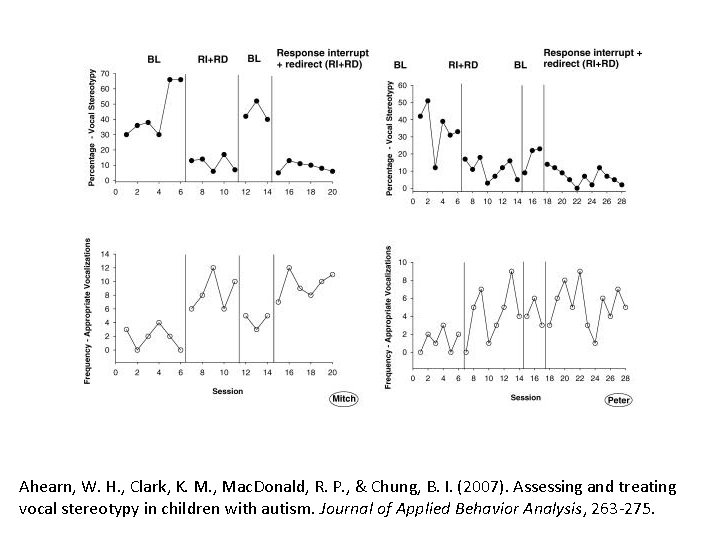
RESPONSE INTERRUPTION AND REDIRECTION Ahearn (2007) published the first article about this commonly used intervention. Subsequent articles have been published improving methodology. Ahearn, W. H. , Clark, K. M. , Mac. Donald, R. P. , & Chung, B. I. (2007). Assessing and treating vocal stereotypy in children with autism. Journal of Applied Behavior Analysis, 263 -275.
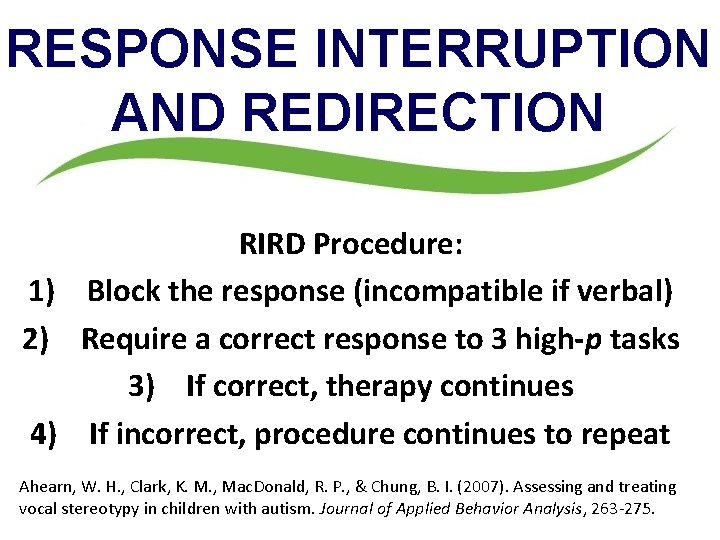
RESPONSE INTERRUPTION AND REDIRECTION RIRD Procedure: 1) Block the response (incompatible if verbal) 2) Require a correct response to 3 high-p tasks 3) If correct, therapy continues 4) If incorrect, procedure continues to repeat Ahearn, W. H. , Clark, K. M. , Mac. Donald, R. P. , & Chung, B. I. (2007). Assessing and treating vocal stereotypy in children with autism. Journal of Applied Behavior Analysis, 263 -275.
Ahearn, W. H. , Clark, K. M. , Mac. Donald, R. P. , & Chung, B. I. (2007). Assessing and treating vocal stereotypy in children with autism. Journal of Applied Behavior Analysis, 263 -275.
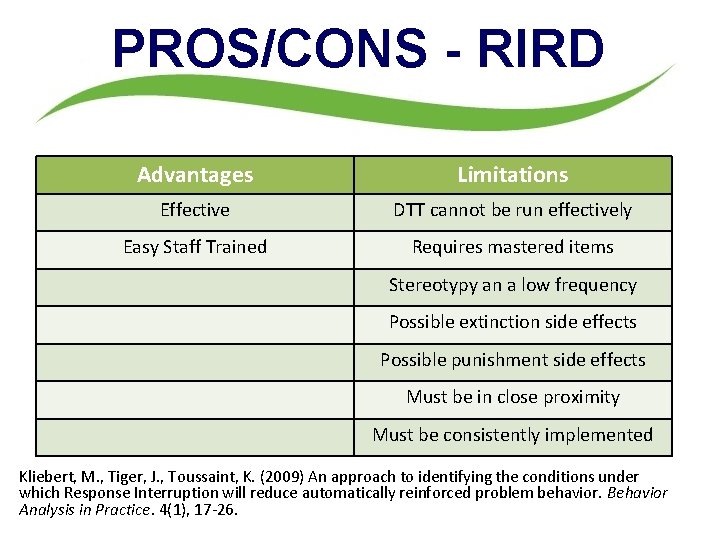
PROS/CONS - RIRD Advantages Limitations Effective DTT cannot be run effectively Easy Staff Trained Requires mastered items Stereotypy an a low frequency Possible extinction side effects Possible punishment side effects Must be in close proximity Must be consistently implemented Kliebert, M. , Tiger, J. , Toussaint, K. (2009) An approach to identifying the conditions under which Response Interruption will reduce automatically reinforced problem behavior. Behavior Analysis in Practice. 4(1), 17 -26.
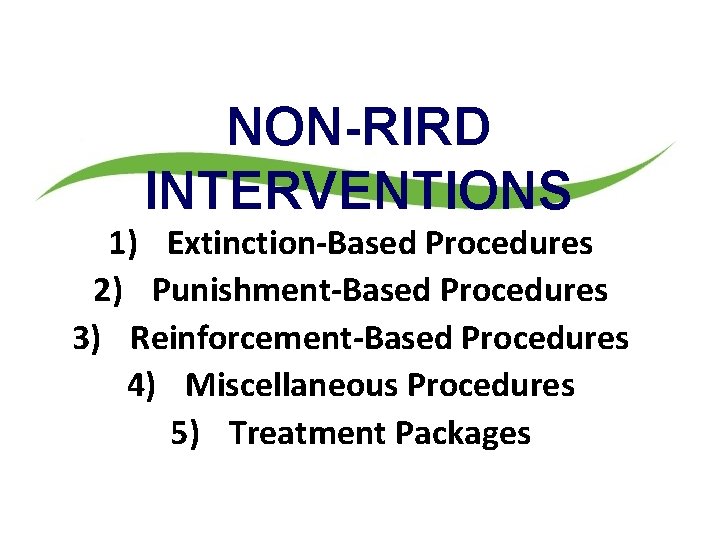
NON-RIRD INTERVENTIONS 1) Extinction-Based Procedures 2) Punishment-Based Procedures 3) Reinforcement-Based Procedures 4) Miscellaneous Procedures 5) Treatment Packages
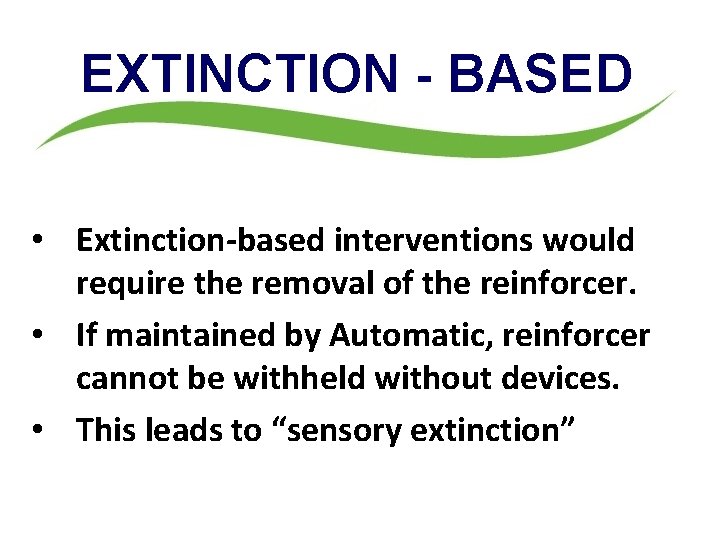
EXTINCTION - BASED • Extinction-based interventions would require the removal of the reinforcer. • If maintained by Automatic, reinforcer cannot be withheld without devices. • This leads to “sensory extinction”
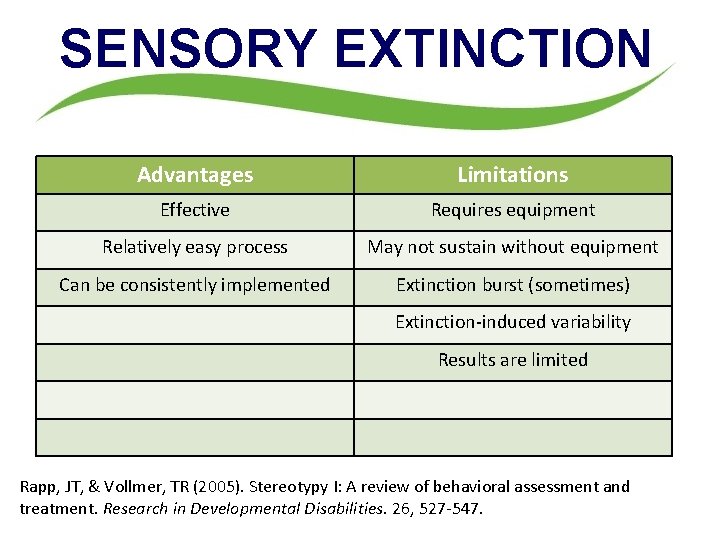
SENSORY EXTINCTION Advantages Limitations Effective Requires equipment Relatively easy process May not sustain without equipment Can be consistently implemented Extinction burst (sometimes) Extinction-induced variability Results are limited Rapp, JT, & Vollmer, TR (2005). Stereotypy I: A review of behavioral assessment and treatment. Research in Developmental Disabilities. 26, 527 -547.
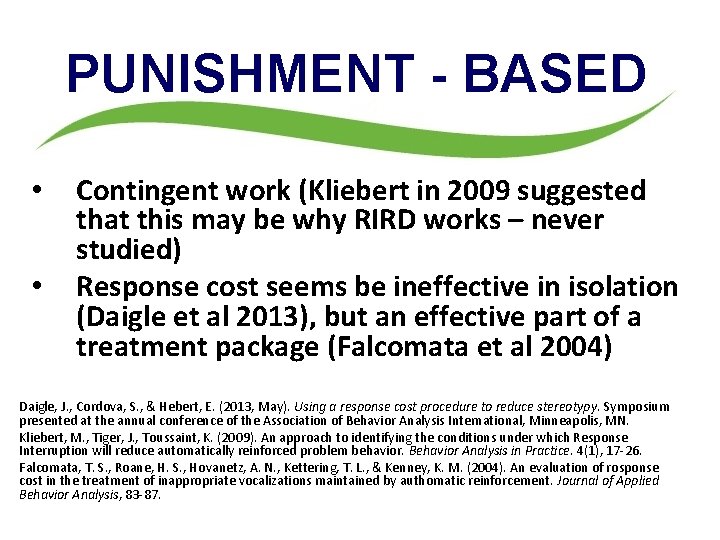
PUNISHMENT - BASED • • Contingent work (Kliebert in 2009 suggested that this may be why RIRD works – never studied) Response cost seems be ineffective in isolation (Daigle et al 2013), but an effective part of a treatment package (Falcomata et al 2004) Daigle, J. , Cordova, S. , & Hebert, E. (2013, May). Using a response cost procedure to reduce stereotypy. Symposium presented at the annual conference of the Association of Behavior Analysis International, Minneapolis, MN. Kliebert, M. , Tiger, J. , Toussaint, K. (2009). An approach to identifying the conditions under which Response Interruption will reduce automatically reinforced problem behavior. Behavior Analysis in Practice. 4(1), 17 -26. Falcomata, T. S. , Roane, H. S. , Hovanetz, A. N. , Kettering, T. L. , & Kenney, K. M. (2004). An evaluation of rosponse cost in the treatment of inappropriate vocalizations maintained by authomatic reinforcement. Journal of Applied Behavior Analysis, 83 -87.
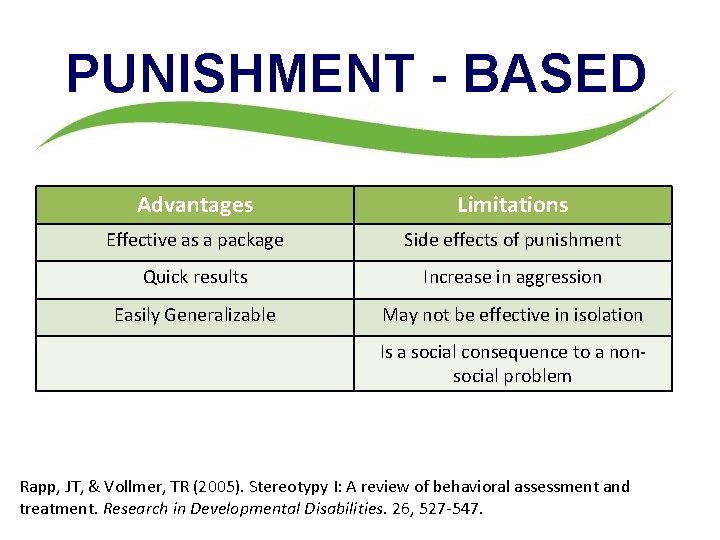
PUNISHMENT - BASED Advantages Limitations Effective as a package Side effects of punishment Quick results Increase in aggression Easily Generalizable May not be effective in isolation Is a social consequence to a nonsocial problem Rapp, JT, & Vollmer, TR (2005). Stereotypy I: A review of behavioral assessment and treatment. Research in Developmental Disabilities. 26, 527 -547.
REINFORCEMENT- BASED • Non-Contingent Reinforcement (NCR) is commonly used and very effective. (Rapp & Vollmer 2005; Carroll & Kodak 2014) Carroll, R. A. & Kodak, T. (2014). An evaluation of interrupted and uninterrupted measurement of vocal stereotypy on perceived treatment outcomes. Journal of Applied Behavior Analysis, 47, 264 -276. Rapp, JT, & Vollmer, TR (2005). Stereotypy I: A review of behavioral assessment and treatment. Research in Developmental Disabilities. 26, 527 -547.
Carroll, R. A. & Kodak, T. (2014). An evaluation of interrupted and uninterrupted measurement of vocal stereotypy on perceived treatment outcomes. Journal of Applied Behavior Analysis, 47, 264 -276.
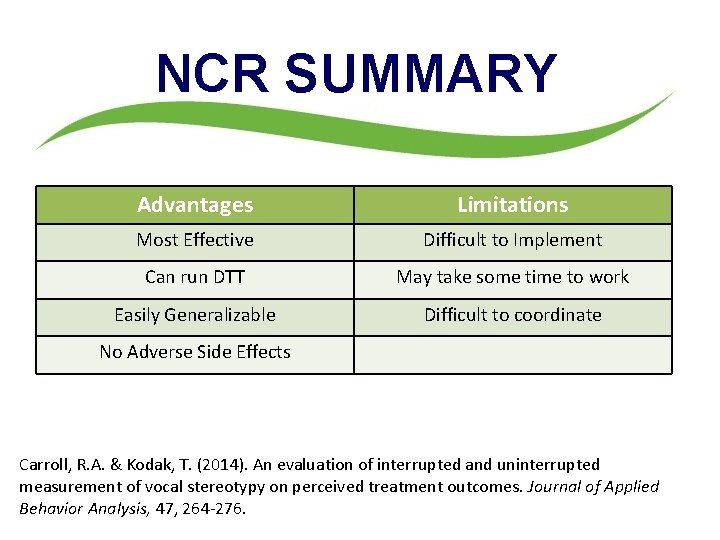
NCR SUMMARY Advantages Limitations Most Effective Difficult to Implement Can run DTT May take some time to work Easily Generalizable Difficult to coordinate No Adverse Side Effects Carroll, R. A. & Kodak, T. (2014). An evaluation of interrupted and uninterrupted measurement of vocal stereotypy on perceived treatment outcomes. Journal of Applied Behavior Analysis, 47, 264 -276.
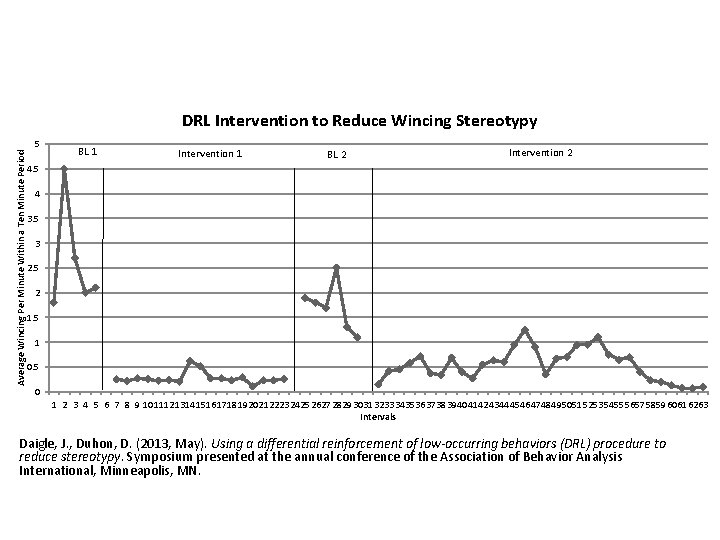
REINFORCEMENT- BASED • DRO and DRL Procedures have been shown to be effective. (Daigle & Duhon, 2013; Singh et al. 1981; Wacker et al. 1990) Daigle, J. , Duhon, D. (2013, May). Using a differential reinforcement of low-occurring behaviors (DRL) procedure to reduce stereotypy. Symposium presented at the annual conference of the Association of Behavior Analysis International, Minneapolis, MN. Singh, N. N. , Dawson, M. J. , & Manning, P. (1981). Effects of spaced responding ERL on the stereotyped behavior of profoundly retarded persons. Journal of Applied Behavior Analysis, 14, 521 -526 Wacker, D. P. , Steege, M. W. , Northup, J. , Sasso, G. , Berg, W. , Reimers, T. , et al. (1990). A component analysis of functional communication training across three topographies of severe problematic behavior. Journal of Applied Behavior Analysis, 23, 417 -429.
Average Wincing Per Minute Within a Ten Minute Period DRL Intervention to Reduce Wincing Stereotypy 5 BL 1 Intervention 1 BL 2 Intervention 2 4. 5 4 3. 5 3 2. 5 2 1. 5 1 0. 5 0 1 2 3 4 5 6 7 8 9 101112131415161718192021222324252627282930313233343536373839404142434445464748495051525354555657585960616263 Intervals Daigle, J. , Duhon, D. (2013, May). Using a differential reinforcement of low-occurring behaviors (DRL) procedure to reduce stereotypy. Symposium presented at the annual conference of the Association of Behavior Analysis International, Minneapolis, MN.
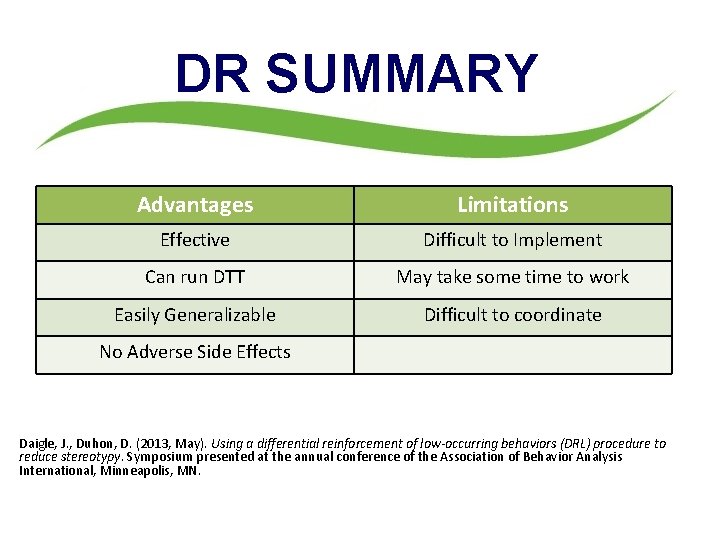
DR SUMMARY Advantages Limitations Effective Difficult to Implement Can run DTT May take some time to work Easily Generalizable Difficult to coordinate No Adverse Side Effects Daigle, J. , Duhon, D. (2013, May). Using a differential reinforcement of low-occurring behaviors (DRL) procedure to reduce stereotypy. Symposium presented at the annual conference of the Association of Behavior Analysis International, Minneapolis, MN.
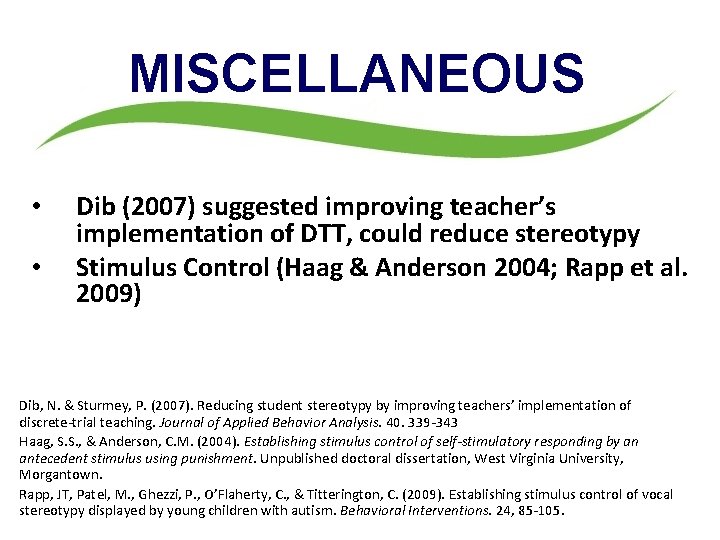
MISCELLANEOUS • • Dib (2007) suggested improving teacher’s implementation of DTT, could reduce stereotypy Stimulus Control (Haag & Anderson 2004; Rapp et al. 2009) Dib, N. & Sturmey, P. (2007). Reducing student stereotypy by improving teachers’ implementation of discrete-trial teaching. Journal of Applied Behavior Analysis. 40. 339 -343 Haag, S. S. , & Anderson, C. M. (2004). Establishing stimulus control of self-stimulatory responding by an antecedent stimulus using punishment. Unpublished doctoral dissertation, West Virginia University, Morgantown. Rapp, JT, Patel, M. , Ghezzi, P. , O’Flaherty, C. , & Titterington, C. (2009). Establishing stimulus control of vocal stereotypy displayed by young children with autism. Behavioral Interventions. 24, 85 -105.
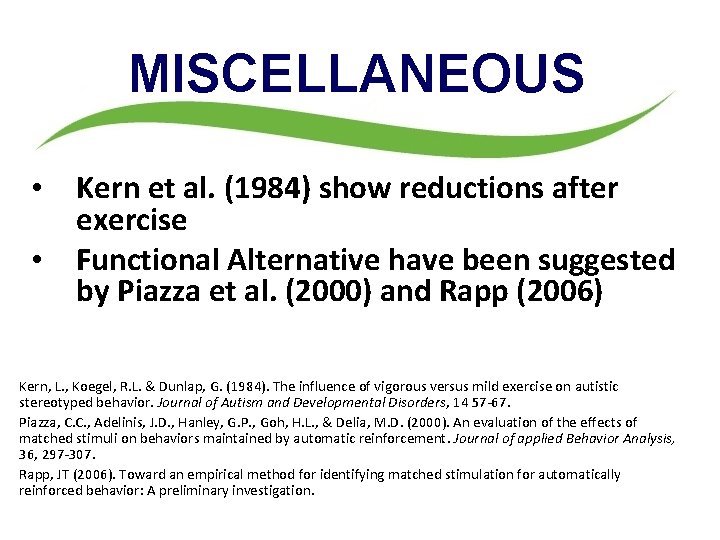
MISCELLANEOUS • Kern et al. (1984) show reductions after exercise • Functional Alternative have been suggested by Piazza et al. (2000) and Rapp (2006) Kern, L. , Koegel, R. L. & Dunlap, G. (1984). The influence of vigorous versus mild exercise on autistic stereotyped behavior. Journal of Autism and Developmental Disorders, 14 57 -67. Piazza, C. C. , Adelinis, J. D. , Hanley, G. P. , Goh, H. L. , & Delia, M. D. (2000). An evaluation of the effects of matched stimuli on behaviors maintained by automatic reinforcement. Journal of applied Behavior Analysis, 36, 297 -307. Rapp, JT (2006). Toward an empirical method for identifying matched stimulation for automatically reinforced behavior: A preliminary investigation.
TREATMENT PACKAGES • NCR, Contingent Demand, and Response Cost (Athens et al 2005) • NCR and Response Cost (Falcomata et al 2004) Athens, E. , Vollmer, T. , Sloman, K. , St. Peter Pipkin, C. (2008). An analysis of vocal stereotypy and therapist fading. Journal of Applied Behavior Analysis. 41, 291 -297. Falcomata, T. S. , Roane, H. S. , Hovanetz, A. N. , Kettering, T. L. , & Kenney, K. M. (2004). An evaluation of response cost in the treatment of inappropriate vocalizations maintained by automatic reinforcement. Journal of Applied Behavior Analysis, 83 -87.
SUMMATION • We do not have a full understanding of the causes of stereotypy. • Providers frequently provide treatment without a full understanding of invention alternatives. • Researchers are needed to increase the body of literature within this area.
CONTACT Justin@TCAcadiana. com www. justindaigle. weebly. com