
Effective Work Groups and Teams Understanding and Managing


- Slides: 31
Effective Work Groups and Teams Understanding and Managing Organizational Behavior Chapter 11 Sixth Edition Jennifer M. George & Gareth R. Jones Copyright © 2012 Pearson Education, Inc. Publishing as Prentice Hall 11 -1
Learning Objectives Describe the sources of process losses and gains and understand how they affect group or team potential performance Understand how social loafing can occur in groups and the steps that can be taken to prevent it Differentiate among three forms of task interdependence and discuss the team performance implications associated with them Copyright © 2012 Pearson Education, Inc. Publishing as Prentice Hall 11 -2
Learning Objectives Understand the ways in which a group’s cohesiveness affects its performance and explain which level of cohesiveness results in the highest team performance Describe the nature of four important kinds of groups in organizations and how and why they help an organization achieve its goals Copyright © 2012 Pearson Education, Inc. Publishing as Prentice Hall 11 -3
How Nokia Uses Teams to Increase Global Effectiveness How can teams help increase performance? • Teams are encouraged to be innovative. • Employees that are most knowledgeable are given opportunity to make decisionsregardless of position. • Good communication, mutual respect, and high regard for team members Copyright © 2012 Pearson Education, Inc. Publishing as Prentice Hall 4
Group Performance What’s hurting group performance? Microsoft’s team approach was effective Performance evaluation emphasizing individual performance hindered team effectiveness Copyright © 2012 Pearson Education, Inc. Publishing as Prentice Hall 11 -5
Potential Performance Potential performance is the highest level of group performance possible; it reflects the work group’s capabilities Copyright © 2012 Pearson Education, Inc. Publishing as Prentice Hall 11 -6
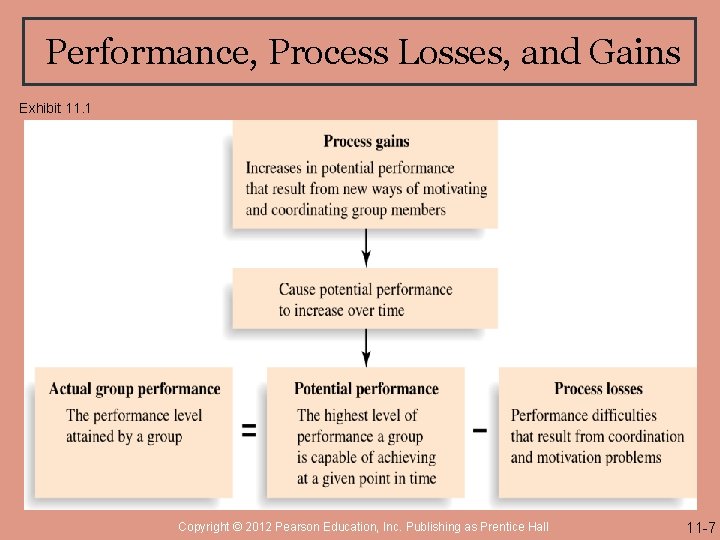
Performance, Process Losses, and Gains Exhibit 11. 1 Copyright © 2012 Pearson Education, Inc. Publishing as Prentice Hall 11 -7
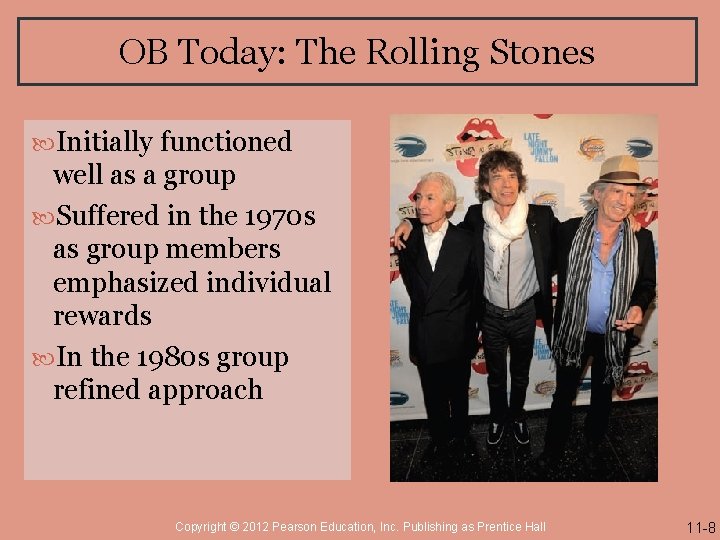
OB Today: The Rolling Stones Initially functioned well as a group Suffered in the 1970 s as group members emphasized individual rewards In the 1980 s group refined approach Copyright © 2012 Pearson Education, Inc. Publishing as Prentice Hall 11 -8
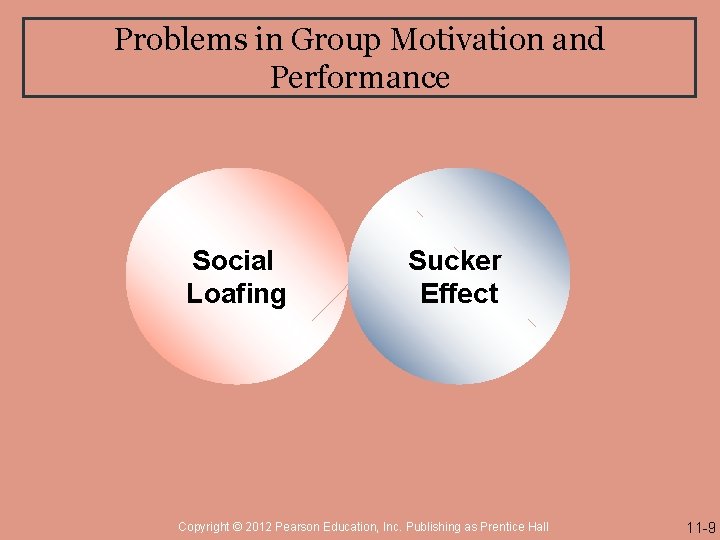
Problems in Group Motivation and Performance Social Loafing Sucker Effect Copyright © 2012 Pearson Education, Inc. Publishing as Prentice Hall 11 -9
Causes of Social Loafing • Lack of connection between inputs and outcomes • Perception that individual efforts are unnecessary or unimportant • Large group size Copyright © 2012 Pearson Education, Inc. Publishing as Prentice Hall 11 -10
Reducing Social Loafing • Make individual contributions identifiable • Make individuals feel that they are making valuable contributions to a group • Remind employees why they were initially chosen for the team • Keep the group as small as possible Copyright © 2012 Pearson Education, Inc. Publishing as Prentice Hall 11 -11
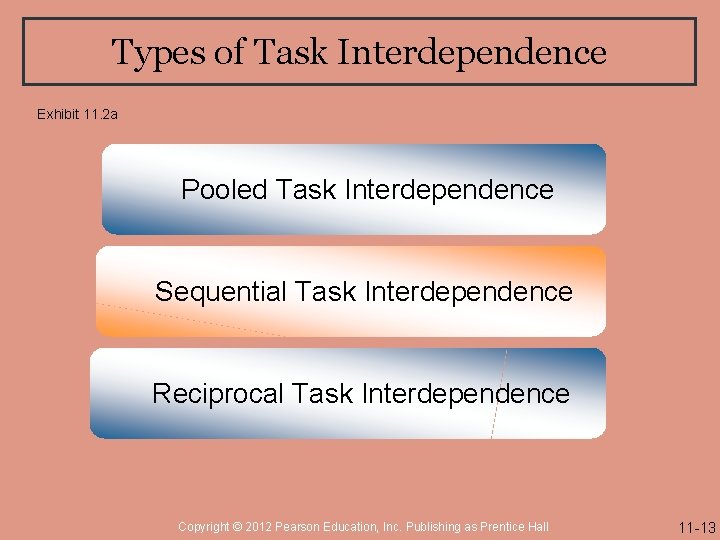
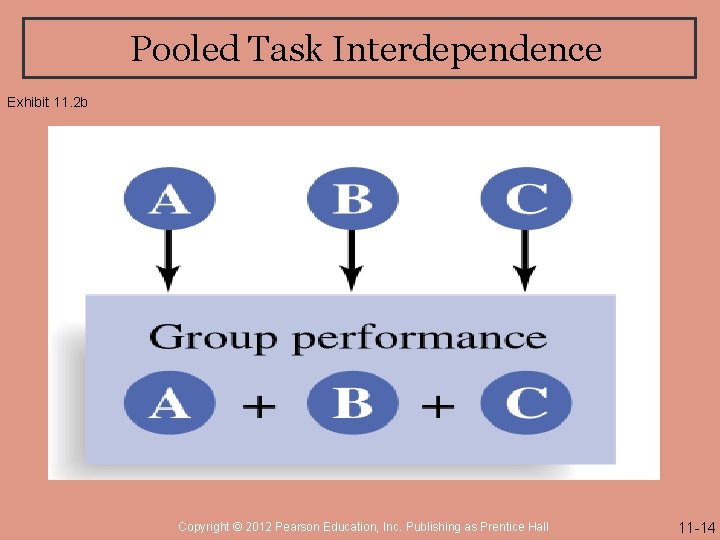
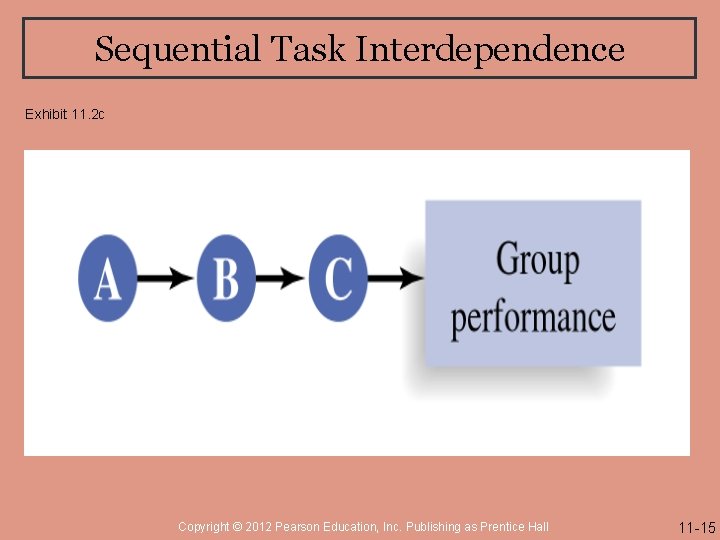
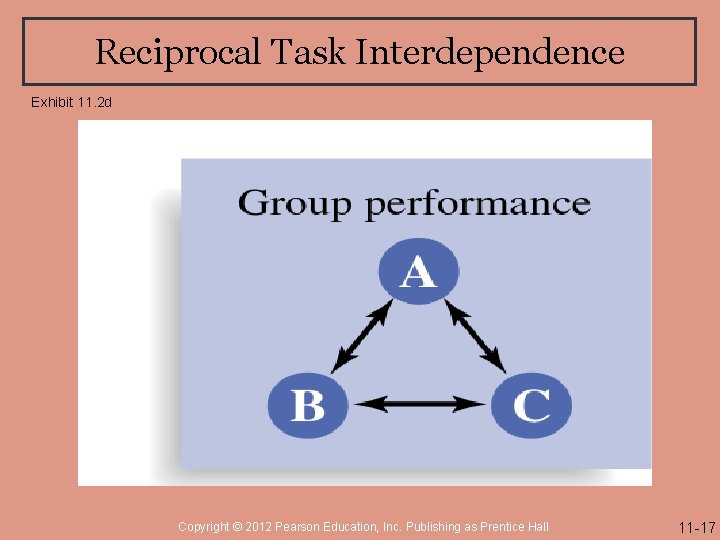
Task Interdependence Task interdependence is the extent to which the work performed by one member affects what other group members do As task interdependence increases, the degree and intensity of the interactions among group members who are required to perform the tasks also increases Copyright © 2012 Pearson Education, Inc. Publishing as Prentice Hall 11 -12
Types of Task Interdependence Exhibit 11. 2 a Pooled Task Interdependence Sequential Task Interdependence Reciprocal Task Interdependence Copyright © 2012 Pearson Education, Inc. Publishing as Prentice Hall 11 -13
Pooled Task Interdependence Exhibit 11. 2 b Copyright © 2012 Pearson Education, Inc. Publishing as Prentice Hall 11 -14
Sequential Task Interdependence Exhibit 11. 2 c Copyright © 2012 Pearson Education, Inc. Publishing as Prentice Hall 11 -15
Sequential Task Interdependence Copyright © 2012 Pearson Education, Inc. Publishing as Prentice Hall 11 -16
Reciprocal Task Interdependence Exhibit 11. 2 d Copyright © 2012 Pearson Education, Inc. Publishing as Prentice Hall 11 -17
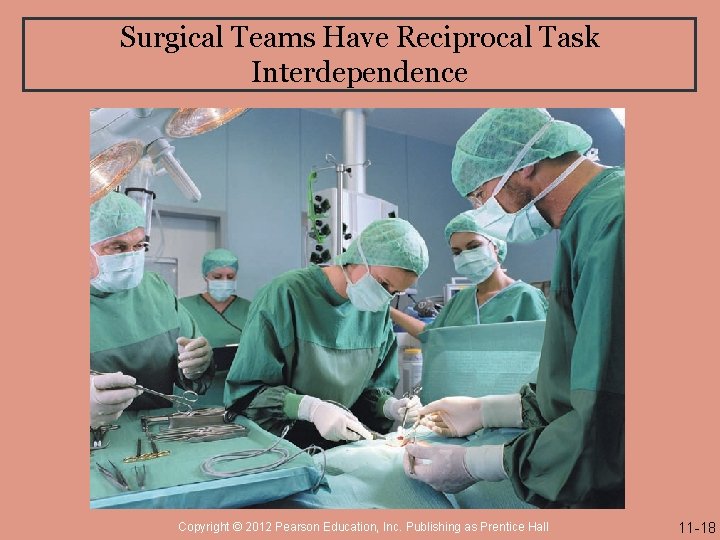
Surgical Teams Have Reciprocal Task Interdependence Copyright © 2012 Pearson Education, Inc. Publishing as Prentice Hall 11 -18
Group Cohesiveness Group cohesiveness is the attractiveness of a group to its members High Low Copyright © 2012 Pearson Education, Inc. Publishing as Prentice Hall 11 -19
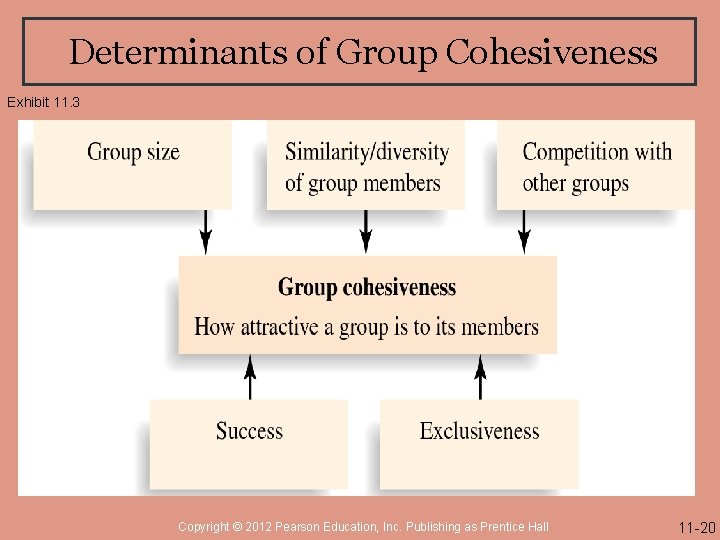
Determinants of Group Cohesiveness Exhibit 11. 3 Copyright © 2012 Pearson Education, Inc. Publishing as Prentice Hall 11 -20
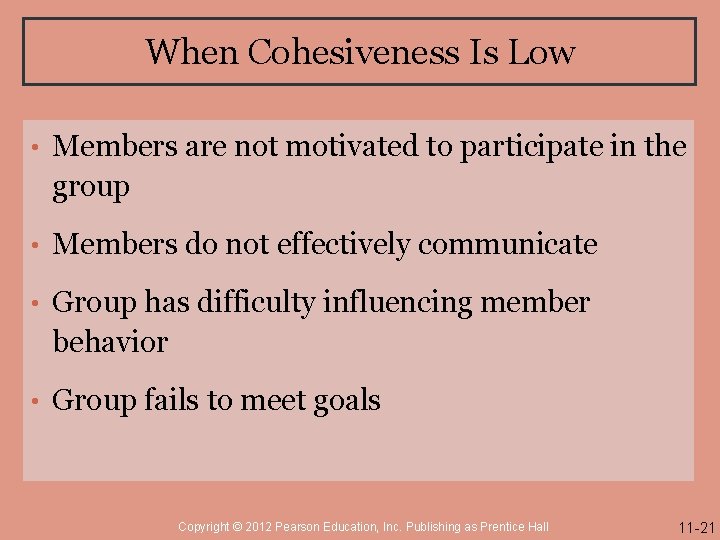
When Cohesiveness Is Low • Members are not motivated to participate in the group • Members do not effectively communicate • Group has difficulty influencing member behavior • Group fails to meet goals Copyright © 2012 Pearson Education, Inc. Publishing as Prentice Hall 11 -21
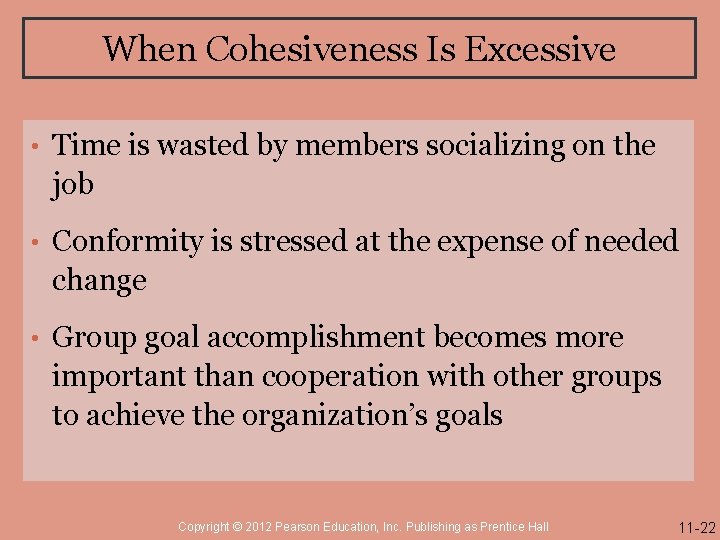
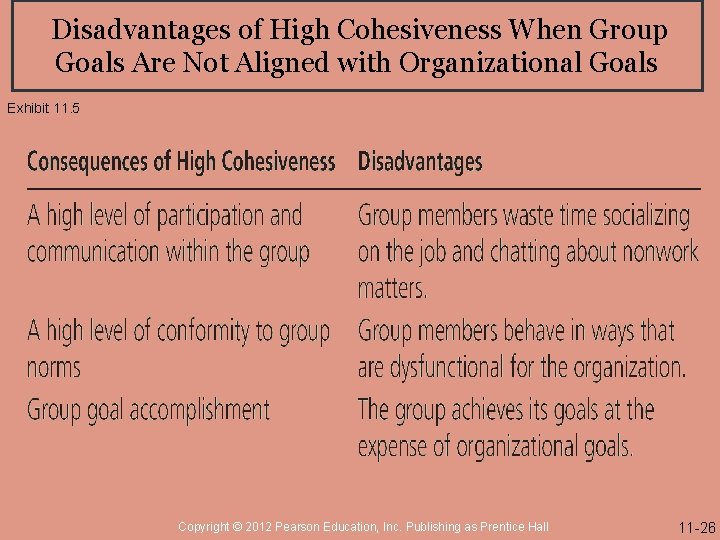
When Cohesiveness Is Excessive • Time is wasted by members socializing on the job • Conformity is stressed at the expense of needed change • Group goal accomplishment becomes more important than cooperation with other groups to achieve the organization’s goals Copyright © 2012 Pearson Education, Inc. Publishing as Prentice Hall 11 -22
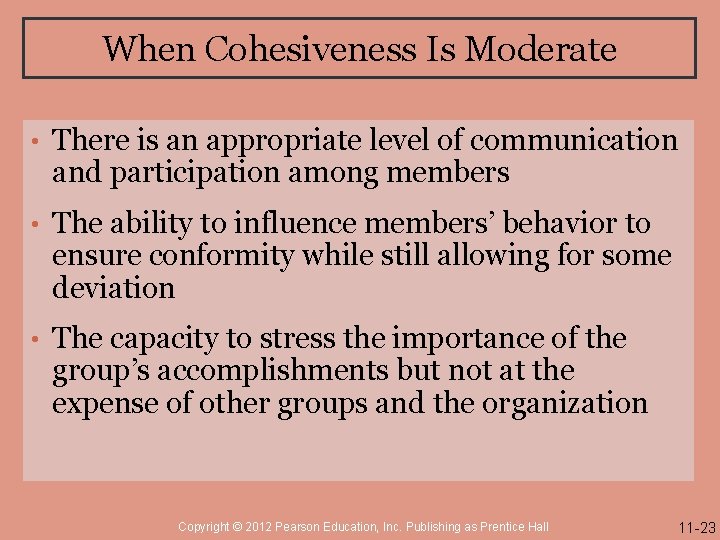
When Cohesiveness Is Moderate • There is an appropriate level of communication and participation among members • The ability to influence members’ behavior to ensure conformity while still allowing for some deviation • The capacity to stress the importance of the group’s accomplishments but not at the expense of other groups and the organization Copyright © 2012 Pearson Education, Inc. Publishing as Prentice Hall 11 -23
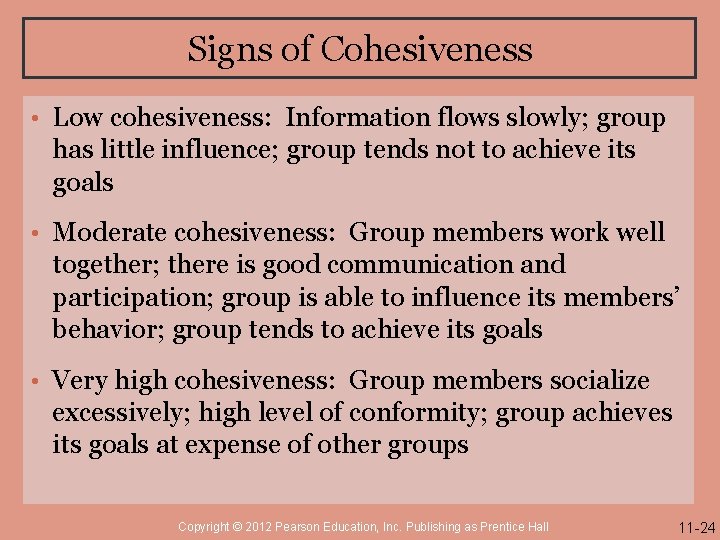
Signs of Cohesiveness • Low cohesiveness: Information flows slowly; group has little influence; group tends not to achieve its goals • Moderate cohesiveness: Group members work well together; there is good communication and participation; group is able to influence its members’ behavior; group tends to achieve its goals • Very high cohesiveness: Group members socialize excessively; high level of conformity; group achieves its goals at expense of other groups Copyright © 2012 Pearson Education, Inc. Publishing as Prentice Hall 11 -24
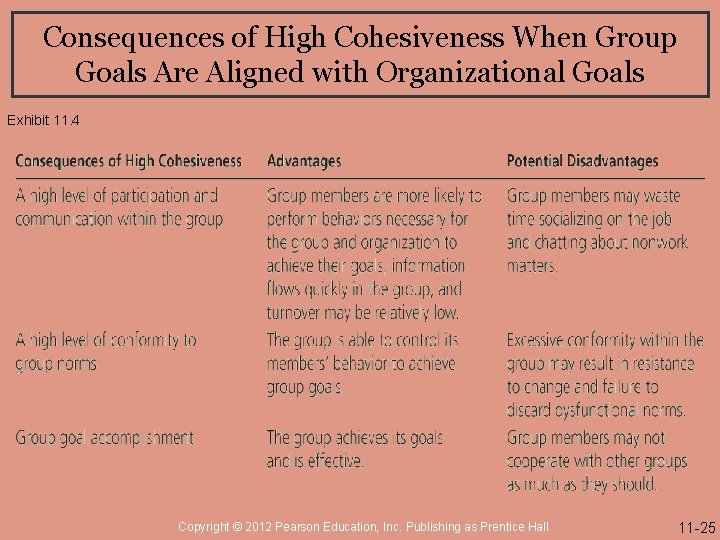
Consequences of High Cohesiveness When Group Goals Are Aligned with Organizational Goals Exhibit 11. 4 Copyright © 2012 Pearson Education, Inc. Publishing as Prentice Hall 11 -25
Disadvantages of High Cohesiveness When Group Goals Are Not Aligned with Organizational Goals Exhibit 11. 5 Copyright © 2012 Pearson Education, Inc. Publishing as Prentice Hall 11 -26
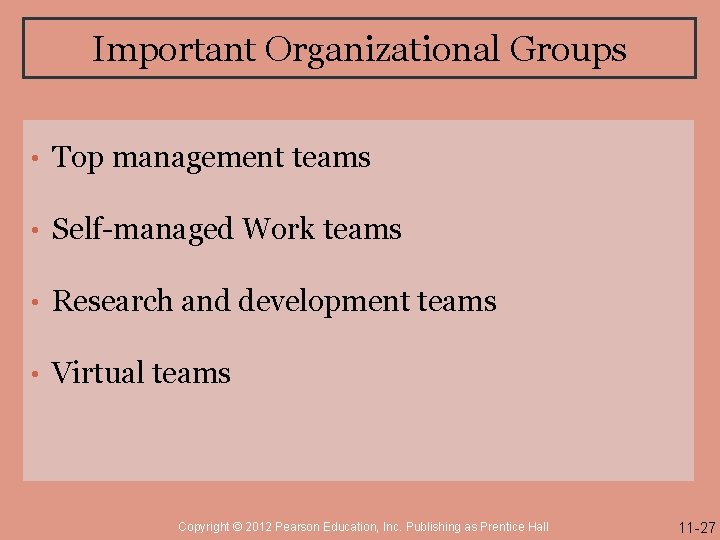
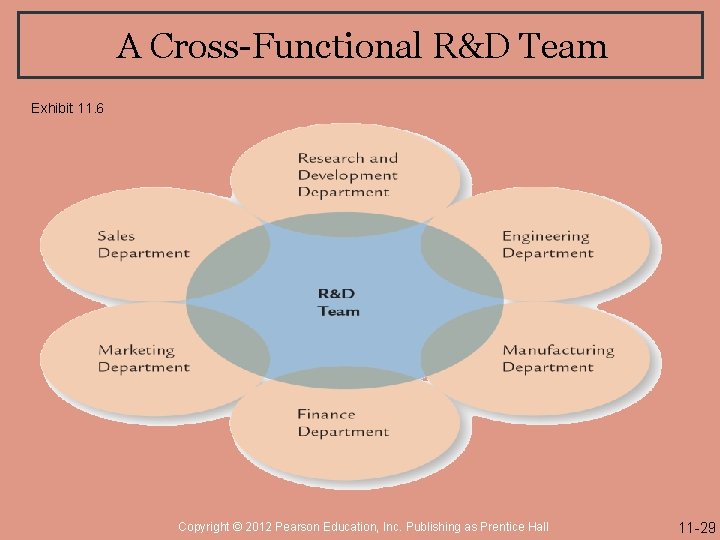
Important Organizational Groups • Top management teams • Self-managed Work teams • Research and development teams • Virtual teams Copyright © 2012 Pearson Education, Inc. Publishing as Prentice Hall 11 -27
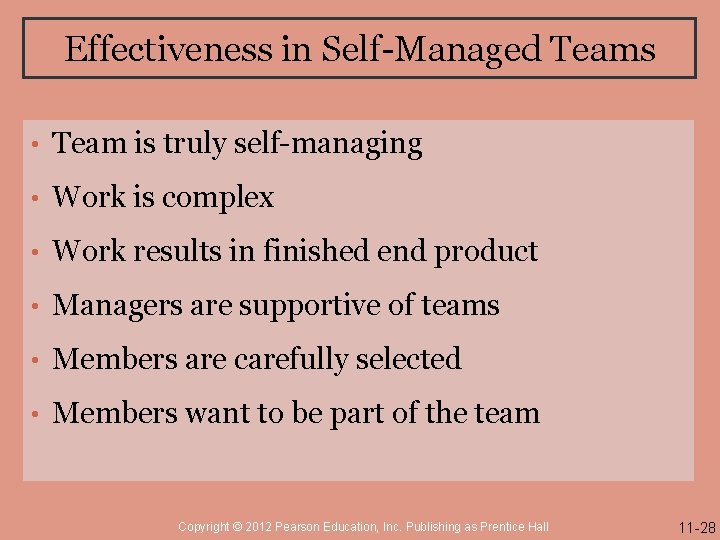
Effectiveness in Self-Managed Teams • Team is truly self-managing • Work is complex • Work results in finished end product • Managers are supportive of teams • Members are carefully selected • Members want to be part of the team Copyright © 2012 Pearson Education, Inc. Publishing as Prentice Hall 11 -28
A Cross-Functional R&D Team Exhibit 11. 6 Copyright © 2012 Pearson Education, Inc. Publishing as Prentice Hall 11 -29
Ford’s Mustang Developed by a Skunk Works Copyright © 2012 Pearson Education, Inc. Publishing as Prentice Hall 11 -30
. This work is protected by United States copyright laws and is provided solely for the use of instructors in teaching their courses and assessing student learning. Dissemination or sale of any part of this work (including on the World. Wide. Web) will destroy the integrity of the work and is not permitted. The work and materials from it should never be made available to students except by instructors using the accompanying text in their classes. All recipients of this work are expected to abide by these restrictions and to honor the intended pedagogical purposes and the needs of other instructors who rely on these materials. All rights reserved. No part of this publication may be reproduced, stored in a retrieval system, or transmitted, in any form or by any means, electronic, mechanical, photocopying, recording or otherwise, without the prior written permission of the publisher. Printed in the United States of America. Copyright © 2012 Pearson Education, Inc. Publishing as Prentice Hall 11 -31