
Effective WordProblem Solving Grades K2 Sarah R Powell
Effective Word-Problem Solving: Grades K-2 Sarah R. Powell, Ph. D. © 2019

srpowell@austin. utexas. edu @sarahpowellphd 119 Sarah R. Powell, Ph. D. © 2019
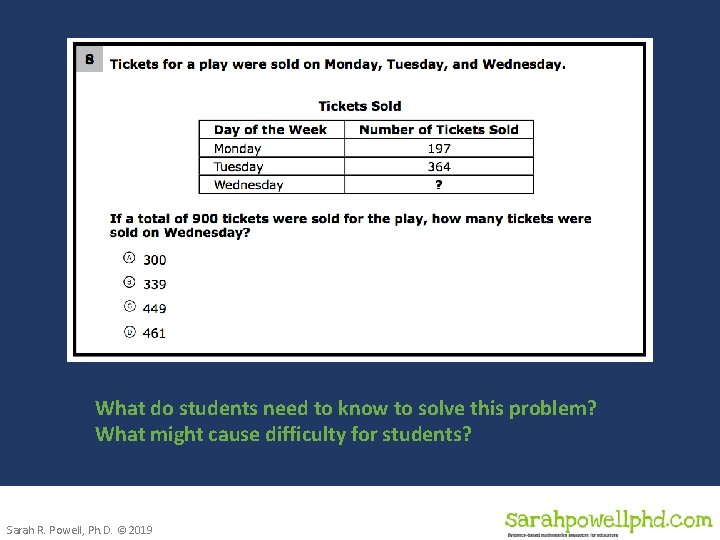
What do students need to know to solve this problem? What might cause difficulty for students? Sarah R. Powell, Ph. D. © 2019
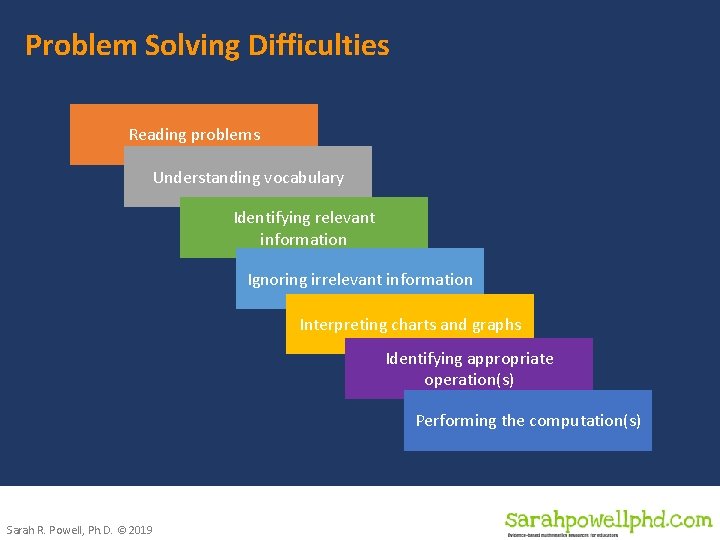
Problem Solving Difficulties Reading problems Understanding vocabulary Identifying relevant information Ignoring irrelevant information Interpreting charts and graphs Identifying appropriate operation(s) Performing the computation(s) Sarah R. Powell, Ph. D. © 2019
Sarah R. Powell, Ph. D. © 2019
Don’t tie key words to operations Do have an attack strategy Do teach word-problem schemas Sarah R. Powell, Ph. D. © 2019
Sarah R. Powell, Ph. D. © 2019
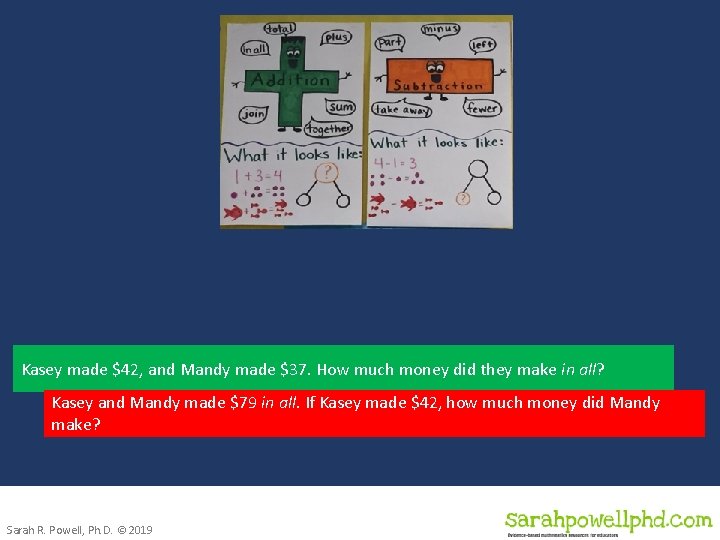
Kasey made $42, and Mandy made $37. How much money did they make in all? Kasey and Mandy made $79 in all. If Kasey made $42, how much money did Mandy make? Sarah R. Powell, Ph. D. © 2019
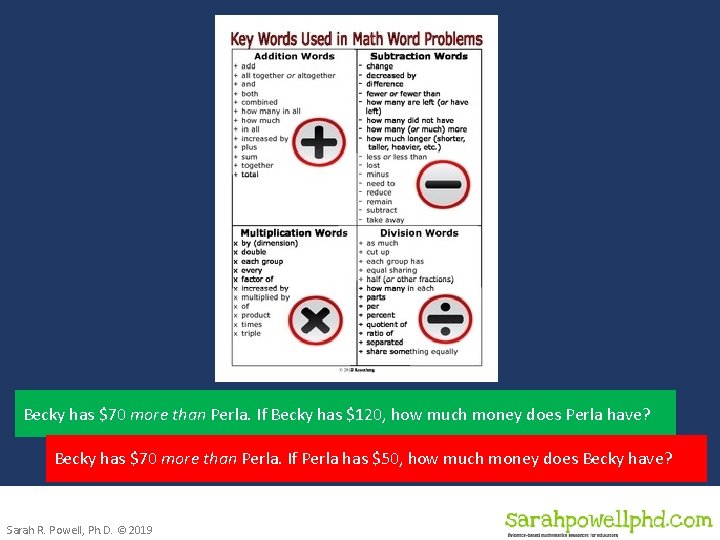
Becky has $70 more than Perla. If Becky has $120, how much money does Perla have? Becky has $70 more than Perla. If Perla has $50, how much money does Becky have? Sarah R. Powell, Ph. D. © 2019
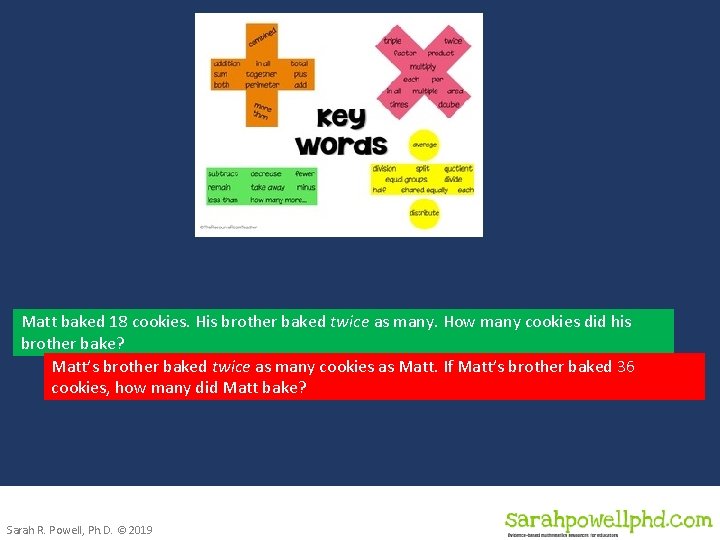
Matt baked 18 cookies. His brother baked twice as many. How many cookies did his brother bake? Matt’s brother baked twice as many cookies as Matt. If Matt’s brother baked 36 cookies, how many did Matt bake? Sarah R. Powell, Ph. D. © 2019
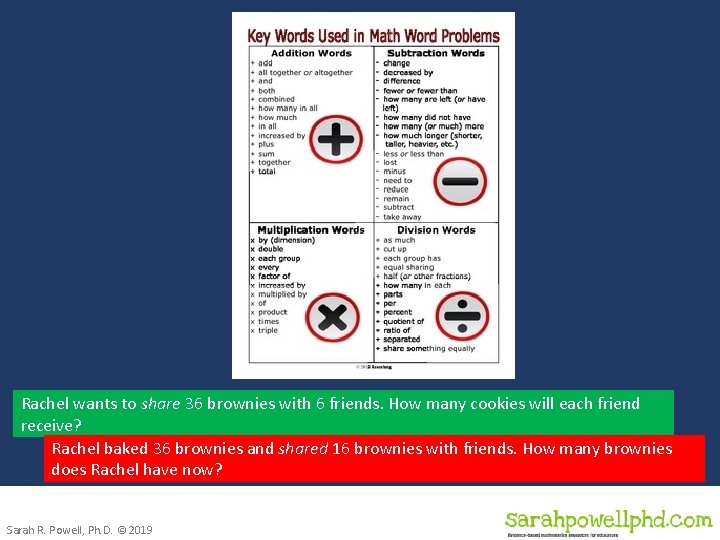
Rachel wants to share 36 brownies with 6 friends. How many cookies will each friend receive? Rachel baked 36 brownies and shared 16 brownies with friends. How many brownies does Rachel have now? Sarah R. Powell, Ph. D. © 2019
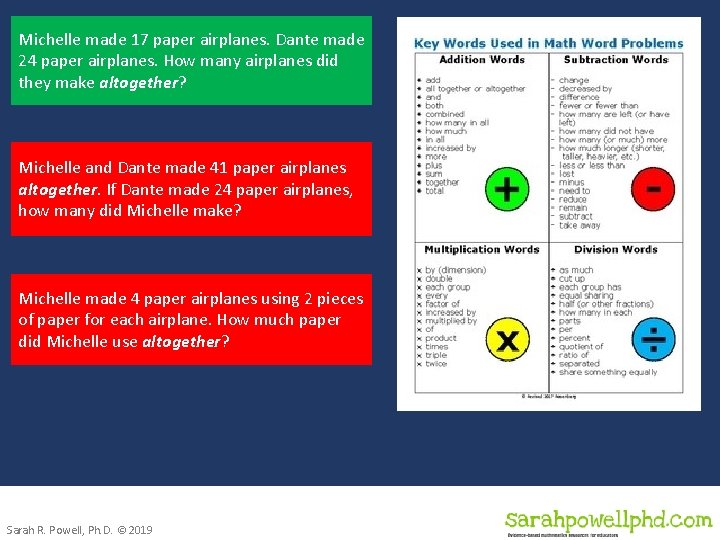
Michelle made 17 paper airplanes. Dante made 24 paper airplanes. How many airplanes did they make altogether? Michelle and Dante made 41 paper airplanes altogether. If Dante made 24 paper airplanes, how many did Michelle make? Michelle made 4 paper airplanes using 2 pieces of paper for each airplane. How much paper did Michelle use altogether? Sarah R. Powell, Ph. D. © 2019
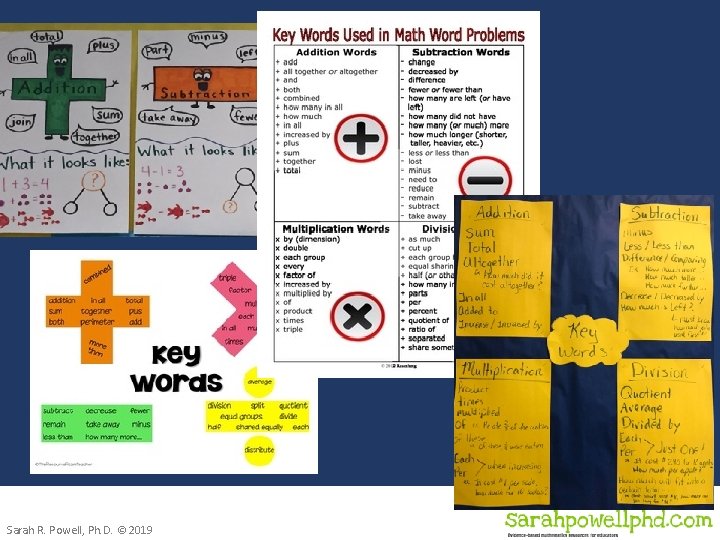
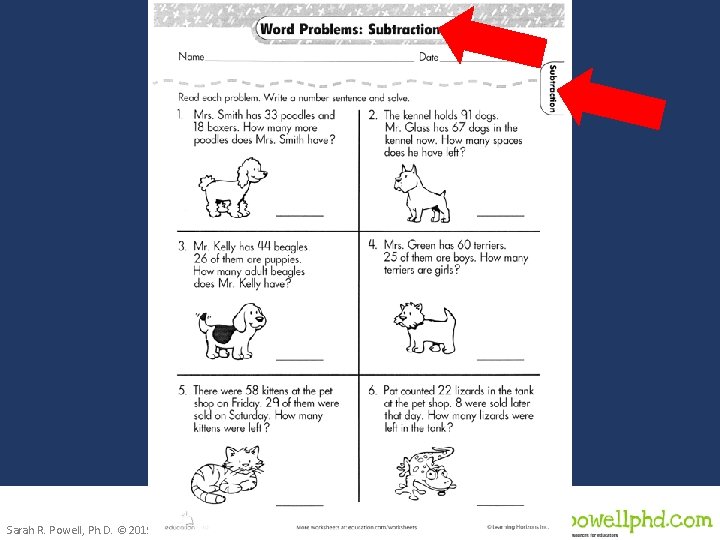
Students need to understand key words. But, key words should not be directly tied to operations. Sarah R. Powell, Ph. D. © 2019
Sarah R. Powell, Ph. D. © 2019
Don’t tie key words to operations Do have an attack strategy Do teach word-problem schemas Sarah R. Powell, Ph. D. © 2019
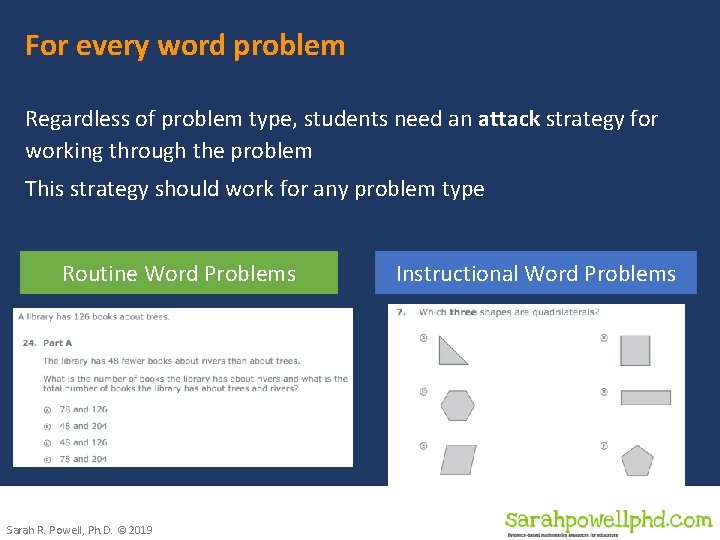
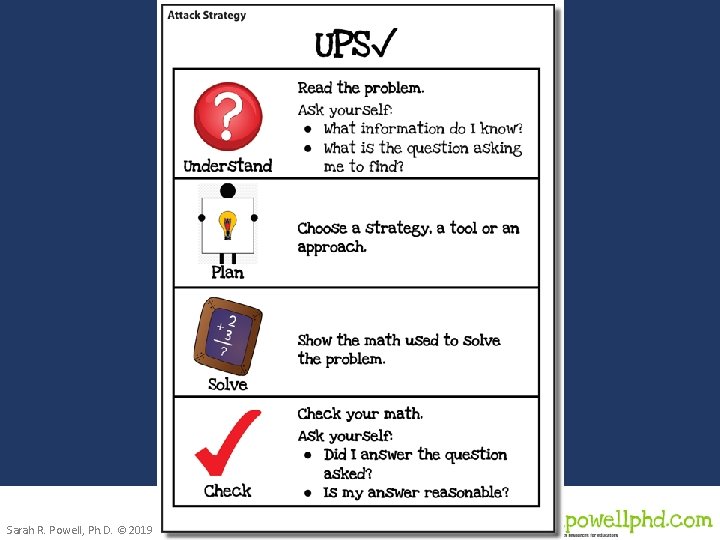
For every word problem Regardless of problem type, students need an attack strategy for working through the problem This strategy should work for any problem type Routine Word Problems Sarah R. Powell, Ph. D. © 2019 Instructional Word Problems
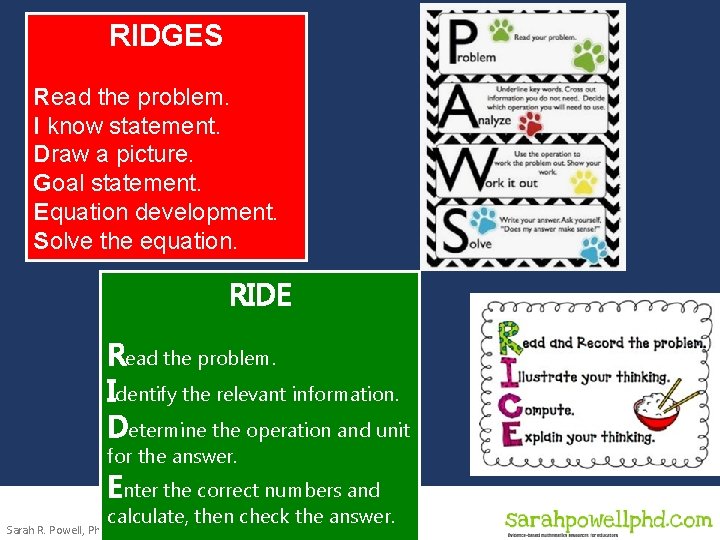
RIDGES Read the problem. I know statement. Draw a picture. Goal statement. Equation development. Solve the equation. RIDE Read the problem. Identify the relevant information. Determine the operation and unit for the answer. Enter the correct numbers and calculate, then check the answer. Sarah R. Powell, Ph. D. © 2019
Sarah R. Powell, Ph. D. © 2019
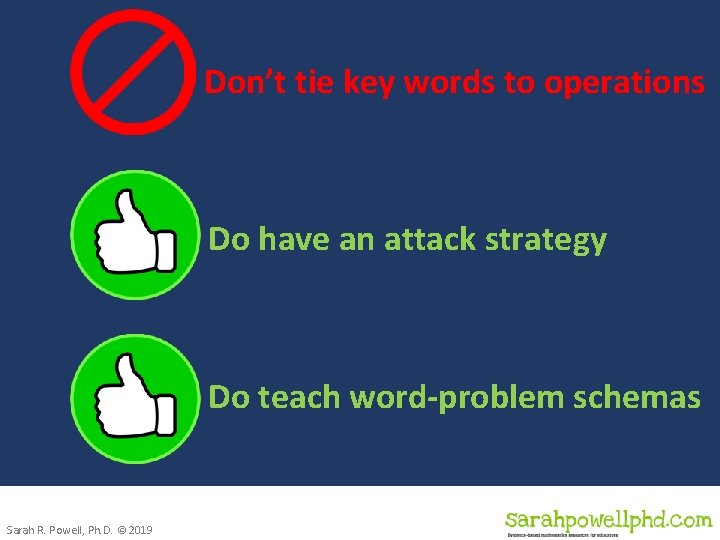
Don’t tie key words to operations Do have an attack strategy Do teach word-problem schemas Sarah R. Powell, Ph. D. © 2019
Sarah R. Powell, Ph. D. © 2019
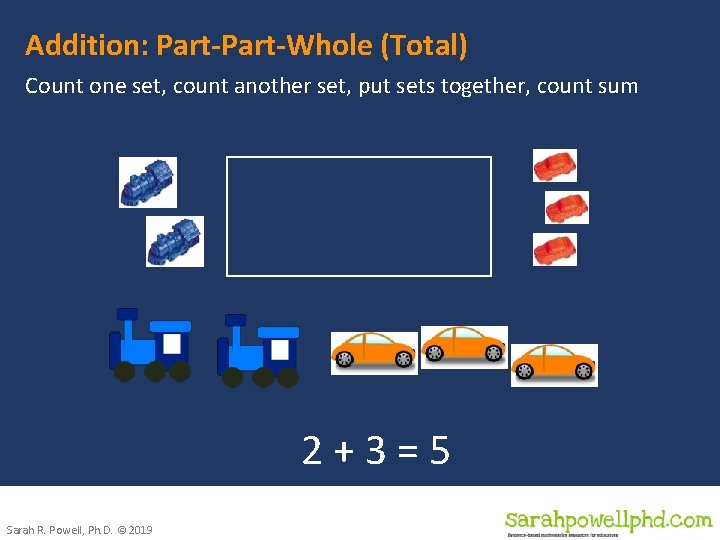
Addition: Part-Whole (Total) Count one set, count another set, put sets together, count sum 2+3=5 Sarah R. Powell, Ph. D. © 2019
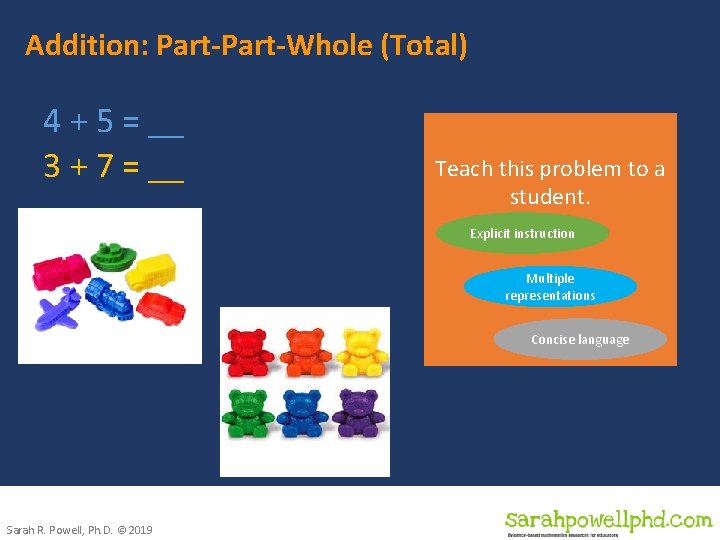
Addition: Part-Whole (Total) 4 + 5 = __ 3 + 7 = __ Teach this problem to a student. Explicit instruction Multiple representations Concise language Sarah R. Powell, Ph. D. © 2019
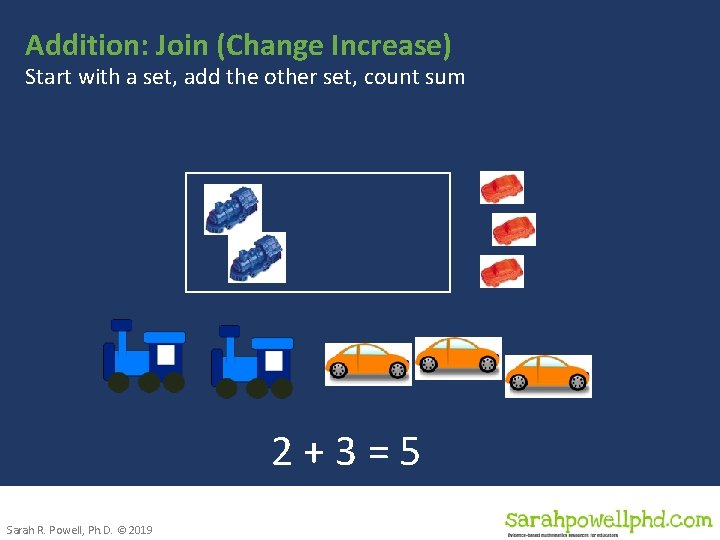
Addition: Join (Change Increase) Start with a set, add the other set, count sum 2+3=5 Sarah R. Powell, Ph. D. © 2019
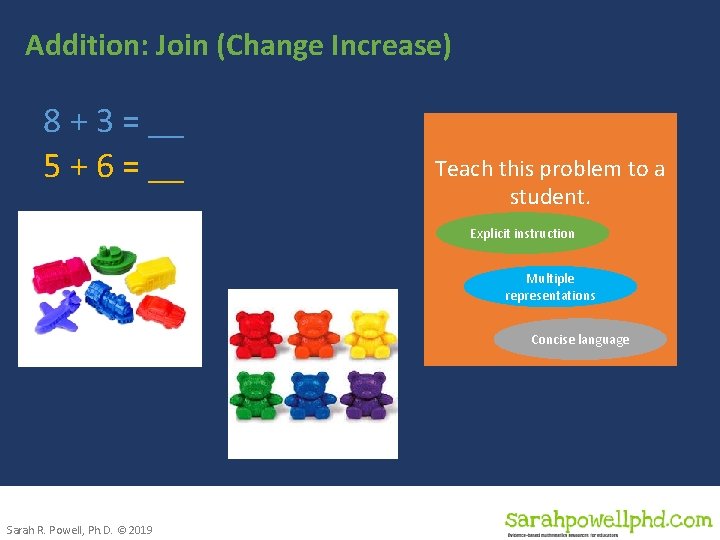
Addition: Join (Change Increase) 8 + 3 = __ 5 + 6 = __ Teach this problem to a student. Explicit instruction Multiple representations Concise language Sarah R. Powell, Ph. D. © 2019
Why is it important to understand addition in two separate ways? Sarah R. Powell, Ph. D. © 2019
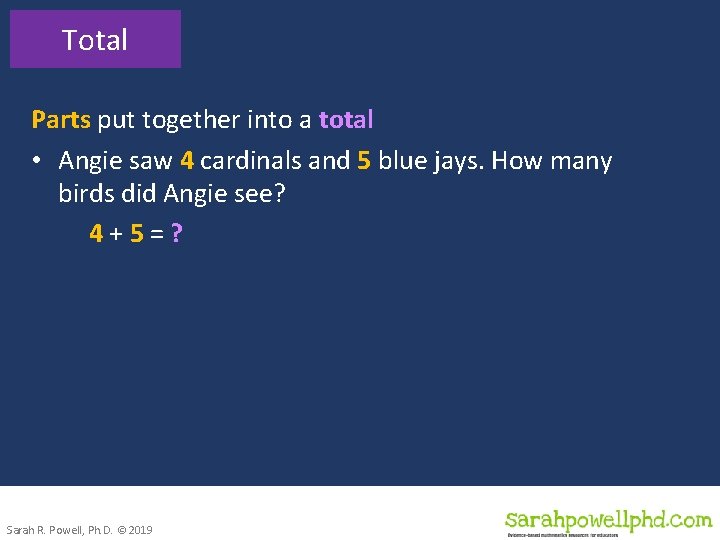
Total Parts put together into a total • Angie saw 4 cardinals and 5 blue jays. How many birds did Angie see? 4+5=? Sarah R. Powell, Ph. D. © 2019
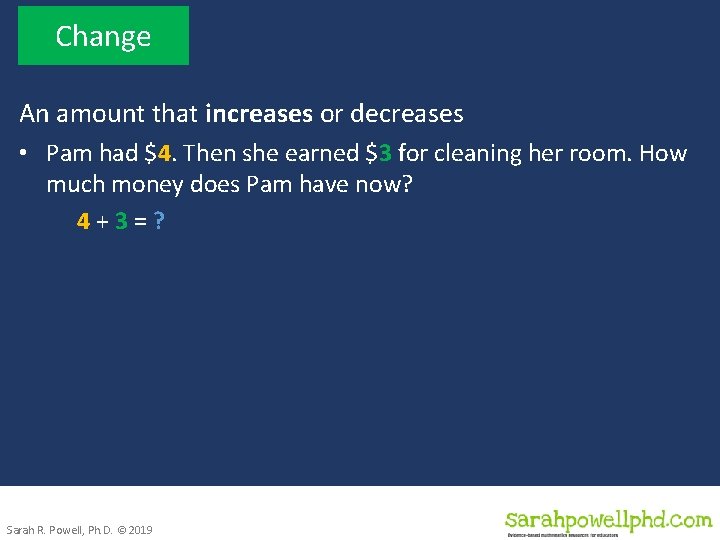
Change An amount that increases or decreases • Pam had $4. Then she earned $3 for cleaning her room. How much money does Pam have now? 4+3=? Sarah R. Powell, Ph. D. © 2019
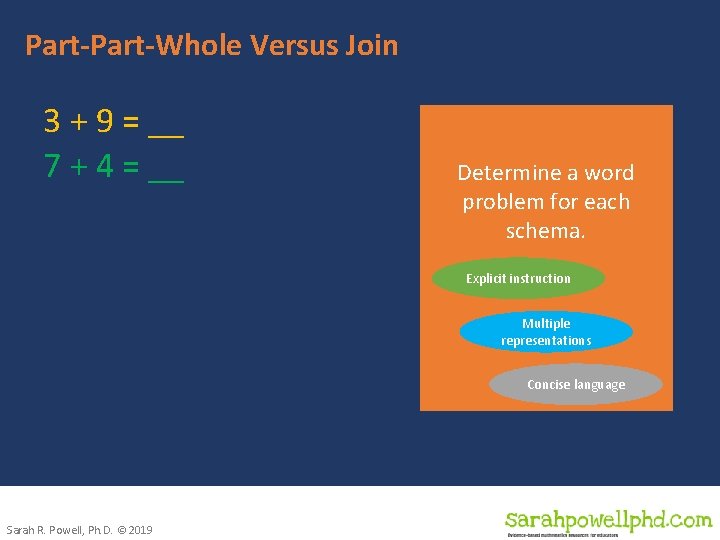
Part-Whole Versus Join 3 + 9 = __ 7 + 4 = __ Determine a word problem for each schema. Explicit instruction Multiple representations Concise language Sarah R. Powell, Ph. D. © 2019
Sarah R. Powell, Ph. D. © 2019
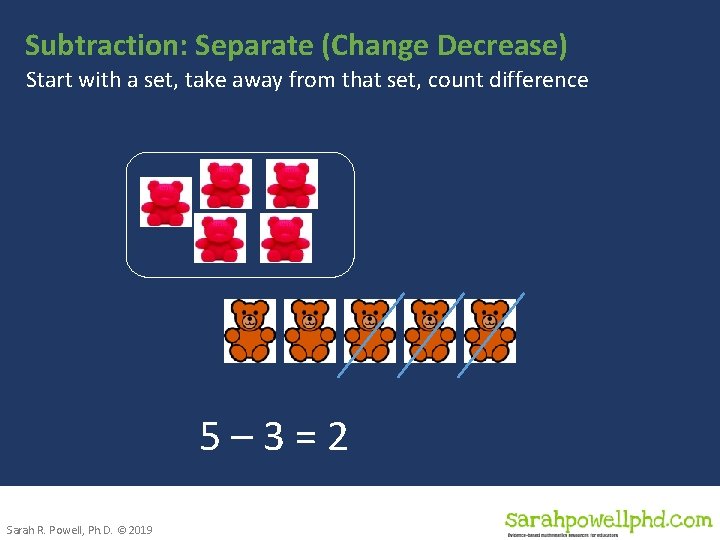
Subtraction: Separate (Change Decrease) Start with a set, take away from that set, count difference 5– 3=2 Sarah R. Powell, Ph. D. © 2019
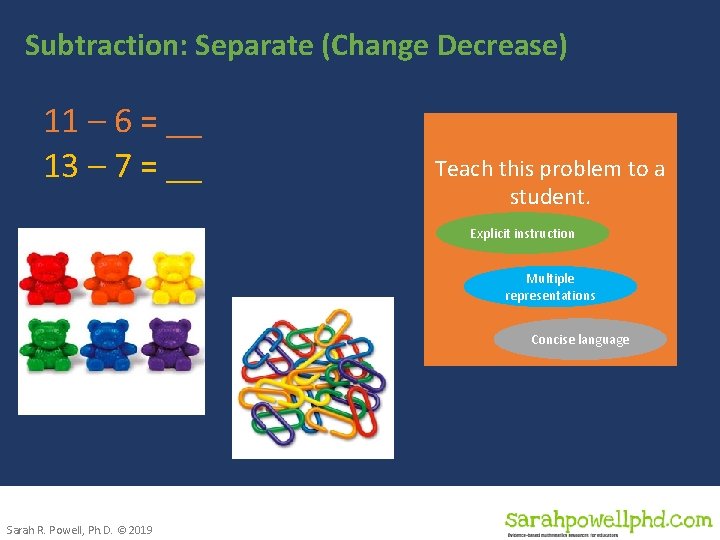
Subtraction: Separate (Change Decrease) 11 – 6 = __ 13 – 7 = __ Teach this problem to a student. Explicit instruction Multiple representations Concise language Sarah R. Powell, Ph. D. © 2019
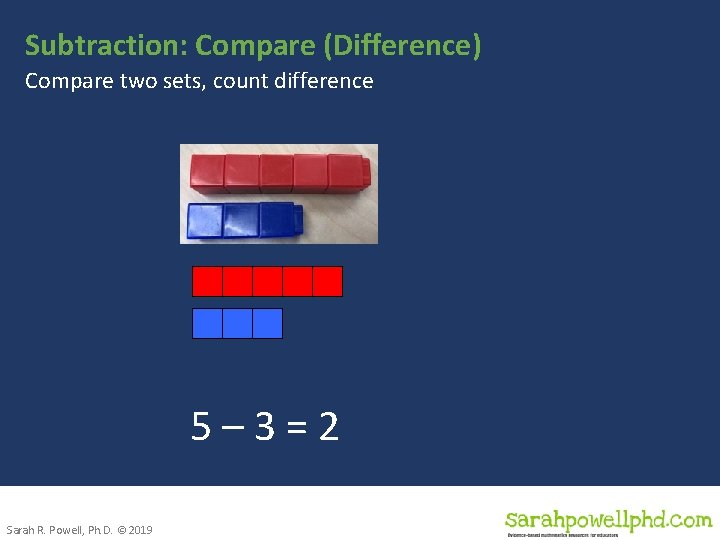
Subtraction: Compare (Difference) Compare two sets, count difference 5– 3=2 Sarah R. Powell, Ph. D. © 2019
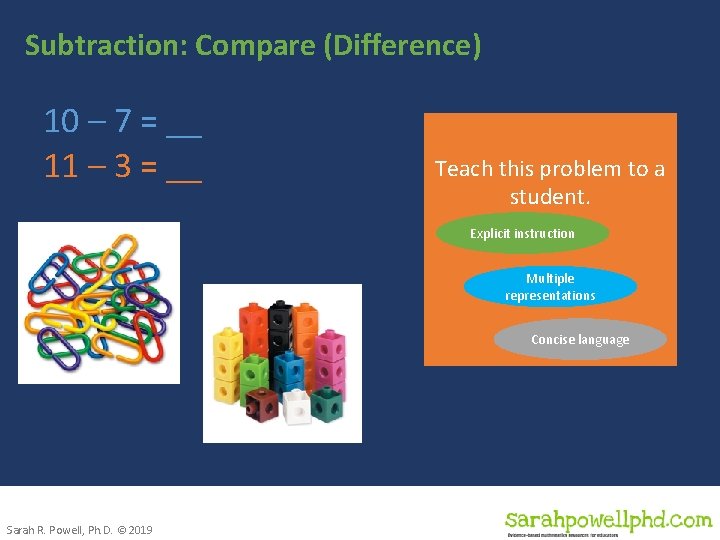
Subtraction: Compare (Difference) 10 – 7 = __ 11 – 3 = __ Teach this problem to a student. Explicit instruction Multiple representations Concise language Sarah R. Powell, Ph. D. © 2019
Why is it important to understand subtraction in two separate ways? Sarah R. Powell, Ph. D. © 2019
Change An amount that increases or decreases • Amanda had 9 cookies. Then she ate 2 of the cookies. How many cookies does Amanda have now? 9– 2=? Sarah R. Powell, Ph. D. © 2019
Difference Greater and less amounts compared for a difference • Scott has 9 apples. Cathy has 4 apples. How many more apples does Scott have? (How many fewer does Cathy have? ) • 9– 4=? Sarah R. Powell, Ph. D. © 2019
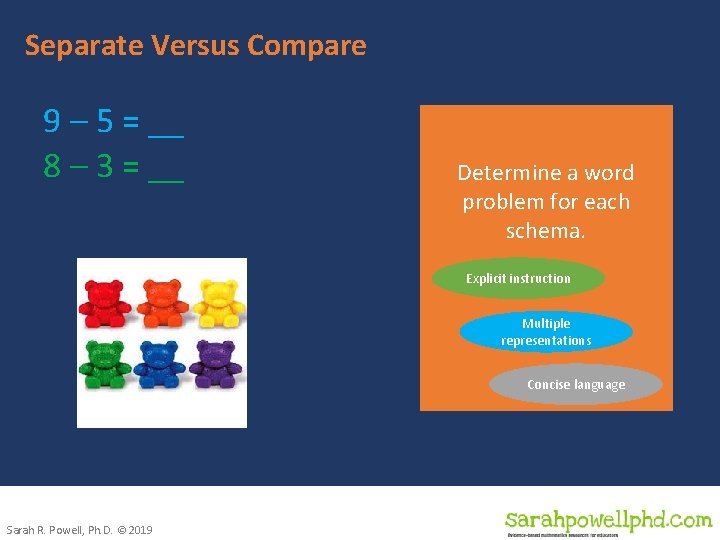
Separate Versus Compare 9 – 5 = __ 8 – 3 = __ Determine a word problem for each schema. Explicit instruction Multiple representations Concise language Sarah R. Powell, Ph. D. © 2019
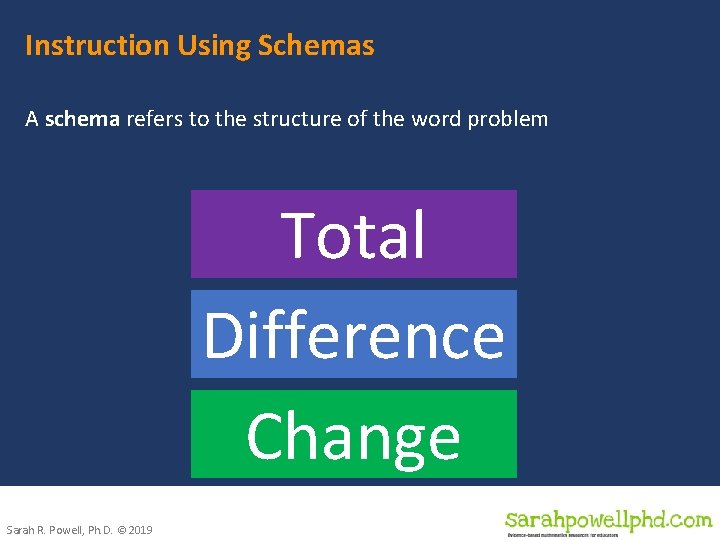
Instruction Using Schemas A schema refers to the structure of the word problem Total Difference Change Sarah R. Powell, Ph. D. © 2019
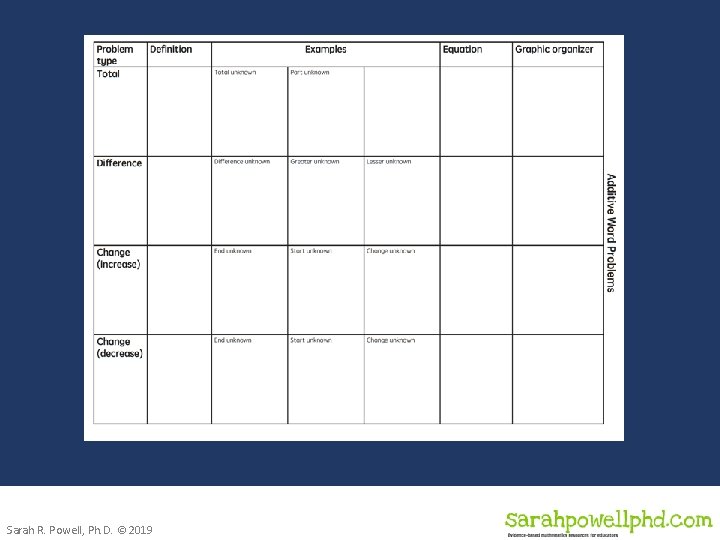
Sarah R. Powell, Ph. D. © 2019
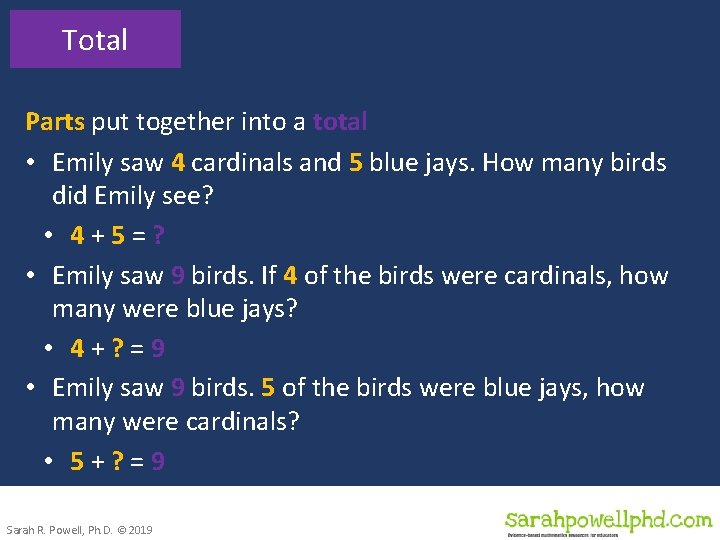
Total Parts put together into a total • Emily saw 4 cardinals and 5 blue jays. How many birds did Emily see? • 4+5=? • Emily saw 9 birds. If 4 of the birds were cardinals, how many were blue jays? • 4+? =9 • Emily saw 9 birds. 5 of the birds were blue jays, how many were cardinals? • 5+? =9 Sarah R. Powell, Ph. D. © 2019
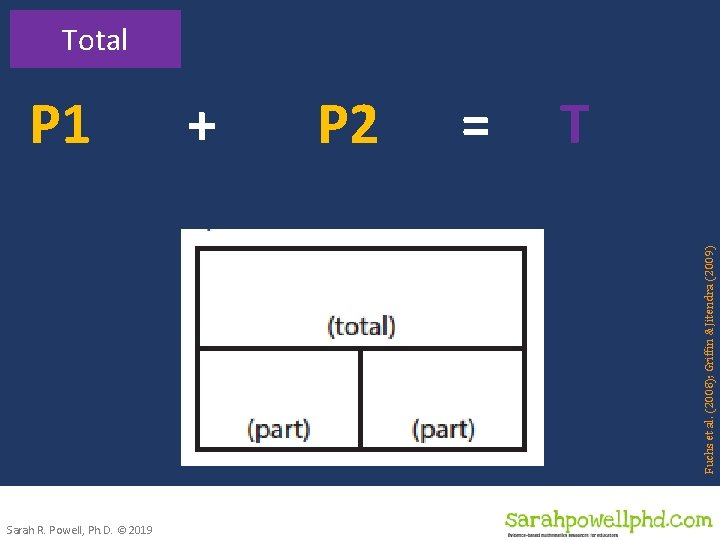
Fuchs et al. (2008); Griffin & Jitendra (2009) Total P 1 Sarah R. Powell, Ph. D. © 2019 + P 2 = T
Total “Are parts put together for a total? ” Sarah R. Powell, Ph. D. © 2019
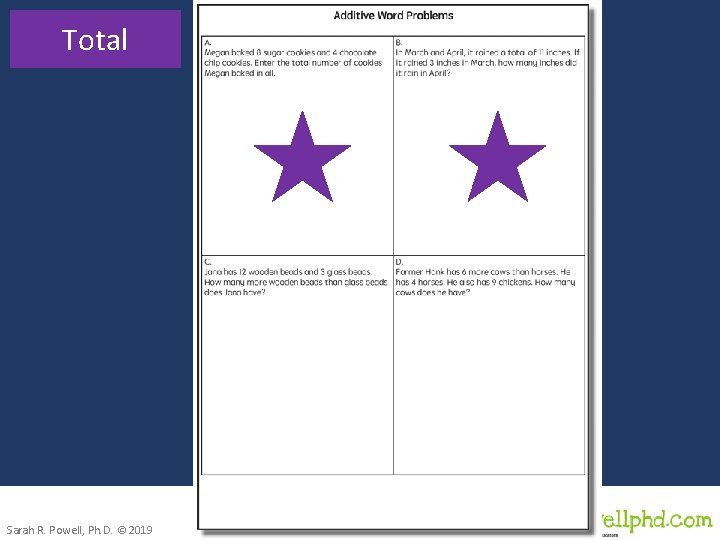
Total Sarah R. Powell, Ph. D. © 2019
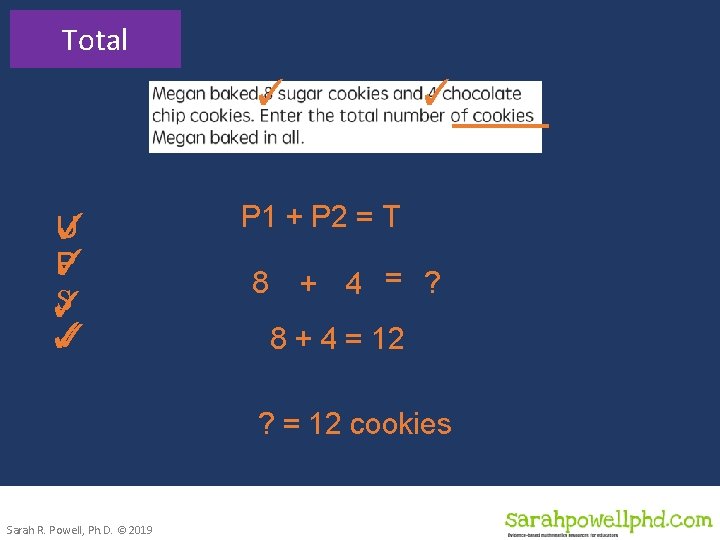
Total ✓ U ✓ P ✓ S ✓ ✓ P 1 + P 2 = T 8 + 4 = ? 8 + 4 = 12 ? = 12 cookies Sarah R. Powell, Ph. D. © 2019
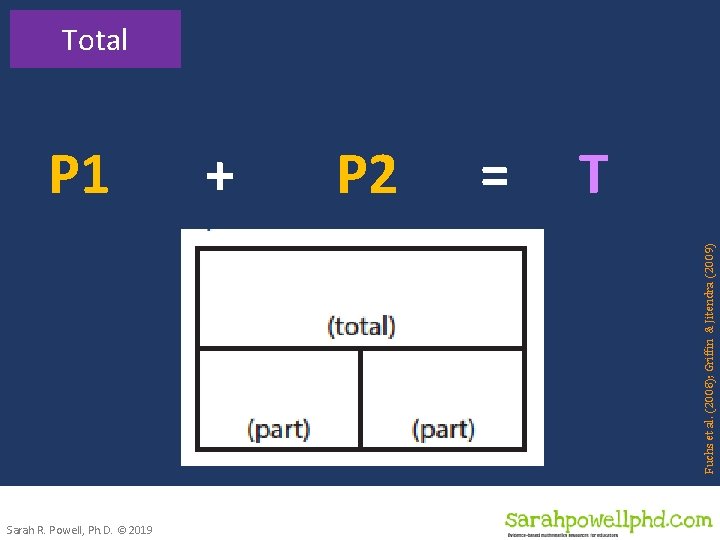
Fuchs et al. (2008); Griffin & Jitendra (2009) Total P 1 Sarah R. Powell, Ph. D. © 2019 + P 2 = T
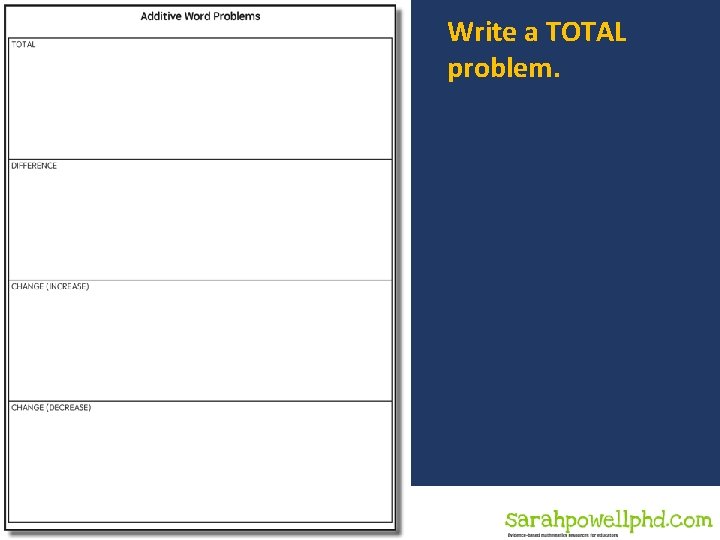
Write a TOTAL problem. Sarah R. Powell, Ph. D. © 2019
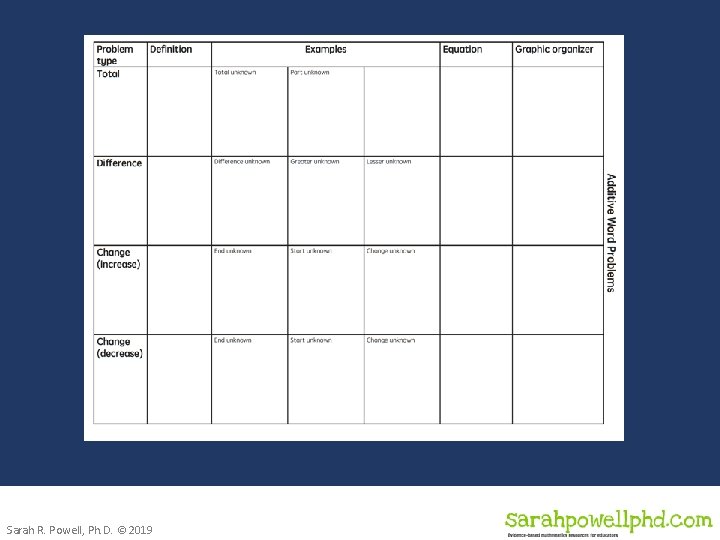
Sarah R. Powell, Ph. D. © 2019
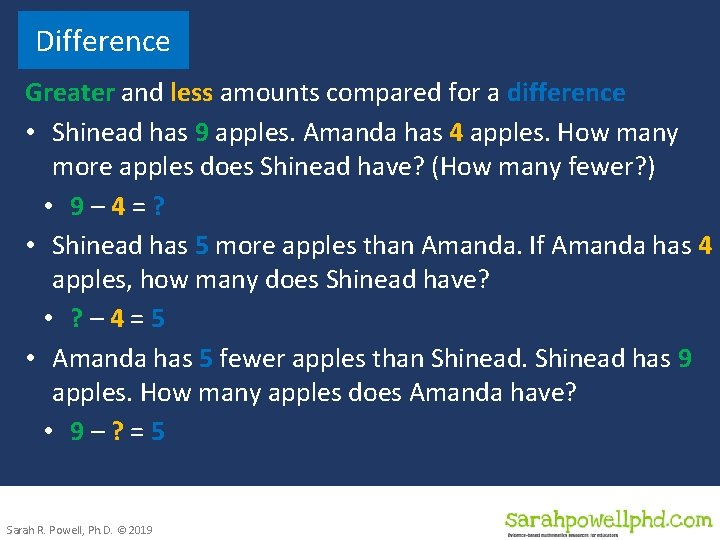
Difference Greater and less amounts compared for a difference • Shinead has 9 apples. Amanda has 4 apples. How many more apples does Shinead have? (How many fewer? ) • 9– 4=? • Shinead has 5 more apples than Amanda. If Amanda has 4 apples, how many does Shinead have? • ? – 4=5 • Amanda has 5 fewer apples than Shinead has 9 apples. How many apples does Amanda have? • 9–? =5 Sarah R. Powell, Ph. D. © 2019
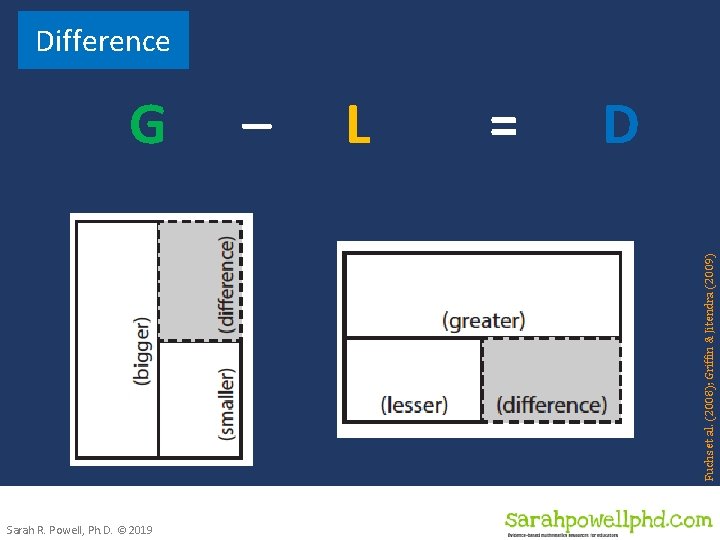
Fuchs et al. (2008); Griffin & Jitendra (2009) Difference G Sarah R. Powell, Ph. D. © 2019 – L = D
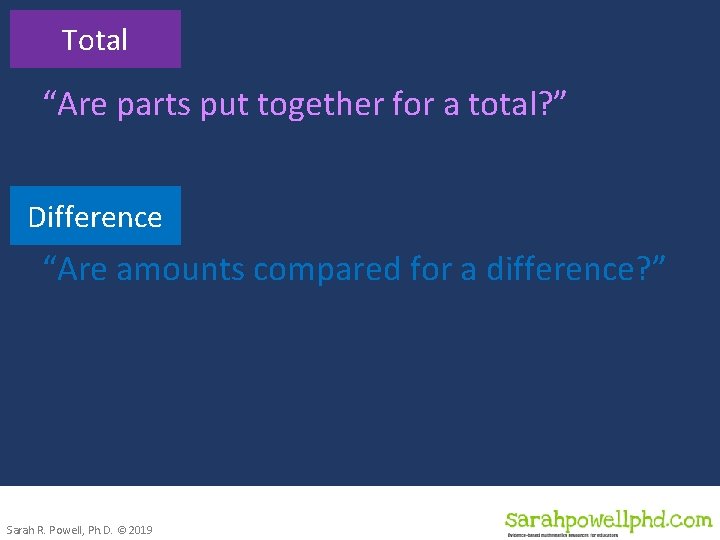
Total “Are parts put together for a total? ” Difference “Are amounts compared for a difference? ” Sarah R. Powell, Ph. D. © 2019
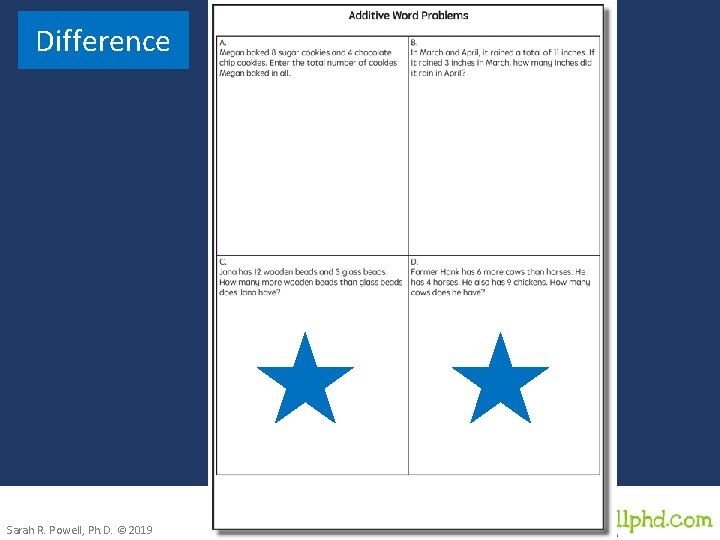
Difference Sarah R. Powell, Ph. D. © 2019
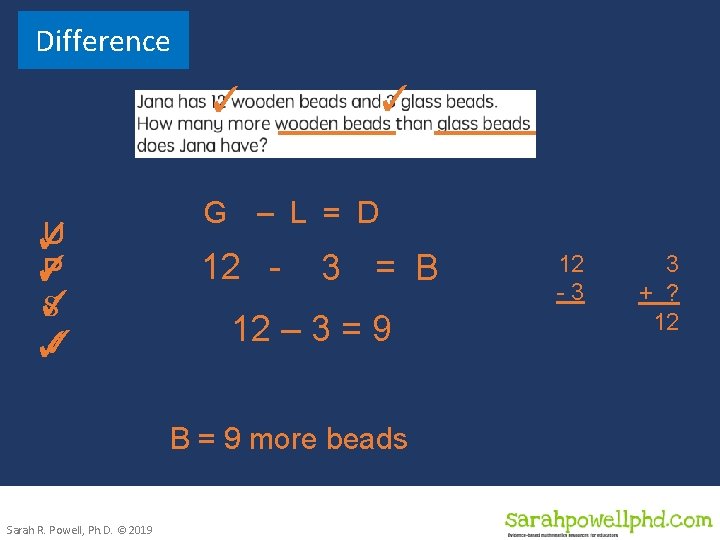
Difference ✓ U ✓ P ✓ ✓ S ✓ ✓ ✓ G – L = D 12 - 3 = B 12 – 3 = 9 B = 9 more beads Sarah R. Powell, Ph. D. © 2019 12 -3 3 + ? 12
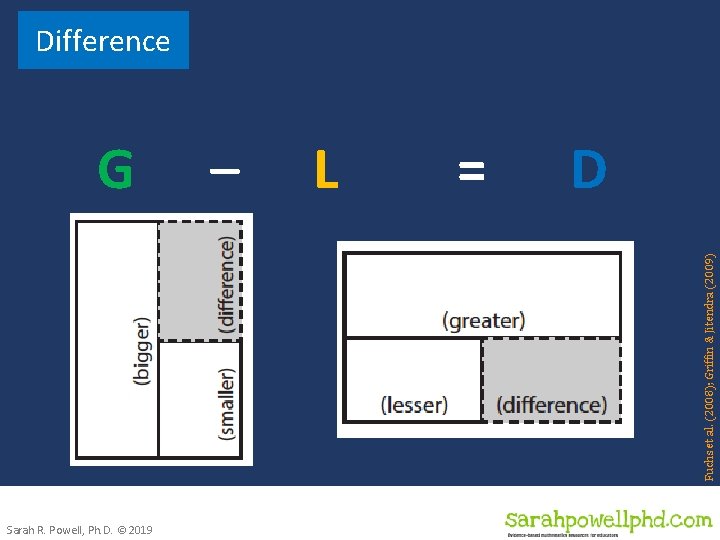
Fuchs et al. (2008); Griffin & Jitendra (2009) Difference G Sarah R. Powell, Ph. D. © 2019 – L = D
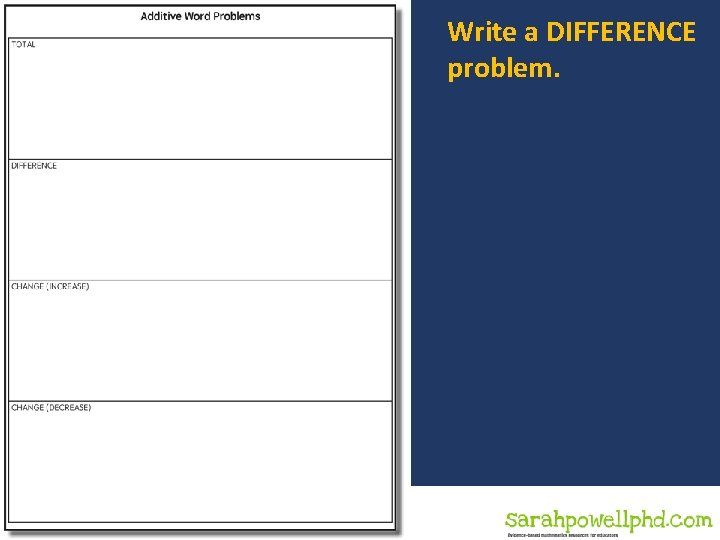
Write a DIFFERENCE problem. Sarah R. Powell, Ph. D. © 2019
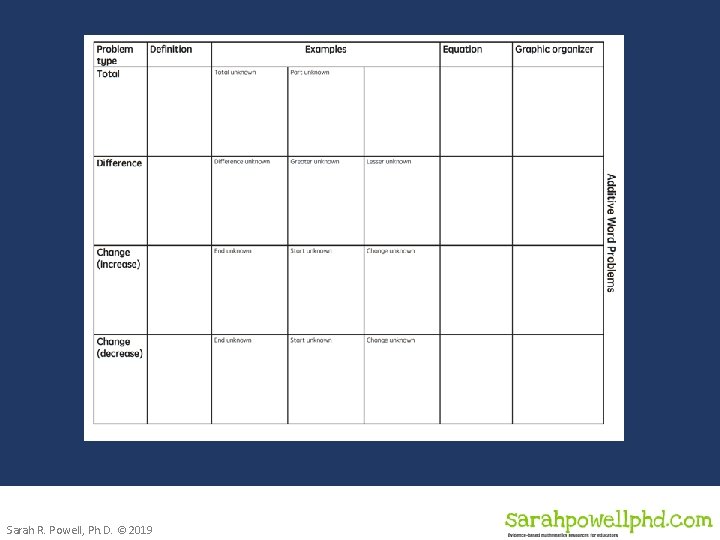
Sarah R. Powell, Ph. D. © 2019
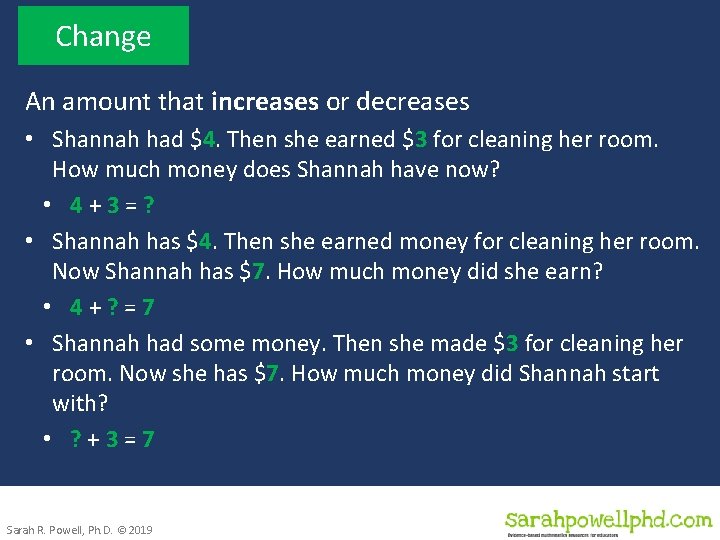
Change An amount that increases or decreases • Shannah had $4. Then she earned $3 for cleaning her room. How much money does Shannah have now? • 4+3=? • Shannah has $4. Then she earned money for cleaning her room. Now Shannah has $7. How much money did she earn? • 4+? =7 • Shannah had some money. Then she made $3 for cleaning her room. Now she has $7. How much money did Shannah start with? • ? +3=7 Sarah R. Powell, Ph. D. © 2019
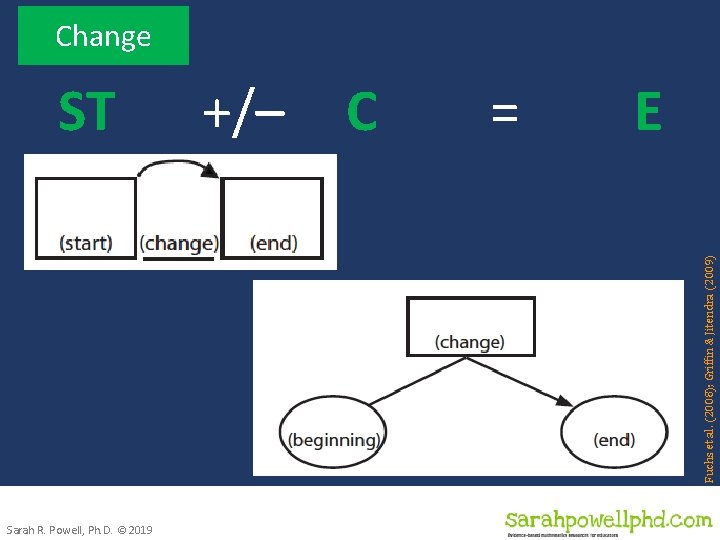
Fuchs et al. (2008); Griffin & Jitendra (2009) Change ST Sarah R. Powell, Ph. D. © 2019 +/– C = E
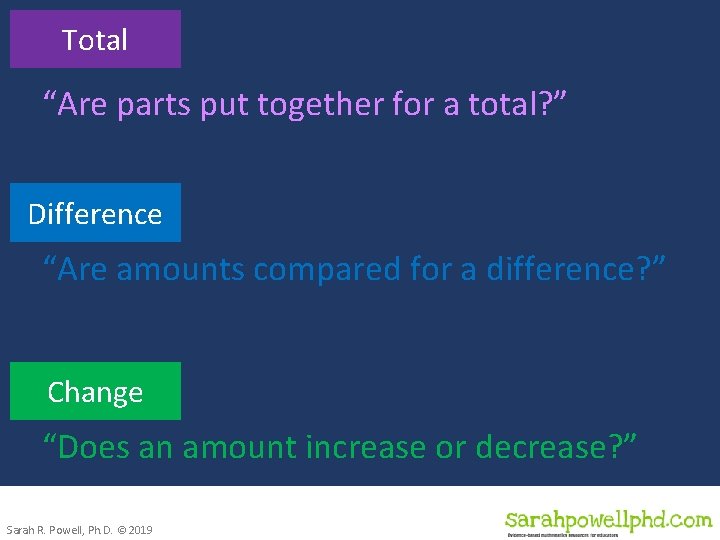
Total “Are parts put together for a total? ” Difference “Are amounts compared for a difference? ” Change “Does an amount increase or decrease? ” Sarah R. Powell, Ph. D. © 2019
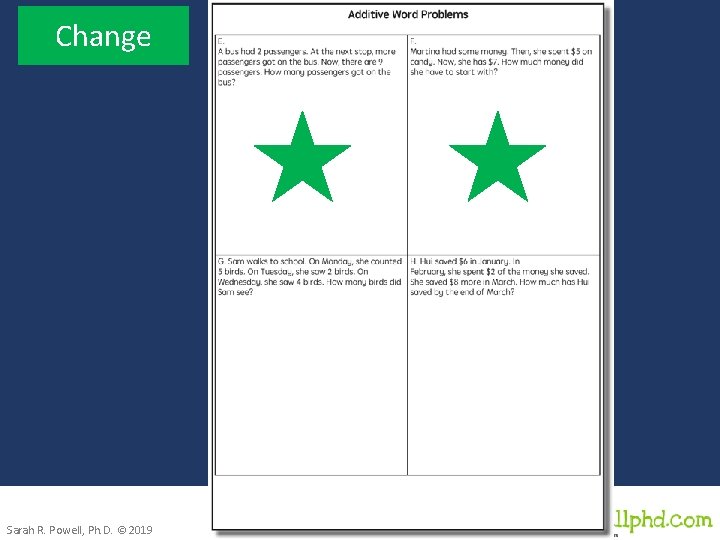
Change Sarah R. Powell, Ph. D. © 2019
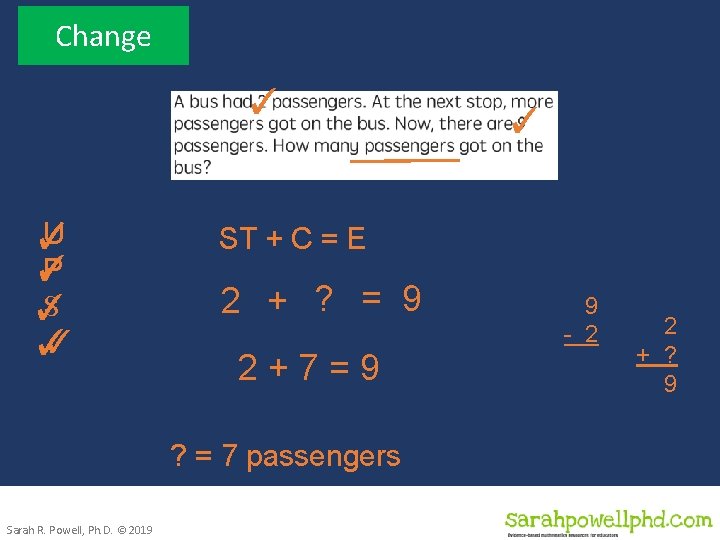
Change ✓ U ✓ P ✓ S ✓ ✓ ✓ ST + C = E 2 + ? = 9 2+7=9 ? = 7 passengers Sarah R. Powell, Ph. D. © 2019 ✓ 9 - 2 2 + ? 9
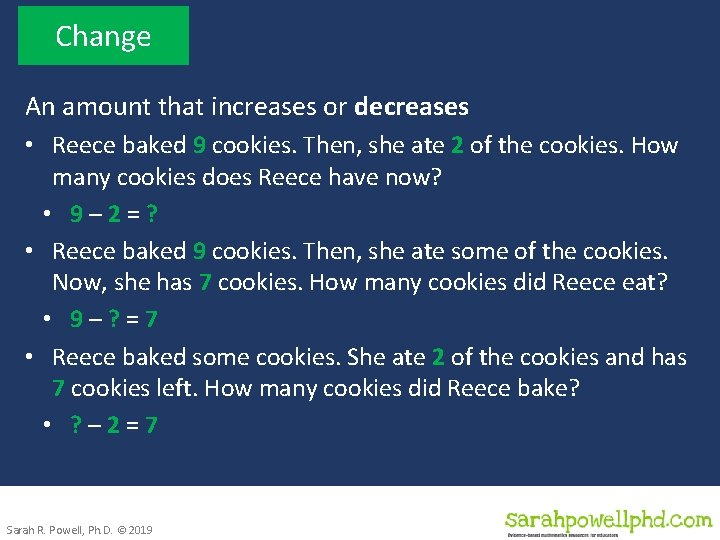
Change An amount that increases or decreases • Reece baked 9 cookies. Then, she ate 2 of the cookies. How many cookies does Reece have now? • 9– 2=? • Reece baked 9 cookies. Then, she ate some of the cookies. Now, she has 7 cookies. How many cookies did Reece eat? • 9–? =7 • Reece baked some cookies. She ate 2 of the cookies and has 7 cookies left. How many cookies did Reece bake? • ? – 2=7 Sarah R. Powell, Ph. D. © 2019
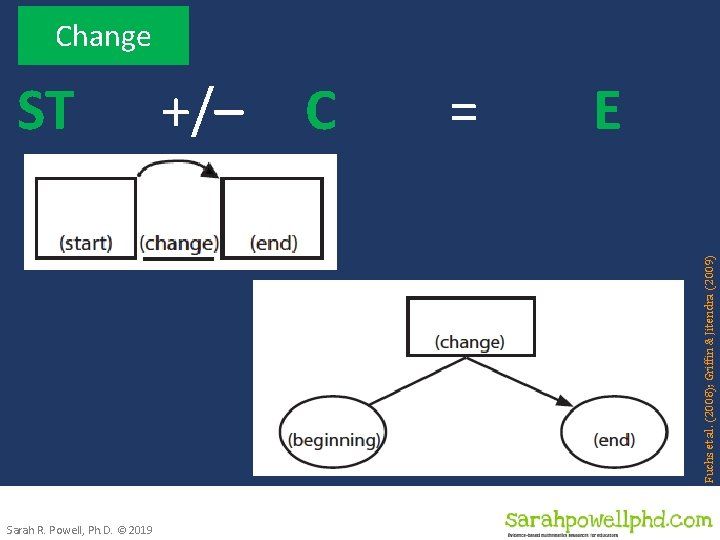
Fuchs et al. (2008); Griffin & Jitendra (2009) Change ST Sarah R. Powell, Ph. D. © 2019 +/– C = E
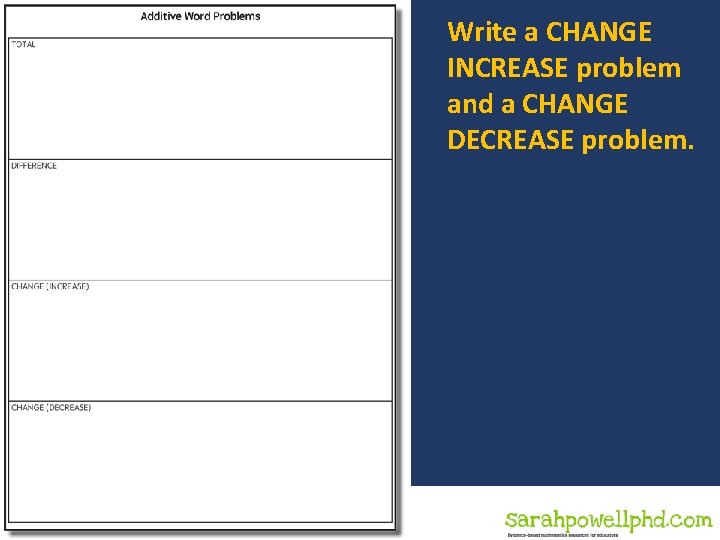
Write a CHANGE INCREASE problem and a CHANGE DECREASE problem. Sarah R. Powell, Ph. D. © 2019
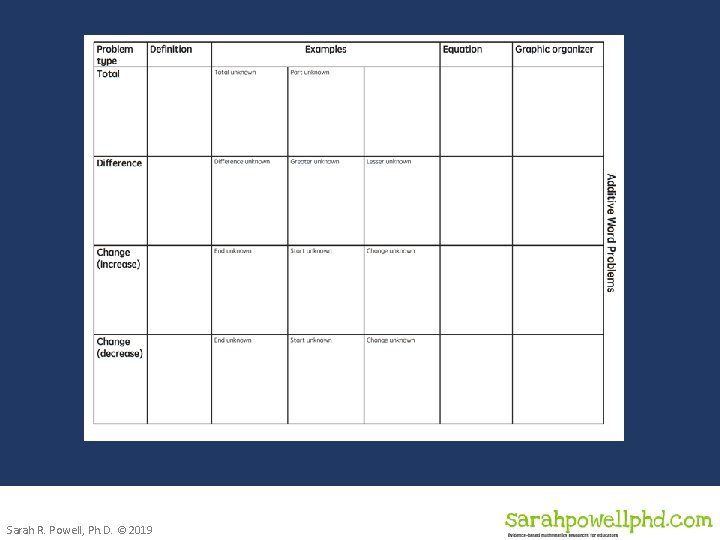
Sarah R. Powell, Ph. D. © 2019
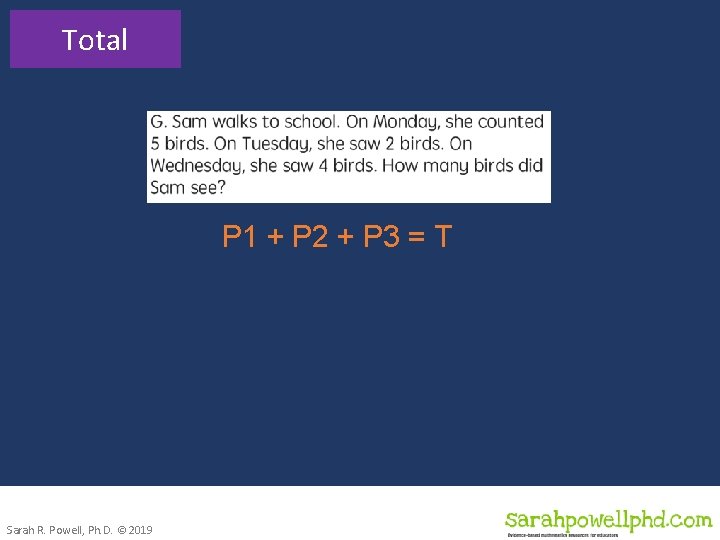
Total P 1 + P 2 + P 3 = T Sarah R. Powell, Ph. D. © 2019
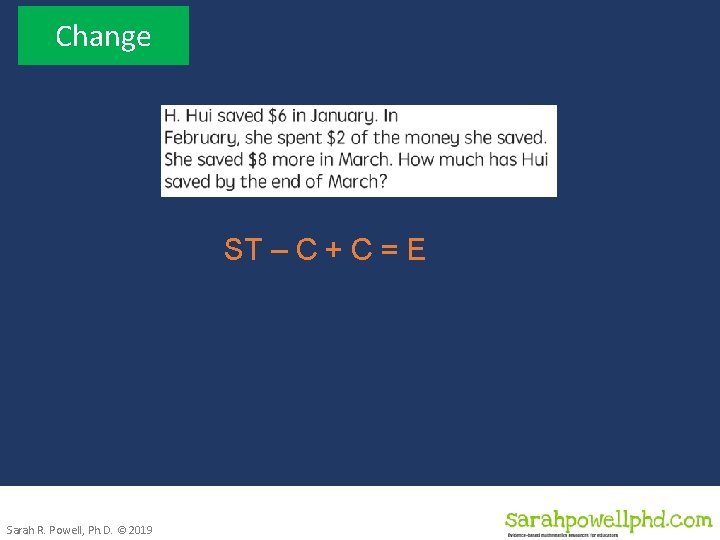
Change ST – C + C = E Sarah R. Powell, Ph. D. © 2019
Let’s Review What’s a Total problem? What’s a Difference problem? What’s a Change problem? Sarah R. Powell, Ph. D. © 2019
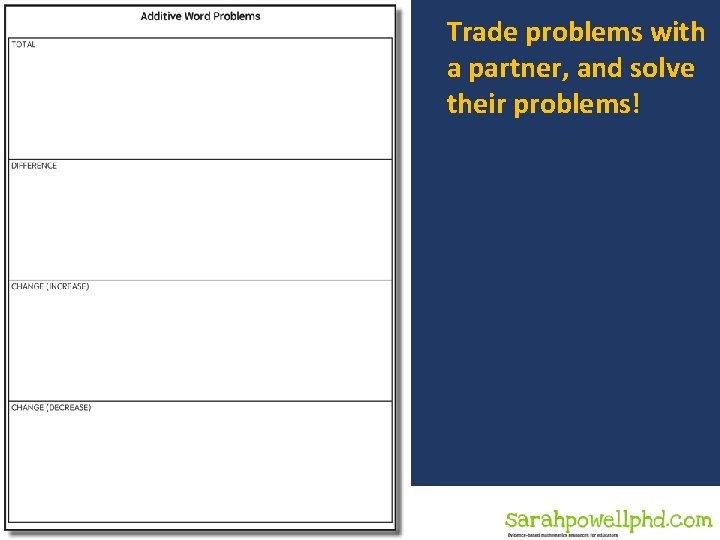
Trade problems with a partner, and solve their problems! Sarah R. Powell, Ph. D. © 2019

Schema Quiz Time! Sarah R. Powell, Ph. D. © 2019
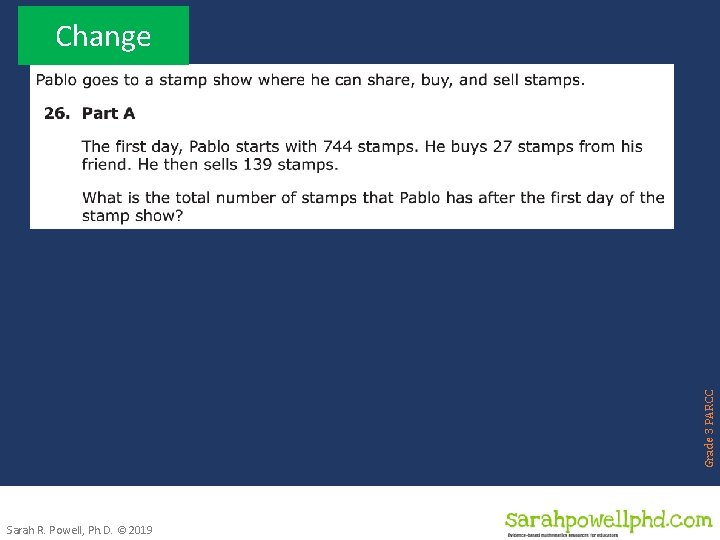
Grade 3 PARCC Change Sarah R. Powell, Ph. D. © 2019
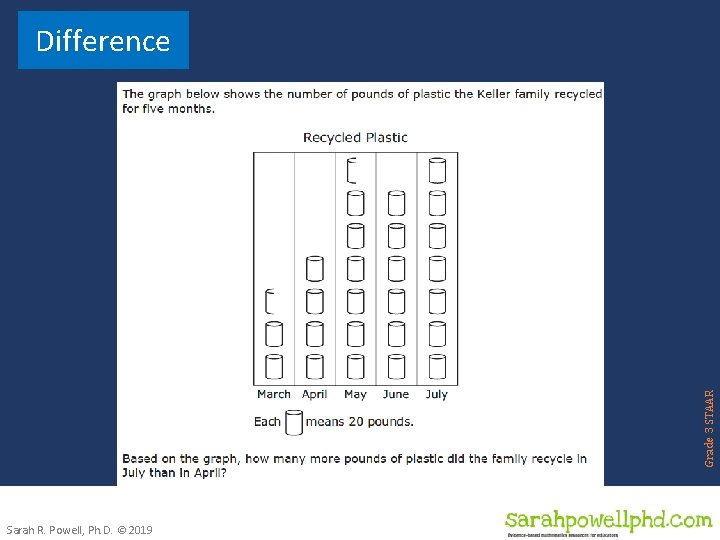
Grade 3 STAAR Difference Sarah R. Powell, Ph. D. © 2019
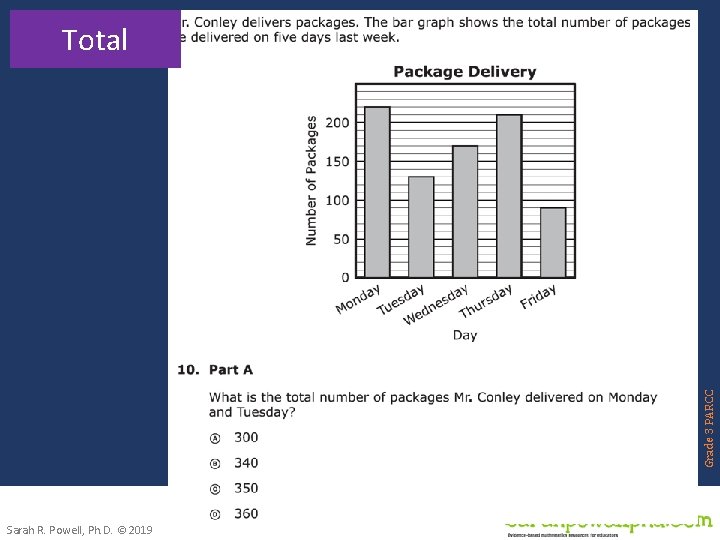
Grade 3 PARCC Total Sarah R. Powell, Ph. D. © 2019
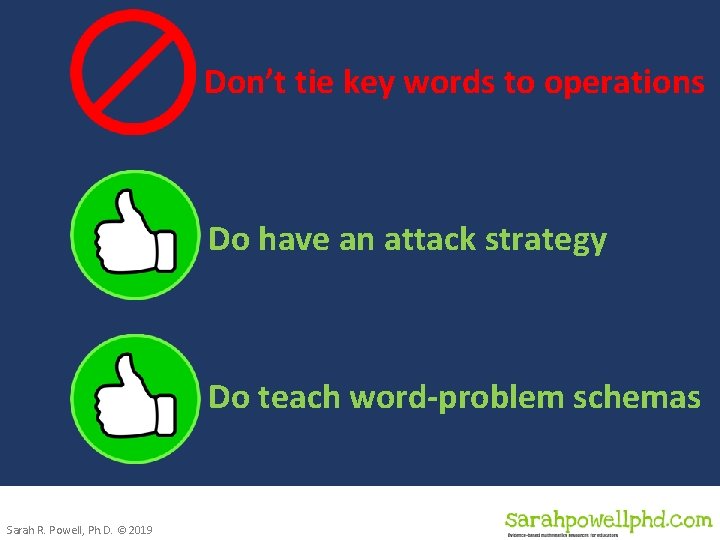
Don’t tie key words to operations Do have an attack strategy Do teach word-problem schemas Sarah R. Powell, Ph. D. © 2019
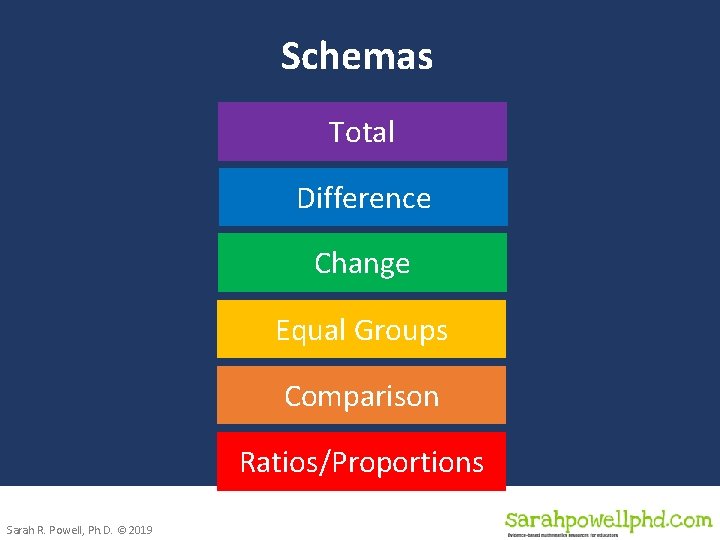
Schemas Total Difference Change Equal Groups Comparison Ratios/Proportions Sarah R. Powell, Ph. D. © 2019

srpowell@austin. utexas. edu @sarahpowellphd 119 Sarah R. Powell, Ph. D. © 2019
- Slides: 75