
Effective Vocabulary Instruction INDIRECT INSTRUCTION EXPOSING STUDENTS TO
Effective Vocabulary Instruction INDIRECT INSTRUCTION • EXPOSING STUDENTS TO A LOT OF NEW WORDS AND HAVING THEM READ A LOT. • HELPING STUDENTS DEVELOP AN APPRECIATION FOR WORDS AND EXPERIENCE ENJOYMENT AND SATISFACTION IN THEIR USE OF VOCABULARY. DIRECT INSTRUCTION • PRE-TEACH OR FRONTLOAD DIFFICULT VOCABULARY PRIOR TO READING
Frontloading Vocabulary: How to choose? Preview text and identify words that are… ◦ ◦ ◦ frequently encountered in text, important to understand main idea or concept, not a part of your students’ prior knowledge, not likely to be learned independently through the use of context, challenging for your students. Have your students do the work and identify words they do not know. Work from this list and add to it as necessary. If a word is adequately defined in text there is no need to directly teach; however, if it is found to be difficult for students to understand – expand on it after reading during a discussion.
Confusing Vocabulary: What do you know? HOMONYMS REFER TO BOTH HOMOPHONES AND HOMOGRAPHS (THERE IS OVERLAP IN THESE CATEGORIES THAT CREATES CONFUSION, BUT IF YOU BREAK THEM APART IT IS EASIER TO UNDERSTAND). HOMOPHONES - ARE WORDS THAT ARE PRONOUNCED THE SAME, BUT HAVE DIFFERENT SPELLINGS, DERIVATION, OR MEANINGS. EXAMPLES THAT MAY OCCUR IN MATH AND/OR CREATE CONFUSION: TO, TWO, AND TOO; FORE AND FOUR; PAIR AND PEAR; SUM AND SOME; AND THERE AND THEIR. HOMOGRAPHS - ARE WORDS THAT ARE SPELLED THE SAME, BUT DIFFER IN ORIGIN, MEANING, OR PRONUNCIATION. EXAMPLES THAT MAY OCCUR IN MATH AND/OR CREATE CONFUSION: VOLUME (A SERIES OF BOOKS, NOISE LEVEL, OR A MEASURE OF SPACE) TEAR (RIP OR DROP FROM EYE); BOW (SHIP OR ARROW). HETERONYMS - ARE WORDS SPELLED THE SAME WAY, BUT WHEN PRONOUNCED DIFFERENTLY, THEY HAVE A DIFFERENT MEANING. EXAMPLES THAT MAY OCCUR IN MATH AND/OR CREATE CONFUSION: SUBJECT, OBJECT, PROJECT, RECORD, AXES, NUMBER, CONVERT, AND CLOSE.
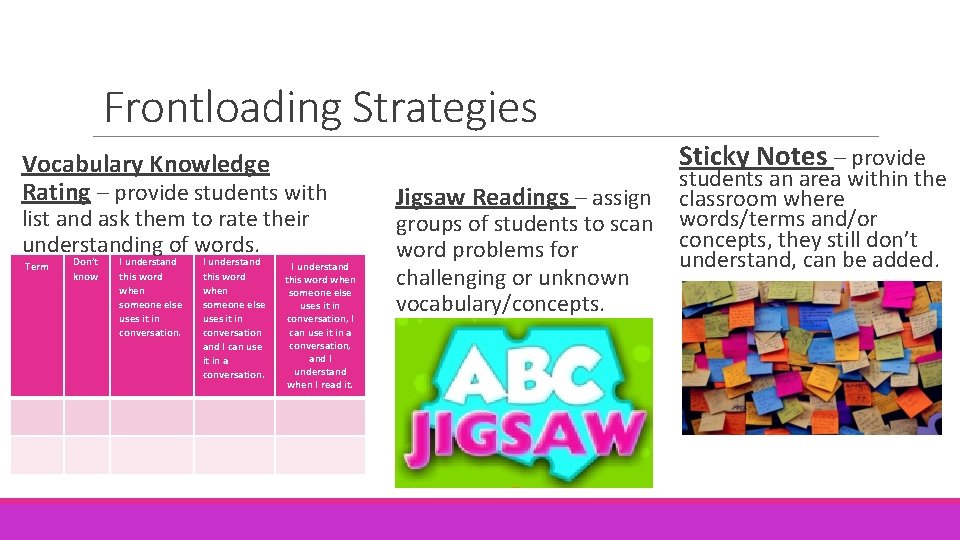
Frontloading Strategies Vocabulary Knowledge Rating – provide students with list and ask them to rate their understanding of words. Term Don’t know I understand this word when someone else uses it in conversation and I can use it in a conversation. I understand this word when someone else uses it in conversation, I can use it in a conversation, and I understand when I read it. Sticky Notes – provide Jigsaw Readings – assign groups of students to scan word problems for challenging or unknown vocabulary/concepts. students an area within the classroom where words/terms and/or concepts, they still don’t understand, can be added.
- Slides: 4