
Effective Vocabulary Instruction in Science by Thersea Burzynski
Effective Vocabulary Instruction in Science by Thersea Burzynski, CESA 10
Contents • Overview of research related to vocabulary instruction/learning • Strategies matched to research • Marzano’s Six Step process for Vocabulary Instruction • Activities for staff
The Role of Science Vocabulary “Scientific investigations, ” Neils Bohr pointed out, “are not exclusively formal, mathematical affairs for they also involve informal discussions in which key concepts are explored and understood. ” Foundations of Physics Vol 18, p. 1233
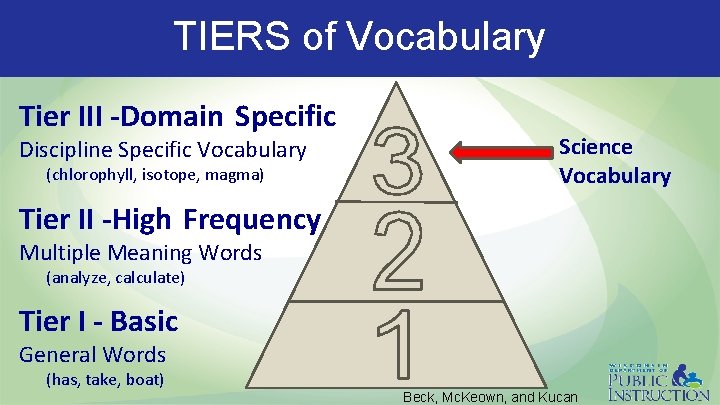
TIERS of Vocabulary Tier III -Domain Specific Discipline Specific Vocabulary (chlorophyll, isotope, magma) Science Vocabulary Tier II -High Frequency Multiple Meaning Words (analyze, calculate) Tier I - Basic General Words (has, take, boat) Beck, Mc. Keown, and Kucan
Explicit Vocabulary Instruction Research indicates that direct instruction in vocabulary can increase vocabulary learning and comprehension. Effect Size =. 97 SD (John Hattie, 2009)
Elements of Effective Vocabulary Direct Instruction • Presenting individual terms and their descriptions in rich contexts (Graves, 2000; National Reading Panel, 2000; Stahl & Fairbanks, 1986) • Asking students to generate information about terms (Anderson & Reder, 1979; Graves, 2000; Nagy, 2005; National Reading Panel, 2000; Scott et al. , 2003; Stahl & Clark, 1987; Stahl & Fairbanks, 1986; Vogel, 2003) • Using multimedia methods (words, pictures, animations, etc. ) to introduce and practice terms (Mayer, 2001; Mayer & Moreno, 2002; National Reading Panel, 2000; Neuman et al. , 2011; Sadoski & Paivio, 2001) • Asking students to relate new terms to words they already know (Anderson & Reder, 1979; Booth, 2009; Chi & Koeske, 1983; Entwisle, 1966; Glaser, 1984; Levelt, Marzano, Robert J. ; Rogers, Katie (2014 -12 -10). Roelofs, & Meyer, 1999; Scott et al. , 2003; Stahl & Murray, 1994; Stahl & Nagy, 2006; Tinkham, 1997) • Providing multiple exposures to new terms and opportunities to use those terms in the classroom (Beck, Mc. Keown, & Kucan, 2002; Beck et al. 1982; Bowman, Donovan, & Burns, 2000; Brophy & Good, 1986; Daniels, 1994, 1996; Dole, Sloan, & Trathen, 1995; Hoffman, 1991; Leung, 1992; Mc. Keown et al. , 1985; Mc. Keown, Beck, & Sandora, 2012; National Reading Panel, 2000; Pressley, Allington, Wharton-Mc. Donald, Block, & Morrow, 2001; Rosenshine, 1986; Scott et al. , 2003; Sénéchal, 1997; Snow, Burns, & Griffin, 1998; Stahl & Fairbanks, 1986; Wharton-Mc. Donald, Pressley, & Hampston, 1998)Marzano, Robert J. ; Rogers, Katie (2014 -12 -10).
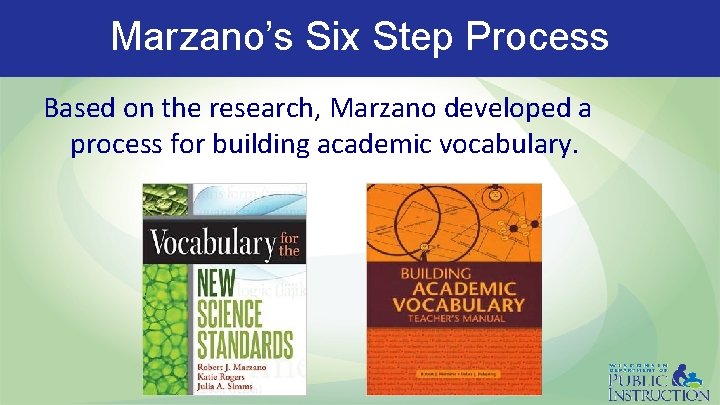
Marzano’s Six Step Process Based on the research, Marzano developed a process for building academic vocabulary.
Marzano’s 6 -Step Process 1) Provide a description, explanation, or example. Include a visual representation. (Flaw with relying on dictionary definitions)
Marzano’s 6 Steps Cont’d 2) Ask students to put the term into their own words. 3) Ask students to construct visual.
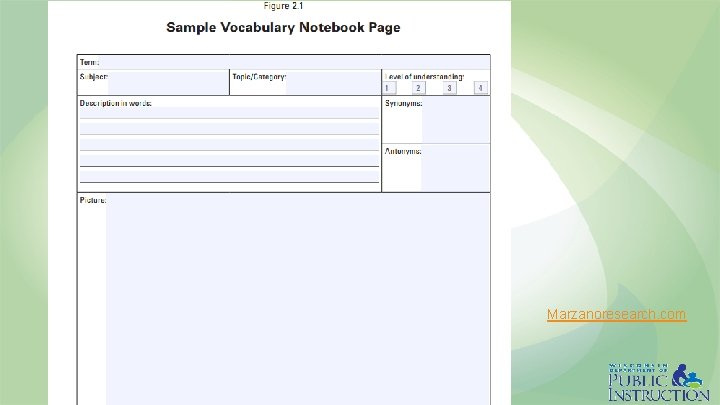
Marzanoresearch. com
Marzano’s 6 Step Process 4) Engage students periodically in adding experience with the words. Examples include: -Phenomenon Exploration/Explanation -Modeling -Inquiry -Videos -Labs -Field Trips -Demonstrations -Reading/Research Vocabulary for the New Science Standards: Marzano’s Resource Site:
Marzano’s 6 Steps Cont’d 5) Students should USE/SPEAK the words often. Examples Include: - Argument/Debate - Summarizing - Discourse Structures - Word Walls, modeling, notebooking - Writing
Productive Talk Terc - Inquiry Project in Science Talk
Pause and Chunk Information Regularly: – Keep your ‘lectures’ short Pause every 5 to 8 min. in ES & 8 to 12 min. in MS/HS – Have students ‘chunk’ or process the information through strategies such as summarization, think-pair-share, or compare and contrast. Eric Jensen: Engaging Students with Poverty in Mind
Scientific Writing Informational Writing & Persuasive Writing Examples: • • • Research Proposals Editorials Article Reviews Letters to the Editor Commentary Forums • Research Articles • Letters to community members or govt • Blogs • Lab Reports
Marzano’s 6 -Steps Cont’d 6) Involve students periodically in games that allow them to play with terms. • Games for the Science Curriculum by Norman Herr PH. D. • Metaphors and Analogies Power Tools for Teaching Any Subject by Rick Wormeli • Vocabulary Games for the Classroom Lindsay Carleton and Robert Marzano
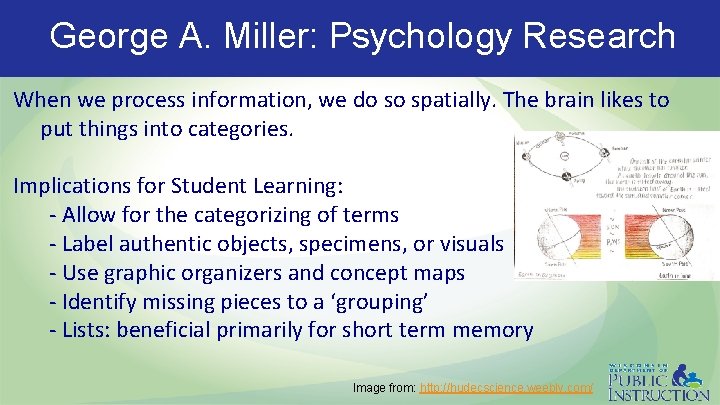
George A. Miller: Psychology Research When we process information, we do so spatially. The brain likes to put things into categories. Implications for Student Learning: - Allow for the categorizing of terms - Label authentic objects, specimens, or visuals - Use graphic organizers and concept maps - Identify missing pieces to a ‘grouping’ - Lists: beneficial primarily for short term memory Image from: http: //hudecscience. weebly. com/
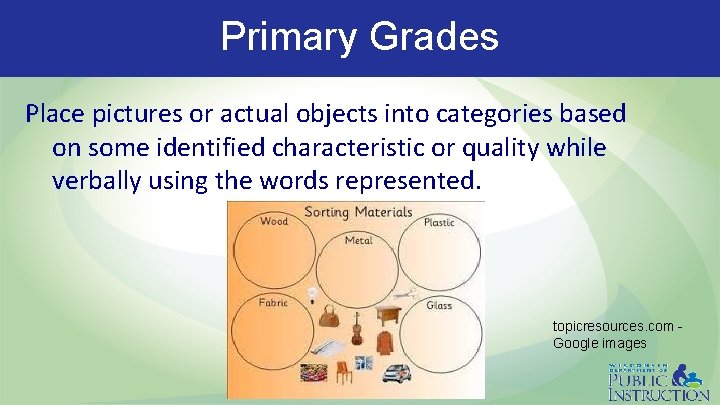
Primary Grades Place pictures or actual objects into categories based on some identified characteristic or quality while verbally using the words represented. topicresources. com Google images
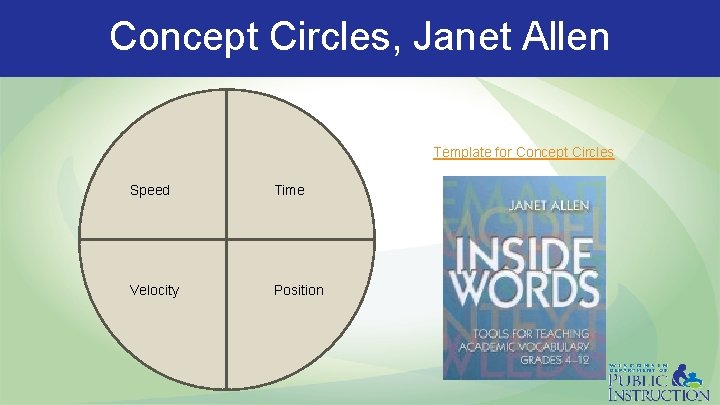
Concept Circles, Janet Allen Template for Concept Circles Speed Time Velocity Position
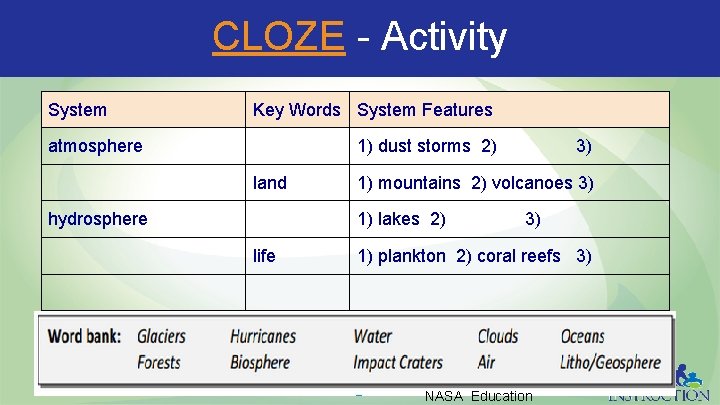
CLOZE - Activity System Key Words System Features atmosphere 1) dust storms 2) land hydrosphere 1) mountains 2) volcanoes 3) 1) lakes 2) life 3) 3) 1) plankton 2) coral reefs 3) NASA Education
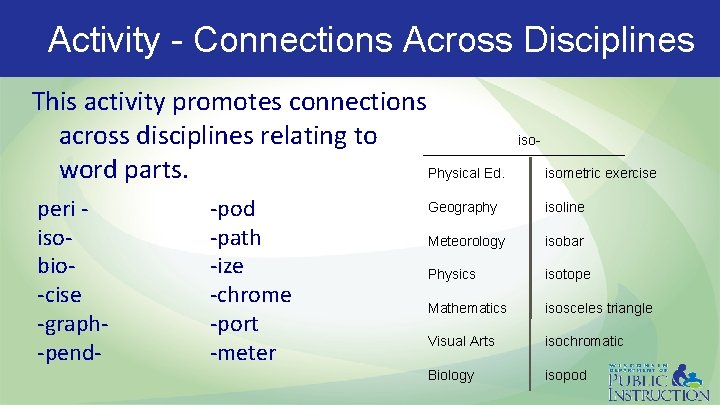
Activity - Connections Across Disciplines This activity promotes connections across disciplines relating to iso_____________ word parts. Physical Ed. isometric exercise peri isobio-cise -graph-pend- -pod -path -ize -chrome -port -meter Geography isoline Meteorology isobar Physics isotope Mathematics isosceles triangle Visual Arts isochromatic Biology isopod
Greek and Latin Foundations Science Root & Affix List Etymology Dictionary Biology and Medical - Root and Affix Dictionary Root Words Frequently used in Chemistry
Activity for A Science Dept. Discuss: ● How do we have students learn science vocabulary (tier III words)? ● How important is it to explicitly teach tier II or process words? ● Do we have specific discourse structures or protocols in place?
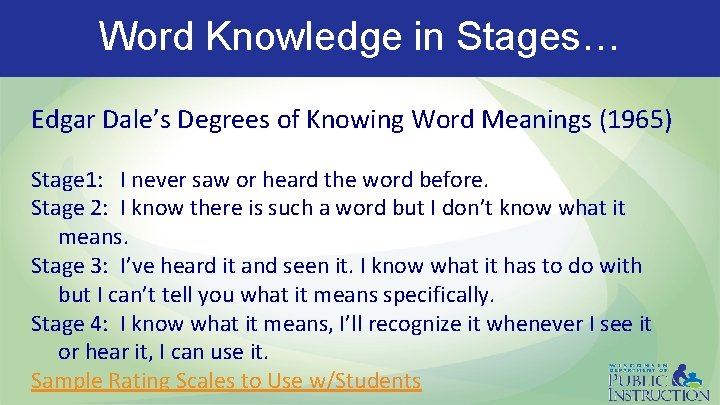
Word Knowledge in Stages… Edgar Dale’s Degrees of Knowing Word Meanings (1965) Stage 1: I never saw or heard the word before. Stage 2: I know there is such a word but I don’t know what it means. Stage 3: I’ve heard it and seen it. I know what it has to do with but I can’t tell you what it means specifically. Stage 4: I know what it means, I’ll recognize it whenever I see it or hear it, I can use it. Sample Rating Scales to Use w/Students
Engagement in Scientific Practices Provides the Context for Vocabulary Development • Engaging Tasks allow for a deep building of concept development and vocabulary use -investigation -discourse -modeling & representations -analysis explanations -argument -application -extended research • Multiple encounters with vocabulary in a variety of contexts allow words to go from the receptive level of understanding to the productive level categorize -compare/contrast -identify similarities and differences -deconstruct -analogies and metaphors
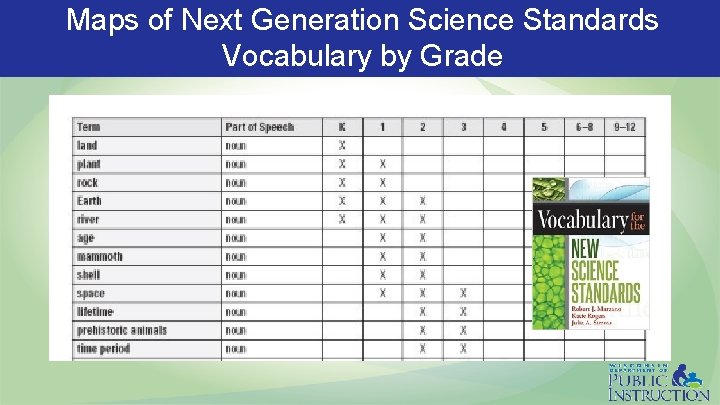
Maps of Next Generation Science Standards Vocabulary by Grade
ACT Science Vocabulary List • ACT Science Vocabulary list • Test Prep Coach - ACT Vocabulary The ACT does not expect you to know the exact definition as much as the general concept and the context of the terms used in the passages.
SAT Vocabulary Change 2016 As part of the SAT redesign there will be less of an emphasis on vocabulary terms with little context such as the sentence completion questions and there will be a greater emphasis on the meaning of words in extended contexts and on how word choice shapes meaning, tone, and impact. Specifications for the New SAT ( pg. 10)
Language of Science Although some might question whether the time spent on vocabulary instruction is worthwhile, Judith Scott, Dianne Jamieson-Noel, and Marlene Asselin (2003) explained that “when conceptual understanding is central, the time devoted to understanding the vocabulary is well worth the effort…. ” Marzano, Robert J. ; Rogers, Katie (2014 -12 -10). Vocabulary for the New Science Standards
Review and Contact Info • Overview of research related to vocabulary instruction/learning • Strategies matched to research • Marzano’s Six Step Process for Vocabulary Instruction • Activities for staff Kevin Anderson – kevin. anderson@dpi. wi. gov Thersea Burzynski – tburzynski@cesa 10. k 12. wi. us
- Slides: 30