
Effective Victim Response Its Everyones Job Terminology TraumaInformed
Effective Victim Response: It’s Everyone’s Job!
Terminology Trauma-Informed • An approach involving educating victims, service providers, and the general community about the impact of trauma on the health and well-being of the victim; attending to the victim’s emotional and physical safety; and using resources, services, and support to increase the victim’s capacity to recover • Full development of a trauma-informed response will include all disciplines involved in response efforts (dispatch, patrol, detectives, supervisors, nurses, victim services personnel, prosecutors, and service providers). National Institute of Justice, “Notifying Sexual Assault Victims After Testing Evidence” (Washington D. C. : U. S. Department of Justice, Office of Justice Programs, January 2016).

Terminology Victim-Centered • An approach involving the victim being at the center of all decisions regarding victim recovery and involvement with the criminal justice system • The victim’s choice, safety, and well-being are the focus, and the needs of the victim are everyone’s concern. • Full embodiment of victim-centered work will result in a transition from case ownership to case stewardship. National Institute of Justice, “Notifying Sexual Assault Victims After Testing Evidence” (Washington D. C. : U. S. Department of Justice, Office of Justice Programs, January 2016).
Victim Engagement • Effective engagement with the criminal justice system relies upon victims’ belief that the system will benefit them. • Engagement conveys a different meaning than cooperation. • • Is there a feeling of equity between victims and system professionals? Is there a basis for trust? • Engagement is not always consistent. • • • Processing information takes time. Information triggers multiple decisions/outcomes. Healing steps influence engagement.
Core Principles of Enhancing Law Enforcement Response to Victims
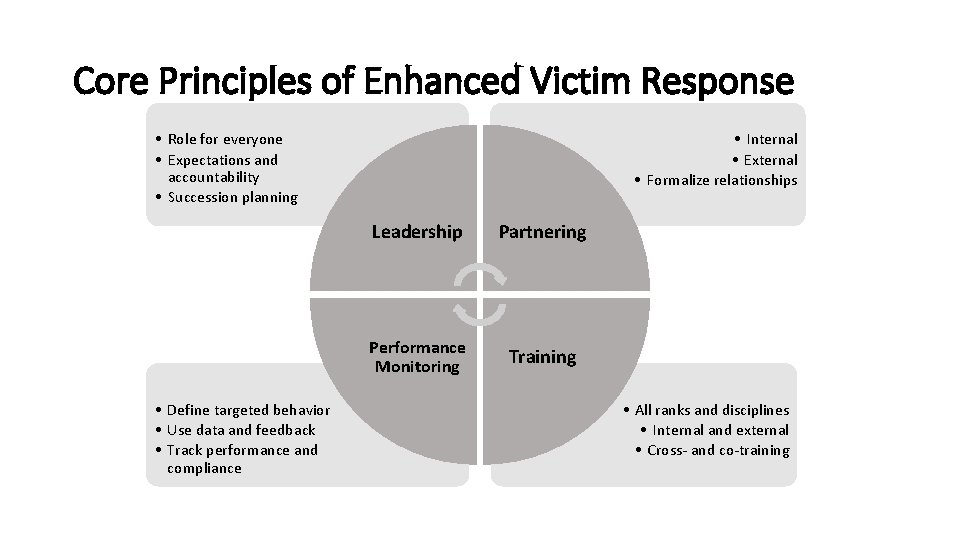
Core Principles of Enhanced Victim Response • Role for everyone • Expectations and accountability • Succession planning • Define targeted behavior • Use data and feedback • Track performance and compliance • Internal • External • Formalize relationships Leadership Partnering Performance Monitoring Training • All ranks and disciplines • Internal and external • Cross- and co-training
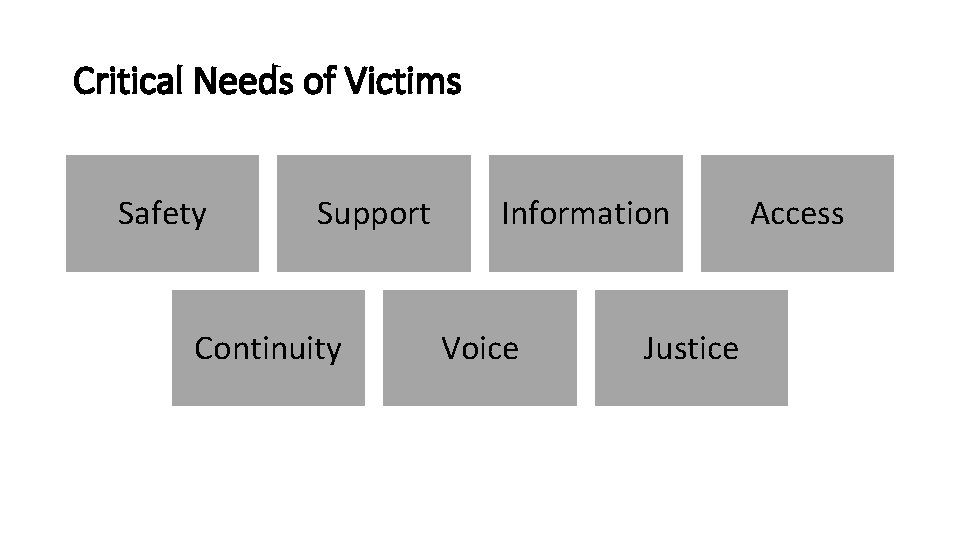
Critical Needs of Victims Safety Support Continuity Information Voice Justice Access

Discussion: Identifying Your Role with Victims
Discussion: Identifying Your Role with Victims • What is your role? • When do you have contact with victims? • What is challenging about this contact? • How do you help address the critical needs of victims in your role? • How could this contact be more responsive to the needs of victims? • What tools/training would help you feel more supported in your role with victims? • How comfortable are you connecting victims with victim services personnel?
Benefits of Effective Victim Response
What’s in It for Law Enforcement? Law enforcement may experience • enhanced victim engagement in cases—engagement leads to improved communication with victims • increased knowledge base—topics, people, customs, approaches that are new and challenging can be used to enhance response to victims • ability to focus on responsibilities related to the suspect and the case, knowing the victim is supported
What’s in It for Professional Staff? Professional staff may experience • ability to communicate the benefits of engaging in the criminal justice system to victims with sincerity and confidence • increased knowledge base—topics, people, customs, and approaches that are new and challenging can be used to enhance response to victims • satisfaction of being part of a larger purpose—everyone wants to feel that their work and contributions matter
What’s in It for Victims? Victims may experience • having a designated representative to focus on their needs—safety, support, information, access, continuity, voice, justice/resolution • reduction in crisis responses—prediction and preparation can help with decision-making • increased satisfaction from criminal justice system engagement—people feel better when they are given access and autonomy
Enhanced Victim Response Take -Aways • Enriched emotional and physical safety of victims • Partnerships maximize resources, efficiency, and outcomes • Broadened connection to resources and support for victims • Improved relationships among criminal justice professionals, community partners, victims, and community members • Restoration of victim choice and autonomy • Increased opportunities for training and crossdiscipline education • Improved community safety

Questions
- Slides: 15