
Effective Transport Systems Circulatory System Excretory System Waste
- Slides: 27
Effective Transport Systems: • Circulatory System • Excretory System - Waste Removal
Why have a transport system? • Single-celled organisms can exchange directly with their environment to obtain what they need. How are they able to do this? • Substances moved by diffusion alone in larger organisms would be very slow. • Materials, such as nutrients, have to be actively transported. – E. g. Oxygen from gas exchange surface in the lungs to cells in your toes.
Why have a transport system? • In active organisms, living tissue can be a long way from where important materials are obtained. • A high metabolic rate has O 2 and nutritional requirements. Need to deliver! • Muscular pumps, such as the heart, used to deliver these requirements via fluid.
Effective Transport System Features • Large surface area for exchange • Reliable and responsive means of moving fluid around the body • Control mechanisms to regulate the transport according to need. • A fluid that is efficient in the amount of material it can carry.
Mammalian Transport Systems Mammals are diverse yet their transport systems are all similar. They have two transport systems: • the blood circulatory system, which is closed and provides for the majority of the animal's transport needs • the lymphatic drainage system, which is an open system that plays a vital role in maintaining osmotic and fluid balance in tissues, and in immune defences.
Types of cellular fluid • Intracellular fluid: – Fluid contained within the plasma membrane, the fluid of the cytosol of a cell. • Everything else is Extracellular fluid: – Fluid outside cell membranes. Between cells and tissues it is referred to as interstitial fluid. • Blood contains both forms, intracellular inside blood cells and plasma (extracellular). The exchange of materials between blood and tissue occurs between plasma and interstitial fluid
The Circulatory System
Open vs Closed Circulatory Systems Open (Insects): No specialised transporting fluid, interstitial fluids pumped away from the heart. – Floats freely in the body then eventually returns to the heart. – Slow system due to low pressures and long circuit times.
Open vs Closed Circulatory Systems Closed (Mammals): Fluid enclosed in a system of tubes the entire time (capillaries and vessels) and pumped by a muscle (heart). • High pressure and short circuit times.
The Circulatory System Two pathways: • Pulmonary vessels to and from the lungs • Systemic vessels to and from the rest of the body
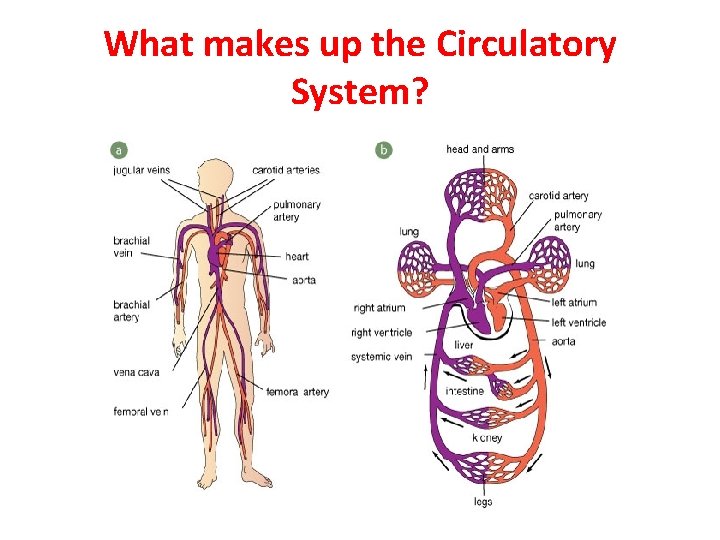
What makes up the Circulatory System? • Heart, a muscular pump with two pumping chambers (ventricles), Moves blood throughout the circulatory system. • Veins and arteries form a network of muscular channels carrying blood to and from the heart. • Pulmonary vessels. carry blood to and from the lungs. • Systemic vessels carry blood to and from all other parts of the body. • Capillaries, numerous fine channels with thin walls, provide large surface area where exchange of substances occurs. • Blood, the circulating fluid, contains cells and is highly specialised for transport and defence.
What makes up the Circulatory System?
Removing Wastes – The Excretory System
Removing Wastes • Getting rid of substances that are no longer of any use. E. g. Carbon Dioxide from respiration. • Some metabolic waste products can be toxic. Toxic materials can also be absorbed from heterotroph’s diets. • Once they rise above desirable levels they are removed. • Excretion is the removal of substances that were once part of an organism’s body. Different to egestion. • Egestion is the removal of undigested food as faeces.
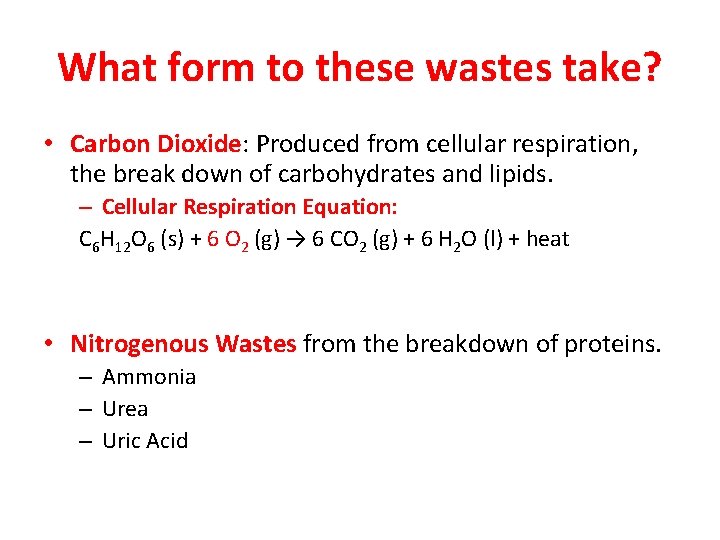
What form to these wastes take? • Carbon Dioxide: Produced from cellular respiration, the break down of carbohydrates and lipids. – Cellular Respiration Equation: C 6 H 12 O 6 (s) + 6 O 2 (g) → 6 CO 2 (g) + 6 H 2 O (l) + heat • Nitrogenous Wastes from the breakdown of proteins. – Ammonia – Urea – Uric Acid
Nitrogenous Wastes Must be removed from cells as they can become toxic. Most animals secrete several nitrogenous compounds. How much and what forms depend on: • the availability of water in the animal's environment • the toxicity of the nitrogenous waste • the energy cost in producing the nitrogenous waste • the pattern of development of the species (how the embryo develops, e. g. egg)
Nitrogenous Wastes Ammonia: Formed from the breakdown of proteins, and is converted via energy consuming processes into Urea or Uric Acid. These have no further use for animals and are removed. Highly toxic molecule but very soluble in water so can be easily removed via diffusion across cell membranes.
Nitrogenous Wastes • Urea Less toxic than ammonia but requires more energy for the conversion. – Highly soluble in water, regulated by the kidneys to minimise water loss when excreted. • Uric Acid Non-toxic but insoluble, and takes twice as much energy than producing urea. – Used by birds and reptiles, as in embryos in egg cannot excrete wastes so has to be non-toxic form. – Precipitates out of solution.
Excretory Organs in Vertebrates • Liver (The Cleaner): Many functions such as protein production and bile secretion, but critical in toxin removal. – Prepares substances for excretion – Detoxifies harmful substances like drugs and alcohol. – Breaks down amino acids into urea – Sends waste products to the kidney for excretion • Kidneys: Filters the blood and reabsorbs useful substances. Sorts the non-recyclable from the recyclable.
The Kidney • Mammals have 2 behind the abdominal cavity. • Blood flow to the kidneys always high, as important in maintaining the stability of the internal environment. • Although kidneys are only about 1% of body tissue, they receive approximately 25% of the body's blood flow.
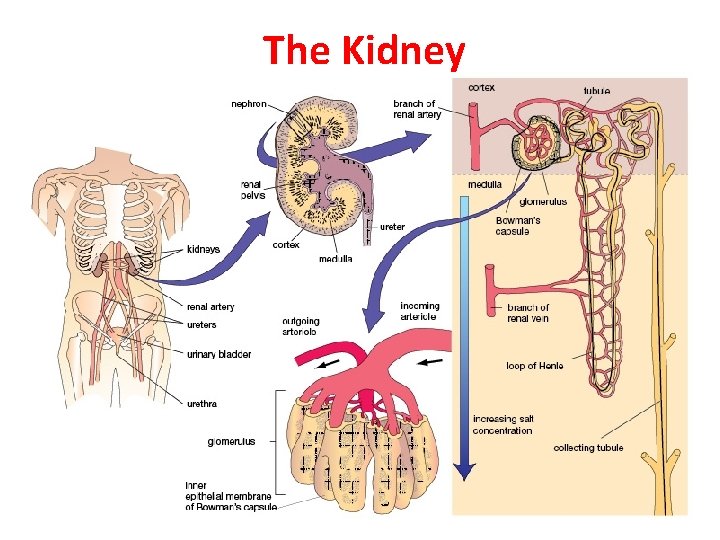
The Kidney • Blood enters the kidney from the aorta through the renal artery • Leaves through the renal vein. • Blood vessels branch throughout the kidney in a complex fashion. • Urine, formed in the kidneys, drains via the ureters into the bladder, for storage, until released via the urethra.
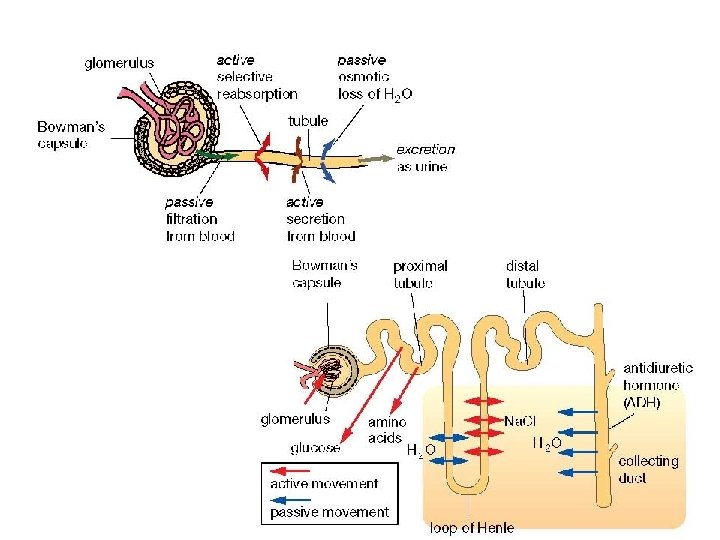
The Kidney • Functions carried out by nephrons • Each composed of a Bowman’s Capsule and a tubular region called loop of Henle • The formation of urine involves passive filtration, selective reabsorption and secretion and the passive removal of water
How The Kidney Works https: //www. youtube. com/watch? v=FN 3 MFh. YPWWo
The Kidney
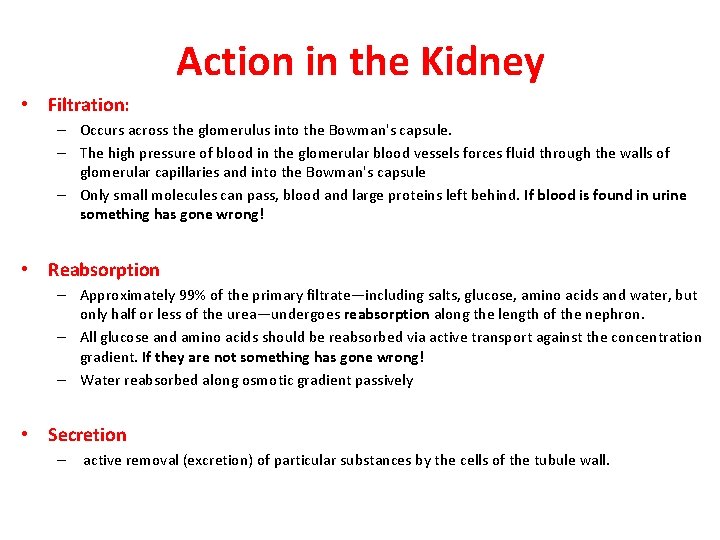
Action in the Kidney • Filtration: – Occurs across the glomerulus into the Bowman's capsule. – The high pressure of blood in the glomerular blood vessels forces fluid through the walls of glomerular capillaries and into the Bowman's capsule – Only small molecules can pass, blood and large proteins left behind. If blood is found in urine something has gone wrong! • Reabsorption – Approximately 99% of the primary filtrate—including salts, glucose, amino acids and water, but only half or less of the urea—undergoes reabsorption along the length of the nephron. – All glucose and amino acids should be reabsorbed via active transport against the concentration gradient. If they are not something has gone wrong! – Water reabsorbed along osmotic gradient passively • Secretion – active removal (excretion) of particular substances by the cells of the tubule wall.
• Active Transport: Requires energy to move substances across membranes • Opposite of Diffusion which occurs simply due to the concentration difference, no energy required.