
Effective Teamwork Week 4 This Photo by Unknown
Effective Teamwork Week 4 This Photo by Unknown Author is licensed under CC BY-SA-NC
Session Aims Reflect on unit requirements Explore theory that connects to recent experiences of teamwork
Task 2 - Autobiography Reflective Autobiography This summative autobiography will contain a discussion of the experience of working as part of a team, which will include an evaluation of key teamwork theories. Learning outcome: On successful completion of this unit the student will be able to: 2, Reflect on key theories of effective team work and processes.

Suggested structure for the autobiography This Photo by Unknown Author is licensed under CC BY
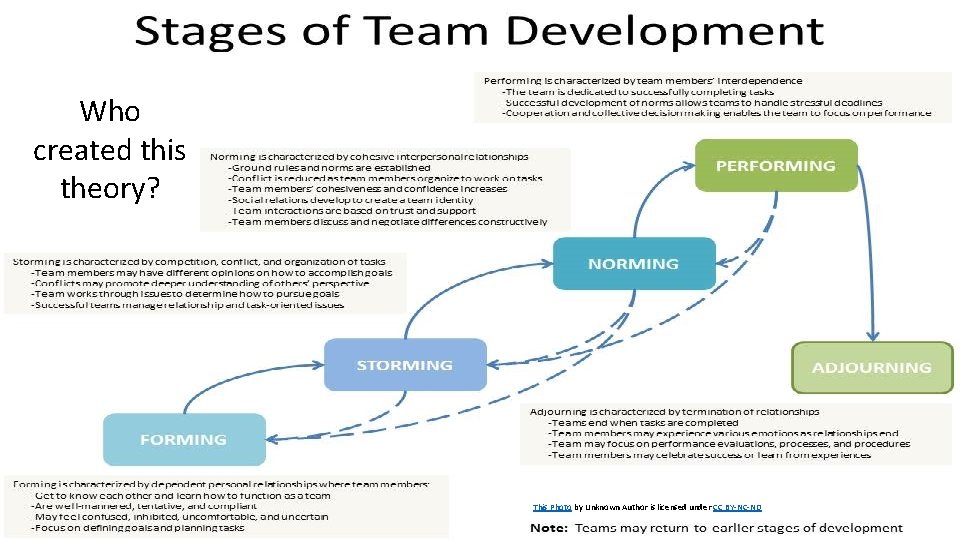
Who created this theory? This Photo by Unknown Author is licensed under CC BY-NC-ND
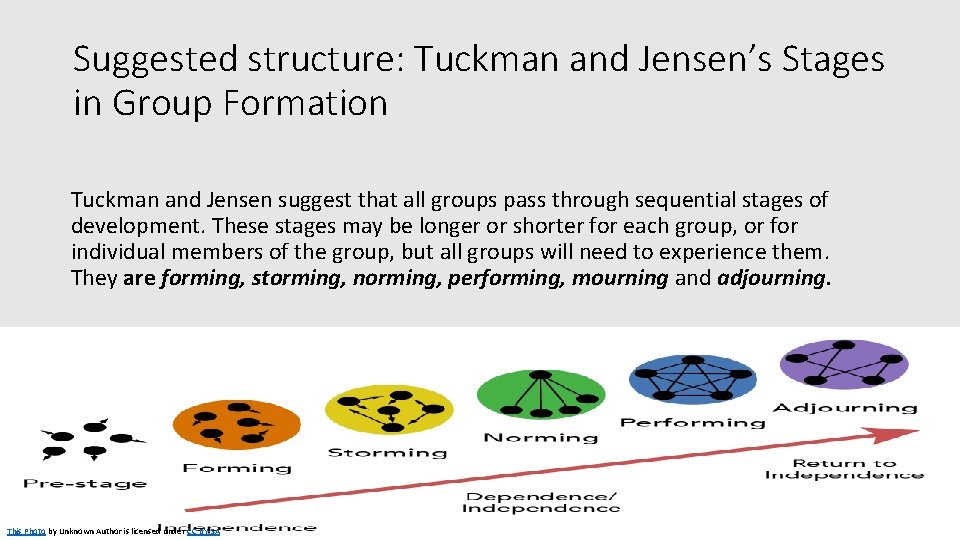
Suggested structure: Tuckman and Jensen’s Stages in Group Formation Tuckman and Jensen suggest that all groups pass through sequential stages of development. These stages may be longer or shorter for each group, or for individual members of the group, but all groups will need to experience them. They are forming, storming, norming, performing, mourning and adjourning. This Photo by Unknown Author is licensed under CC BY-SA
Lets see theory in action…
Reflect on your autobiography as you work through each slide. If you have not already discussed something specific that is mentioned in each stage, consider if this needs to be added to your autobiography and develop a clear plan. There are links to wider reading on each slide, that addresses each stage
Stage 1 - Forming During this stage • individual behaviour is driven by a desire to be accepted by the others, and avoid controversy or conflict. • Serious issues and feelings are avoided, and people focus on being busy with routines, such as team organisation, who does what, when to meet, etc. • individuals are also gathering information and impressions - about each other, and about the scope of the task and how to approach it. • This is a comfortable stage to be in, but the avoidance of conflict and threat means that not much actually gets done. http: //www. chimaeraconsulting. com/tuckman. htm
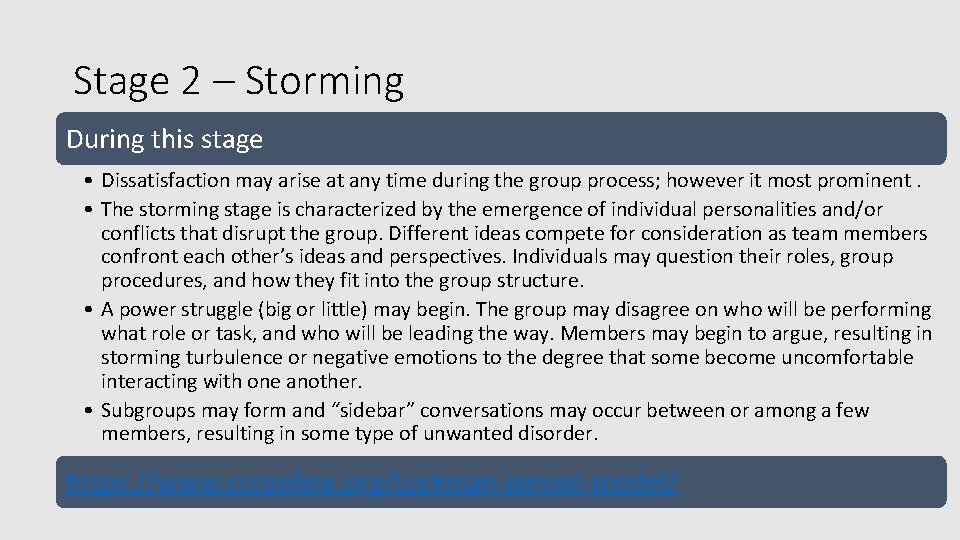
Stage 2 – Storming During this stage • Dissatisfaction may arise at any time during the group process; however it most prominent. • The storming stage is characterized by the emergence of individual personalities and/or conflicts that disrupt the group. Different ideas compete for consideration as team members confront each other’s ideas and perspectives. Individuals may question their roles, group procedures, and how they fit into the group structure. • A power struggle (big or little) may begin. The group may disagree on who will be performing what role or task, and who will be leading the way. Members may begin to argue, resulting in storming turbulence or negative emotions to the degree that some become uncomfortable interacting with one another. • Subgroups may form and “sidebar” conversations may occur between or among a few members, resulting in some type of unwanted disorder. https: //www. ccconline. org/tuckman-jensen-model/
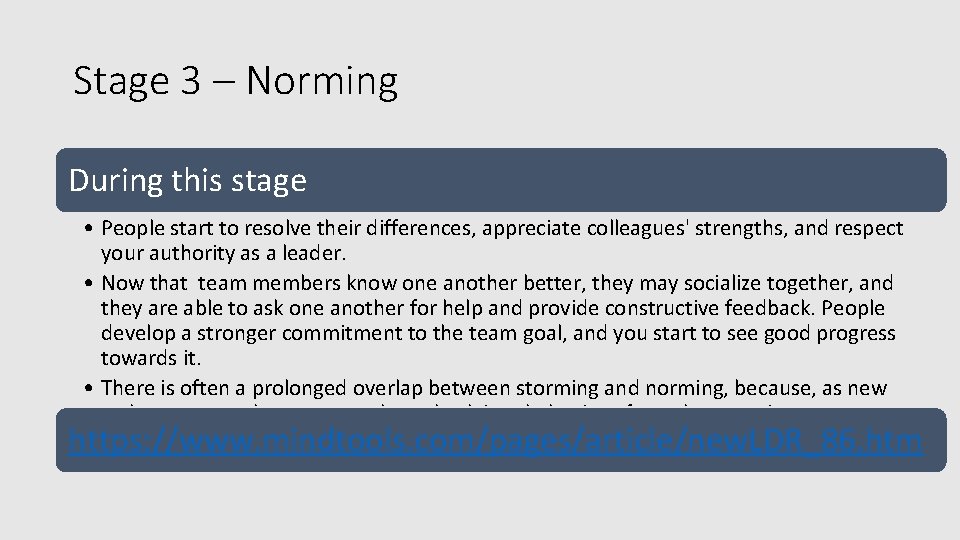
Stage 3 – Norming During this stage • People start to resolve their differences, appreciate colleagues' strengths, and respect your authority as a leader. • Now that team members know one another better, they may socialize together, and they are able to ask one another for help and provide constructive feedback. People develop a stronger commitment to the team goal, and you start to see good progress towards it. • There is often a prolonged overlap between storming and norming, because, as new tasks come up, the team may lapse back into behaviour from the storming stage. https: //www. mindtools. com/pages/article/new. LDR_86. htm
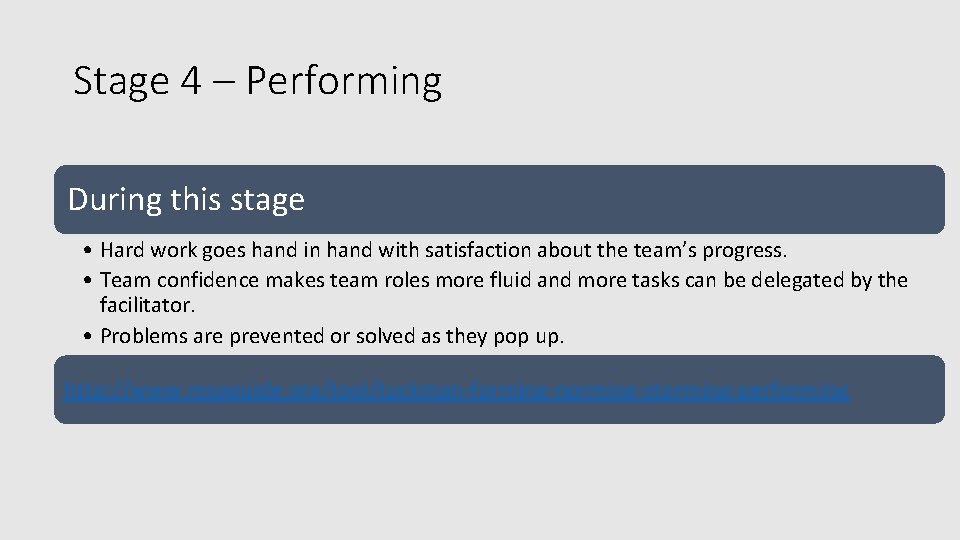
Stage 4 – Performing During this stage • Hard work goes hand in hand with satisfaction about the team’s progress. • Team confidence makes team roles more fluid and more tasks can be delegated by the facilitator. • Problems are prevented or solved as they pop up. http: //www. mspguide. org/tool/tuckman-forming-norming-storming-performing
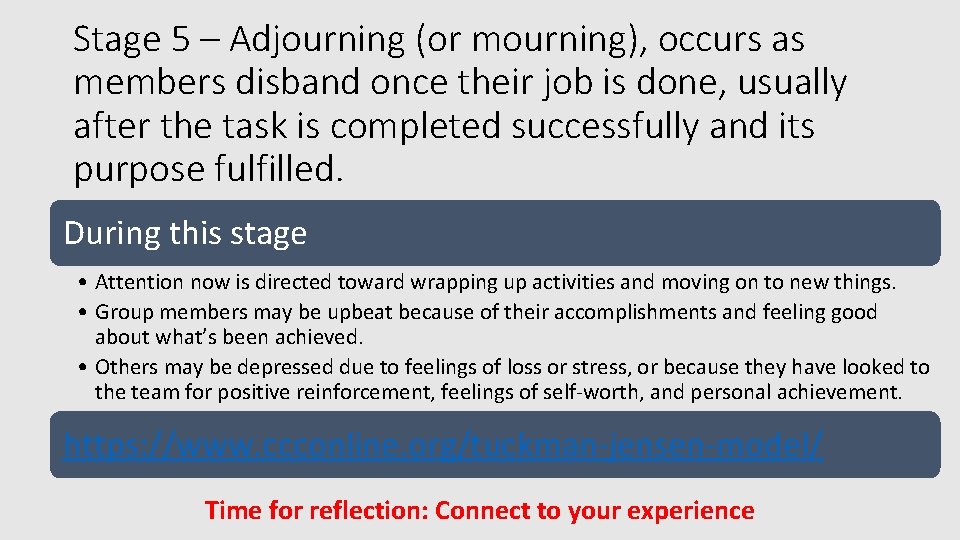
Stage 5 – Adjourning (or mourning), occurs as members disband once their job is done, usually after the task is completed successfully and its purpose fulfilled. During this stage • Attention now is directed toward wrapping up activities and moving on to new things. • Group members may be upbeat because of their accomplishments and feeling good about what’s been achieved. • Others may be depressed due to feelings of loss or stress, or because they have looked to the team for positive reinforcement, feelings of self-worth, and personal achievement. https: //www. ccconline. org/tuckman-jensen-model/ Time for reflection: Connect to your experience
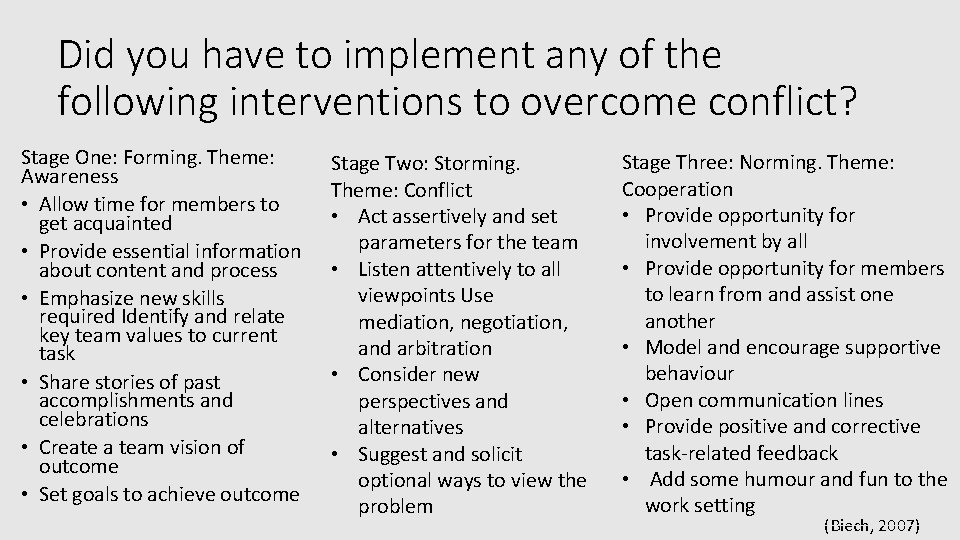
Did you have to implement any of the following interventions to overcome conflict? Stage One: Forming. Theme: Awareness • Allow time for members to get acquainted • Provide essential information about content and process • Emphasize new skills required Identify and relate key team values to current task • Share stories of past accomplishments and celebrations • Create a team vision of outcome • Set goals to achieve outcome Stage Two: Storming. Theme: Conflict • Act assertively and set parameters for the team • Listen attentively to all viewpoints Use mediation, negotiation, and arbitration • Consider new perspectives and alternatives • Suggest and solicit optional ways to view the problem Stage Three: Norming. Theme: Cooperation • Provide opportunity for involvement by all • Provide opportunity for members to learn from and assist one another • Model and encourage supportive behaviour • Open communication lines • Provide positive and corrective task-related feedback • Add some humour and fun to the work setting (Biech, 2007)
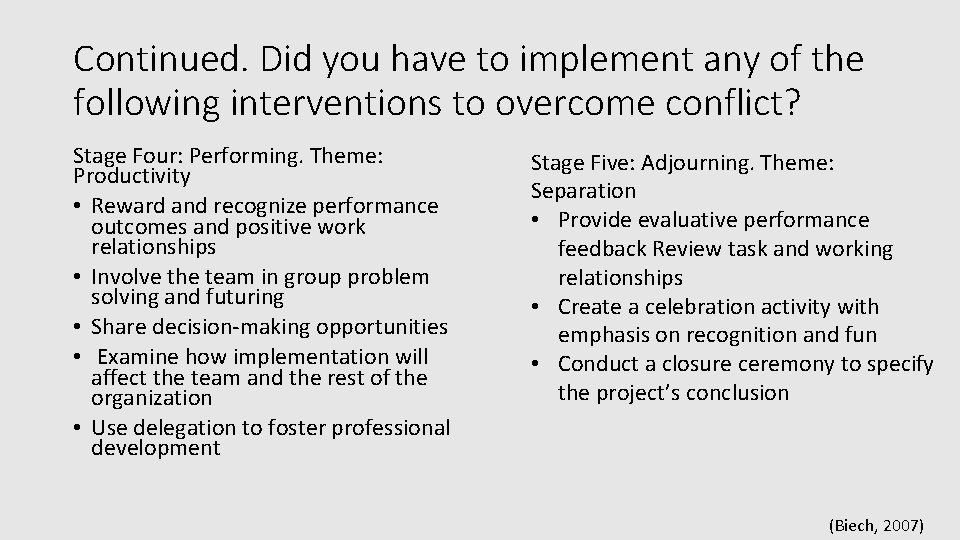
Continued. Did you have to implement any of the following interventions to overcome conflict? Stage Four: Performing. Theme: Productivity • Reward and recognize performance outcomes and positive work relationships • Involve the team in group problem solving and futuring • Share decision-making opportunities • Examine how implementation will affect the team and the rest of the organization • Use delegation to foster professional development Stage Five: Adjourning. Theme: Separation • Provide evaluative performance feedback Review task and working relationships • Create a celebration activity with emphasis on recognition and fun • Conduct a closure ceremony to specify the project’s conclusion (Biech, 2007)
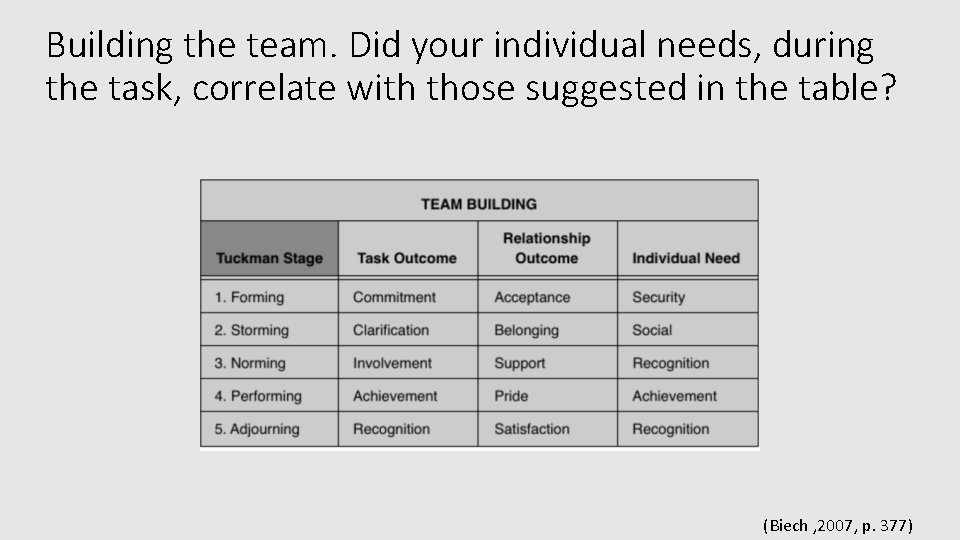
Building the team. Did your individual needs, during the task, correlate with those suggested in the table? (Biech , 2007, p. 377)
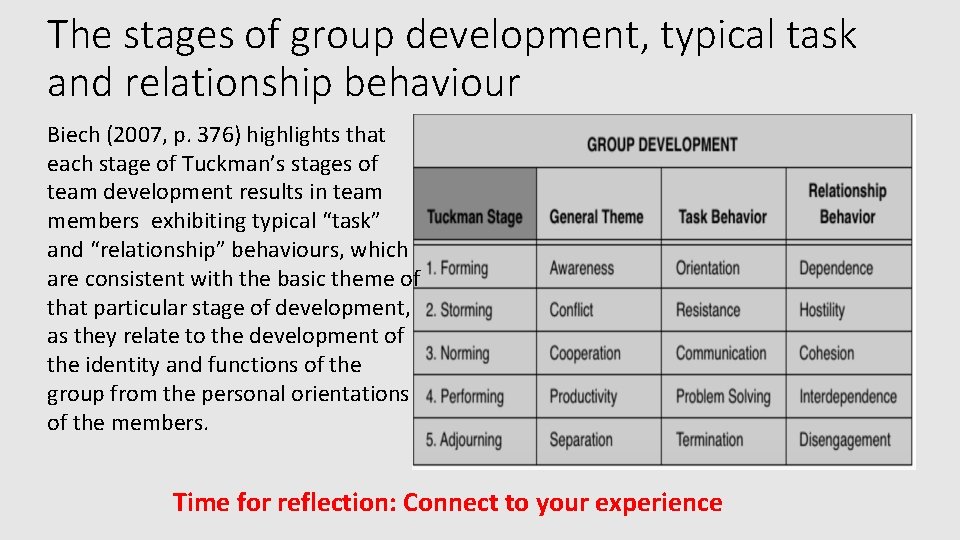
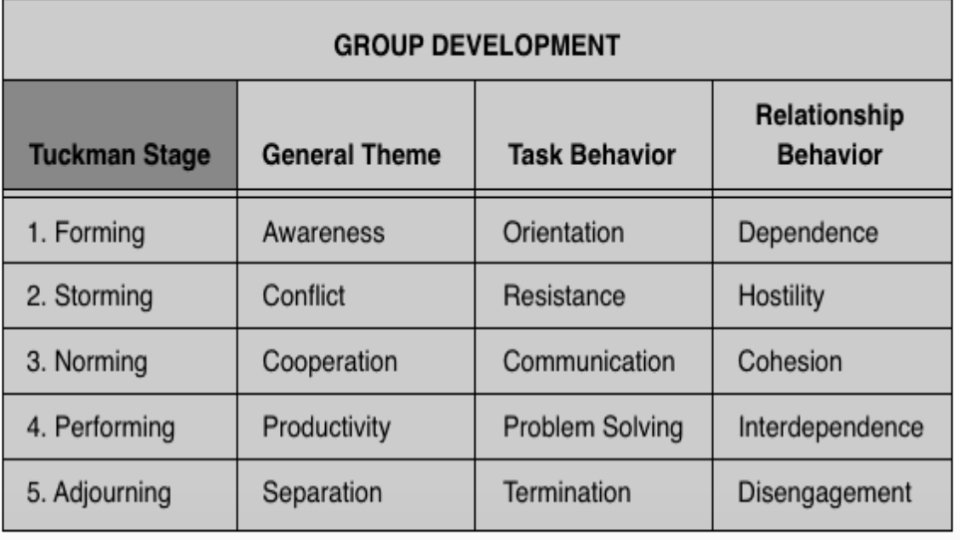
The stages of group development, typical task and relationship behaviour Biech (2007, p. 376) highlights that each stage of Tuckman’s stages of team development results in team members exhibiting typical “task” and “relationship” behaviours, which are consistent with the basic theme of that particular stage of development, as they relate to the development of the identity and functions of the group from the personal orientations of the members. Time for reflection: Connect to your experience
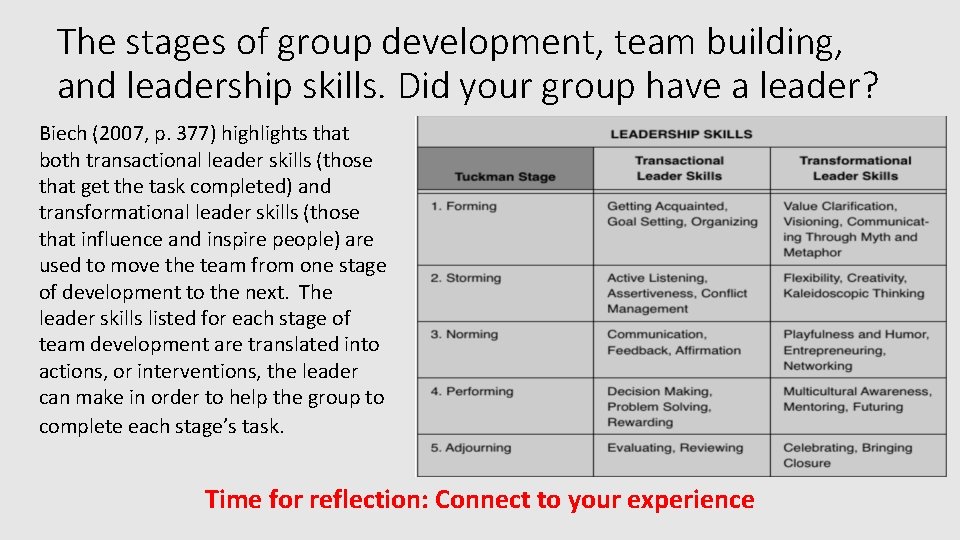
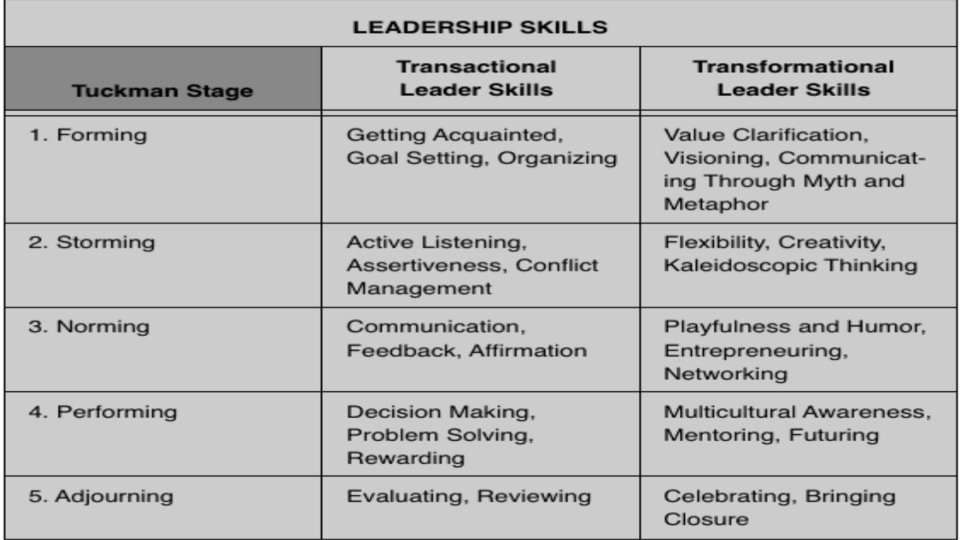
The stages of group development, team building, and leadership skills. Did your group have a leader? Biech (2007, p. 377) highlights that both transactional leader skills (those that get the task completed) and transformational leader skills (those that influence and inspire people) are used to move the team from one stage of development to the next. The leader skills listed for each stage of team development are translated into actions, or interventions, the leader can make in order to help the group to complete each stage’s task. Time for reflection: Connect to your experience

List some theoretical models/ theories of teamwork This Photo by Unknown Author is licensed under CC BY-NC-ND
Some theoretical models of teamwork Belbin (2010) –focus on team roles, strengths and weaknesses in the workplace Tuckman’s (1965) – model of group development, group processes (later Tuckman & Jensen ) Woodcock (1989) –building blocks of effective teamwork Honey and Mumford’s Leaning Styles Honey’s Team Roles
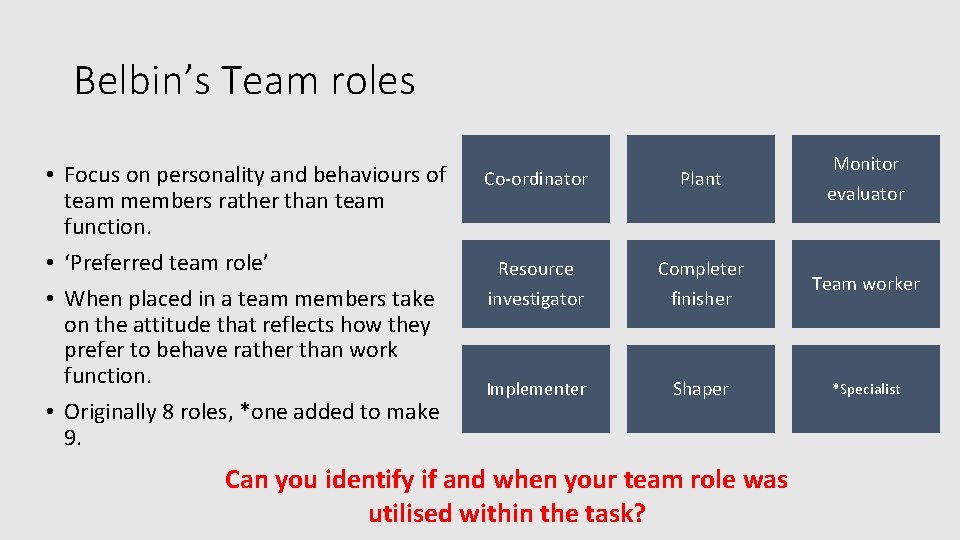
Belbin’s Team roles • Focus on personality and behaviours of team members rather than team function. • ‘Preferred team role’ • When placed in a team members take on the attitude that reflects how they prefer to behave rather than work function. • Originally 8 roles, *one added to make 9. Co-ordinator Plant Resource Completer investigator finisher Implementer Shaper Can you identify if and when your team role was utilised within the task? Monitor evaluator Team worker *Specialist
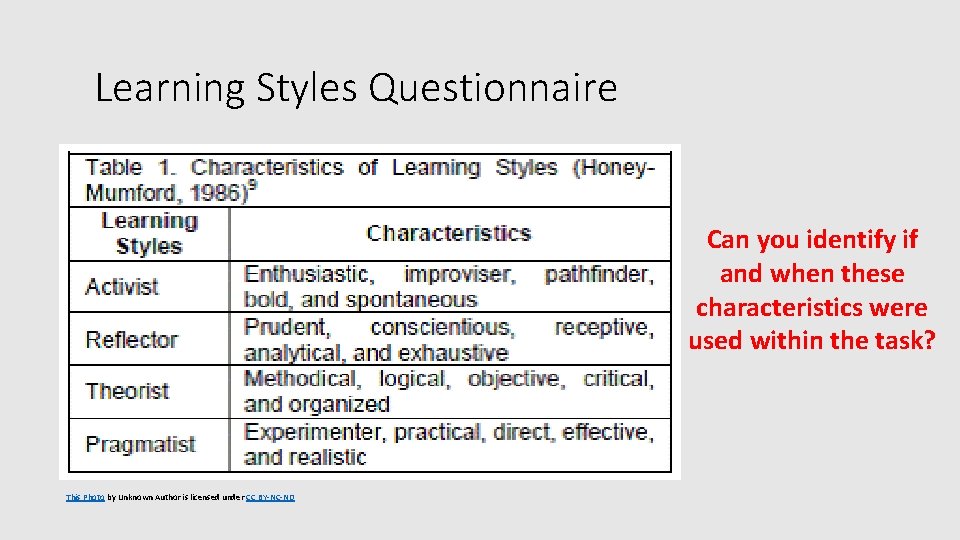
Learning Styles Questionnaire Can you identify if and when these characteristics were used within the task? This Photo by Unknown Author is licensed under CC BY-NC-ND
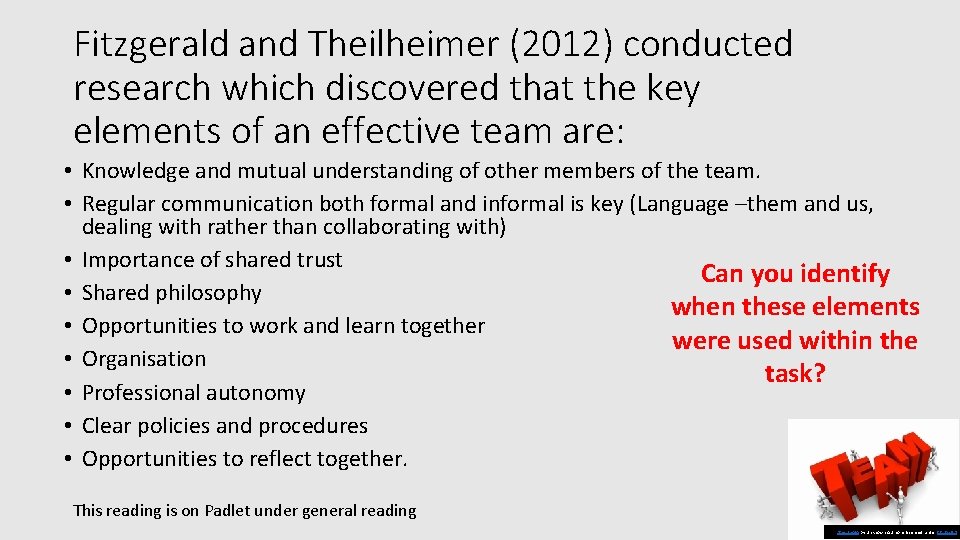
Fitzgerald and Theilheimer (2012) conducted research which discovered that the key elements of an effective team are: • Knowledge and mutual understanding of other members of the team. • Regular communication both formal and informal is key (Language –them and us, dealing with rather than collaborating with) • Importance of shared trust Can you identify • Shared philosophy when these elements • Opportunities to work and learn together were used within the • Organisation task? • Professional autonomy • Clear policies and procedures • Opportunities to reflect together. This reading is on Padlet under general reading This Photo by Unknown Author is licensed under CC BY-ND
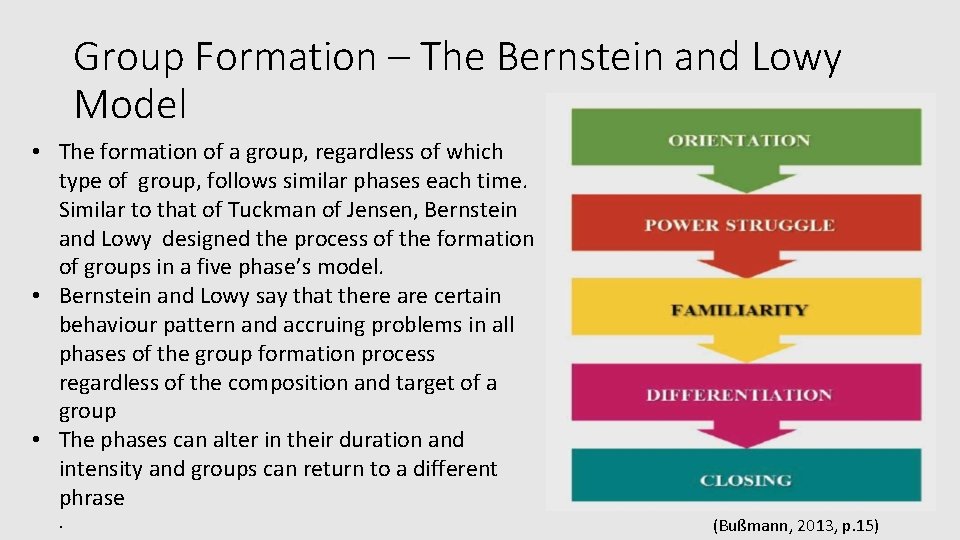
Group Formation – The Bernstein and Lowy Model • The formation of a group, regardless of which type of group, follows similar phases each time. Similar to that of Tuckman of Jensen, Bernstein and Lowy designed the process of the formation of groups in a five phase’s model. • Bernstein and Lowy say that there are certain behaviour pattern and accruing problems in all phases of the group formation process regardless of the composition and target of a group • The phases can alter in their duration and intensity and groups can return to a different phrase. (Bußmann, 2013, p. 15)
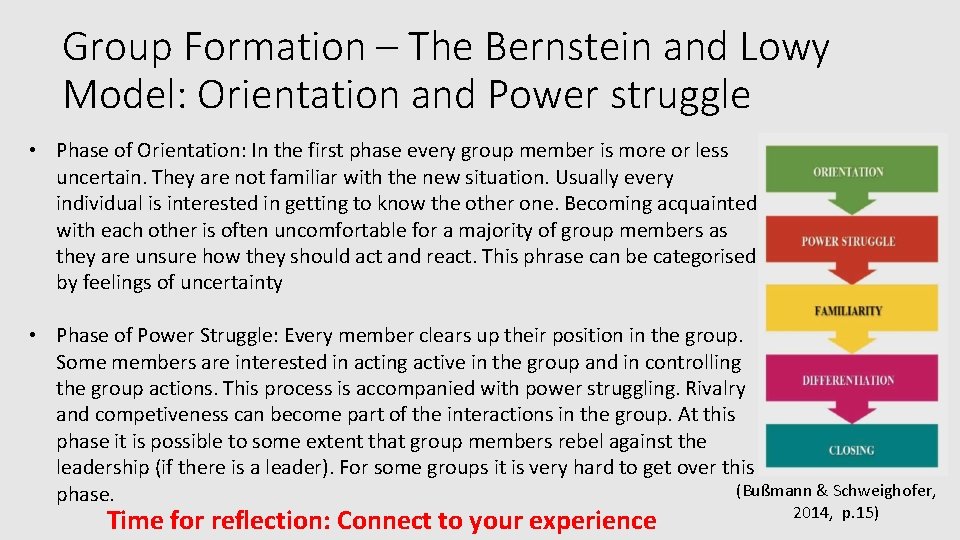
Group Formation – The Bernstein and Lowy Model: Orientation and Power struggle • Phase of Orientation: In the first phase every group member is more or less uncertain. They are not familiar with the new situation. Usually every individual is interested in getting to know the other one. Becoming acquainted with each other is often uncomfortable for a majority of group members as they are unsure how they should act and react. This phrase can be categorised by feelings of uncertainty • Phase of Power Struggle: Every member clears up their position in the group. Some members are interested in acting active in the group and in controlling the group actions. This process is accompanied with power struggling. Rivalry and competiveness can become part of the interactions in the group. At this phase it is possible to some extent that group members rebel against the leadership (if there is a leader). For some groups it is very hard to get over this (Bußmann & Schweighofer, phase. Time for reflection: Connect to your experience 2014, p. 15)
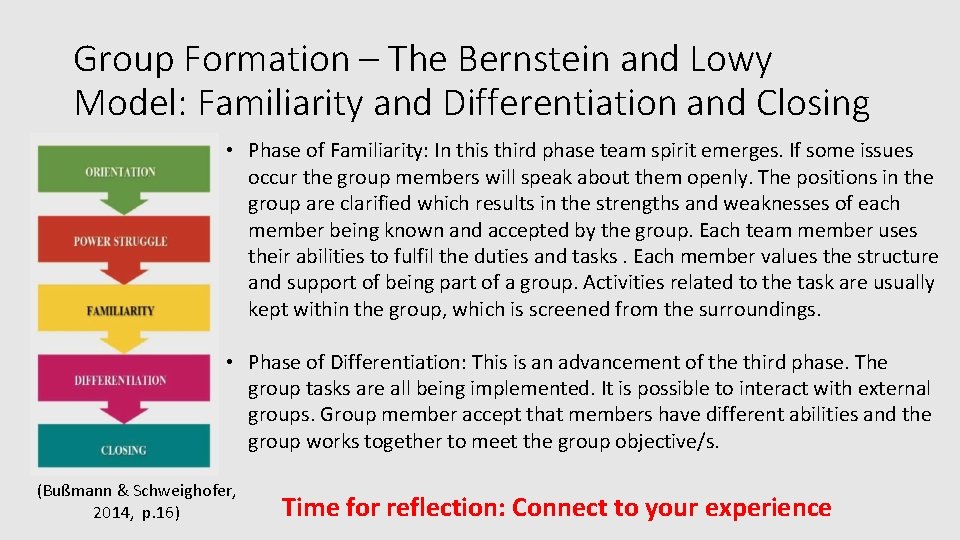
Group Formation – The Bernstein and Lowy Model: Familiarity and Differentiation and Closing • Phase of Familiarity: In this third phase team spirit emerges. If some issues occur the group members will speak about them openly. The positions in the group are clarified which results in the strengths and weaknesses of each member being known and accepted by the group. Each team member uses their abilities to fulfil the duties and tasks. Each member values the structure and support of being part of a group. Activities related to the task are usually kept within the group, which is screened from the surroundings. • Phase of Differentiation: This is an advancement of the third phase. The group tasks are all being implemented. It is possible to interact with external groups. Group member accept that members have different abilities and the group works together to meet the group objective/s. (Bußmann & Schweighofer, 2014, p. 16) Time for reflection: Connect to your experience
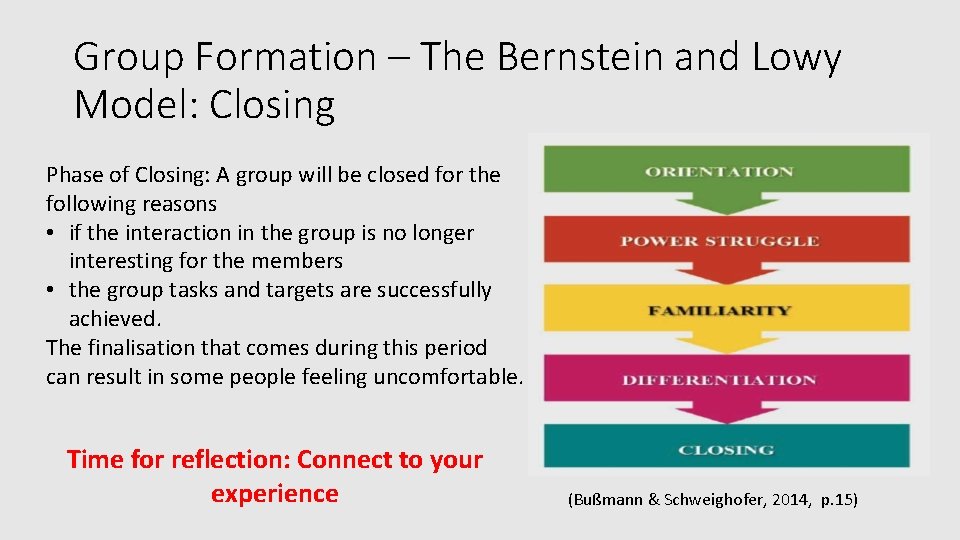
Group Formation – The Bernstein and Lowy Model: Closing Phase of Closing: A group will be closed for the following reasons • if the interaction in the group is no longer interesting for the members • the group tasks and targets are successfully achieved. The finalisation that comes during this period can result in some people feeling uncomfortable. Time for reflection: Connect to your experience (Bußmann & Schweighofer, 2014, p. 15)
Woodcock’s Building Blocks Read the handout and complete the following: • Identify the building blocks for effective teamwork • List some relevant building blocks that could connect to your experience • Provide some examples within your table groups • http: //www. oakwoodlearning. com/pdf/book%20 s ummary%20 -%20 Team%20 Dev%20 Manual. pdf
Spend the remainder of the session working on your Autobiography Reflective Autobiography This summative autobiography will contain a discussion of the experience of working as part of a team, which will include an evaluation of key teamwork theories. Learning outcome: On successful completion of this unit the student will be able to: 2, Reflect on key theories of effective team work and processes. • Submission date: WC
• Biech, E. (Ed. ). (2007). The pfeiffer book of successful team-building tools : Best of the annuals. Retrieved from https: //ebookcentral. proquest. com • Bußmann, U. & Schweighofer, S. (2014). Group dynamics : The nature of groups as well as dynamics of informal groups and dysfunctions. Retrieved from https: //ebookcentral. proquest. com
- Slides: 32