
Effective Teaching Standards and Indicators Curriculum Planning and
- Slides: 12
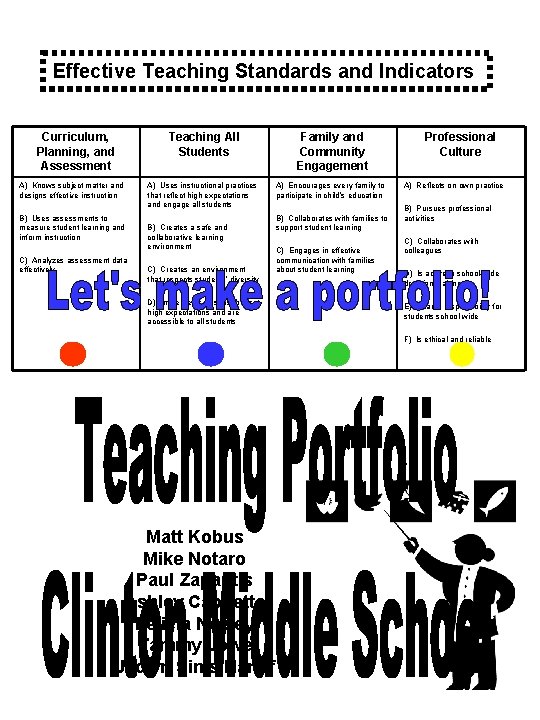
Effective Teaching Standards and Indicators Curriculum, Planning, and Assessment A) Knows subject matter and designs effective instruction B) Uses assessments to measure student learning and inform instruction C) Analyzes assessment data effectively Teaching All Students A) Uses instructional practices that reflect high expectations and engage all students B) Creates a safe and collaborative learning environment C) Creates an environment that respects students’ diversity D) Implements lessons that set high expectations and are accessible to all students Family and Community Engagement A) Encourages every family to participate in child’s education B) Collaborates with families to support student learning C) Engages in effective communication with families about student learning Professional Culture A) Reflects on own practice B) Pursues professional activities C) Collaborates with colleagues D) Is active in school-wide decision making E) Shares responsibility for students school-wide F) Is ethical and reliable Matt Kobus Mike Notaro Paul Zapantis Ashley Caouette Felicia Neeley Tammy Lowe Jaclyn Sims Nanof
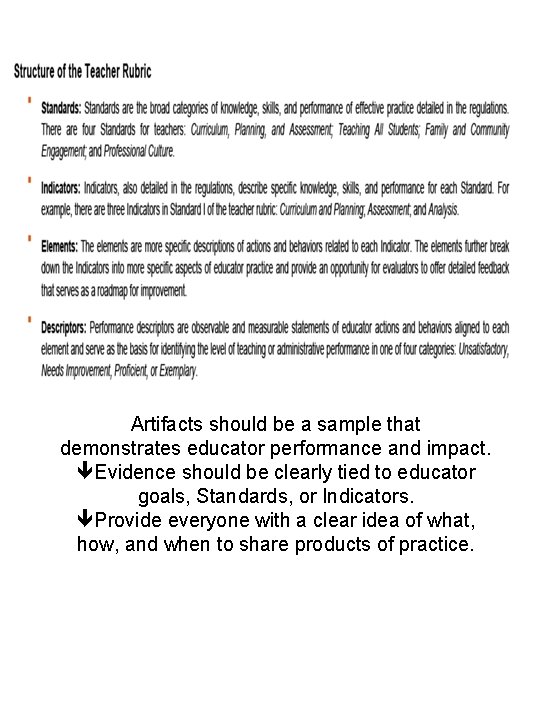
Artifacts should be a sample that demonstrates educator performance and impact. Evidence should be clearly tied to educator goals, Standards, or Indicators. Provide everyone with a clear idea of what, how, and when to share products of practice.
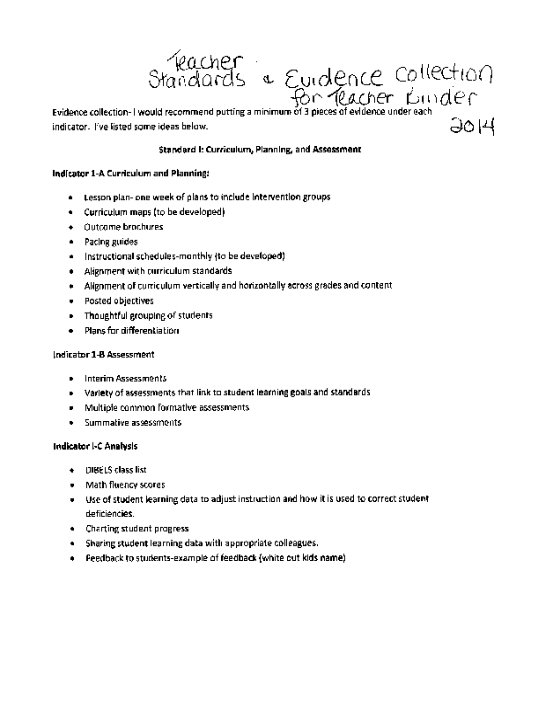
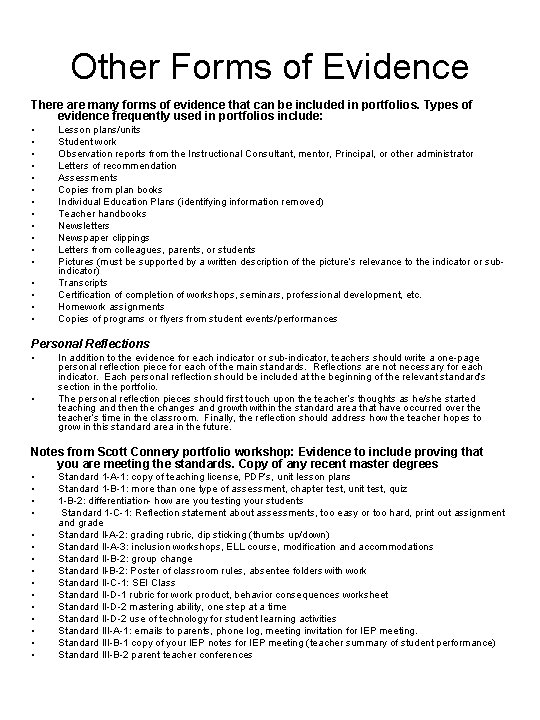
Other Forms of Evidence There are many forms of evidence that can be included in portfolios. Types of evidence frequently used in portfolios include: • • • • Lesson plans/units Student work Observation reports from the Instructional Consultant, mentor, Principal, or other administrator Letters of recommendation Assessments Copies from plan books Individual Education Plans (identifying information removed) Teacher handbooks Newsletters Newspaper clippings Letters from colleagues, parents, or students Pictures (must be supported by a written description of the picture’s relevance to the indicator or subindicator) Transcripts Certification of completion of workshops, seminars, professional development, etc. Homework assignments Copies of programs or flyers from student events/performances Personal Reflections • • In addition to the evidence for each indicator or sub-indicator, teachers should write a one-page personal reflection piece for each of the main standards. Reflections are not necessary for each indicator. Each personal reflection should be included at the beginning of the relevant standard’s section in the portfolio. The personal reflection pieces should first touch upon the teacher’s thoughts as he/she started teaching and then the changes and growth within the standard area that have occurred over the teacher’s time in the classroom. Finally, the reflection should address how the teacher hopes to grow in this standard area in the future. Notes from Scott Connery portfolio workshop: Evidence to include proving that you are meeting the standards. Copy of any recent master degrees • • • • Standard 1 -A-1: copy of teaching license, PDP’s, unit lesson plans Standard 1 -B-1: more than one type of assessment, chapter test, unit test, quiz 1 -B-2: differentiation- how are you testing your students Standard 1 -C-1: Reflection statement about assessments, too easy or too hard, print out assignment and grade Standard ll-A-2: grading rubric, dip sticking (thumbs up/down) Standard II-A-3: inclusion workshops, ELL course, modification and accommodations Standard II-B-2: group change Standard ll-B-2: Poster of classroom rules, absentee folders with work Standard II-C-1: SEI Class Standard II-D-1 rubric for work product, behavior consequences worksheet Standard II-D-2 mastering ability, one step at a time Standard II-D-2 use of technology for student learning activities Standard III-A-1: emails to parents, phone log, meeting invitation for IEP meeting. Standard III-B-1 copy of your IEP notes for IEP meeting (teacher summary of student performance) Standard III-B-2 parent teacher conferences
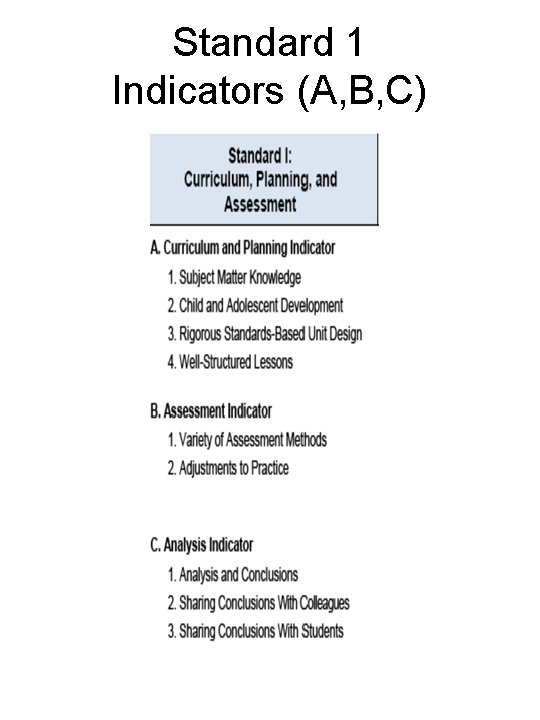
Standard 1 Indicators (A, B, C)
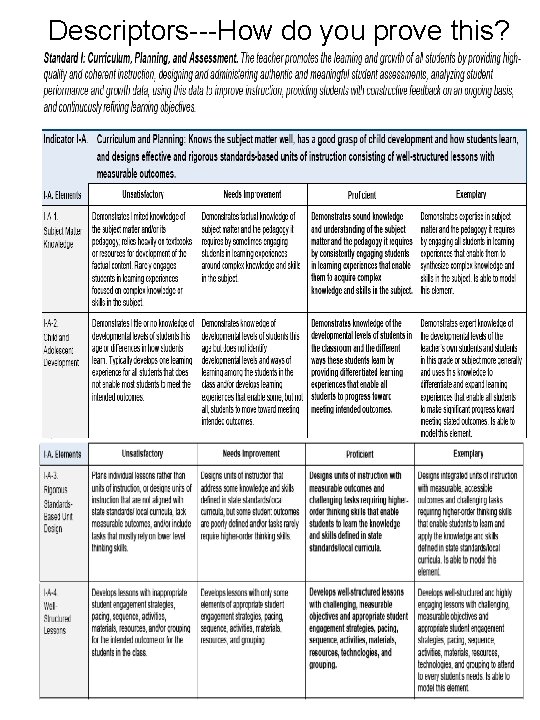
Descriptors---How do you prove this?
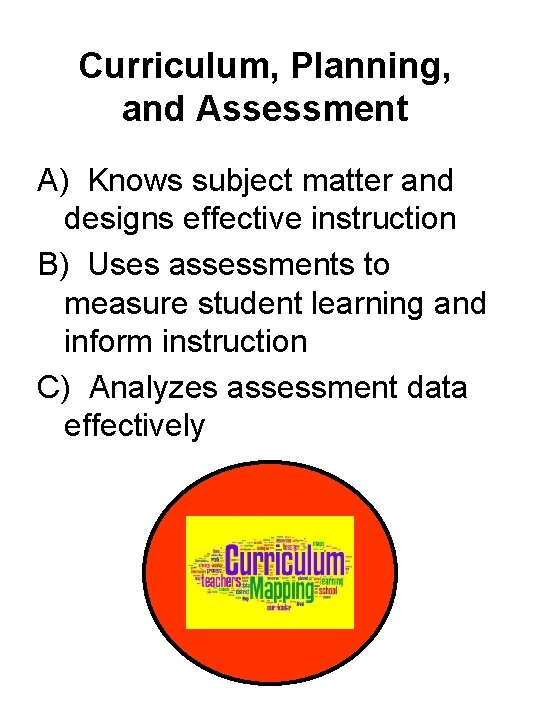
Curriculum, Planning, and Assessment A) Knows subject matter and designs effective instruction B) Uses assessments to measure student learning and inform instruction C) Analyzes assessment data effectively
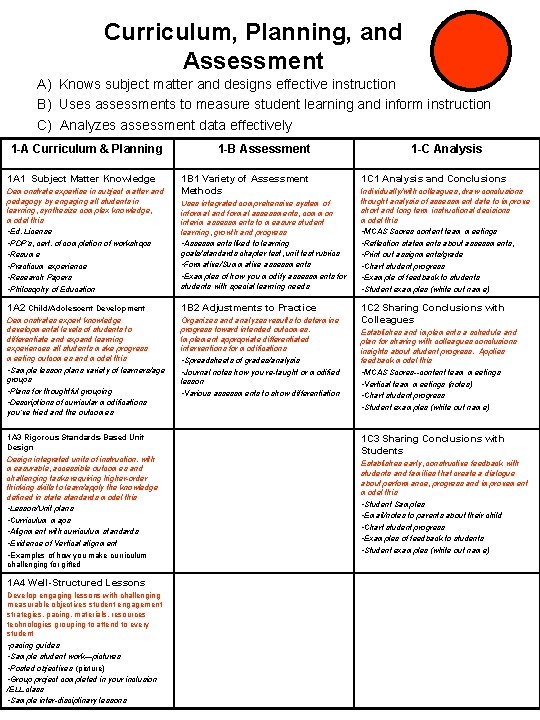
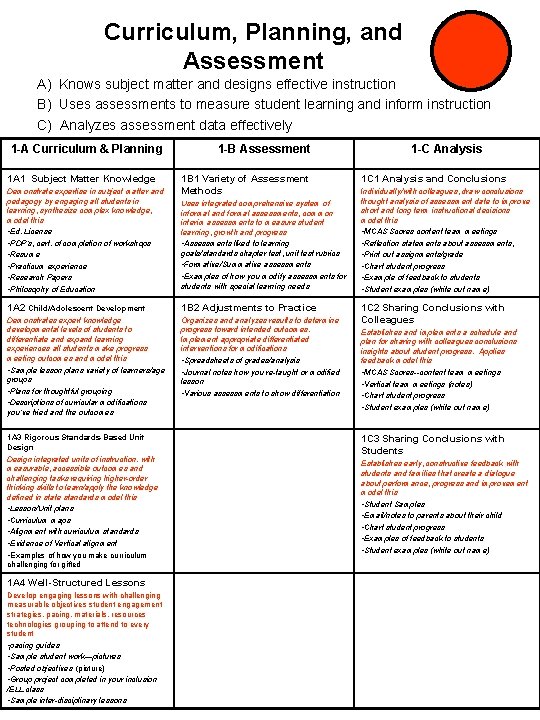
Curriculum, Planning, and Assessment A) Knows subject matter and designs effective instruction B) Uses assessments to measure student learning and inform instruction C) Analyzes assessment data effectively 1 -A Curriculum & Planning 1 A 1 Subject Matter Knowledge Demonstrate expertise in subject matter and pedagogy by engaging all students in learning, synthesize complex knowledge, model this • Ed. License • PDP’s, cert. of completion of workshops • Resume • Practicum experience • Research Papers • Philosophy of Education 1 -B Assessment 1 B 1 Variety of Assessment Methods Uses integrated comprehensive system of informal and formal assessments, common interim assessments to measure student learning, growth and progress • Assessments liked to learning goals/standards chapter test, unit test rubrics • Formative/Summative assessments • Examples of how you modify assessments for students with special learning needs 1 A 2 Child/Adolescent Development 1 B 2 Adjustments to Practice Demonstrates expert knowledge developmental levels of students to differentiate and expand learning experiences all students make progress meeting outcomes and model this • Sample lesson plans variety of learners/age groups • Plans for thoughtful grouping • Descriptions of curricular modifications you’ve tried and the outcomes Organizes and analyzes results to determine progress toward intended outcomes. Implement appropriate differentiated interventions for modifications • Spreadsheets of grades/analysis • Journal notes how you re-taught or modified lesson • Various assessments to show differentiation 1 A 3 Rigorous Standards-Based Unit Design integrated units of instruction. with measurable, accessible outcomes and challenging tasks requiring higher-order thinking skills to learn/apply the knowledge defined in state standards model this • Lesson/Unit plans • Curriculum maps • Alignment with curriculum standards • Evidence of Vertical alignment • Examples of how you make curriculum challenging for gifted 1 A 4 Well-Structured Lessons Develop engaging lessons with challenging measurable objectives student engagement strategies, pacing, materials, resources technologies grouping to attend to every student • pacing guides • Sample student work—pictures • Posted objectives (picture) • Group project completed in your inclusion /ELL class • Sample inter-disciplinary lessons 1 -C Analysis 1 C 1 Analysis and Conclusions Individually/with colleagues, draw conclusions thought analysis of assessment date to improve short and long term instructional decisions model this • MCAS Scores content team meetings • Reflection statements about assessments, • Print out assignments/grade • Chart student progress • Example of feedback to students • Student examples (white out name) 1 C 2 Sharing Conclusions with Colleagues Establishes and implements a schedule and plan for sharing with colleagues conclusions insights about student progress. Applies feedback model this • MCAS Scores--content team meetings • Vertical team meetings (notes) • Chart student progress • Student examples (white out name) 1 C 3 Sharing Conclusions with Students Establishes early, constructive feedback with students and families that create a dialogue about performance, progress and improvement model this • Student Samples • Email/notes to parents about their child • Chart student progress • Examples of feedback to students • Student examples (white out name)
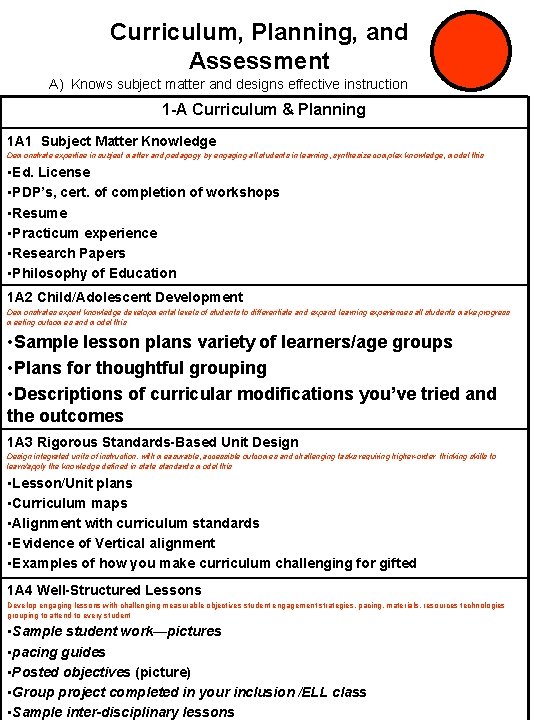
Curriculum, Planning, and Assessment A) Knows subject matter and designs effective instruction 1 -A Curriculum & Planning 1 A 1 Subject Matter Knowledge Demonstrate expertise in subject matter and pedagogy by engaging all students in learning, synthesize complex knowledge, model this • Ed. License • PDP’s, cert. of completion of workshops • Resume • Practicum experience • Research Papers • Philosophy of Education 1 A 2 Child/Adolescent Development Demonstrates expert knowledge developmental levels of students to differentiate and expand learning experiences all students make progress meeting outcomes and model this • Sample lesson plans variety of learners/age groups • Plans for thoughtful grouping • Descriptions of curricular modifications you’ve tried and the outcomes 1 A 3 Rigorous Standards-Based Unit Design integrated units of instruction. with measurable, accessible outcomes and challenging tasks requiring higher-order thinking skills to learn/apply the knowledge defined in state standards model this • Lesson/Unit plans • Curriculum maps • Alignment with curriculum standards • Evidence of Vertical alignment • Examples of how you make curriculum challenging for gifted 1 A 4 Well-Structured Lessons Develop engaging lessons with challenging measurable objectives student engagement strategies, pacing, materials, resources technologies grouping to attend to every student • Sample student work—pictures • pacing guides • Posted objectives (picture) • Group project completed in your inclusion /ELL class • Sample inter-disciplinary lessons
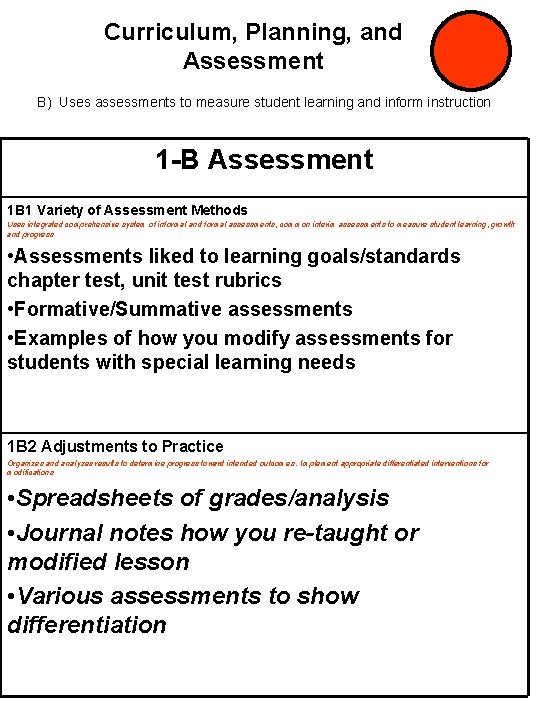
Curriculum, Planning, and Assessment B) Uses assessments to measure student learning and inform instruction 1 -B Assessment 1 B 1 Variety of Assessment Methods Uses integrated comprehensive system of informal and formal assessments, common interim assessments to measure student learning, growth and progress • Assessments liked to learning goals/standards chapter test, unit test rubrics • Formative/Summative assessments • Examples of how you modify assessments for students with special learning needs 1 B 2 Adjustments to Practice Organizes and analyzes results to determine progress toward intended outcomes. Implement appropriate differentiated interventions for modifications • Spreadsheets of grades/analysis • Journal notes how you re-taught or modified lesson • Various assessments to show differentiation
Curriculum, Planning, and Assessment A) Knows subject matter and designs effective instruction B) Uses assessments to measure student learning and inform instruction C) Analyzes assessment data effectively 1 -A Curriculum & Planning 1 A 1 Subject Matter Knowledge Demonstrate expertise in subject matter and pedagogy by engaging all students in learning, synthesize complex knowledge, model this • Ed. License • PDP’s, cert. of completion of workshops • Resume • Practicum experience • Research Papers • Philosophy of Education 1 -B Assessment 1 B 1 Variety of Assessment Methods Uses integrated comprehensive system of informal and formal assessments, common interim assessments to measure student learning, growth and progress • Assessments liked to learning goals/standards chapter test, unit test rubrics • Formative/Summative assessments • Examples of how you modify assessments for students with special learning needs 1 A 2 Child/Adolescent Development 1 B 2 Adjustments to Practice Demonstrates expert knowledge developmental levels of students to differentiate and expand learning experiences all students make progress meeting outcomes and model this • Sample lesson plans variety of learners/age groups • Plans for thoughtful grouping • Descriptions of curricular modifications you’ve tried and the outcomes Organizes and analyzes results to determine progress toward intended outcomes. Implement appropriate differentiated interventions for modifications • Spreadsheets of grades/analysis • Journal notes how you re-taught or modified lesson • Various assessments to show differentiation 1 A 3 Rigorous Standards-Based Unit Design integrated units of instruction. with measurable, accessible outcomes and challenging tasks requiring higher-order thinking skills to learn/apply the knowledge defined in state standards model this • Lesson/Unit plans • Curriculum maps • Alignment with curriculum standards • Evidence of Vertical alignment • Examples of how you make curriculum challenging for gifted 1 A 4 Well-Structured Lessons Develop engaging lessons with challenging measurable objectives student engagement strategies, pacing, materials, resources technologies grouping to attend to every student • pacing guides • Sample student work—pictures • Posted objectives (picture) • Group project completed in your inclusion /ELL class • Sample inter-disciplinary lessons 1 -C Analysis 1 C 1 Analysis and Conclusions Individually/with colleagues, draw conclusions thought analysis of assessment date to improve short and long term instructional decisions model this • MCAS Scores content team meetings • Reflection statements about assessments, • Print out assignments/grade • Chart student progress • Example of feedback to students • Student examples (white out name) 1 C 2 Sharing Conclusions with Colleagues Establishes and implements a schedule and plan for sharing with colleagues conclusions insights about student progress. Applies feedback model this • MCAS Scores--content team meetings • Vertical team meetings (notes) • Chart student progress • Student examples (white out name) 1 C 3 Sharing Conclusions with Students Establishes early, constructive feedback with students and families that create a dialogue about performance, progress and improvement model this • Student Samples • Email/notes to parents about their child • Chart student progress • Examples of feedback to students • Student examples (white out name)
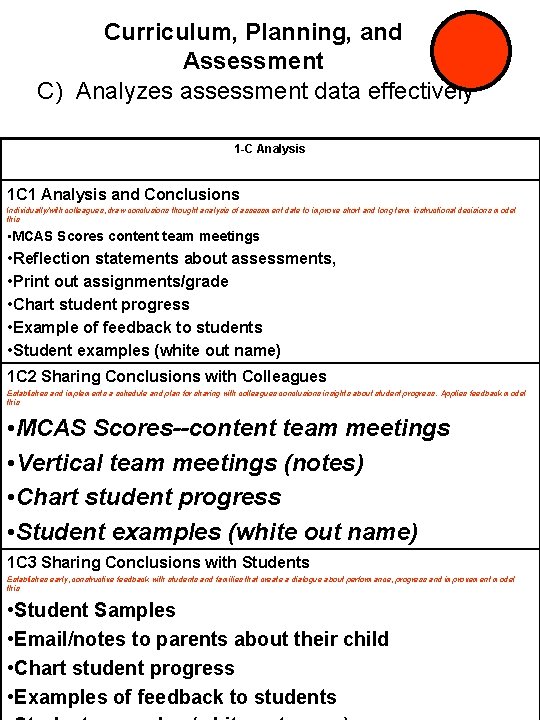
Curriculum, Planning, and Assessment C) Analyzes assessment data effectively 1 -C Analysis 1 C 1 Analysis and Conclusions Individually/with colleagues, draw conclusions thought analysis of assessment date to improve short and long term instructional decisions model this • MCAS Scores content team meetings • Reflection statements about assessments, • Print out assignments/grade • Chart student progress • Example of feedback to students • Student examples (white out name) 1 C 2 Sharing Conclusions with Colleagues Establishes and implements a schedule and plan for sharing with colleagues conclusions insights about student progress. Applies feedback model this • MCAS Scores--content team meetings • Vertical team meetings (notes) • Chart student progress • Student examples (white out name) 1 C 3 Sharing Conclusions with Students Establishes early, constructive feedback with students and families that create a dialogue about performance, progress and improvement model this • Student Samples • Email/notes to parents about their child • Chart student progress • Examples of feedback to students