
Effective Teacher Practices Supporting the North Carolina Foundations
- Slides: 32
Effective Teacher Practices Supporting the North Carolina Foundations for Early Learning and Development 2018 Module 1: Overview NC EARLY LEARNING NETWORK IS A JOINT PROJECT OF THE NC DEPARTMENT OF PUBLIC INSTRUCTION, OFFICE OF EARLY LEARNING AND UNC FRANK PORTER GRAHAM CHILD DEVELOPMENT INSTITUTE
Review Pre-learning Assignment • Complete Foundations Self-Assessment • What questions were you unsure of? • What questions made you stop and think? 2
Objectives • To understand the relationship between early learning standards and curriculum • To understand the relationship between the NC Standard Course of Study for Kindergarten and the NC Foundations for Early Learning and Development • To understand the structure of the professional development modules for instructional practices that support Foundations for Early Learning and Development 3
The Back Story How we got where we are today 4
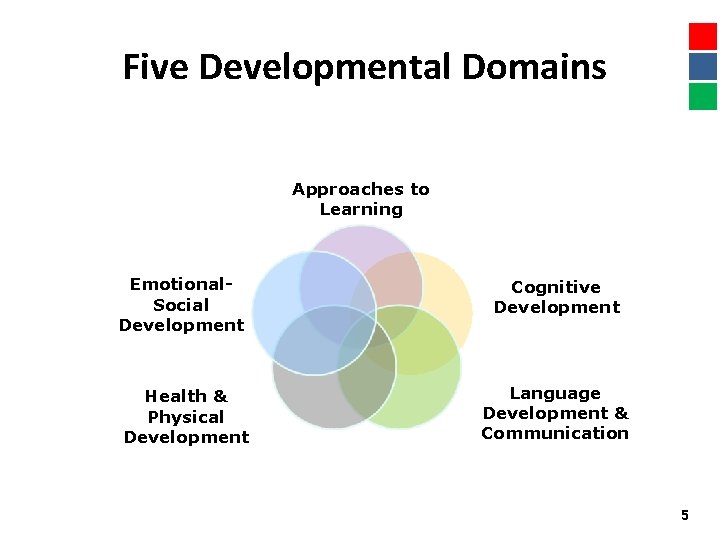
Five Developmental Domains Approaches to Learning Emotional. Social Development Cognitive Development Health & Physical Development Language Development & Communication 5
Foundations Treasure Hunt! 6
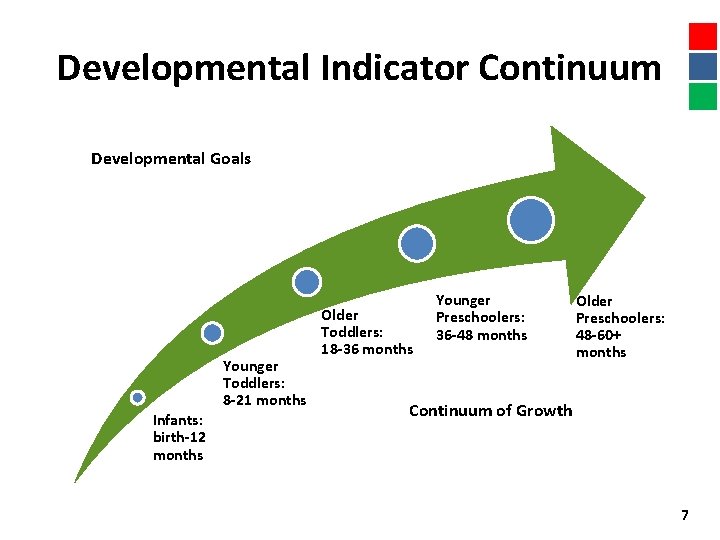
Developmental Indicator Continuum Developmental Goals Younger Toddlers: 8 -21 months Infants: birth-12 months Older Toddlers: 18 -36 months Younger Preschoolers: 36 -48 months Older Preschoolers: 48 -60+ months Continuum of Growth 7
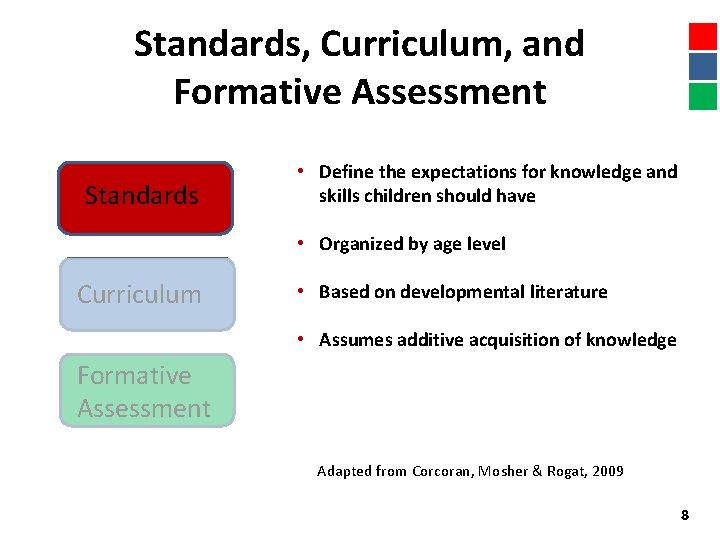
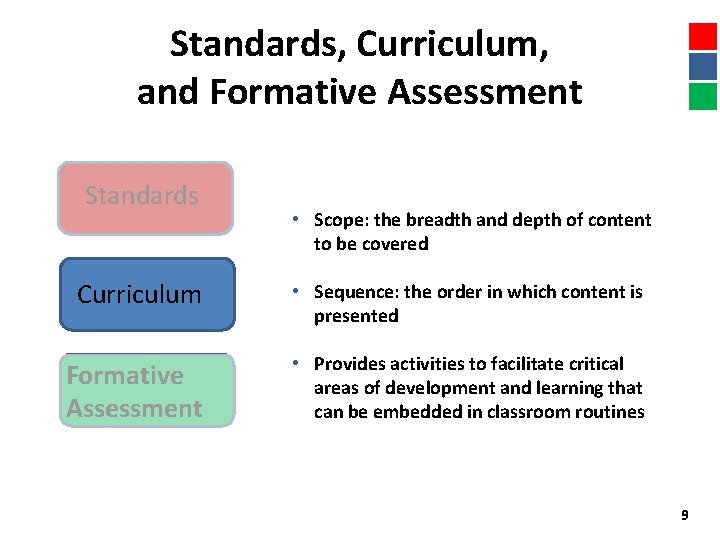
Standards, Curriculum, and Formative Assessment Standards • Define the expectations for knowledge and skills children should have • Organized by age level Curriculum • Based on developmental literature • Assumes additive acquisition of knowledge Formative Assessment Adapted from Corcoran, Mosher & Rogat, 2009 8
Standards, Curriculum, and Formative Assessment Standards • Scope: the breadth and depth of content to be covered Curriculum • Sequence: the order in which content is presented Formative Assessment • Provides activities to facilitate critical areas of development and learning that can be embedded in classroom routines 9
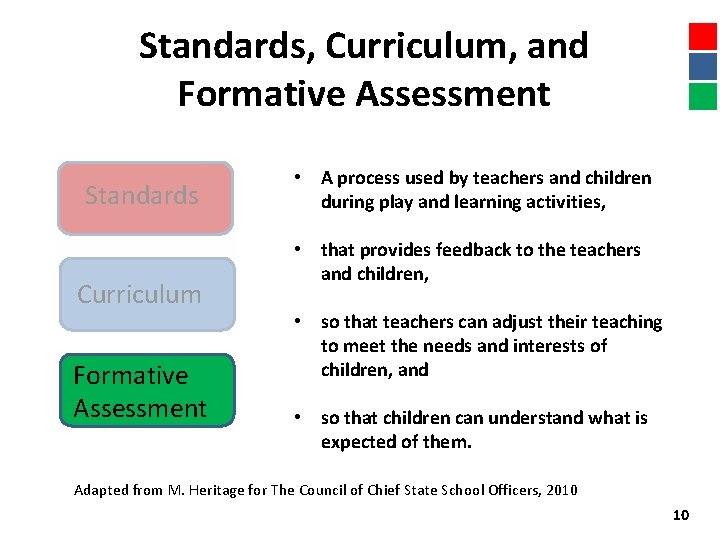
Standards, Curriculum, and Formative Assessment Standards Curriculum Formative Assessment • A process used by teachers and children during play and learning activities, • that provides feedback to the teachers and children, • so that teachers can adjust their teaching to meet the needs and interests of children, and • so that children can understand what is expected of them. Adapted from M. Heritage for The Council of Chief State School Officers, 2010 10
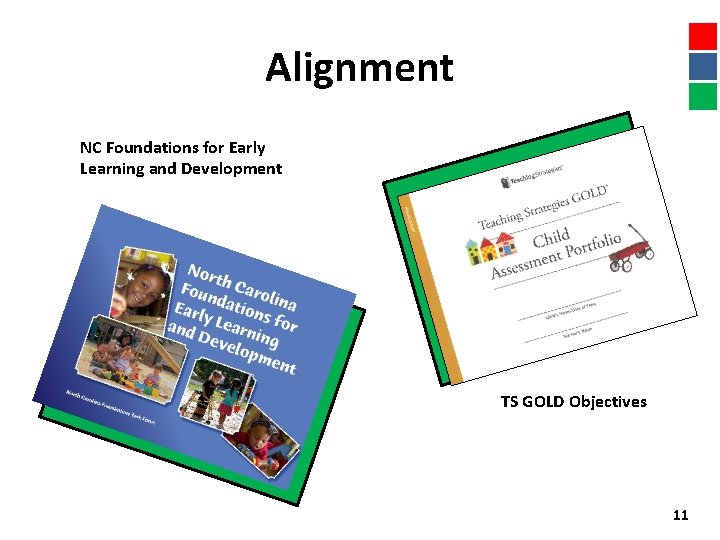
Alignment NC Foundations for Early Learning and Development TS GOLD Objectives 11
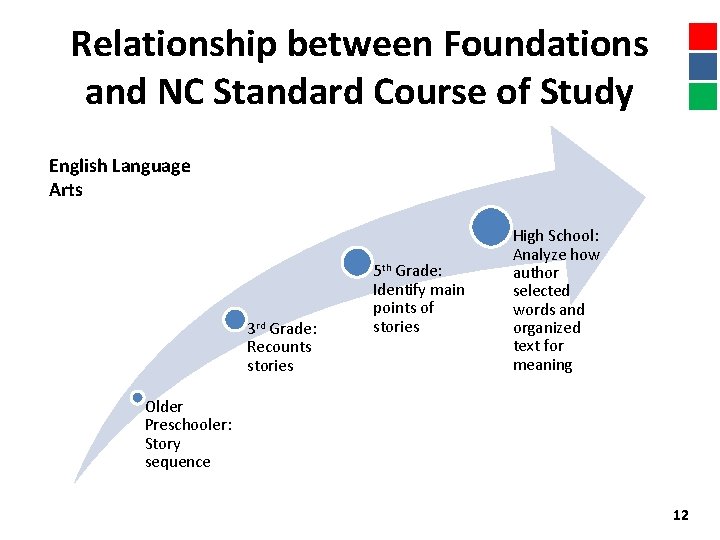
Relationship between Foundations and NC Standard Course of Study English Language Arts 3 rd Grade: Recounts stories 5 th Grade: Identify main points of stories High School: Analyze how author selected words and organized text for meaning Older Preschooler: Story sequence 12
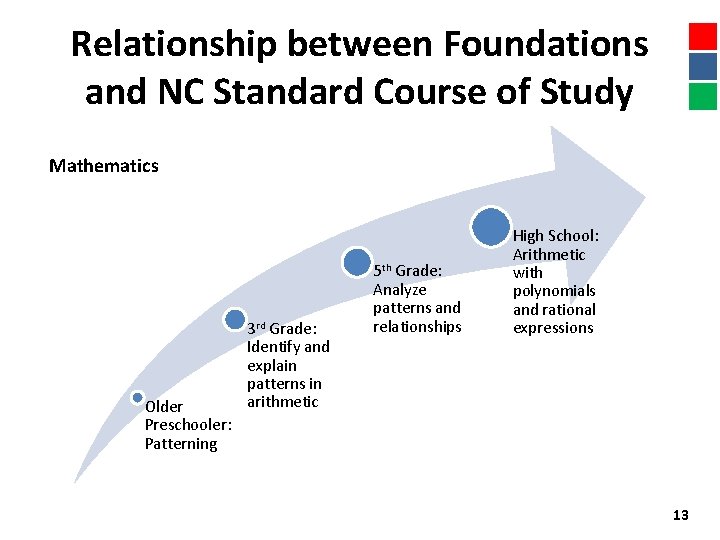
Relationship between Foundations and NC Standard Course of Study Mathematics Older Preschooler: Patterning 3 rd Grade: Identify and explain patterns in arithmetic 5 th Grade: Analyze patterns and relationships High School: Arithmetic with polynomials and rational expressions 13
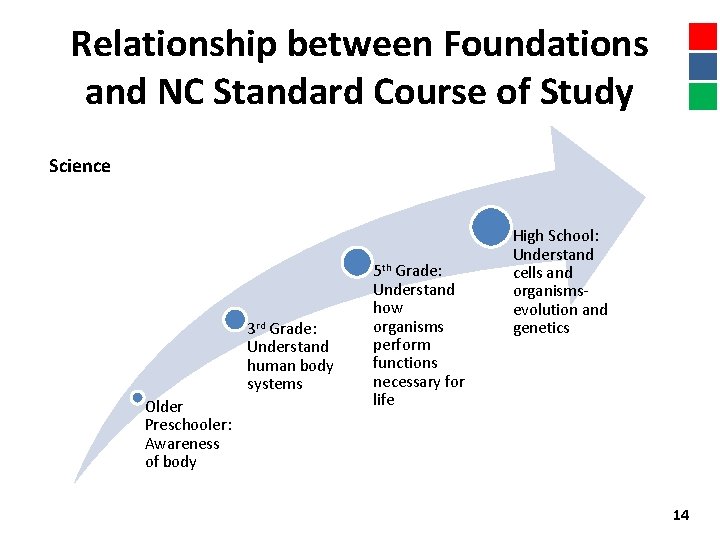
Relationship between Foundations and NC Standard Course of Study Science 3 rd Grade: Understand human body systems Older Preschooler: Awareness of body 5 th Grade: Understand how organisms perform functions necessary for life High School: Understand cells and organismsevolution and genetics 14
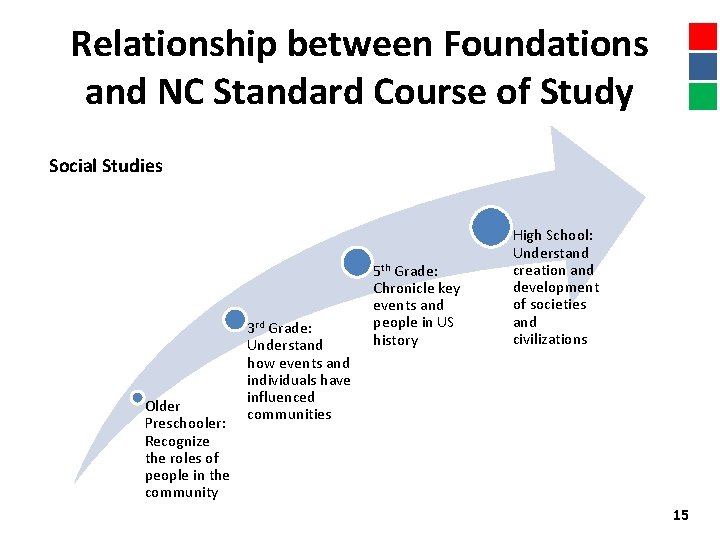
Relationship between Foundations and NC Standard Course of Study Social Studies Older Preschooler: Recognize the roles of people in the community 3 rd Grade: Understand how events and individuals have influenced communities 5 th Grade: Chronicle key events and people in US history High School: Understand creation and development of societies and civilizations 15
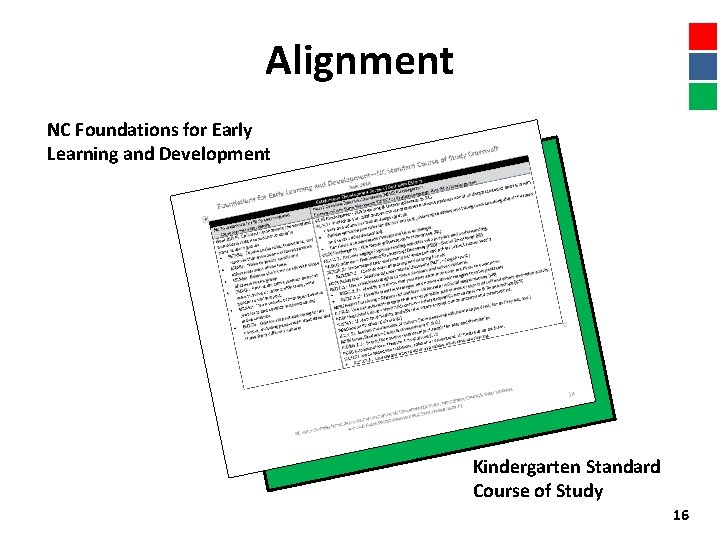
Alignment NC Foundations for Early Learning and Development Kindergarten Standard Course of Study 16
Foundations Training Modules The “Why” Behind the Structure of the Modules 17
Stakeholder Input Identifying professional development needs for schools systems and the early intervention program Stakeholder input helped to identify: • priorities for training, and • resources needed to implement Foundations through teacher/practitioner practices 18
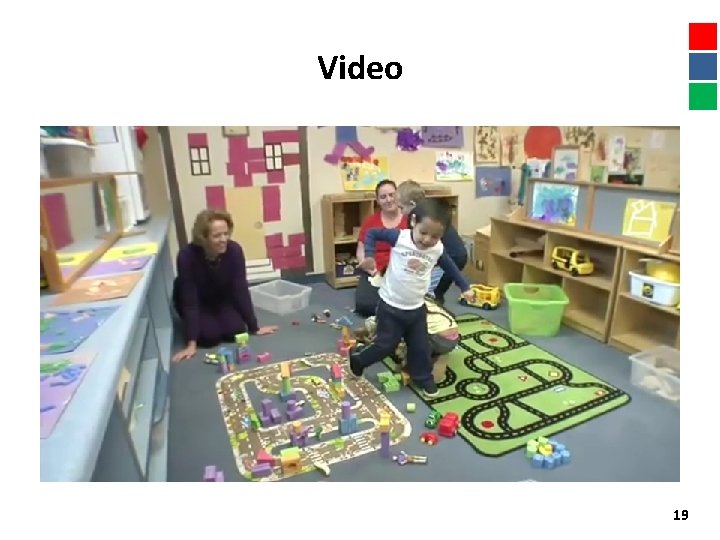
Video 19
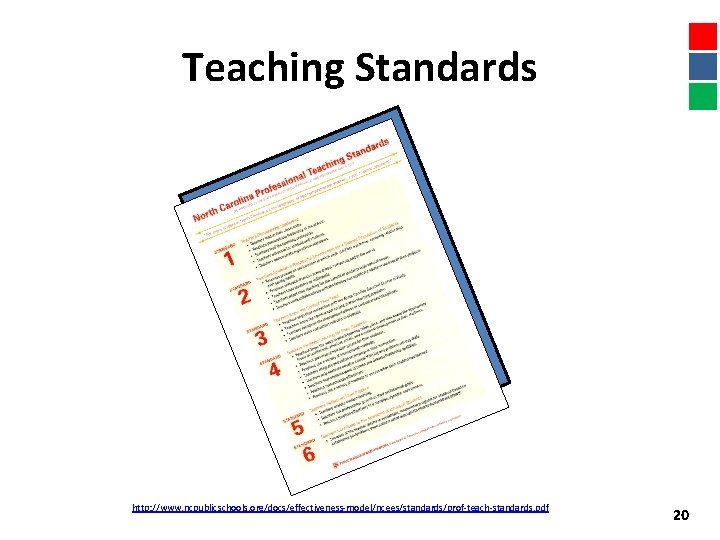
Teaching Standards http: //www. ncpublicschools. org/docs/effectiveness-model/ncees/standards/prof-teach-standards. pdf 20
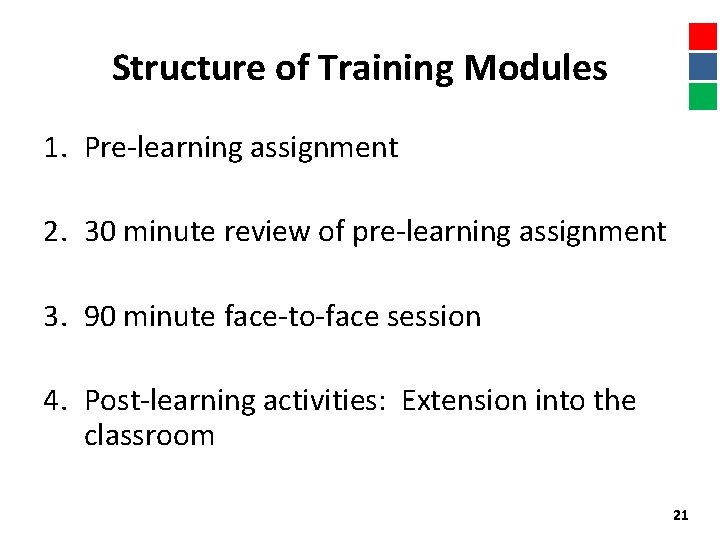
Structure of Training Modules 1. Pre-learning assignment 2. 30 minute review of pre-learning assignment 3. 90 minute face-to-face session 4. Post-learning activities: Extension into the classroom 21
Foundations Training Modules The Structure of the Training Modules
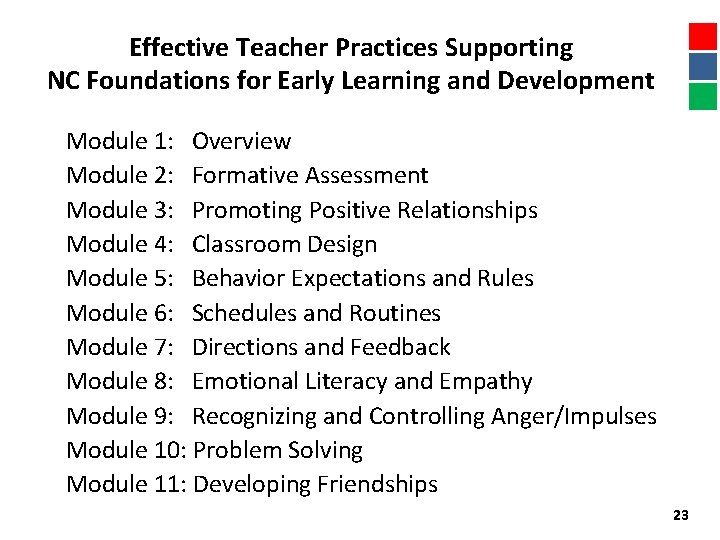
Effective Teacher Practices Supporting NC Foundations for Early Learning and Development Module 1: Overview Module 2: Formative Assessment Module 3: Promoting Positive Relationships Module 4: Classroom Design Module 5: Behavior Expectations and Rules Module 6: Schedules and Routines Module 7: Directions and Feedback Module 8: Emotional Literacy and Empathy Module 9: Recognizing and Controlling Anger/Impulses Module 10: Problem Solving Module 11: Developing Friendships 23
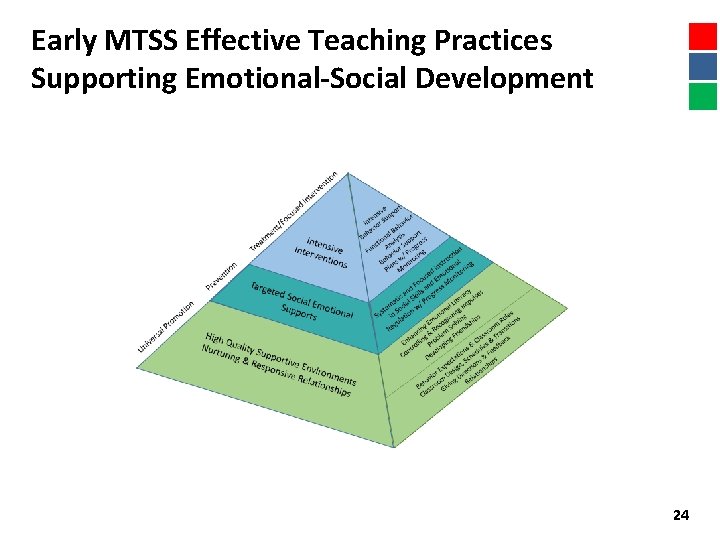
Early MTSS Effective Teaching Practices Supporting Emotional-Social Development 24
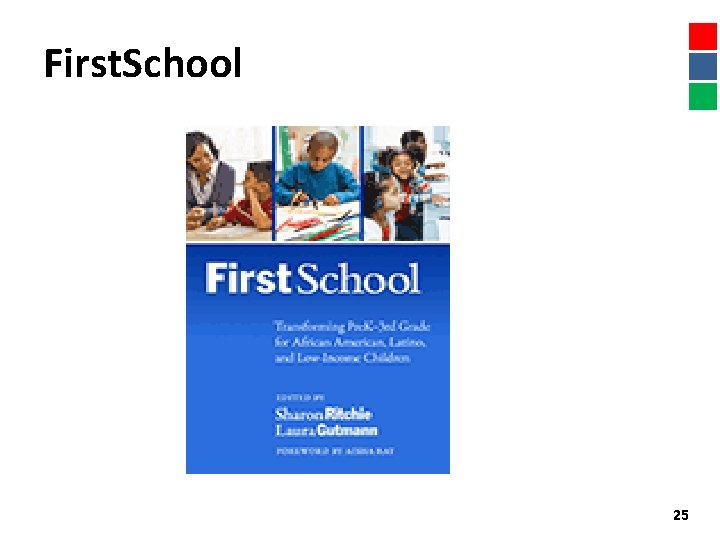
First. School 25
Family Engagement 26
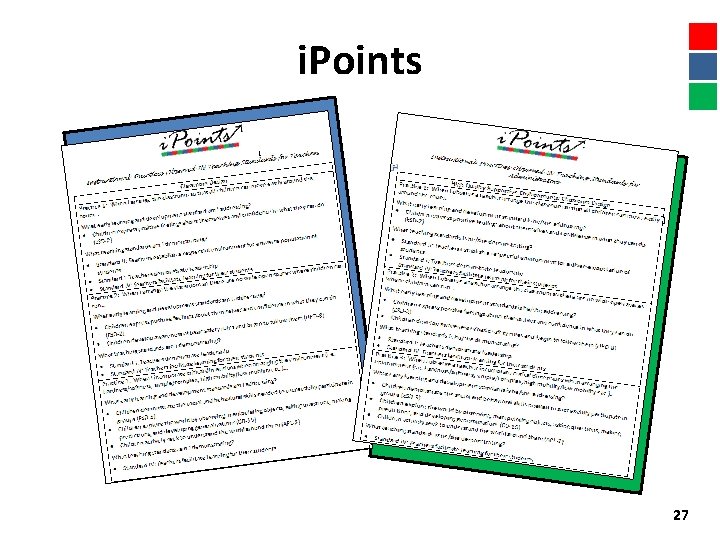
i. Points 27
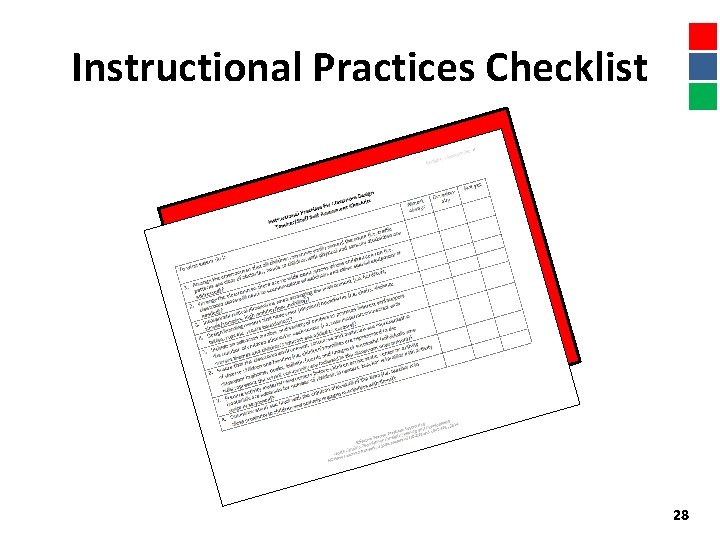
Instructional Practices Checklist 28
Off on a Journey! 29
Post-learning Activity • Select a lesson plan • Identify Foundations domain, subdomain, goals, and indicators • Analyze lesson plan 30
Questions? 31
References Center on the Social and Emotional Foundations for Early Learning. (n. d. ). Retrieved from http: //csefel. vanderbilt. edu/ Corcoran, T. , Mosher, F. , & Rogat, A. (2009). Learning progressions in science: An evidenced-based approach to reform. Retrieved from http: //www. cpre. org/images/stories/cpre_pdfs/lp_science_rr 63. pdf Dr. Seuss. (1978). I can read with my eyes shut! New York, NY: Random House. Dr. Seuss. (1990). Oh, the places you’ll go. New York, NY: Random House. Heritage, M. (2010). Formative assessment and next-generation assessment systems: Are we losing an opportunity? Washington, DC: Council of Chief State School Officers. Retrieved from http: //www. ccsso. org/Documents/2010/Formative_Assessment_Next_Generation_2010. pdf Heritage, M. (2013). Formative assessment in practice. Cambridge, MA: Harvard Education Press. Heroman, C. , Burts, D. C. , Berke, K. , & Bickart, T. S. (2010). Teaching Strategies GOLD objectives for development & learning: Birth through kindergarten. Bethesda, MD: Teaching Strategies, LLC. Retrieved from http: //teachingstrategies. com/wp-content/uploads/2014/06/NC-GOLD-Alignment-PS-2014. pdf North Carolina Department of Public Instruction (n. d. ). K-12 standards, curriculum and instruction. Retrieved from http: //www. ncpublicschools. org/curriculum/ North Carolina Department of Public Instruction. (2012). North Carolina Teacher Evaluation Process. Raleigh: Author. Retrieved from http: //www. ncpublicschools. org/docs/effectiveness-model/ncees/instruments/teach-eval-manual. pdf North Carolina Foundations Task Force. (2013). North Carolina foundations for early learning and development. Raleigh: Author. Retrieved from http: //ncchildcare. nc. gov/pdf_forms/NC_foundations. pdf NC FALCON. (n. d. ). North Carolina’s formative assessment learning community’s online network. Retrieved from https: //center. ncsu. edu/ncfalcon/ Ritchie, S. & Gutmann, L. (Eds. ). (2014). First. School: Transforming Pre. K-3 rd grade for African American, Latino, and low-income children. New York: Teachers College Press. Teaching Strategies, LLC. (2010). The Creative Curriculum for preschool. Washington, DC: Author. 32