
Effective Student Communication During COVID19 Sana Meghani Program

- Slides: 19
Effective Student Communication During COVID-19 Sana Meghani, Program Manager Zach Taylor, Institutional Support Consultant
Introductions Sana Meghani Zach Taylor Program Manager of Virtual Student Support Program Institutional Support Consultant
Webinar Outline • Current Landscape of Higher Education • Defining a Crisis and Crisis Communication • Best Practices in Crisis Communication • The Power of Text Messaging • Resource Allocation/Dissemination • Immediately Actionable Steps • High-Quality COVID-19 Resources • Questions and Discussion
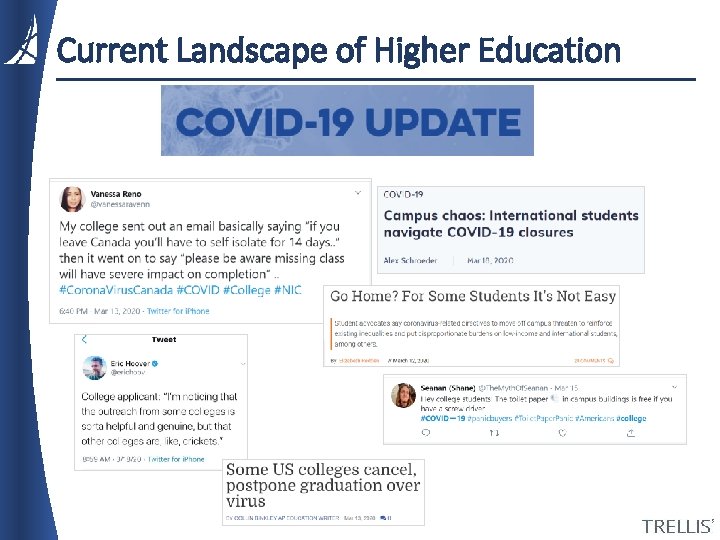
Current Landscape of Higher Education
Defining “Crisis” and Crisis Communication • The Centers for Disease Control and Prevention (CDC) has referred to COVID-19 as a ‘crisis’ affecting the mental health of many. • Crisis defined as: • an incident that is unexpected, negative, and overwhelming; a major threat that can have a negative effect on the organization, industry, or stakeholders if handled improperly (Coombs & Holladay, 2011). • Communication during COVID-19 may be perceived as crisis communication by stakeholders—we are here to help.
Institutional Best Practices for Crisis Communication • Send high-quality, accurate, updated information. • Crisis communication should be evidence-based (Coombs, 2015). • Share resources from high-quality, trusted organizations: The Centers for Disease Control and Prevention and World Health Organization. • Help avoid spreading ‘fake news’ and misinformation.
Institutional Best Practices for Crisis Communication • Be honest, flexible, and sympathetic. • Be honest with your stakeholders (Coombs, 2015, p. 135) and “extend expressions of concern and sympathy” (p. 143). • Not all messaging should be informational—send messages of concern and sympathy. • Adopt a ‘culture-centered approach, ’ to express genuine care through collaboration (Ulmer, Sellnow, & Seeger, 2015, p. 45). • Different students respond differently (Sheldon & Antony, 2018). • Try your best to understand differences and communicate with students how they want to be communicated with.
Institutional Best Practices for Crisis Communication • Be consistent. • Students prefer consistent, personalized communication directly from the institution (Mc. Gee & Gow, 2012). • Students should NOT get mixed messages from text to email to social media, etc. • Students will confirm communication accuracy through personal networks, other sources (Mc. Gee & Gow, 2012). • Leadership should have clearly defined crisis communication roles and consistently follow those roles (Madden, 2017).
Institutional Best Practices for Crisis Communication • Keep it simple and do not overcommunicate. • Students should be able to easily read and comprehend your communication (Taylor & Barrera, 2019). • Institutional crisis communication should be written near the 8 th grade English reading comprehension level (Taylor, 2018). • Use the Microsoft Word readability function to assess your communication levels.
Institutional Best Practices for Crisis Communication • Use preferred, common forms of technology. • Text messages can be personalized, which students prefer over generic communication (Mc. Gee & Gow, 2012). • Student perceptions: “messages sent through text messages are perceived to be more serious than warning messages sent through social media” (Sheldon, 2018). • Text messaging is simultaneous, reaches students on their personal device, and does not rely on social media alerts being ‘turned on’ by the user (Taylor & Barrera, 2019).
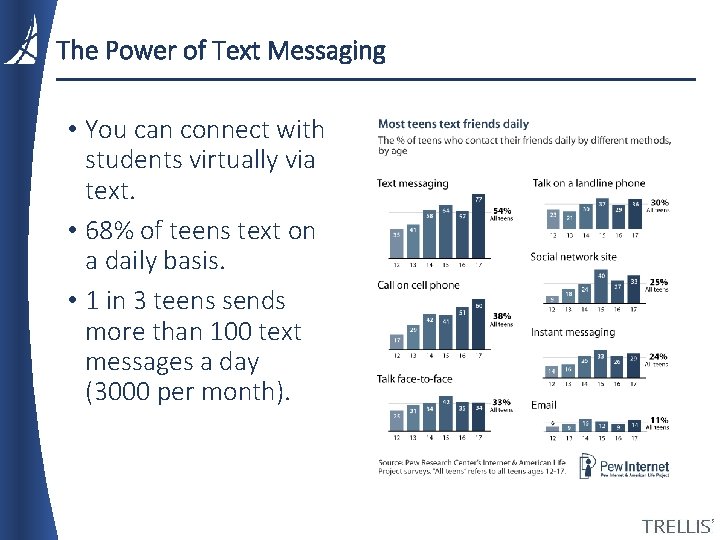
The Power of Text Messaging • You can connect with students virtually via text. • 68% of teens text on a daily basis. • 1 in 3 teens sends more than 100 text messages a day (3000 per month).
Power of a Simple Nudge • Nudge – personalized and timely message to urge students to complete tasks and navigate processes. • Counsel – provide access to resources and one-onone counseling through complex processes and decision-making moments.
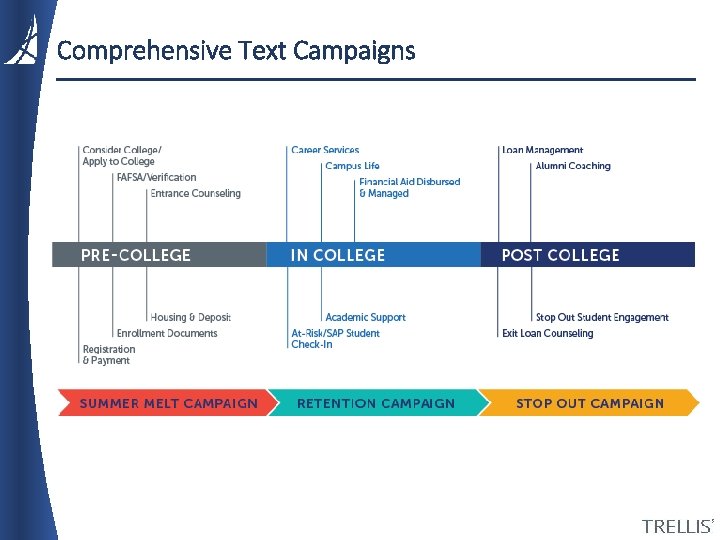
Comprehensive Text Campaigns
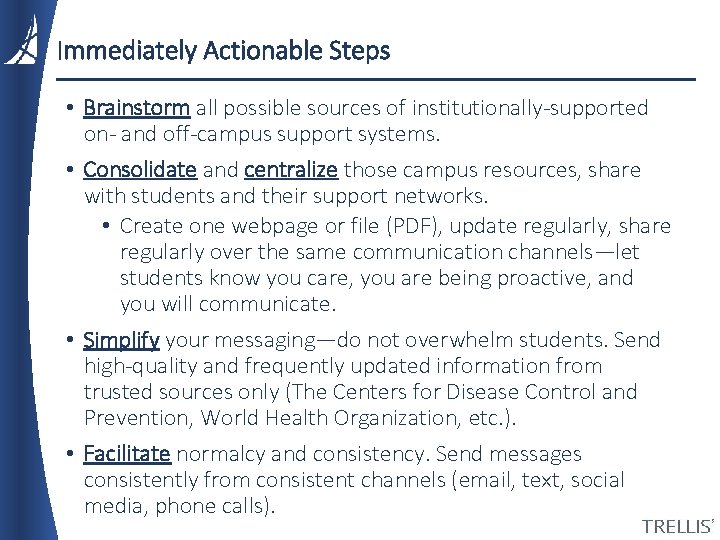
Immediately Actionable Steps • Brainstorm all possible sources of institutionally-supported on- and off-campus support systems. • Consolidate and centralize those campus resources, share with students and their support networks. • Create one webpage or file (PDF), update regularly, share regularly over the same communication channels—let students know you care, you are being proactive, and you will communicate. • Simplify your messaging—do not overwhelm students. Send high-quality and frequently updated information from trusted sources only (The Centers for Disease Control and Prevention, World Health Organization, etc. ). • Facilitate normalcy and consistency. Send messages consistently from consistent channels (email, text, social media, phone calls).
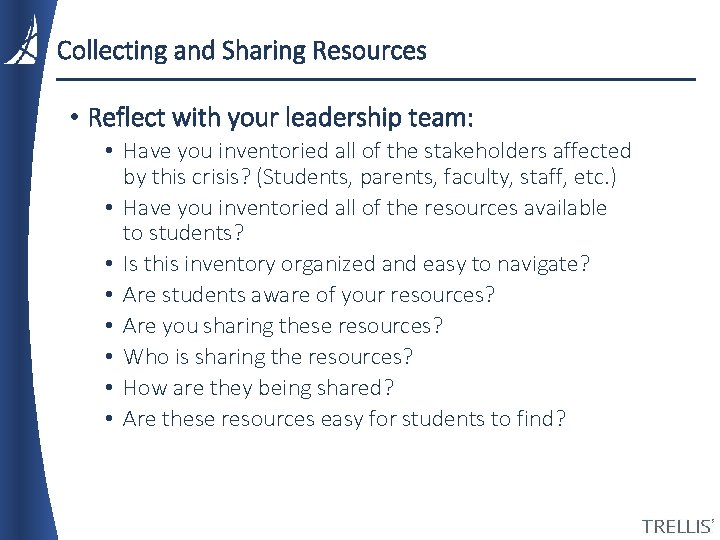
Collecting and Sharing Resources • Reflect with your leadership team: • Have you inventoried all of the stakeholders affected by this crisis? (Students, parents, faculty, staff, etc. ) • Have you inventoried all of the resources available to students? • Is this inventory organized and easy to navigate? • Are students aware of your resources? • Are you sharing these resources? • Who is sharing the resources? • How are they being shared? • Are these resources easy for students to find?
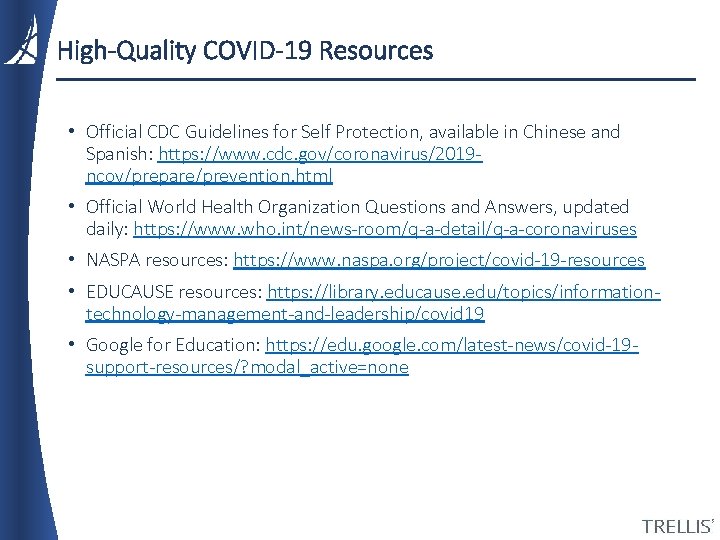
High-Quality COVID-19 Resources • Official CDC Guidelines for Self Protection, available in Chinese and Spanish: https: //www. cdc. gov/coronavirus/2019 ncov/prepare/prevention. html • Official World Health Organization Questions and Answers, updated daily: https: //www. who. int/news-room/q-a-detail/q-a-coronaviruses • NASPA resources: https: //www. naspa. org/project/covid-19 -resources • EDUCAUSE resources: https: //library. educause. edu/topics/informationtechnology-management-and-leadership/covid 19 • Google for Education: https: //edu. google. com/latest-news/covid-19 support-resources/? modal_active=none
Questions and Discussion • Questions? • Discussion Points: • Many, if not all, college campuses have closed physically; extended spring breaks; plan to continue instruction virtually/online for Spring 2020. • Student impact? Forced housing evacuations; unclear student loan guidance; possibility of increased housing and food insecurity; schools moving to pass/fail. • Enrollment management after COVID-19? Mass transition to virtual campus tours; exploring online/virtual options for international students for summer/fall semesters; extending deposit timelines; planning for longer term disruptions.
Sources for Webinar Information • Coombs, W. T. , & Holladay, S. (eds). (2010). The handbook of crisis communication. Chichester: Wiley. Blackwell. • Coombs, W. T. (2015). Ongoing crisis communication: Planning, managing, and responding (4 th ed. ). Thousand Oaks, CA: Sage. • Madden, S. (2017). The clock is ticking: Temporal dynamics of campus emergency notifications. Journal of Contingencies and Crisis Management, 25(4), 370 -375. https: //doi. org/10. 1111/1468 -5973. 12162 • Mc. Gee, T. K. , & Gow, G. A. (2012) Potential responses by on-campus university students to a university emergency alert, Journal of Risk Research, 15: 6, 693 -710, DOI: 10. 1080/13669877. 2011. 652653 • Sheldon, P. (2018). Emergency alert communications on college campuses: Understanding students’ perceptions of the severity of a crisis and their intentions to share the alert with parents and friends. Western Journal of Communication, 82: 1, 100 -116, DOI: 10. 1080/10570314. 2017. 1308005 • Sheldon, P. , & Antony, M. G. (2018). Sharing emergency alerts on a college campus: How gender and technology matter, Southern Communication Journal, 83: 3, 167178, DOI: 10. 1080/1041794 X. 2018. 1437467 • Taylor, Z. W. (2018) Comprehension in a crisis: Evaluating the readability and translation of emergency response messaging in higher education. Journal of Student Affairs, 27(1), 83 -92. https: //ssrn. com/abstract=3390901 • Taylor, Z. W. , & Barrera, M. C. (2019) Documenting a crisis: How postsecondary leaders addressed DACA students after Trump’s rescission. Teachers College Record, 121(5), 1 -28. http: //www. tcrecord. org/Content. asp? Content. Id=22657 • Ulmer, R. R. , Sellnow, T. L. , & Seeger, M. W. (2015). Effective crisis communication (3 rd ed. ). Thousand Oaks, CA: Sage.
Proven Services. Extraordinary Support.