
Effective Sample SizeCalibrated Multiple Comparison Methods for Long
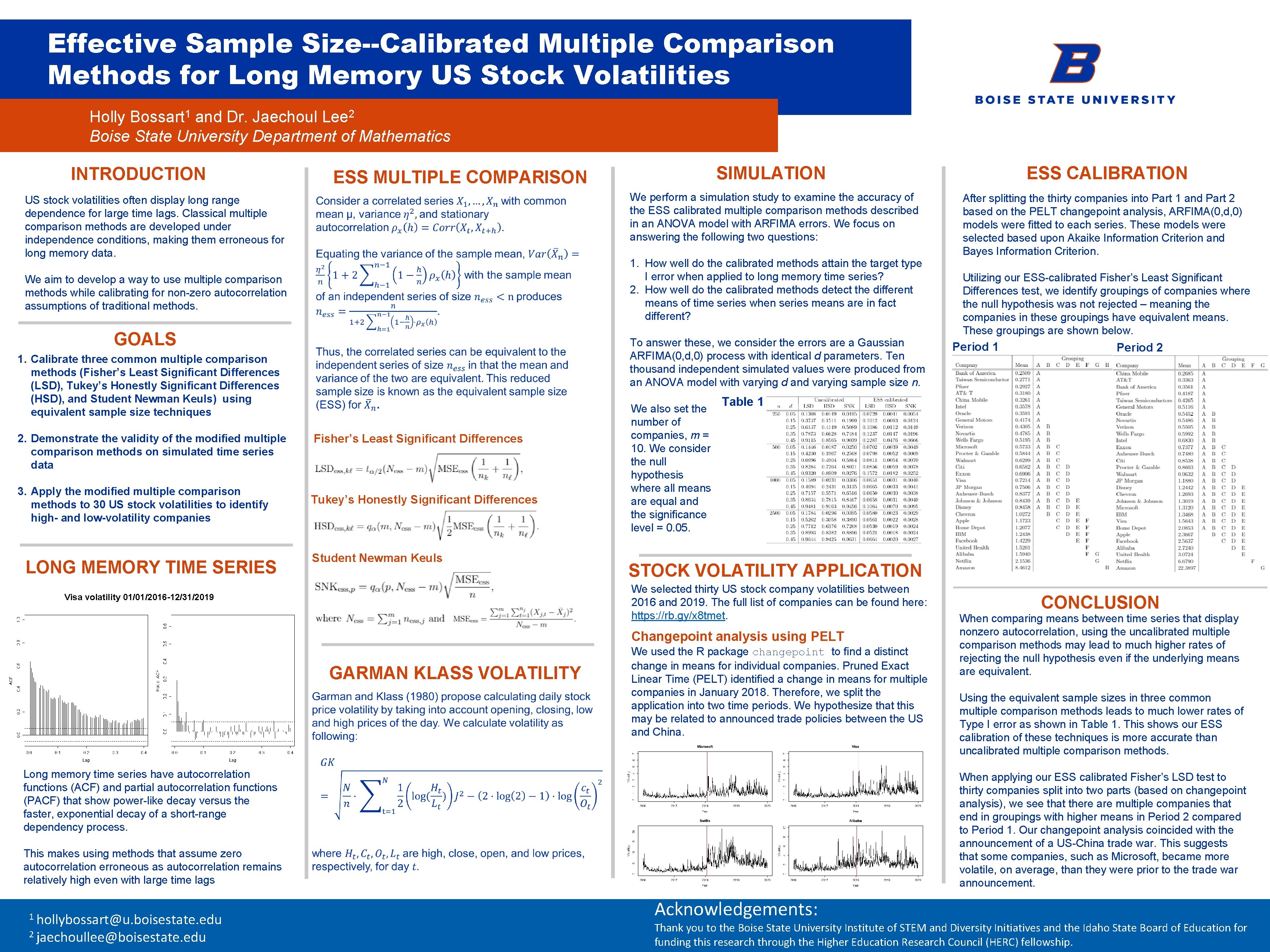
Effective Sample Size--Calibrated Multiple Comparison Methods for Long Memory US Stock Volatilities 1 Bossart Holly and Dr. Jaechoul Boise State University Department of Mathematics INTRODUCTION 2 Lee We perform a simulation study to examine the accuracy of the ESS calibrated multiple comparison methods described in an ANOVA model with ARFIMA errors. We focus on answering the following two questions: US stock volatilities often display long range dependence for large time lags. Classical multiple comparison methods are developed under independence conditions, making them erroneous for long memory data. 1. How well do the calibrated methods attain the target type I error when applied to long memory time series? 2. How well do the calibrated methods detect the different means of time series when series means are in fact different? We aim to develop a way to use multiple comparison methods while calibrating for non-zero autocorrelation assumptions of traditional methods. GOALS To answer these, we consider the errors are a Gaussian ARFIMA(0, d, 0) process with identical d parameters. Ten thousand independent simulated values were produced from an ANOVA model with varying d and varying sample size n. 1. Calibrate three common multiple comparison methods (Fisher’s Least Significant Differences (LSD), Tukey’s Honestly Significant Differences (HSD), and Student Newman Keuls) using equivalent sample size techniques 2. Demonstrate the validity of the modified multiple comparison methods on simulated time series data 3. Apply the modified multiple comparison methods to 30 US stock volatilities to identify high- and low-volatility companies LONG MEMORY TIME SERIES SIMULATION ESS MULTIPLE COMPARISON Fisher’s Least Significant Differences Tukey’s Honestly Significant Differences Student Newman Keuls We also set the number of companies, m = 10. We consider the null hypothesis where all means are equal and the significance level = 0. 05. We used the R package changepoint to find a distinct change in means for individual companies. Pruned Exact Linear Time (PELT) identified a change in means for multiple companies in January 2018. Therefore, we split the application into two time periods. We hypothesize that this may be related to announced trade policies between the US and China. Long memory time series have autocorrelation functions (ACF) and partial autocorrelation functions (PACF) that show power-like decay versus the faster, exponential decay of a short-range dependency process. 2 jaechoullee@boisestate. edu Period 1 Period 2 CONCLUSION When comparing means between time series that display nonzero autocorrelation, using the uncalibrated multiple comparison methods may lead to much higher rates of rejecting the null hypothesis even if the underlying means are equivalent. Using the equivalent sample sizes in three common multiple comparison methods leads to much lower rates of Type I error as shown in Table 1. This shows our ESS calibration of these techniques is more accurate than uncalibrated multiple comparison methods. When applying our ESS calibrated Fisher’s LSD test to thirty companies split into two parts (based on changepoint analysis), we see that there are multiple companies that end in groupings with higher means in Period 2 compared to Period 1. Our changepoint analysis coincided with the announcement of a US-China trade war. This suggests that some companies, such as Microsoft, became more volatile, on average, than they were prior to the trade war announcement. This makes using methods that assume zero autocorrelation erroneous as autocorrelation remains relatively high even with large time lags 1 hollybossart@u. boisestate. edu Utilizing our ESS-calibrated Fisher’s Least Significant Differences test, we identify groupings of companies where the null hypothesis was not rejected – meaning the companies in these groupings have equivalent means. These groupings are shown below. STOCK VOLATILITY APPLICATION Changepoint analysis using PELT GARMAN KLASS VOLATILITY After splitting the thirty companies into Part 1 and Part 2 based on the PELT changepoint analysis, ARFIMA(0, d, 0) models were fitted to each series. These models were selected based upon Akaike Information Criterion and Bayes Information Criterion. Table 1 We selected thirty US stock company volatilities between 2016 and 2019. The full list of companies can be found here: https: //rb. gy/x 8 tmet. Visa volatility 01/01/2016 -12/31/2019 ESS CALIBRATION Acknowledgements: Thank you to the Boise State University Institute of STEM and Diversity Initiatives and the Idaho State Board of Education for funding this research through the Higher Education Research Council (HERC) fellowship.
- Slides: 1