
Effective Rough Structure Design For Low Wetting Angle




- Slides: 26
Effective Rough Structure Design For Low Wetting Angle Hysteresis: Double Rough Structure and Free Energy Calculation Tae-Young Kim*, *** , Bialuch Ingmar **, Klaus Bewilogua **, Kyu Hwan Oh ***and Kwang-Ryeol Lee * * Future Technology Research Division, KIST, KOREA ** New Tribological Coating, Fraunhofer IST, GERMANY ***Department of Materials Engineering, SNU, KOREA
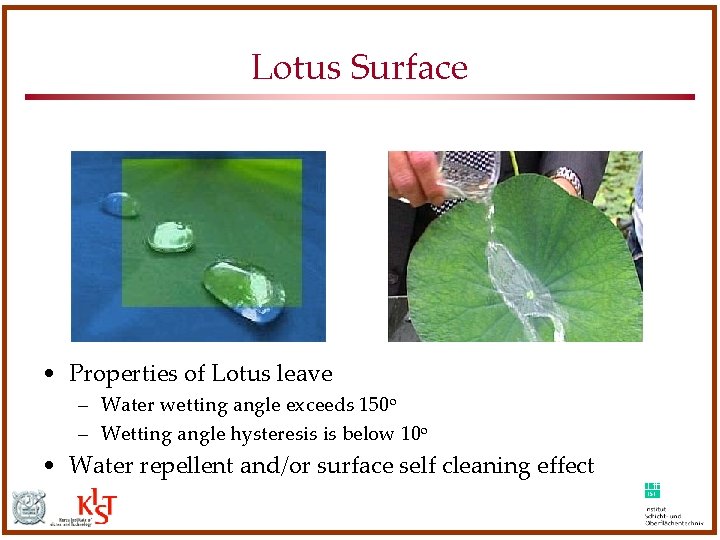
Lotus Surface • Properties of Lotus leave – Water wetting angle exceeds 150 o – Wetting angle hysteresis is below 10 o • Water repellent and/or surface self cleaning effect
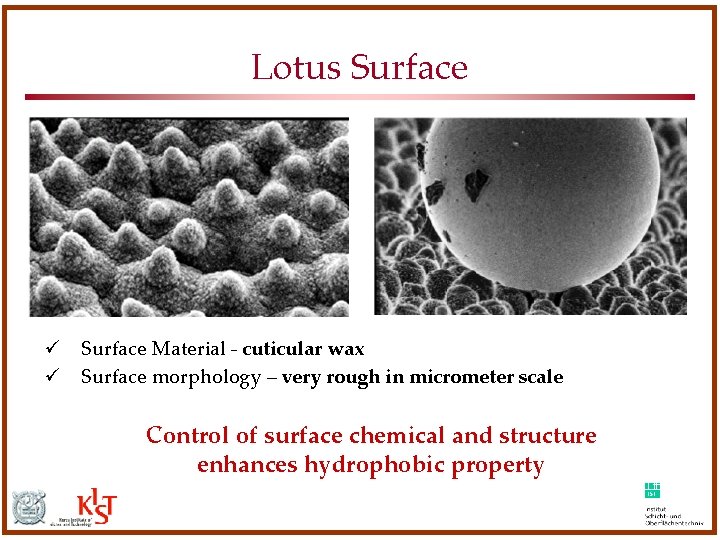
Lotus Surface ü Surface Material - cuticular wax ü Surface morphology – very rough in micrometer scale Control of surface chemical and structure enhances hydrophobic property
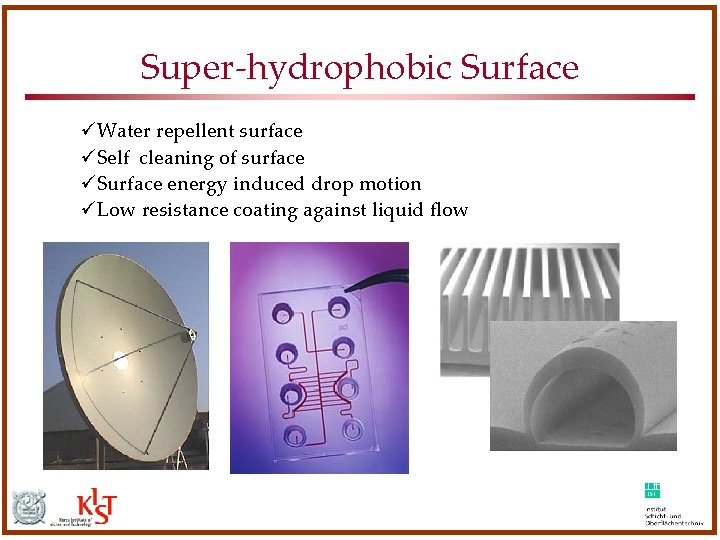
Super-hydrophobic Surface üWater repellent surface üSelf cleaning of surface üSurface energy induced drop motion üLow resistance coating against liquid flow
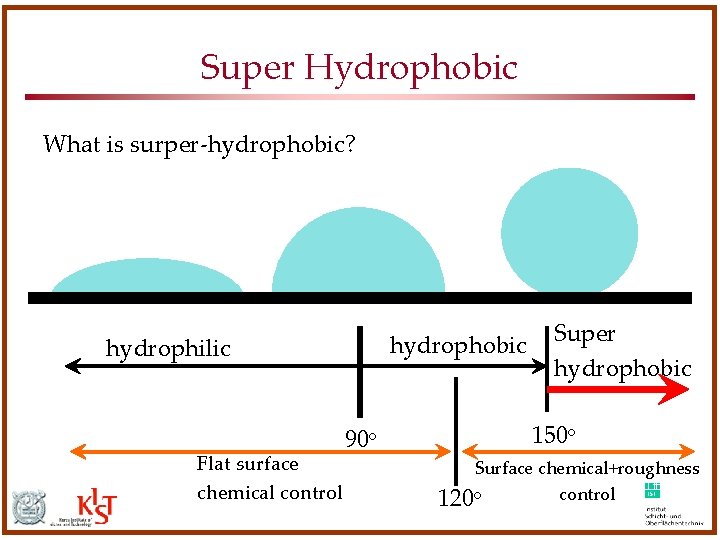
Super Hydrophobic What is surper-hydrophobic? hydrophobic hydrophilic Flat surface chemical control 90 o Super hydrophobic 150 o Surface chemical+roughness control 120 o
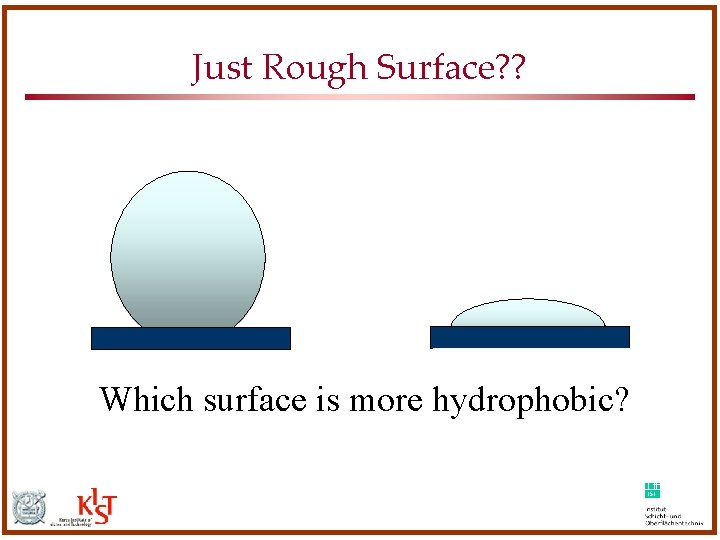
Just Rough Surface? ? Which surface is more hydrophobic?
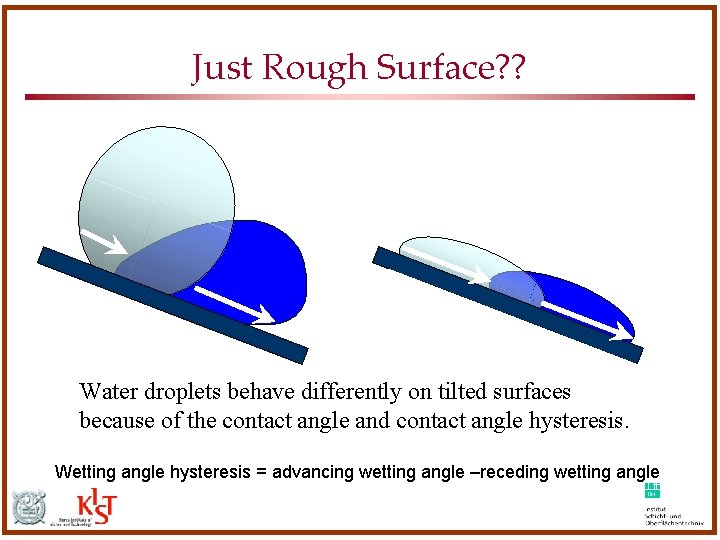
Just Rough Surface? ? Water droplets behave differently on tilted surfaces because of the contact angle and contact angle hysteresis. Wetting angle hysteresis = advancing wetting angle –receding wetting angle
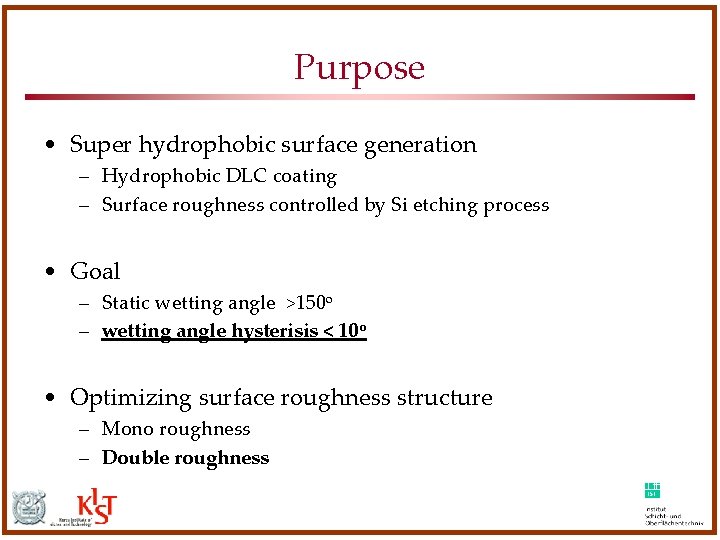
Purpose • Super hydrophobic surface generation – Hydrophobic DLC coating – Surface roughness controlled by Si etching process • Goal – Static wetting angle >150 o – wetting angle hysterisis < 10 o • Optimizing surface roughness structure – Mono roughness – Double roughness
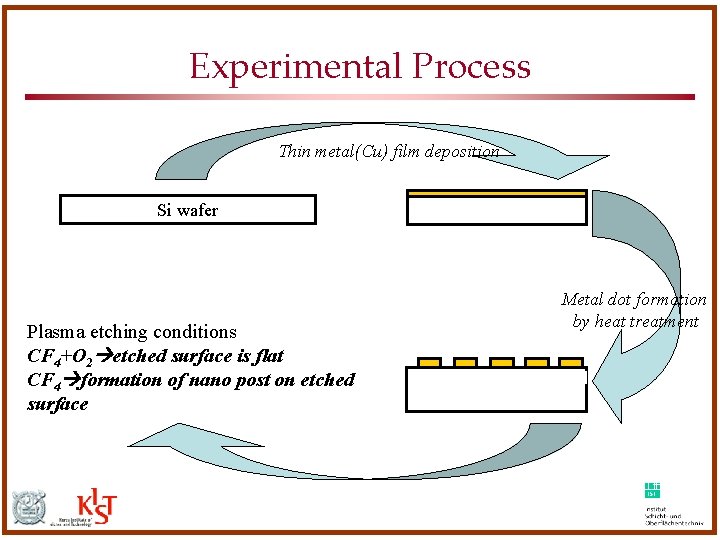
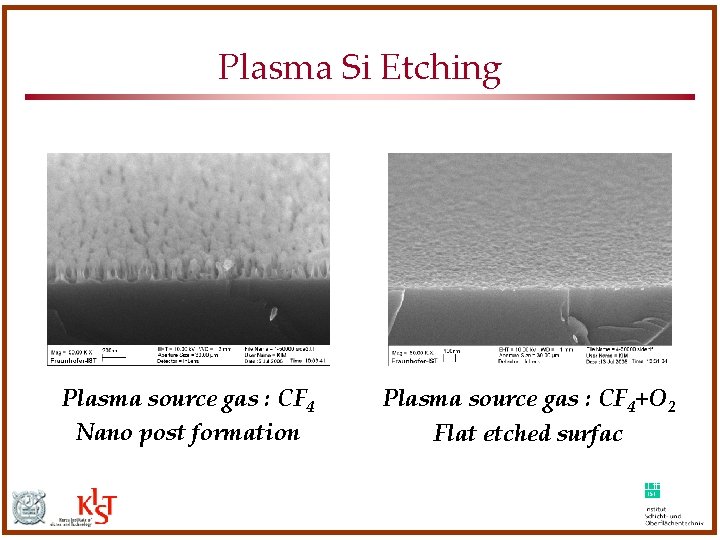
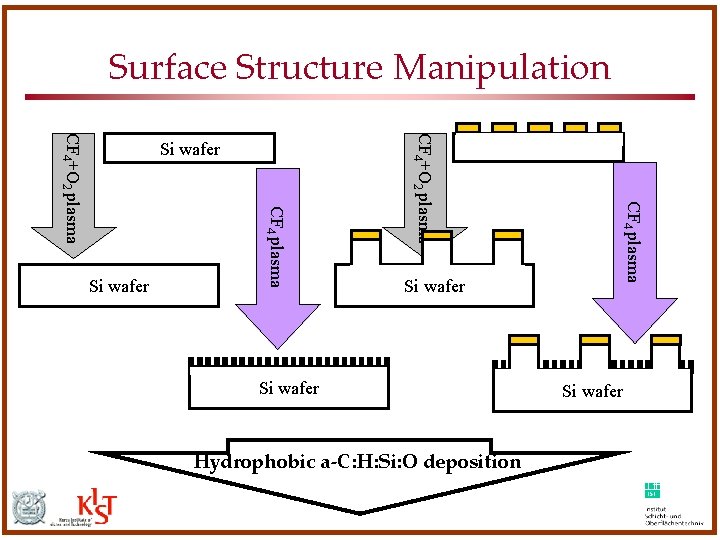
Experimental Process Thin metal(Cu) film deposition Si wafer Plasma etching conditions CF 4+O 2 etched surface is flat CF 4 formation of nano post on etched surface Metal dot formation by heat treatment
Plasma Si Etching Plasma source gas : CF 4 Nano post formation Plasma source gas : CF 4+O 2 Flat etched surfac
Surface Structure Manipulation Si wafer Hydrophobic a-C: H: Si: O deposition CF 4 plasma Si wafer CF 4+O 2 plasma Si wafer
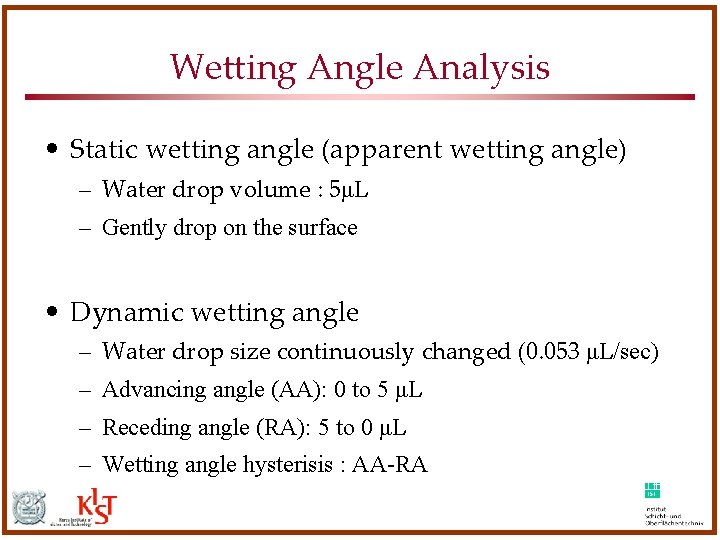
Wetting Angle Analysis • Static wetting angle (apparent wetting angle) – Water drop volume : 5μL – Gently drop on the surface • Dynamic wetting angle – Water drop size continuously changed (0. 053 μL/sec) – Advancing angle (AA): 0 to 5 μL – Receding angle (RA): 5 to 0 μL – Wetting angle hysterisis : AA-RA
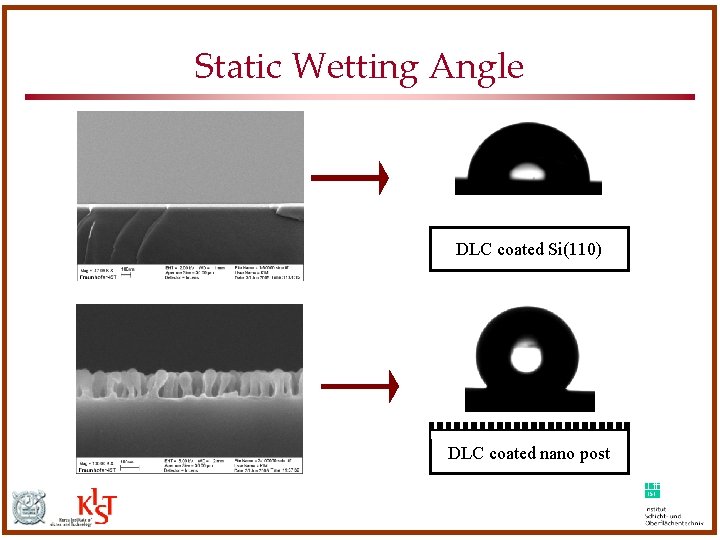
Static Wetting Angle DLC coated Si(110) DLC coated nano post
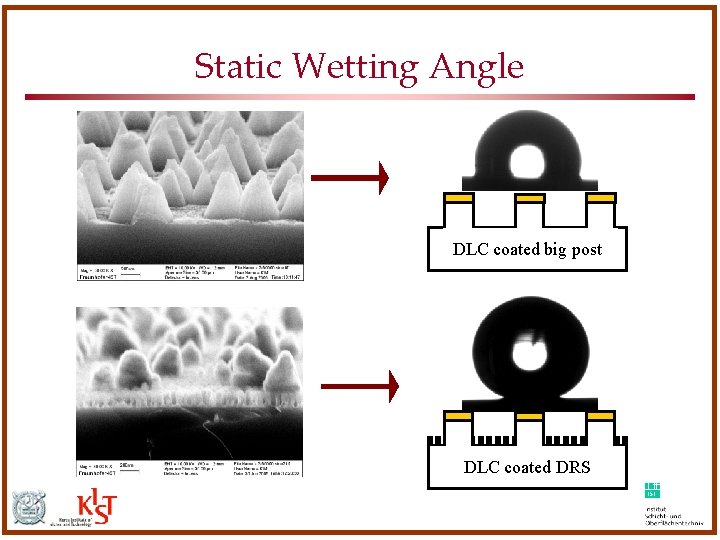
Static Wetting Angle DLC coated big post DLC coated DRS
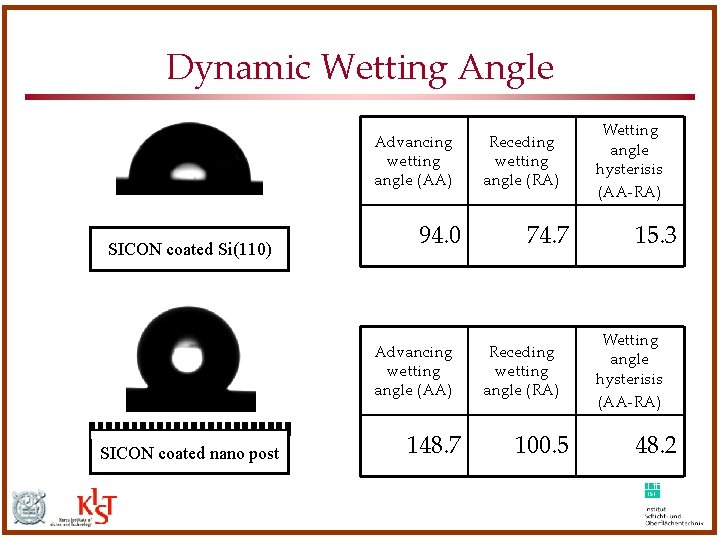
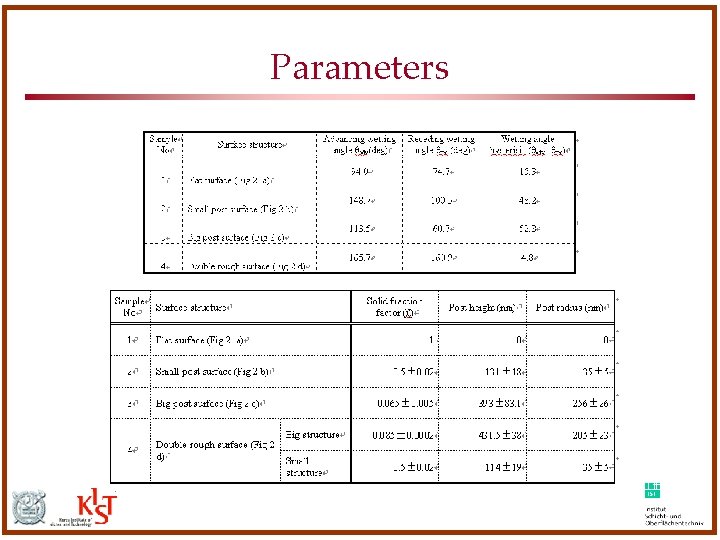
Dynamic Wetting Angle Advancing wetting angle (AA) SICON coated Si(110) 94. 0 Advancing wetting angle (AA) SICON coated nano post 148. 7 Receding wetting angle (RA) 74. 7 Receding wetting angle (RA) 100. 5 Wetting angle hysterisis (AA-RA) 15. 3 Wetting angle hysterisis (AA-RA) 48. 2
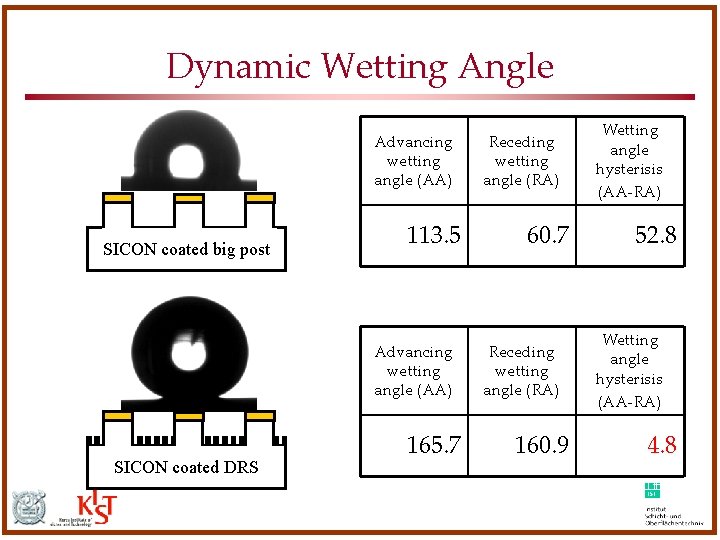
Dynamic Wetting Angle Advancing wetting angle (AA) SICON coated big post 113. 5 Advancing wetting angle (AA) SICON coated DRS 165. 7 Receding wetting angle (RA) 60. 7 Receding wetting angle (RA) 160. 9 Wetting angle hysterisis (AA-RA) 52. 8 Wetting angle hysterisis (AA-RA) 4. 8
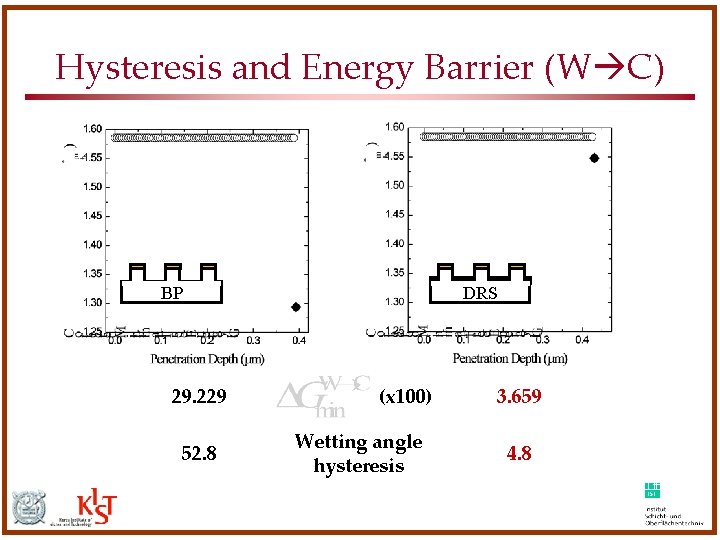
Double Rough Structure Effect DRS BP 103. 8 Static wetting angle 159. 6 52. 8 Wetting angle hysteresis 4. 8 DRS is more hydrophobic and suitable for moving droplet application than BP. The difference in structure is just bottom nano post in DRS effect
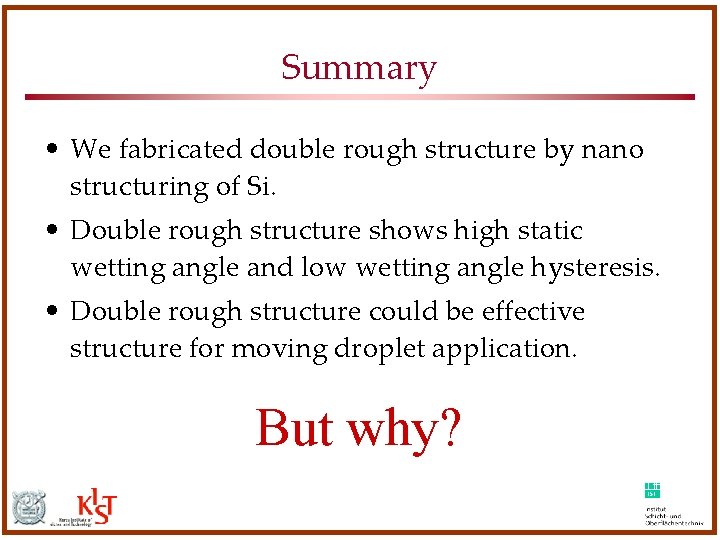
Summary • We fabricated double rough structure by nano structuring of Si. • Double rough structure shows high static wetting angle and low wetting angle hysteresis. • Double rough structure could be effective structure for moving droplet application. But why?
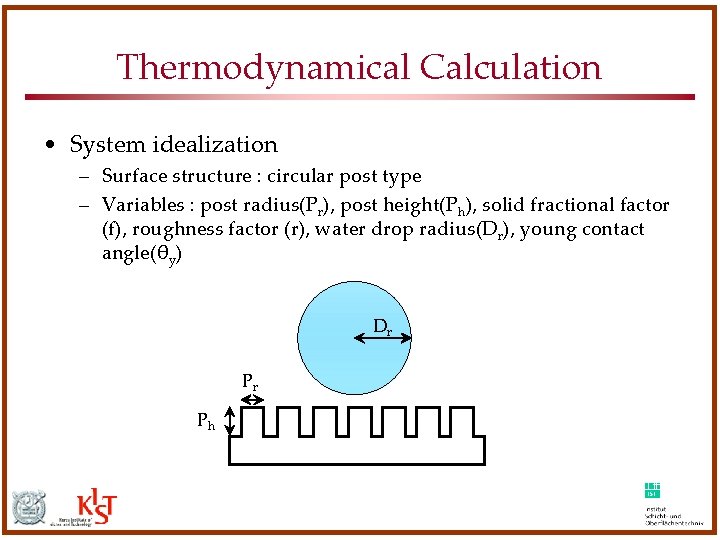
Thermodynamical Calculation • System idealization – Surface structure : circular post type – Variables : post radius(Pr), post height(Ph), solid fractional factor (f), roughness factor (r), water drop radius(Dr), young contact angle(θy) Dr Pr Ph
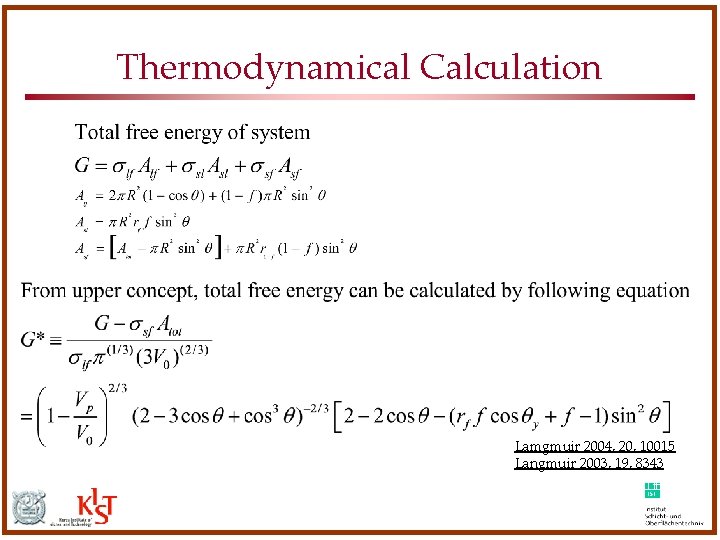
Thermodynamical Calculation Lamgmuir 2004, 20, 10015 Langmuir 2003, 19, 8343
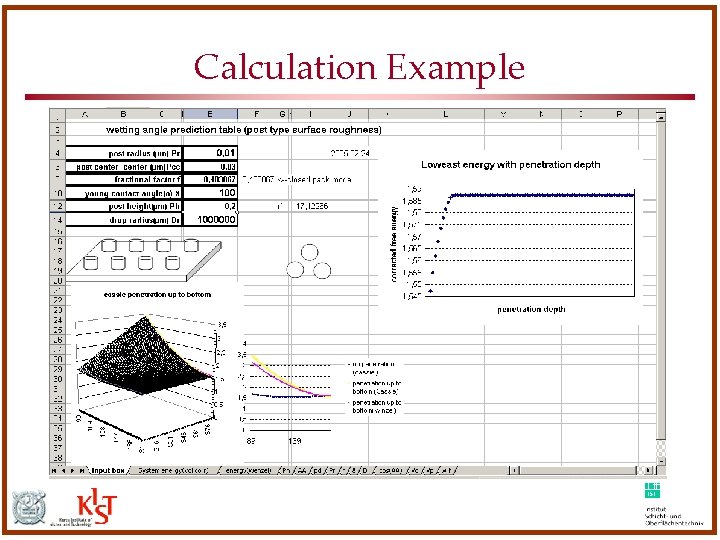
Calculation Example
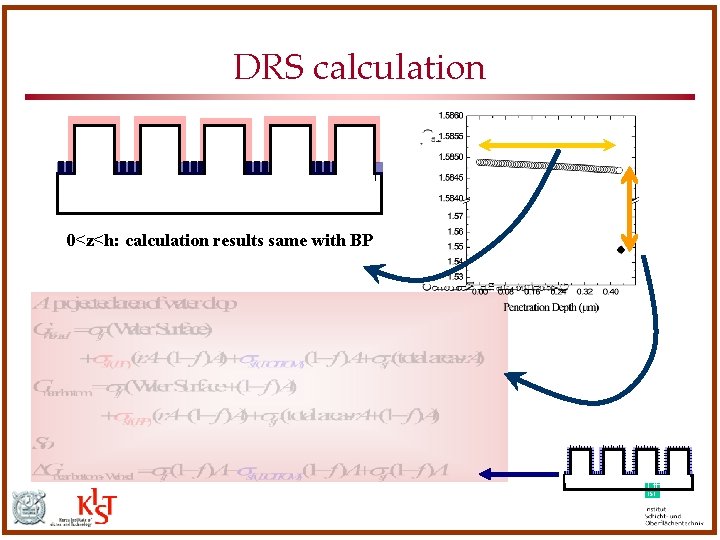
DRS calculation 0<z<h: calculation results same with BP
Parameters
Hysteresis and Energy Barrier (W C) BP 29. 229 52. 8 DRS (x 100) Wetting angle hysteresis 3. 659 4. 8
Conclusion • We fabricated double rough structure by nano structuring of Si. • Double rough structure shows high static wetting angle and low wetting angle hysteresis. • Double rough structure could be effective structure for moving droplet application. • Low hysteresis in DRS would caused by decrement of detaching energy barrier.