
Effective questioning and responding in the mathematics classroom
- Slides: 12
Effective questioning and responding in the mathematics classroom An NCETM research study module John Mason, 2010 John Mason has had a long and distinguished career at the Open University where he is now a Visiting Emeritus Professor. He is continuing to research the development of mathematical thinking of which his work on questioning forms a part.
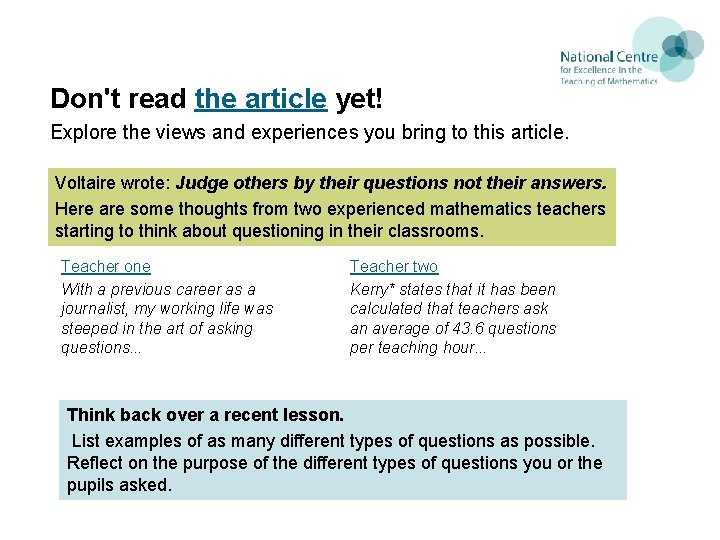
Don't read the article yet! Explore the views and experiences you bring to this article. Voltaire wrote: Judge others by their questions not their answers. Here are some thoughts from two experienced mathematics teachers starting to think about questioning in their classrooms. Teacher one With a previous career as a journalist, my working life was steeped in the art of asking questions. . . Teacher two Kerry* states that it has been calculated that teachers ask an average of 43. 6 questions per teaching hour. . . Think back over a recent lesson. List examples of as many different types of questions as possible. Reflect on the purpose of the different types of questions you or the pupils asked.
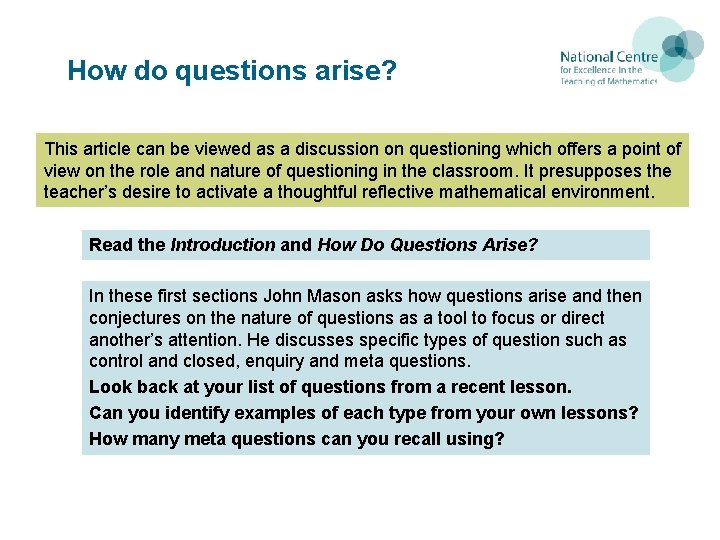
How do questions arise? This article can be viewed as a discussion on questioning which offers a point of view on the role and nature of questioning in the classroom. It presupposes the teacher’s desire to activate a thoughtful reflective mathematical environment. Read the Introduction and How Do Questions Arise? In these first sections John Mason asks how questions arise and then conjectures on the nature of questions as a tool to focus or direct another’s attention. He discusses specific types of question such as control and closed, enquiry and meta questions. Look back at your list of questions from a recent lesson. Can you identify examples of each type from your own lessons? How many meta questions can you recall using?
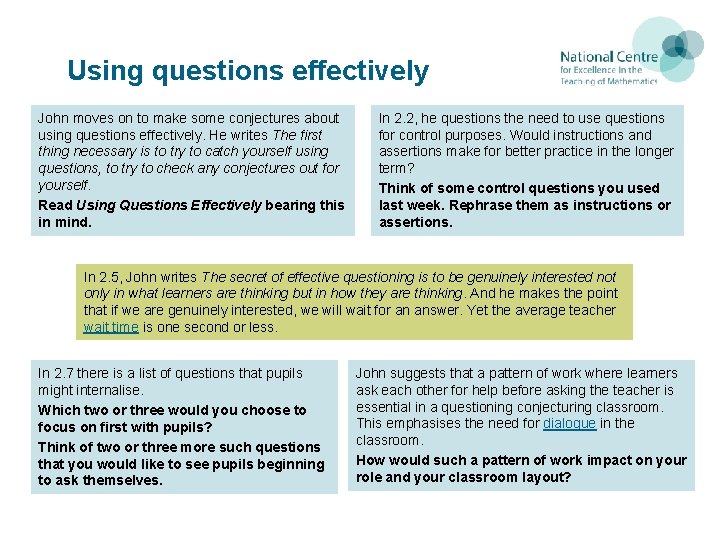
Using questions effectively John moves on to make some conjectures about using questions effectively. He writes The first thing necessary is to try to catch yourself using questions, to try to check any conjectures out for yourself. Read Using Questions Effectively bearing this in mind. In 2. 2, he questions the need to use questions for control purposes. Would instructions and assertions make for better practice in the longer term? Think of some control questions you used last week. Rephrase them as instructions or assertions. In 2. 5, John writes The secret of effective questioning is to be genuinely interested not only in what learners are thinking but in how they are thinking. And he makes the point that if we are genuinely interested, we will wait for an answer. Yet the average teacher wait time is one second or less. In 2. 7 there is a list of questions that pupils might internalise. Which two or three would you choose to focus on first with pupils? Think of two or three more such questions that you would like to see pupils beginning to ask themselves. John suggests that a pattern of work where learners ask each other for help before asking the teacher is essential in a questioning conjecturing classroom. This emphasises the need for dialogue in the classroom. How would such a pattern of work impact on your role and your classroom layout?
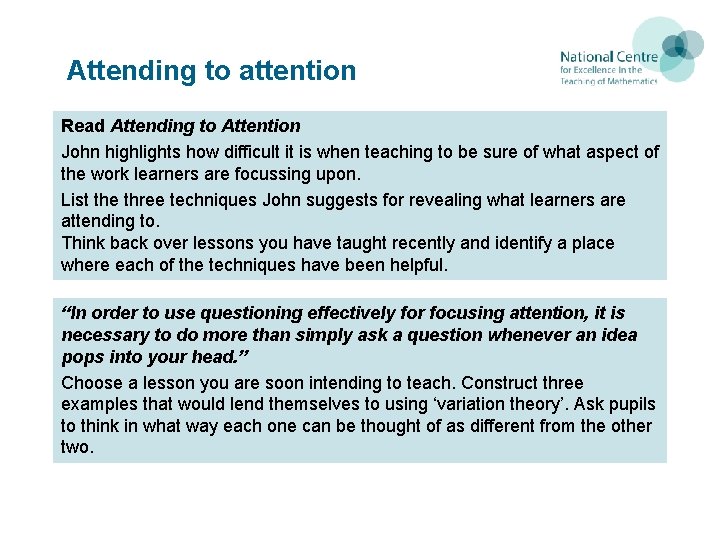
Attending to attention Read Attending to Attention John highlights how difficult it is when teaching to be sure of what aspect of the work learners are focussing upon. List the three techniques John suggests for revealing what learners are attending to. Think back over lessons you have taught recently and identify a place where each of the techniques have been helpful. “In order to use questioning effectively for focusing attention, it is necessary to do more than simply ask a question whenever an idea pops into your head. ” Choose a lesson you are soon intending to teach. Construct three examples that would lend themselves to using ‘variation theory’. Ask pupils to think in what way each one can be thought of as different from the other two.
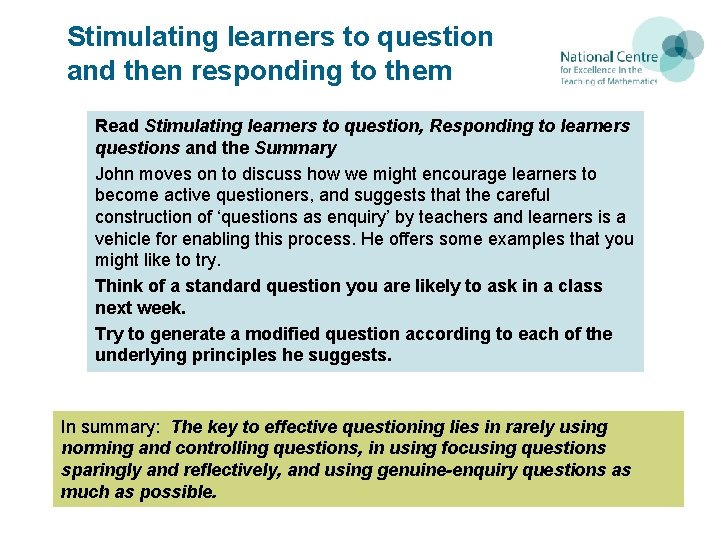
Stimulating learners to question and then responding to them Read Stimulating learners to question, Responding to learners questions and the Summary John moves on to discuss how we might encourage learners to become active questioners, and suggests that the careful construction of ‘questions as enquiry’ by teachers and learners is a vehicle for enabling this process. He offers some examples that you might like to try. Think of a standard question you are likely to ask in a class next week. Try to generate a modified question according to each of the underlying principles he suggests. In summary: The key to effective questioning lies in rarely using norming and controlling questions, in using focusing questions sparingly and reflectively, and using genuine-enquiry questions as much as possible.
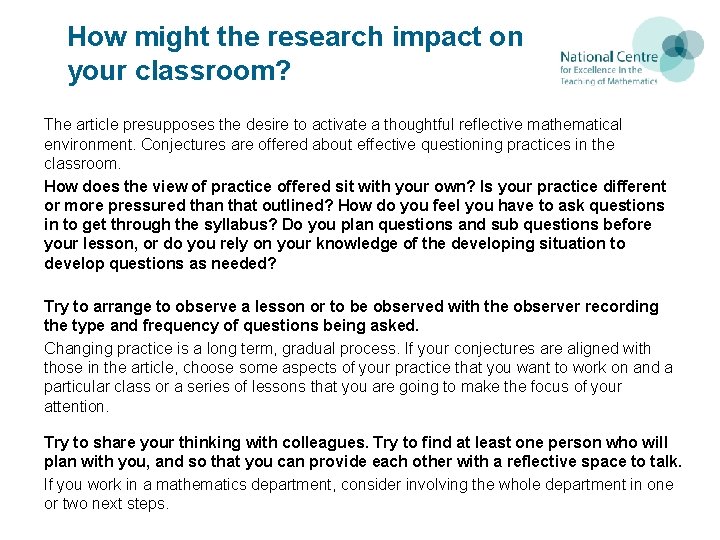
How might the research impact on your classroom? The article presupposes the desire to activate a thoughtful reflective mathematical environment. Conjectures are offered about effective questioning practices in the classroom. How does the view of practice offered sit with your own? Is your practice different or more pressured than that outlined? How do you feel you have to ask questions in to get through the syllabus? Do you plan questions and sub questions before your lesson, or do you rely on your knowledge of the developing situation to develop questions as needed? Try to arrange to observe a lesson or to be observed with the observer recording the type and frequency of questions being asked. Changing practice is a long term, gradual process. If your conjectures are aligned with those in the article, choose some aspects of your practice that you want to work on and a particular class or a series of lessons that you are going to make the focus of your attention. Try to share your thinking with colleagues. Try to find at least one person who will plan with you, and so that you can provide each other with a reflective space to talk. If you work in a mathematics department, consider involving the whole department in one or two next steps.
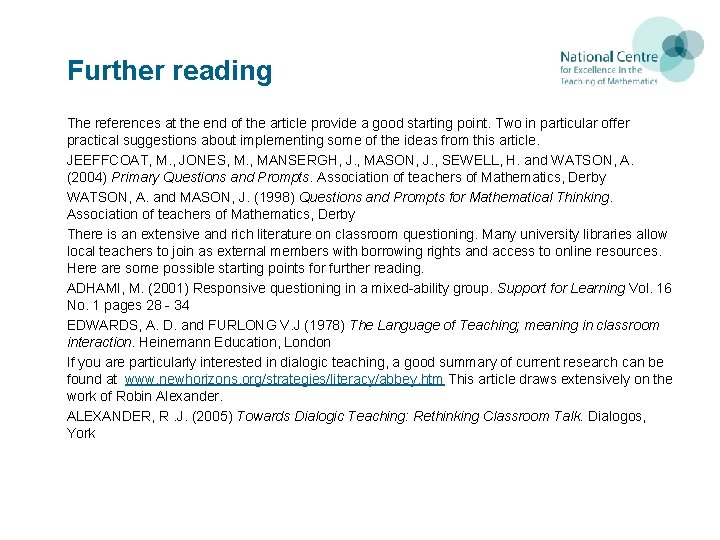
Further reading The references at the end of the article provide a good starting point. Two in particular offer practical suggestions about implementing some of the ideas from this article. JEEFFCOAT, M. , JONES, M. , MANSERGH, J. , MASON, J. , SEWELL, H. and WATSON, A. (2004) Primary Questions and Prompts. Association of teachers of Mathematics, Derby WATSON, A. and MASON, J. (1998) Questions and Prompts for Mathematical Thinking. Association of teachers of Mathematics, Derby There is an extensive and rich literature on classroom questioning. Many university libraries allow local teachers to join as external members with borrowing rights and access to online resources. Here are some possible starting points for further reading. ADHAMI, M. (2001) Responsive questioning in a mixed-ability group. Support for Learning Vol. 16 No. 1 pages 28 - 34 EDWARDS, A. D. and FURLONG V. J (1978) The Language of Teaching; meaning in classroom interaction. Heinemann Education, London If you are particularly interested in dialogic teaching, a good summary of current research can be found at www. newhorizons. org/strategies/literacy/abbey. htm This article draws extensively on the work of Robin Alexander. ALEXANDER, R. J. (2005) Towards Dialogic Teaching: Rethinking Classroom Talk. Dialogos, York
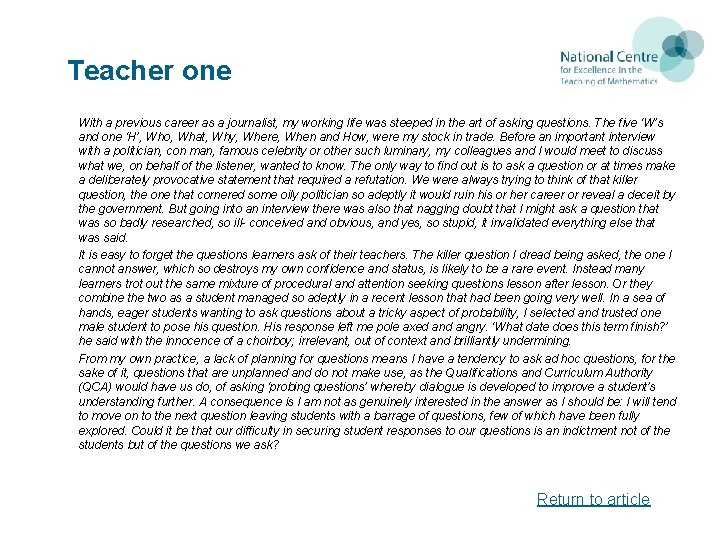
Teacher one With a previous career as a journalist, my working life was steeped in the art of asking questions. The five ‘W’s and one ‘H’, Who, What, Why, Where, When and How, were my stock in trade. Before an important interview with a politician, con man, famous celebrity or other such luminary, my colleagues and I would meet to discuss what we, on behalf of the listener, wanted to know. The only way to find out is to ask a question or at times make a deliberately provocative statement that required a refutation. We were always trying to think of that killer question, the one that cornered some oily politician so adeptly it would ruin his or her career or reveal a deceit by the government. But going into an interview there was also that nagging doubt that I might ask a question that was so badly researched, so ill- conceived and obvious, and yes, so stupid, it invalidated everything else that was said. It is easy to forget the questions learners ask of their teachers. The killer question I dread being asked, the one I cannot answer, which so destroys my own confidence and status, is likely to be a rare event. Instead many learners trot out the same mixture of procedural and attention seeking questions lesson after lesson. Or they combine the two as a student managed so adeptly in a recent lesson that had been going very well. In a sea of hands, eager students wanting to ask questions about a tricky aspect of probability, I selected and trusted one male student to pose his question. His response left me pole axed angry. ‘What date does this term finish? ’ he said with the innocence of a choirboy; irrelevant, out of context and brilliantly undermining. From my own practice, a lack of planning for questions means I have a tendency to ask ad hoc questions, for the sake of it, questions that are unplanned and do not make use, as the Qualifications and Curriculum Authority (QCA) would have us do, of asking ‘probing questions’ whereby dialogue is developed to improve a student’s understanding further. A consequence is I am not as genuinely interested in the answer as I should be: I will tend to move on to the next question leaving students with a barrage of questions, few of which have been fully explored. Could it be that our difficulty in securing student responses to our questions is an indictment not of the students but of the questions we ask? Return to article
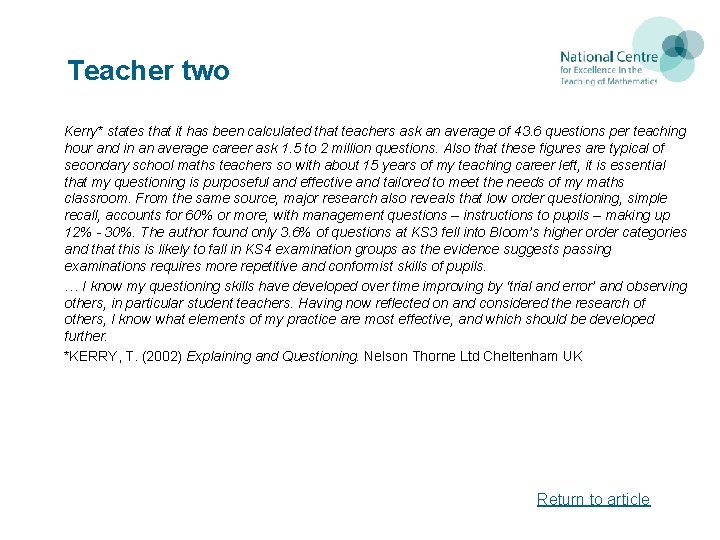
Teacher two Kerry* states that it has been calculated that teachers ask an average of 43. 6 questions per teaching hour and in an average career ask 1. 5 to 2 million questions. Also that these figures are typical of secondary school maths teachers so with about 15 years of my teaching career left, it is essential that my questioning is purposeful and effective and tailored to meet the needs of my maths classroom. From the same source, major research also reveals that low order questioning, simple recall, accounts for 60% or more, with management questions – instructions to pupils – making up 12% - 30%. The author found only 3. 6% of questions at KS 3 fell into Bloom’s higher order categories and that this is likely to fall in KS 4 examination groups as the evidence suggests passing examinations requires more repetitive and conformist skills of pupils. … I know my questioning skills have developed over time improving by ‘trial and error’ and observing others, in particular student teachers. Having now reflected on and considered the research of others, I know what elements of my practice are most effective, and which should be developed further. *KERRY, T. (2002) Explaining and Questioning. Nelson Thorne Ltd Cheltenham UK Return to article
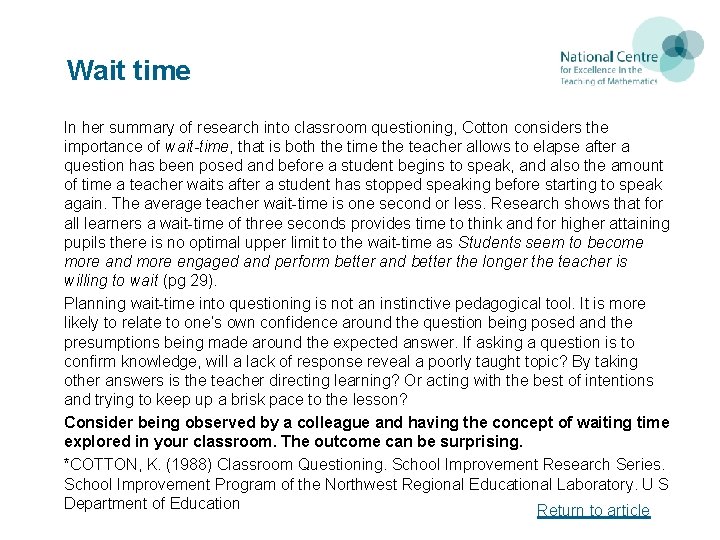
Wait time In her summary of research into classroom questioning, Cotton considers the importance of wait-time, that is both the time the teacher allows to elapse after a question has been posed and before a student begins to speak, and also the amount of time a teacher waits after a student has stopped speaking before starting to speak again. The average teacher wait-time is one second or less. Research shows that for all learners a wait-time of three seconds provides time to think and for higher attaining pupils there is no optimal upper limit to the wait-time as Students seem to become more and more engaged and perform better and better the longer the teacher is willing to wait (pg 29). Planning wait-time into questioning is not an instinctive pedagogical tool. It is more likely to relate to one’s own confidence around the question being posed and the presumptions being made around the expected answer. If asking a question is to confirm knowledge, will a lack of response reveal a poorly taught topic? By taking other answers is the teacher directing learning? Or acting with the best of intentions and trying to keep up a brisk pace to the lesson? Consider being observed by a colleague and having the concept of waiting time explored in your classroom. The outcome can be surprising. *COTTON, K. (1988) Classroom Questioning. School Improvement Research Series. School Improvement Program of the Northwest Regional Educational Laboratory. U S Department of Education Return to article
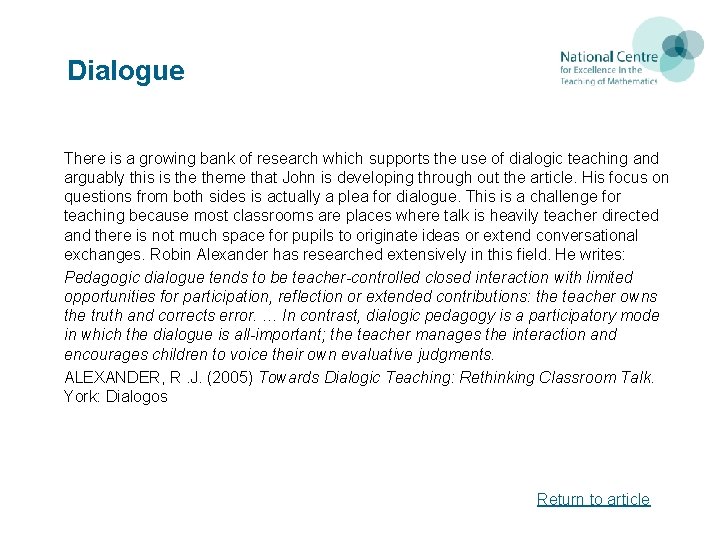
Dialogue There is a growing bank of research which supports the use of dialogic teaching and arguably this is theme that John is developing through out the article. His focus on questions from both sides is actually a plea for dialogue. This is a challenge for teaching because most classrooms are places where talk is heavily teacher directed and there is not much space for pupils to originate ideas or extend conversational exchanges. Robin Alexander has researched extensively in this field. He writes: Pedagogic dialogue tends to be teacher-controlled closed interaction with limited opportunities for participation, reflection or extended contributions: the teacher owns the truth and corrects error. … In contrast, dialogic pedagogy is a participatory mode in which the dialogue is all-important; the teacher manages the interaction and encourages children to voice their own evaluative judgments. ALEXANDER, R. J. (2005) Towards Dialogic Teaching: Rethinking Classroom Talk. York: Dialogos Return to article