
Effective Project Management The University of California Berkeley
Effective Project Management The University of California Berkeley – School of Information
Class 11 Agenda n n Project Management Today Guest Speaker: Kimberly Tsutsui, President; KT Hanks Consulting Group, Inc. Next Week Q & A © 2011 by Anne Walker. All rights reserved. 2
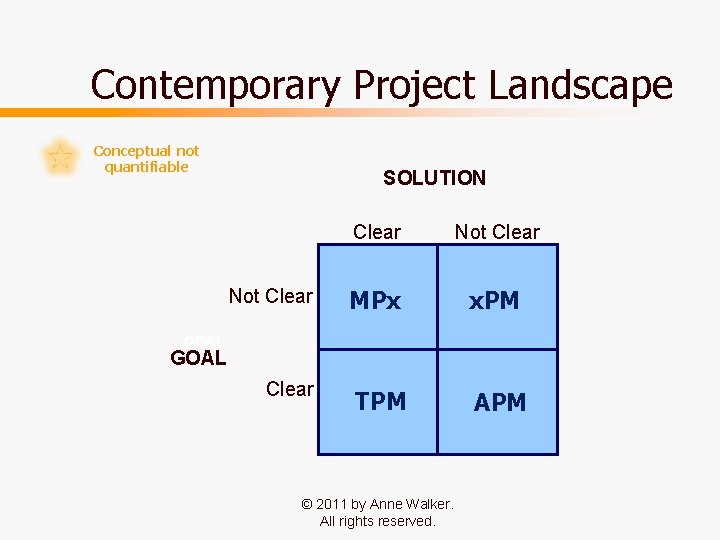
Contemporary Project Landscape Conceptual not quantifiable SOLUTION Not Clear MPx x. PM TPM APM GOAL Clear © 2011 by Anne Walker. All rights reserved.
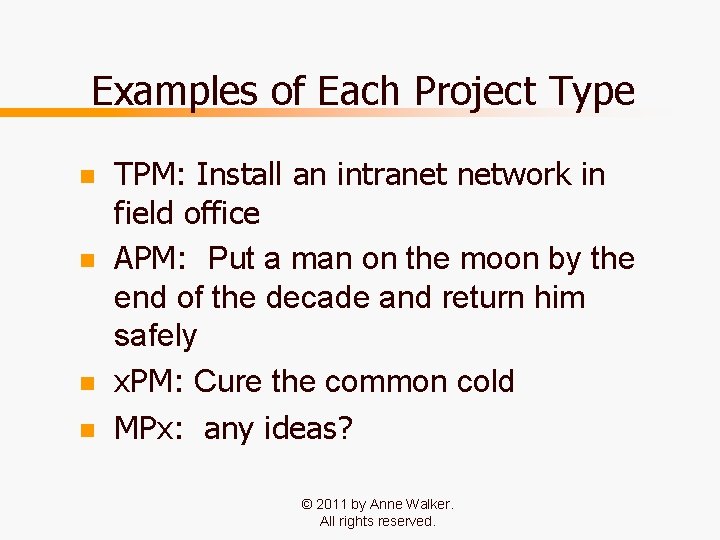
Examples of Each Project Type n n TPM: Install an intranet network in field office APM: Put a man on the moon by the end of the decade and return him safely x. PM: Cure the common cold MPx: any ideas? © 2011 by Anne Walker. All rights reserved. 4
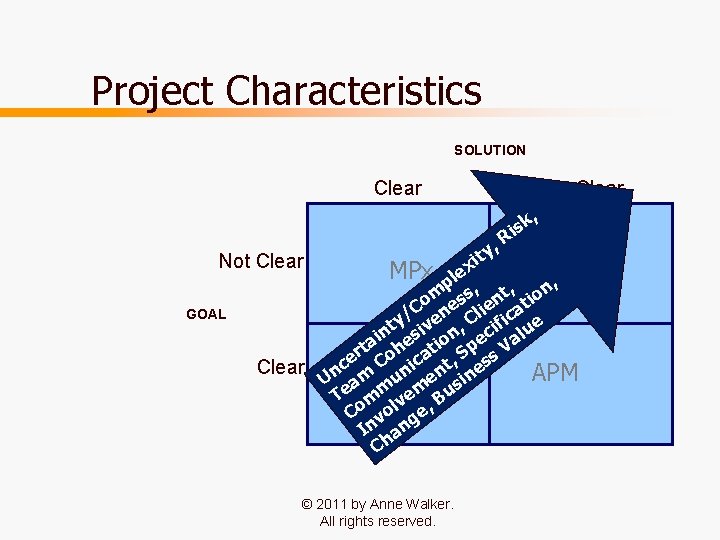
Project Characteristics SOLUTION Clear Not Clear , Not Clear GOAL Clear , y t i k is R x. PM ex l p , t, n, s m o o es ien ti C a y/ iven , Cl ific ue t in es ion ec al a rt oh cat , Sp s V e C ni nt es c n APM m u e sin U a TPM m m Te m lve Bu Co vo ge, In an Ch MPx © 2011 by Anne Walker. All rights reserved. 5
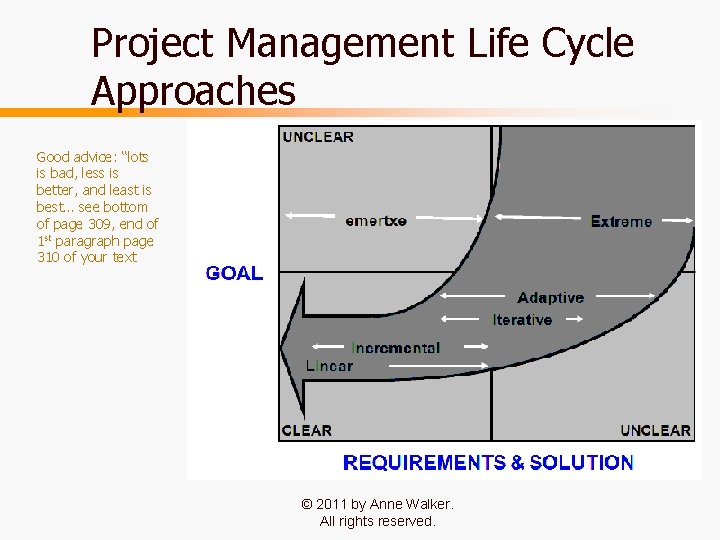
Project Management Life Cycle Approaches Good advice: “lots is bad, less is better, and least is best… see bottom of page 309, end of 1 st paragraph page 310 of your text © 2011 by Anne Walker. All rights reserved.
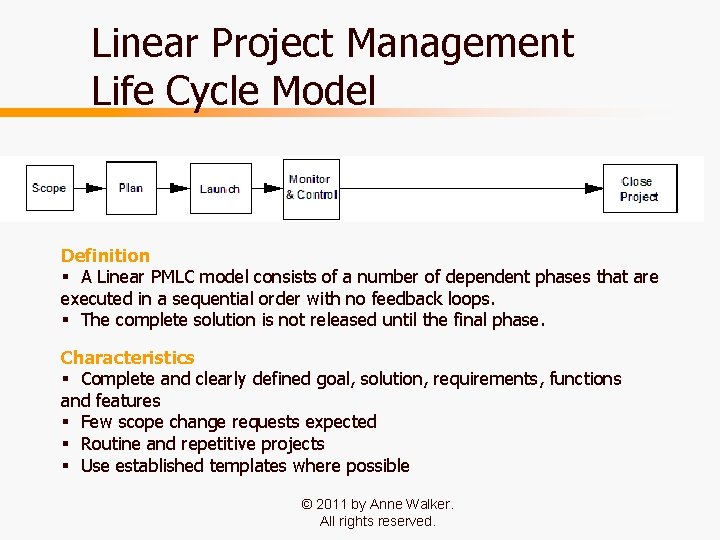
Linear Project Management Life Cycle Model Definition § A Linear PMLC model consists of a number of dependent phases that are executed in a sequential order with no feedback loops. § The complete solution is not released until the final phase. Characteristics § Complete and clearly defined goal, solution, requirements, functions and features § Few scope change requests expected § Routine and repetitive projects § Use established templates where possible © 2011 by Anne Walker. All rights reserved.
Linear Pros and Cons Strengths n Entire project is scheduled up front n Resource requirements are known n Does not require the most skilled resources n Team members can be geographically distributed Weaknesses n Does not accommodate change very well n Costs too much n Takes too long n Requires complete and detailed plans n Must follow a defined set of processes n Is not focused on delivering client value © 2011 by Anne Walker. All rights reserved. 8
When to use a Linear Approach n n n Projects that are repetitive Simple, short duration projects Projects contained totally within a single department and use no outside resources © 2011 by Anne Walker. All rights reserved. 9
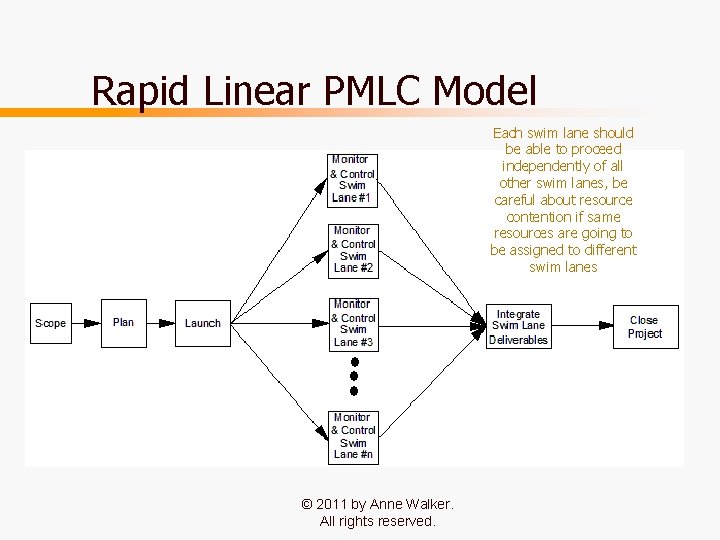
Rapid Linear PMLC Model Each swim lane should be able to proceed independently of all other swim lanes, be careful about resource contention if same resources are going to be assigned to different swim lanes © 2011 by Anne Walker. All rights reserved. 10
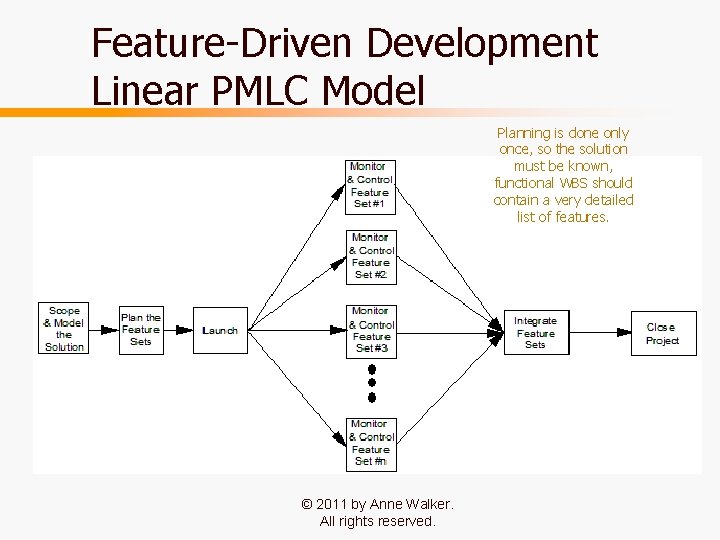
Feature-Driven Development Linear PMLC Model Planning is done only once, so the solution must be known, functional WBS should contain a very detailed list of features. © 2011 by Anne Walker. All rights reserved. 11
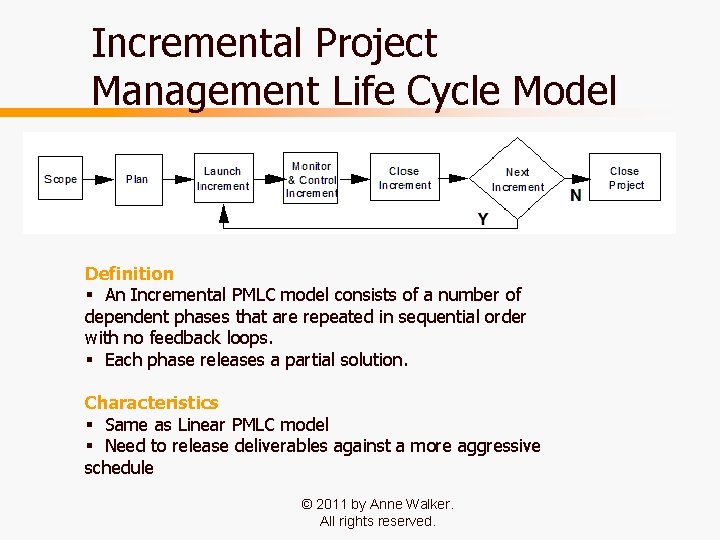
Incremental Project Management Life Cycle Model Definition § An Incremental PMLC model consists of a number of dependent phases that are repeated in sequential order with no feedback loops. § Each phase releases a partial solution. Characteristics § Same as Linear PMLC model § Need to release deliverables against a more aggressive schedule © 2011 by Anne Walker. All rights reserved.
Incremental Pros and Cons Strengths n Produces business value early in the life cycle n Able to better use scarce resources through proper increment definition n Can accommodate some change requests between increments n Offers a product improvement opportunity n More focused on client value than the linear approaches Weaknesses n The team may not remain intact between increments n Requires hand-off documentation between increments n Must follow a defined set of processes n An Incremental PMLC model takes longer than the Linear PMLC model n Requires more client involvement than Linear PMLC models n Partitioning the functions and features may be problematic n Must define increments based on function and feature dependencies rather than business value © 2011 by Anne Walker. All rights reserved. 13
When to use a Incremental Approach n n To get to a partial product or service to market sooner To get partial solution to the end user sooner © 2011 by Anne Walker. All rights reserved. 14
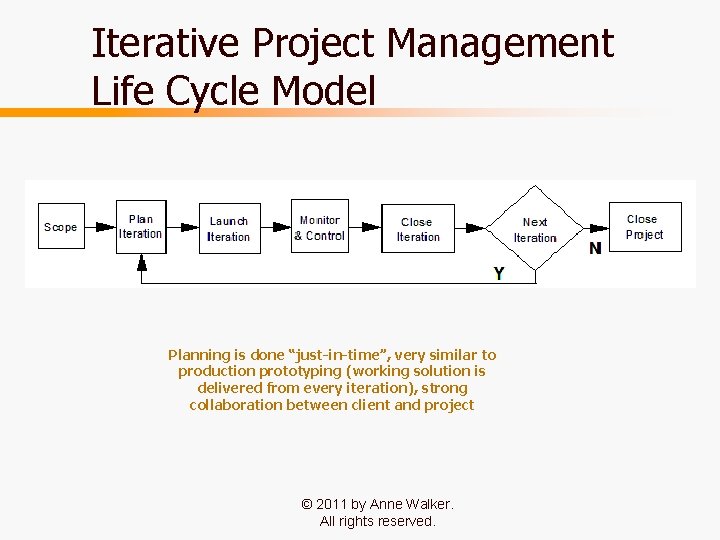
Iterative Project Management Life Cycle Model Planning is done “just-in-time”, very similar to production prototyping (working solution is delivered from every iteration), strong collaboration between client and project © 2011 by Anne Walker. All rights reserved.
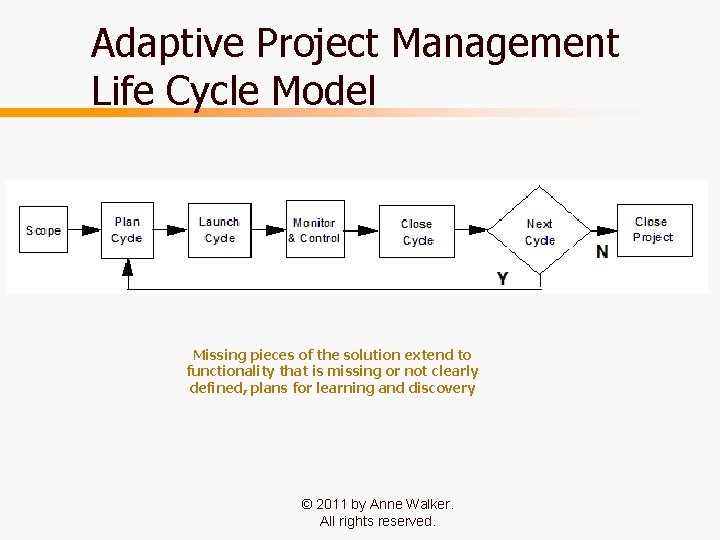
Adaptive Project Management Life Cycle Model Missing pieces of the solution extend to functionality that is missing or not clearly defined, plans for learning and discovery © 2011 by Anne Walker. All rights reserved.
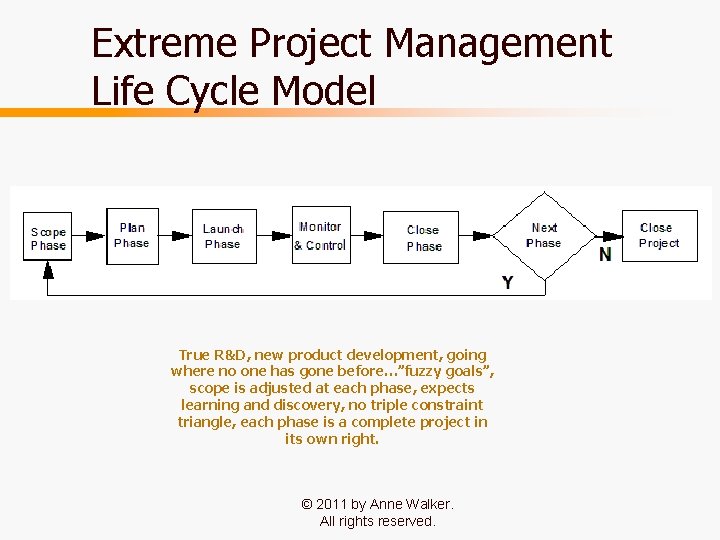
Extreme Project Management Life Cycle Model True R&D, new product development, going where no one has gone before…”fuzzy goals”, scope is adjusted at each phase, expects learning and discovery, no triple constraint triangle, each phase is a complete project in its own right. © 2011 by Anne Walker. All rights reserved.
Recap of the PMLC Models Similarities Ø All 5 Process Groups are used in each PMLC Model Ø Each PMLC Model begins with a Scope Process Group Ø Each PMLC Model ends with a Close Process Group Differences Ø The models form a natural ordering (Linear, Incremental, Iterative, Adaptive, Extreme) by degree of solution uncertainty Ø The processes that form repetitive groups recognize the effect of increasing uncertainty as you traverse the natural ordering Ø Complete project planning is replaced by just-in-time project planning as the degree of uncertainty increases Ø Risk management becomes more significant as degree of solution uncertainty increases Ø The need for meaningful client involvement increases as degree of solution uncertainty increases © 2011 by Anne Walker. All rights reserved.
When to Use (1 of 2) Linear Clearly defined solution and requirements Ø Not many scope change requests Ø Routine and repetitive projects Ø Uses established templates Incremental Ø Same as linear but delivers business value early and often Ø Some likelihood of scope change requests Iterative Ø Unstable or incomplete requirements and functionality Ø Learn by doing and by discovery Ø © 2011 by Anne Walker. All rights reserved.
When to Use (2 of 2) Adaptive Ø Goal known but solution not known Ø Solution highly influenced by expected changes Ø New product development and process improvement projects Extreme Ø Goal and solution not known Ø Through iteration converge on goal and solution Ø Typically for R&D projects © 2011 by Anne Walker. All rights reserved.
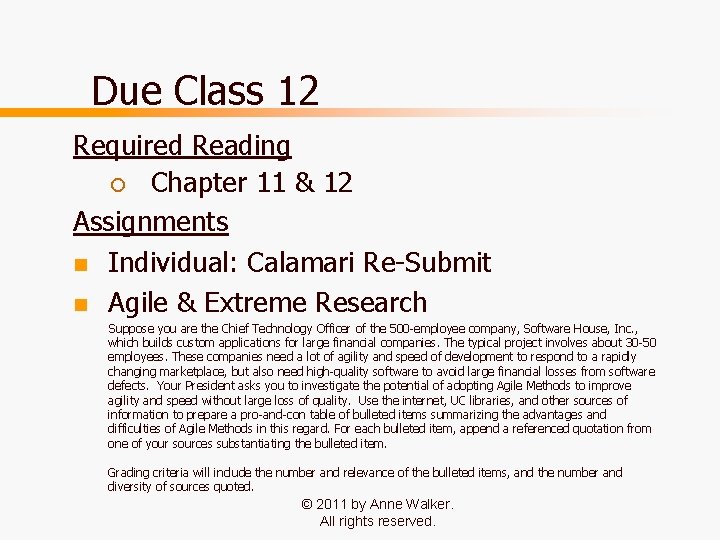
Due Class 12 Required Reading ¡ Chapter 11 & 12 Assignments n Individual: Calamari Re-Submit n Agile & Extreme Research Suppose you are the Chief Technology Officer of the 500 -employee company, Software House, Inc. , which builds custom applications for large financial companies. The typical project involves about 30 -50 employees. These companies need a lot of agility and speed of development to respond to a rapidly changing marketplace, but also need high-quality software to avoid large financial losses from software defects. Your President asks you to investigate the potential of adopting Agile Methods to improve agility and speed without large loss of quality. Use the internet, UC libraries, and other sources of information to prepare a pro-and-con table of bulleted items summarizing the advantages and difficulties of Agile Methods in this regard. For each bulleted item, append a referenced quotation from one of your sources substantiating the bulleted item. Grading criteria will include the number and relevance of the bulleted items, and the number and diversity of sources quoted. © 2011 by Anne Walker. All rights reserved. 21
Q & A © 2011 by Anne Walker. All rights reserved. 22
- Slides: 22