
Effective online monitoring and saving strategy for largescale

- Slides: 2
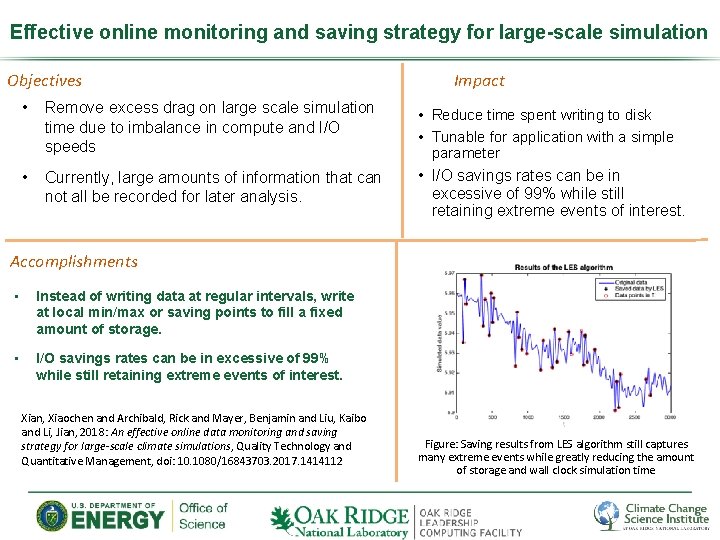
Effective online monitoring and saving strategy for large-scale simulation Objectives • Remove excess drag on large scale simulation time due to imbalance in compute and I/O speeds • Currently, large amounts of information that can not all be recorded for later analysis. Impact • Reduce time spent writing to disk • Tunable for application with a simple parameter • I/O savings rates can be in excessive of 99% while still retaining extreme events of interest. Accomplishments • Instead of writing data at regular intervals, write at local min/max or saving points to fill a fixed amount of storage. • I/O savings rates can be in excessive of 99% while still retaining extreme events of interest. Xian, Xiaochen and Archibald, Rick and Mayer, Benjamin and Liu, Kaibo and Li, Jian, 2018: An effective online data monitoring and saving strategy for large-scale climate simulations, Quality Technology and Quantitative Management, doi: 10. 1080/16843703. 2017. 1414112 Figure: Saving results from LES algorithm still captures many extreme events while greatly reducing the amount of storage and wall clock simulation time
Effective online monitoring and saving strategy for large-scale simulation Summary Large-scale climate simulation models have been developed and widely used to generate historical data and study future climate scenarios. These simulation models often have to run for a couple of months to understand the changes in the global climate over the course of decades. This long-duration simulation process creates a huge amount of data with both high temporal and spatial resolution information; however, how to effectively monitor and record the climate changes based on these large-scale simulation results that are continuously produced in real time still remains to be resolved. Due to the slow process of writing data to disk, the current practice is to save a snapshot of the simulation results at a constant, slow rate although the data generation process runs at a very high speed. This paper proposes an effective online data monitoring and saving strategy over the temporal and spatial domains with the consideration of practical storage and memory capacity constraints. Our proposed method is able to intelligently select and record the most informative extreme values in the raw data generated from real-time simulations in the context of better monitoring climate changes. Xian, Xiaochen and Archibald, Rick and Mayer, Benjamin and Liu, Kaibo and Li, Jian, 2018: An effective online data monitoring and saving strategy for large-scale climate simulations, Quality Technology and Quantitative Management, doi: 10. 1080/16843703. 2017. 1414112