
Effective Models for Mental Health Consultation in Early
- Slides: 12
Effective Models for Mental Health Consultation in Early Childhood Settings Beth Green, Ph. D. NPC Research, Inc. & Research and Training Center for Family Support and Children’s Mental Health Portland State University June 2003 Building on Family Strengths green@npcresearch. com Annual Conference
Why Do Early Childhood Programs Need to Provide Mental Health Services? n Increasing prevalence of behavioral and emotional problems in children under 5: n Behavioral and emotional problems among preschool children challenge families and teachers – Shifts focus in classroom from support to behavioral control – Aggressive behavior = exclusive practice June 2003 Building on Family Strengths Annual Conference 2
A Paradigm Shift in Providing Mental Health Services in Early Childhood Settings n Piotrkowski, Collins, Knitzer, and Robinson (1994): – Shift away from problem-focused, therapeutic treatment of individual children – Shift towards holistic, integrated, prevention -oriented mental health services n Revised Head Start performance standards June 2003 Building on Family Strengths Annual Conference 3
Early Childhood Mental Health Consultation: What Does it Look Like? n Child-centered consultation: Traditional, problem-focused approach n Program-centered consultation: Supports programs and staff more generally to implement prevention and early intervention for all children June 2003 Building on Family Strengths Annual Conference 4
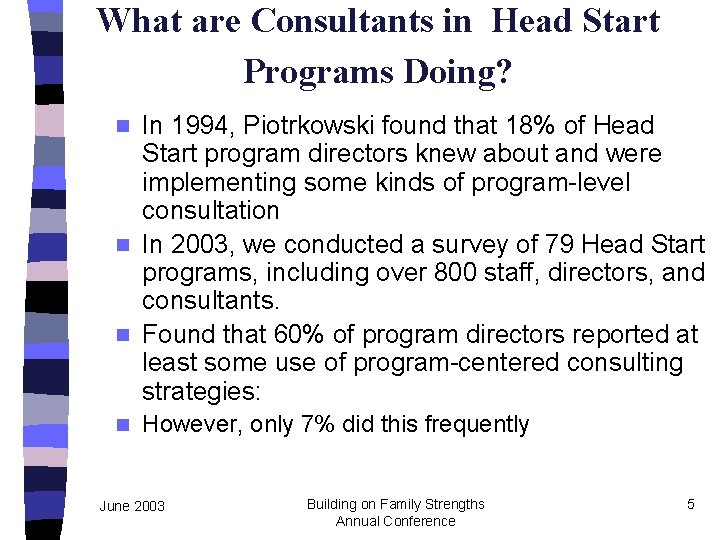
What are Consultants in Head Start Programs Doing? In 1994, Piotrkowski found that 18% of Head Start program directors knew about and were implementing some kinds of program-level consultation n In 2003, we conducted a survey of 79 Head Start programs, including over 800 staff, directors, and consultants. n Found that 60% of program directors reported at least some use of program-centered consulting strategies: n n However, only 7% did this frequently June 2003 Building on Family Strengths Annual Conference 5
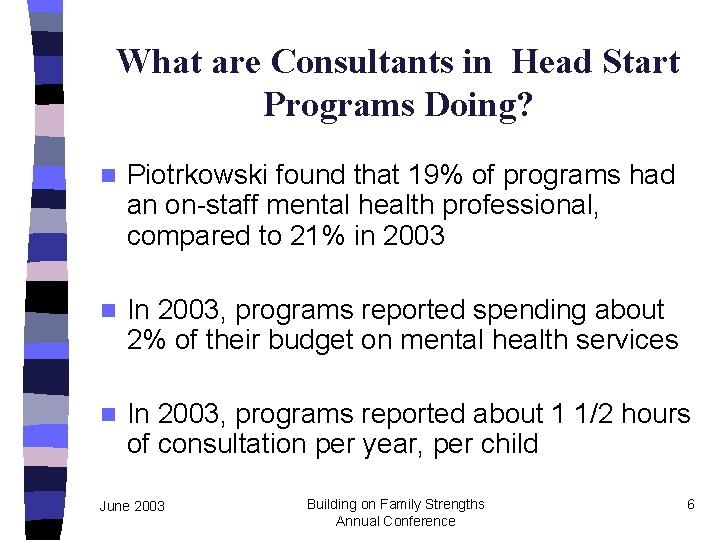
What are Consultants in Head Start Programs Doing? n Piotrkowski found that 19% of programs had an on-staff mental health professional, compared to 21% in 2003 n In 2003, programs reported spending about 2% of their budget on mental health services n In 2003, programs reported about 1 1/2 hours of consultation per year, per child June 2003 Building on Family Strengths Annual Conference 6
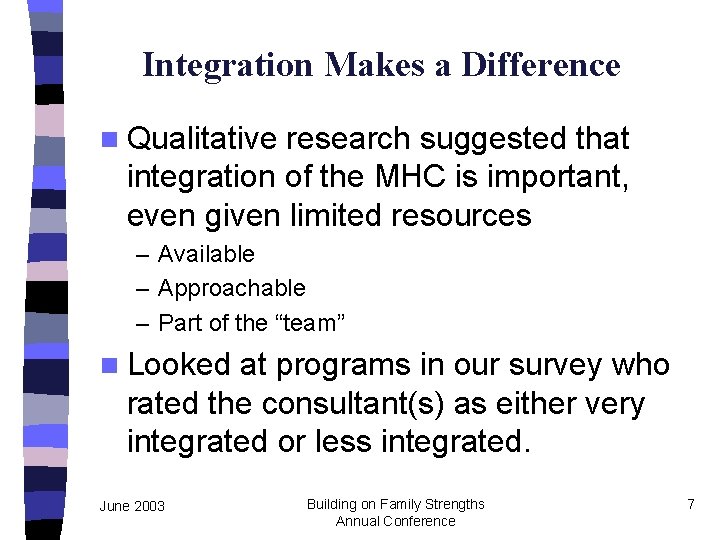
Integration Makes a Difference n Qualitative research suggested that integration of the MHC is important, even given limited resources – Available – Approachable – Part of the “team” n Looked at programs in our survey who rated the consultant(s) as either very integrated or less integrated. June 2003 Building on Family Strengths Annual Conference 7
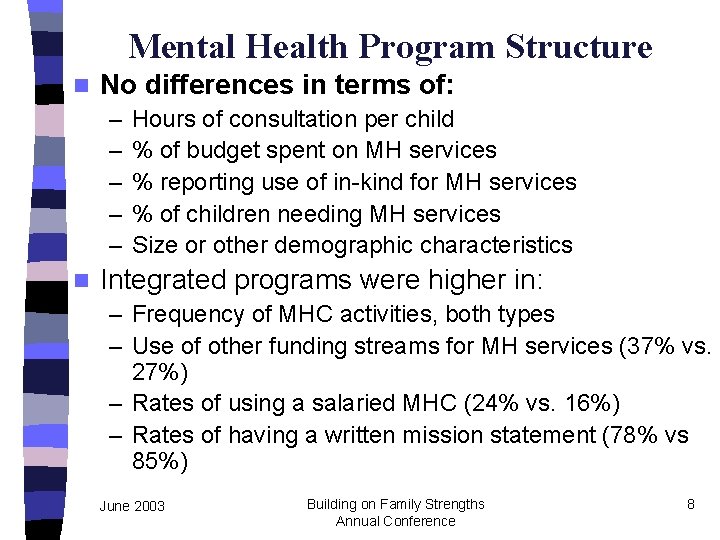
Mental Health Program Structure n No differences in terms of: – – – n Hours of consultation per child % of budget spent on MH services % reporting use of in-kind for MH services % of children needing MH services Size or other demographic characteristics Integrated programs were higher in: – Frequency of MHC activities, both types – Use of other funding streams for MH services (37% vs. 27%) – Rates of using a salaried MHC (24% vs. 16%) – Rates of having a written mission statement (78% vs 85%) June 2003 Building on Family Strengths Annual Conference 8
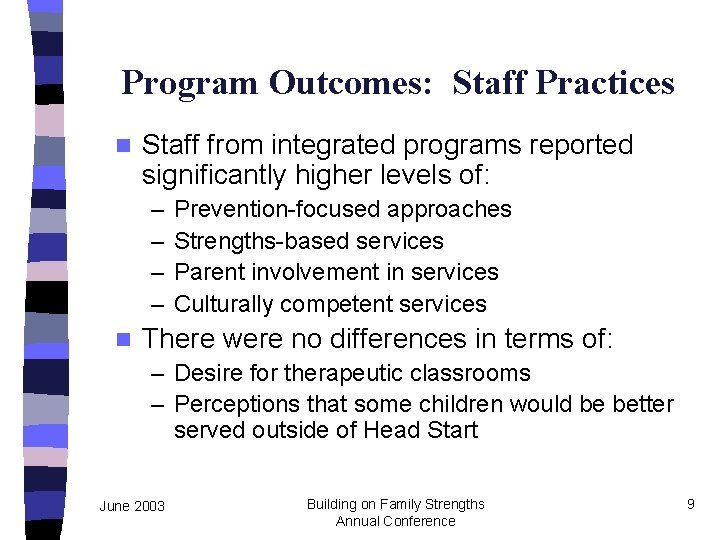
Program Outcomes: Staff Practices n Staff from integrated programs reported significantly higher levels of: – – n Prevention-focused approaches Strengths-based services Parent involvement in services Culturally competent services There were no differences in terms of: – Desire for therapeutic classrooms – Perceptions that some children would be better served outside of Head Start June 2003 Building on Family Strengths Annual Conference 9
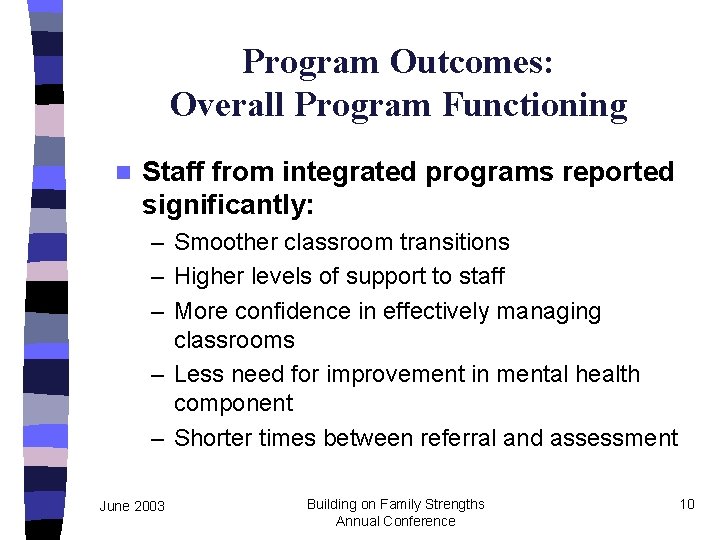
Program Outcomes: Overall Program Functioning n Staff from integrated programs reported significantly: – Smoother classroom transitions – Higher levels of support to staff – More confidence in effectively managing classrooms – Less need for improvement in mental health component – Shorter times between referral and assessment June 2003 Building on Family Strengths Annual Conference 10
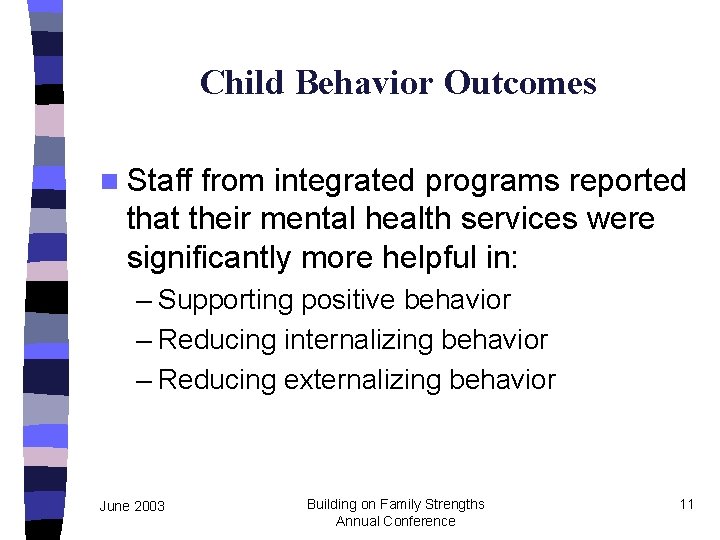
Child Behavior Outcomes n Staff from integrated programs reported that their mental health services were significantly more helpful in: – Supporting positive behavior – Reducing internalizing behavior – Reducing externalizing behavior June 2003 Building on Family Strengths Annual Conference 11
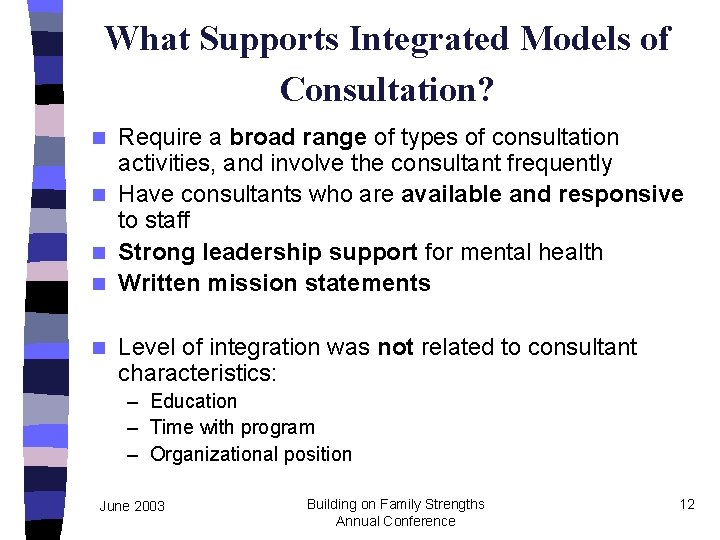
What Supports Integrated Models of Consultation? Require a broad range of types of consultation activities, and involve the consultant frequently n Have consultants who are available and responsive to staff n Strong leadership support for mental health n Written mission statements n n Level of integration was not related to consultant characteristics: – Education – Time with program – Organizational position June 2003 Building on Family Strengths Annual Conference 12