
Effective Modeling of ThinFilm Shells Exhibiting Wrinkling Deformations
Effective Modeling of Thin-Film Shells Exhibiting Wrinkling Deformations David W. Sleight, Alex Tessler, and John T. Wang Analytical and Computational Methods Branch NASA Langley Research Center David. W. Sleight@nasa. gov FEMCI Workshop 2003 May 7 -8, 2003 Analytical and Computational Methods Br. Structures and Materials Competency NASA Langley Research Center
Outline § § § Motivation Objectives Shell modeling strategies Numerical and experimental results Conclusions Analytical and Computational Methods Br. Structures and Materials Competency NASA Langley Research Center
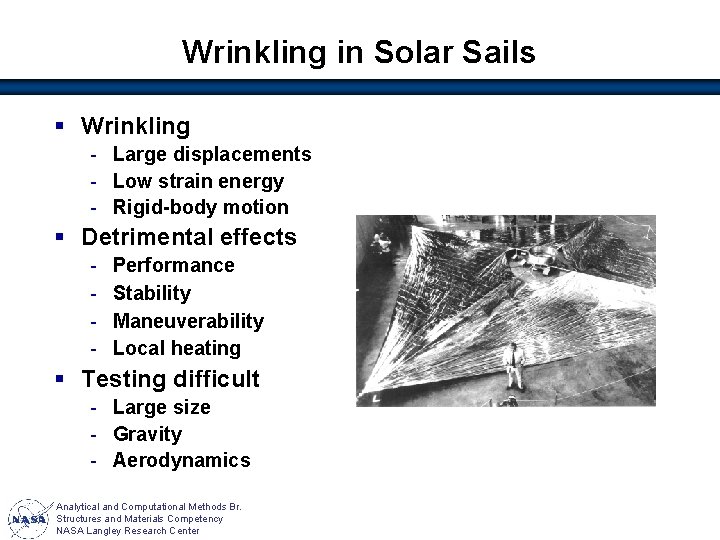
Wrinkling in Solar Sails § Wrinkling - Large displacements - Low strain energy - Rigid-body motion § Detrimental effects - Performance Stability Maneuverability Local heating § Testing difficult - Large size - Gravity - Aerodynamics Analytical and Computational Methods Br. Structures and Materials Competency NASA Langley Research Center
Objectives § Explore nonlinear shell modeling of thin-film membranes using ABAQUS § § Achieve high-fidelity wrinkling predictions Perform experimental validation Analytical and Computational Methods Br. Structures and Materials Competency NASA Langley Research Center

Shell Modeling § Characteristics - Bending and membrane coupling effects included Geometrically nonlinear shell deformations § Capabilities - Wrinkling amplitude, wave length and shape Membrane-to-bending coupling using imperfections - Buckling modes (Wong & Pellegrino, 2002) Trigonometric functions (Lee & Lee, 2002) Analytical and Computational Methods Br. Structures and Materials Competency NASA Langley Research Center Wong & Pellegrino
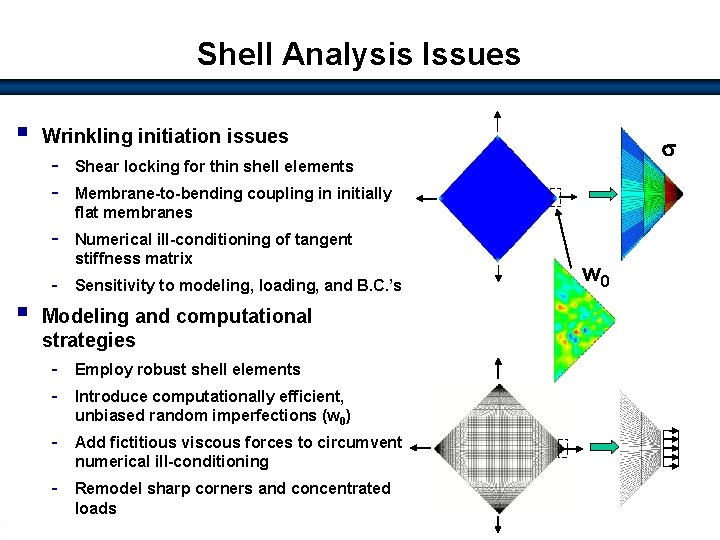
Shell Analysis Issues § § Wrinkling initiation issues - Shear locking for thin shell elements - Numerical ill-conditioning of tangent stiffness matrix - Sensitivity to modeling, loading, and B. C. ’s Membrane-to-bending coupling in initially flat membranes Modeling and computational strategies - Employ robust shell elements - Introduce computationally efficient, unbiased random imperfections (w 0) - s Add fictitious viscous forces to circumvent numerical ill-conditioning - Remodel sharp corners and concentrated Analytical and Computational Methods Br. loads Structures and Materials Competency NASA Langley Research Center w 0
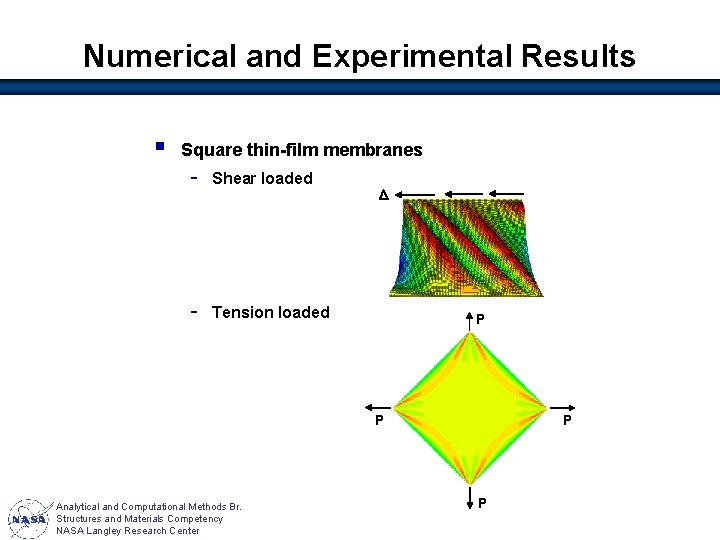
Numerical and Experimental Results § Square thin-film membranes - Shear loaded - Tension loaded D P P Analytical and Computational Methods Br. Structures and Materials Competency NASA Langley Research Center P P

ABAQUS Shell Modeling § Basic modeling strategies - Use robust, locking-free, shell element - Add fictitious viscous forces to circumvent numerical illconditioning (STABILIZE) - Introduce small, unbiased, random transverse imperfections to enable membrane-to-bending coupling Analytical and Computational Methods Br. Structures and Materials Competency NASA Langley Research Center S 4 R 5
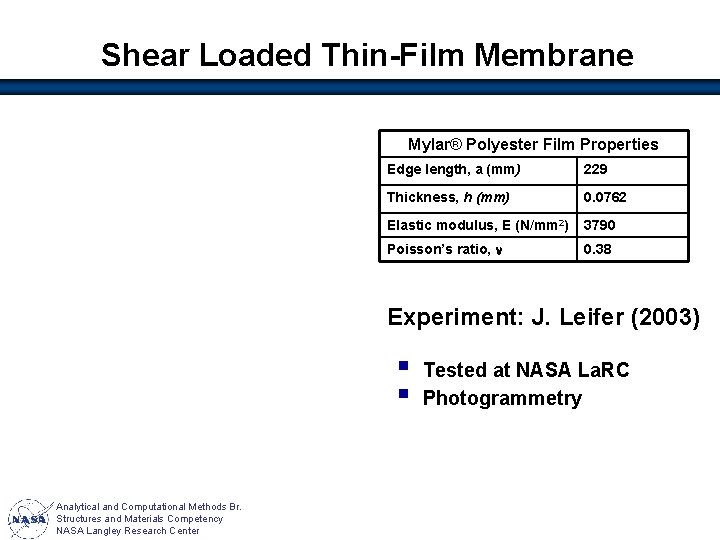
Shear Loaded Thin-Film Membrane Mylar® Polyester Film Properties Edge length, a (mm) 229 Thickness, h (mm) 0. 0762 Elastic modulus, E (N/mm 2) 3790 Poisson’s ratio, n 0. 38 Experiment: J. Leifer (2003) § § Analytical and Computational Methods Br. Structures and Materials Competency NASA Langley Research Center Tested at NASA La. RC Photogrammetry
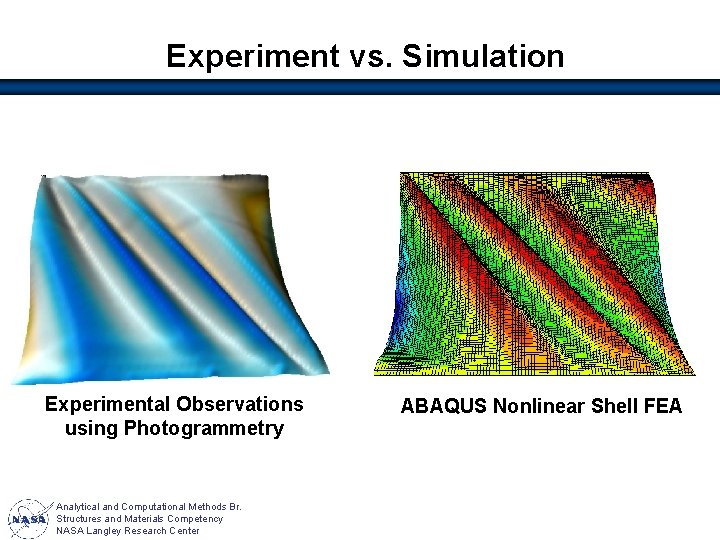
Experiment vs. Simulation Experimental Observations using Photogrammetry Analytical and Computational Methods Br. Structures and Materials Competency NASA Langley Research Center ABAQUS Nonlinear Shell FEA
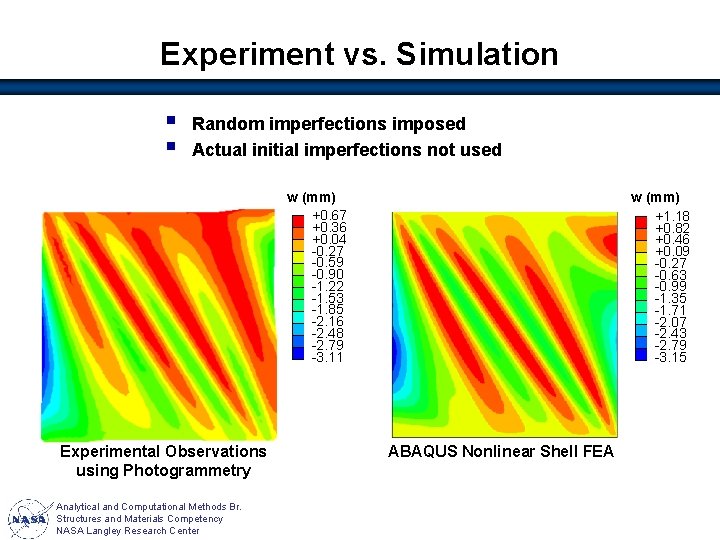
Experiment vs. Simulation § § Random imperfections imposed Actual initial imperfections not used w (mm) +0. 67 +0. 36 +0. 04 -0. 27 -0. 59 -0. 90 -1. 22 -1. 53 -1. 85 -2. 16 -2. 48 -2. 79 -3. 11 Experimental Observations using Photogrammetry Analytical and Computational Methods Br. Structures and Materials Competency NASA Langley Research Center w (mm) +1. 18 +0. 82 +0. 46 +0. 09 -0. 27 -0. 63 -0. 99 -1. 35 -1. 71 -2. 07 -2. 43 -2. 79 -3. 15 ABAQUS Nonlinear Shell FEA
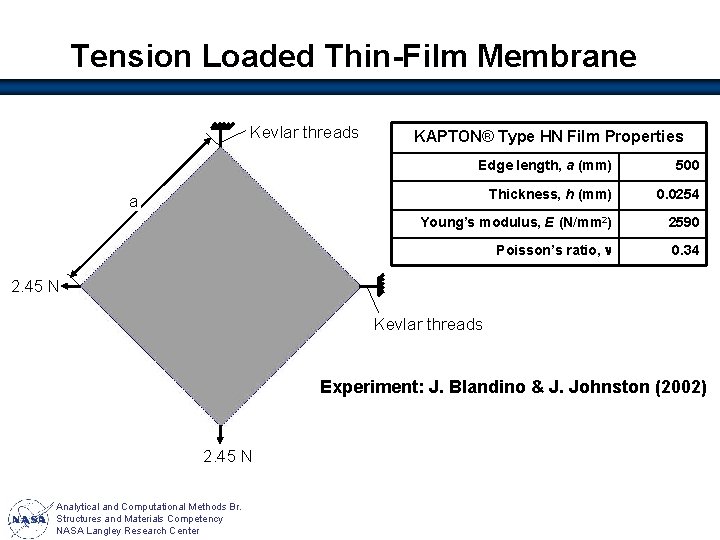
Tension Loaded Thin-Film Membrane Kevlar threads KAPTON® Type HN Film Properties Edge length, a (mm) 500 Thickness, h (mm) 0. 0254 Young’s modulus, E (N/mm 2) 2590 Poisson’s ratio, n 0. 34 a 2. 45 N Kevlar threads Experiment: J. Blandino & J. Johnston (2002) 2. 45 N Analytical and Computational Methods Br. Structures and Materials Competency NASA Langley Research Center
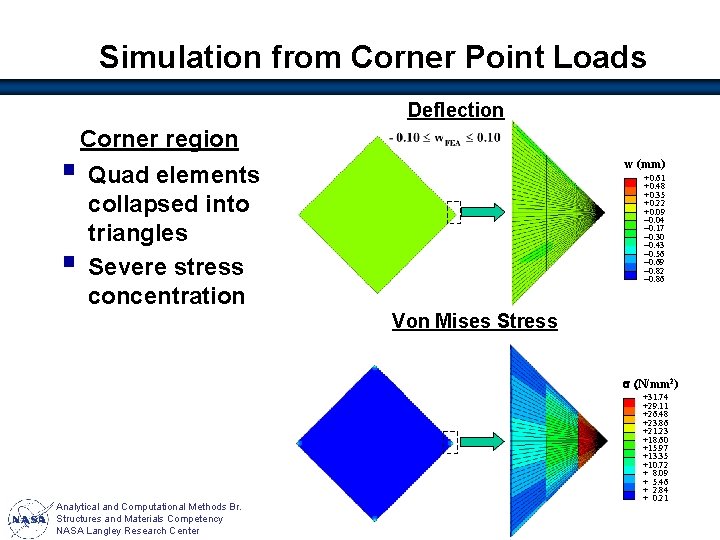
Simulation from Corner Point Loads Deflection Corner region § Quad elements collapsed into triangles § Severe stress concentration w (mm) +0. 61 +0. 48 +0. 35 +0. 22 +0. 09 – 0. 04 – 0. 17 – 0. 30 – 0. 43 – 0. 56 – 0. 69 – 0. 82 – 0. 86 Von Mises Stress s (N/mm 2) Analytical and Computational Methods Br. Structures and Materials Competency NASA Langley Research Center +31. 74 +29. 11 +26. 48 +23. 86 +21. 23 +18. 60 +15. 97 +13. 35 +10. 72 + 8. 09 + 5. 46 + 2. 84 + 0. 21
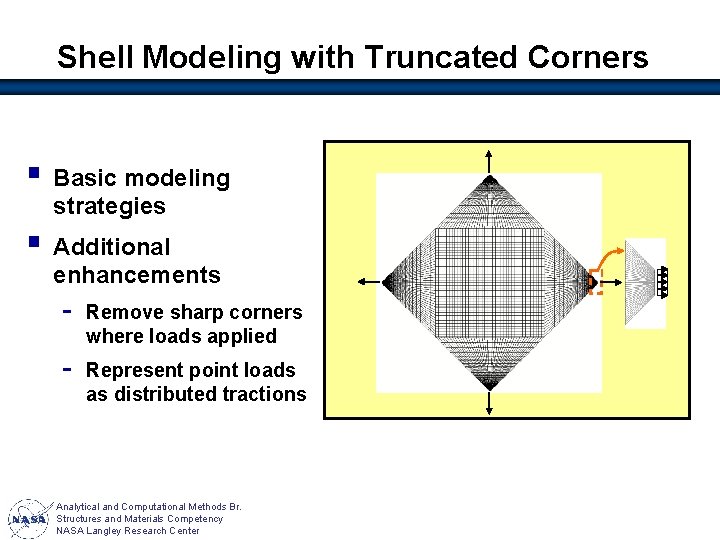
Shell Modeling with Truncated Corners § Basic modeling strategies § Additional enhancements - Remove sharp corners where loads applied - Represent point loads as distributed tractions Analytical and Computational Methods Br. Structures and Materials Competency NASA Langley Research Center

Truncated Corners Model • • • § § § Corner region Sharp corners removed Stress concentration reduced Sharp corners Good correlation withremoved experimental results concentration Severe Deflection w (mm) +0. 34 +0. 24 +0. 14 +0. 04 – 0. 06 – 0. 16 – 0. 26 – 0. 36 – 0. 46 – 0. 56 – 0. 66 – 0. 76 – 0. 86 reduced Wrinkles develop Von Mises Stress s (N/mm 2) +18. 96 +17. 74 +15. 83 +14. 27 +12. 71 +11. 15 + 9. 58 + 8. 02 + 6. 46 + 4. 90 + 3. 33 + 1. 77 + 0. 21 Analytical and Computational Methods Br. Structures and Materials Competency NASA Langley Research Center
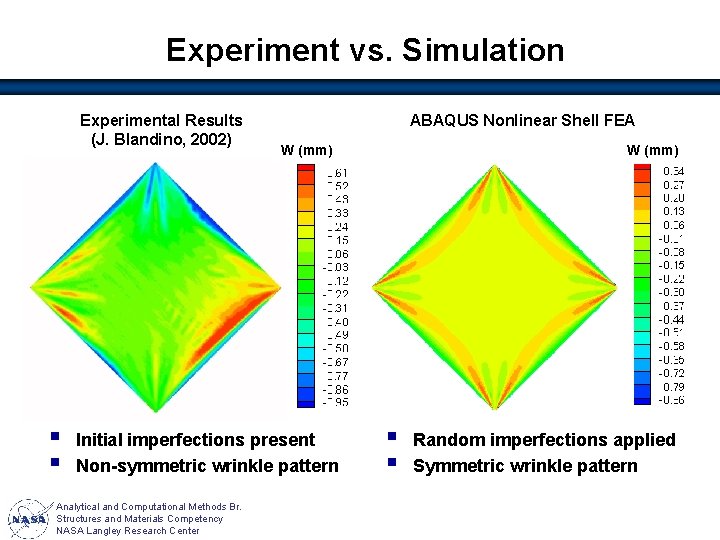
Experiment vs. Simulation Experimental Results (J. Blandino, 2002) § § ABAQUS Nonlinear Shell FEA W (mm) Initial imperfections present Non-symmetric wrinkle pattern Analytical and Computational Methods Br. Structures and Materials Competency NASA Langley Research Center W (mm) § § Random imperfections applied Symmetric wrinkle pattern
Conclusions § § Large displacement shell modeling of thin-film membranes to achieve wrinkling deformations - Robust shell elements free of shear locking - Improved modeling of sharp corner regions subjected to tension loads Fictitious viscous forces to circumvent numerical ill-conditioning Unbiased random transverse imperfections to enable membrane-to -bending coupling Numerical examples and experimental validation - Square membranes loaded in shear and tension Numerical results compared favorably with experiments Analytical and Computational Methods Br. Structures and Materials Competency NASA Langley Research Center
Conclusions (cont. ) § Remaining Issues - Element technology Nonlinear analysis convergence and viscous-force stabilization Adaptive mesh refinement / robust error estimation Sensitivity to boundary conditions and applied loading Analytical and Computational Methods Br. Structures and Materials Competency NASA Langley Research Center
- Slides: 18