
Effective Java Creating and Destroying Objects Last Updated
Effective Java: Creating and Destroying Objects Last Updated: Fall 2012

Agenda n Material From Joshua Bloch n n n Effective Java: Programming Language Guide Cover Items 1 -7 Bottom Line: n n Understand Java Construction First C++ Creation/Destruction More Complex Creating and Destroying Objects
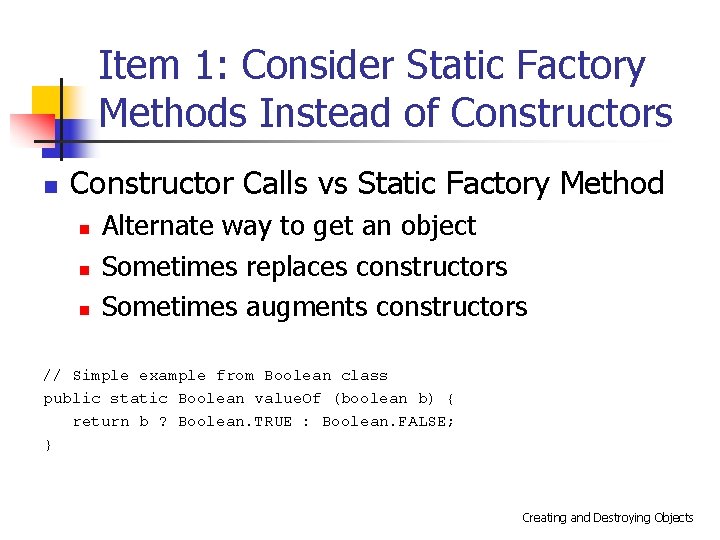
Item 1: Consider Static Factory Methods Instead of Constructors n Constructor Calls vs Static Factory Method n n n Alternate way to get an object Sometimes replaces constructors Sometimes augments constructors // Simple example from Boolean class public static Boolean value. Of (boolean b) { return b ? Boolean. TRUE : Boolean. FALSE; } Creating and Destroying Objects
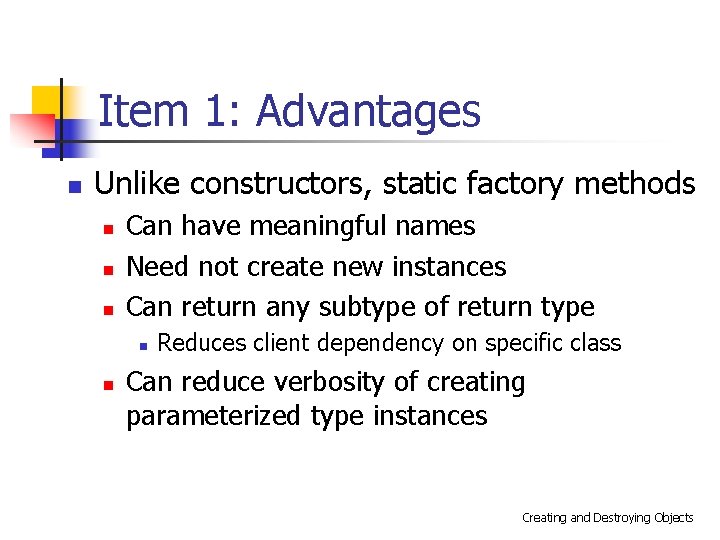
Item 1: Advantages n Unlike constructors, static factory methods n n n Can have meaningful names Need not create new instances Can return any subtype of return type n n Reduces client dependency on specific class Can reduce verbosity of creating parameterized type instances Creating and Destroying Objects
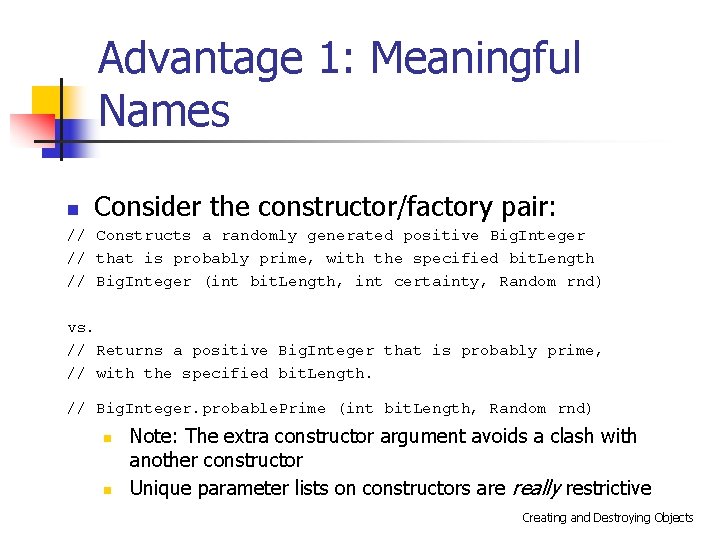
Advantage 1: Meaningful Names n Consider the constructor/factory pair: // Constructs a randomly generated positive Big. Integer // that is probably prime, with the specified bit. Length // Big. Integer (int bit. Length, int certainty, Random rnd) vs. // Returns a positive Big. Integer that is probably prime, // with the specified bit. Length. // Big. Integer. probable. Prime (int bit. Length, Random rnd) n n Note: The extra constructor argument avoids a clash with another constructor Unique parameter lists on constructors are really restrictive Creating and Destroying Objects

Advantage 2: Not Required To Create New Object n Instance-controlled classes can be useful n Can avoid creating unnecessary duplicate objects n n n Boolean. value. Of(boolean) is an example Can guarantee a “singleton” or “noninstatiable” object Can allow for very fast “equals” test Creating and Destroying Objects
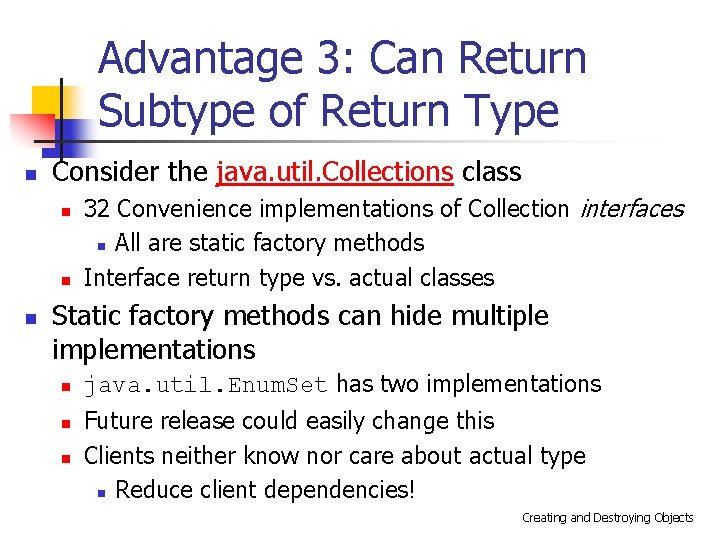
Advantage 3: Can Return Subtype of Return Type n Consider the java. util. Collections class n n n 32 Convenience implementations of Collection interfaces n All are static factory methods Interface return type vs. actual classes Static factory methods can hide multiple implementations n n n java. util. Enum. Set has two implementations Future release could easily change this Clients neither know nor care about actual type n Reduce client dependencies! Creating and Destroying Objects
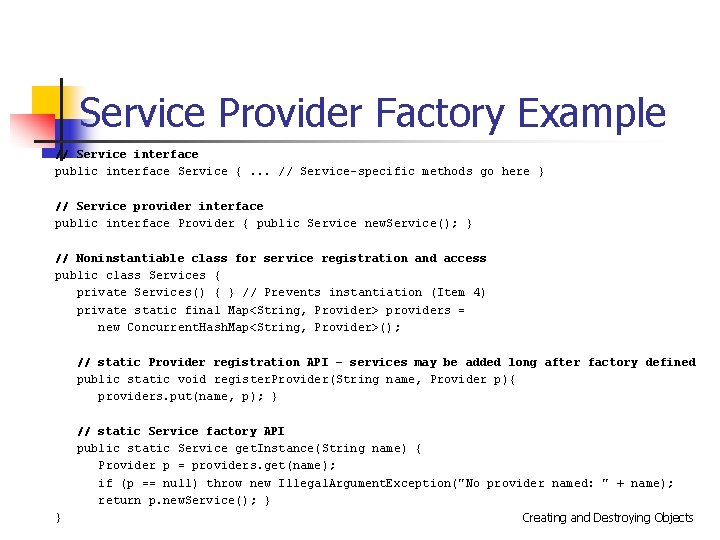
Service Provider Factory Example // Service interface public interface Service {. . . // Service-specific methods go here } // Service provider interface public interface Provider { public Service new. Service(); } // Noninstantiable class for service registration and access public class Services { private Services() { } // Prevents instantiation (Item 4) private static final Map<String, Provider> providers = new Concurrent. Hash. Map<String, Provider>(); // static Provider registration API – services may be added long after factory defined public static void register. Provider(String name, Provider p){ providers. put(name, p); } // static Service factory API public static Service get. Instance(String name) { Provider p = providers. get(name); if (p == null) throw new Illegal. Argument. Exception("No provider named: " + name); return p. new. Service(); } } Creating and Destroying Objects
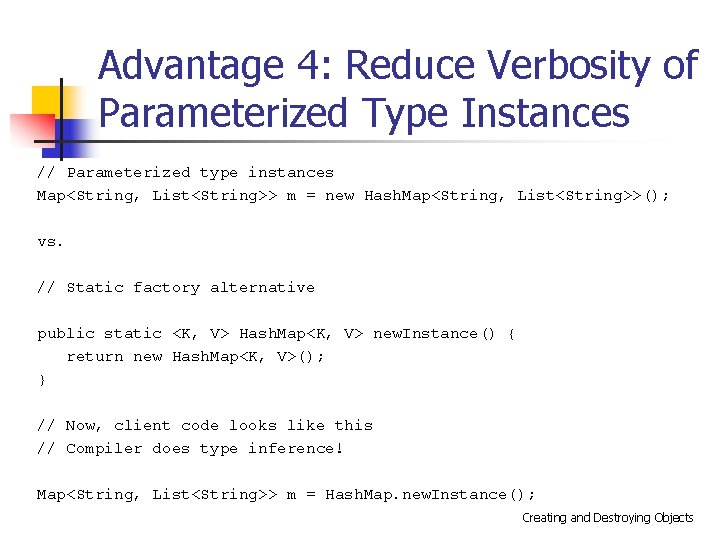
Advantage 4: Reduce Verbosity of Parameterized Type Instances // Parameterized type instances Map<String, List<String>> m = new Hash. Map<String, List<String>>(); vs. // Static factory alternative public static <K, V> Hash. Map<K, V> new. Instance() { return new Hash. Map<K, V>(); } // Now, client code looks like this // Compiler does type inference! Map<String, List<String>> m = Hash. Map. new. Instance(); Creating and Destroying Objects
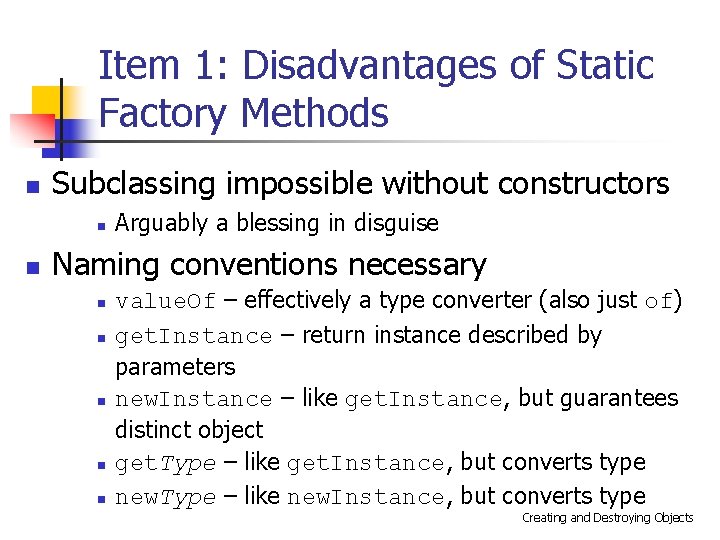
Item 1: Disadvantages of Static Factory Methods n Subclassing impossible without constructors n n Arguably a blessing in disguise Naming conventions necessary n n n value. Of – effectively a type converter (also just of) get. Instance – return instance described by parameters new. Instance – like get. Instance, but guarantees distinct object get. Type – like get. Instance, but converts type new. Type – like new. Instance, but converts type Creating and Destroying Objects
Item 2: Consider a Builder vs. Many Constructor Parameters n n Static factories and constructors don’t scale well to large numbers of optional parameters Bloch’s examples: n n Nutrition. Facts. Telescoping. java Nutrition. Facts. Beans. java Nutrition. Facts. Builder. java The last version enjoys significant advantages Creating and Destroying Objects
Item 3: Enforce Singleton Property n A Singleton is a class that’s instantiated exactly once n n Two approaches before Enums: n n n Note: singletons are hard to mock in unit testing Public static member (a constant, of course) Public static factory method Enum singleton is now preferred n Lots of subtle advantages: security, serialization, etc. Creating and Destroying Objects
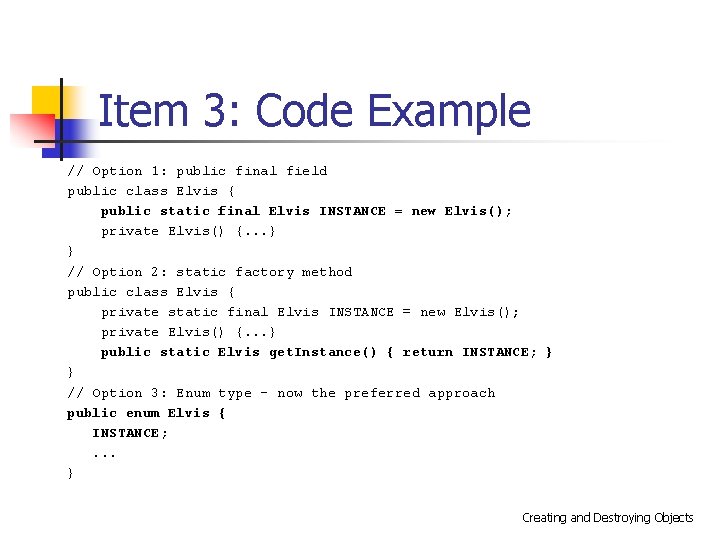
Item 3: Code Example // Option 1: public final field public class Elvis { public static final Elvis INSTANCE = new Elvis(); private Elvis() {. . . } } // Option 2: static factory method public class Elvis { private static final Elvis INSTANCE = new Elvis(); private Elvis() {. . . } public static Elvis get. Instance() { return INSTANCE; } } // Option 3: Enum type – now the preferred approach public enum Elvis { INSTANCE; . . . } Creating and Destroying Objects
Item 4: Enforce Noninstantiability With a Private Constructor n Some classes just group static methods and/or fields n n Trying to enforce noninstantiability by making class abstract doesn’t work n n n Makes no sense to instantiate such a class Subclassing is possible Clients are led to believe subclassing makes sense However, a private constructor does the job Creating and Destroying Objects
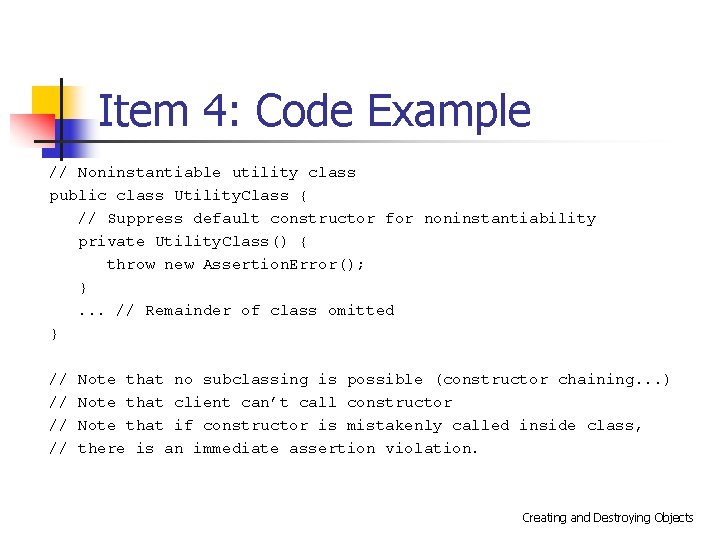
Item 4: Code Example // Noninstantiable utility class public class Utility. Class { // Suppress default constructor for noninstantiability private Utility. Class() { throw new Assertion. Error(); }. . . // Remainder of class omitted } // // Note that no subclassing is possible (constructor chaining. . . ) Note that client can’t call constructor Note that if constructor is mistakenly called inside class, there is an immediate assertion violation. Creating and Destroying Objects
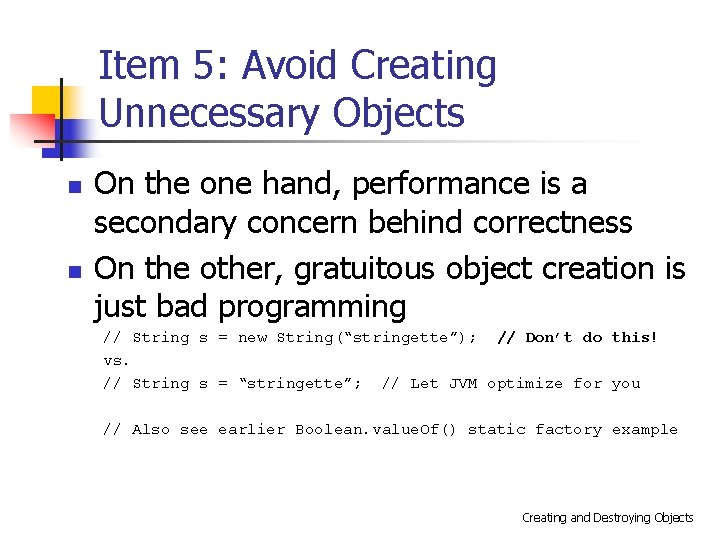
Item 5: Avoid Creating Unnecessary Objects n n On the one hand, performance is a secondary concern behind correctness On the other, gratuitous object creation is just bad programming // String s = new String(“stringette”); // Don’t do this! vs. // String s = “stringette”; // Let JVM optimize for you // Also see earlier Boolean. value. Of() static factory example Creating and Destroying Objects
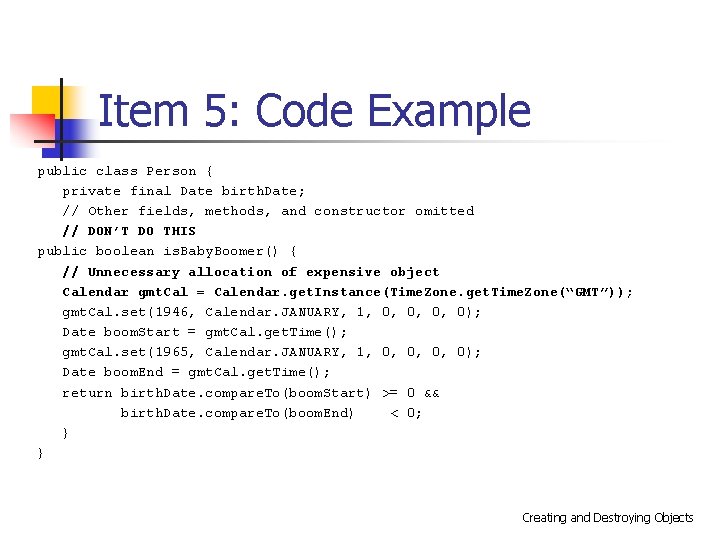
Item 5: Code Example public class Person { private final Date birth. Date; // Other fields, methods, and constructor omitted // DON’T DO THIS public boolean is. Baby. Boomer() { // Unnecessary allocation of expensive object Calendar gmt. Cal = Calendar. get. Instance(Time. Zone. get. Time. Zone(“GMT”)); gmt. Cal. set(1946, Calendar. JANUARY, 1, 0, 0); Date boom. Start = gmt. Cal. get. Time(); gmt. Cal. set(1965, Calendar. JANUARY, 1, 0, 0); Date boom. End = gmt. Cal. get. Time(); return birth. Date. compare. To(boom. Start) >= 0 && birth. Date. compare. To(boom. End) < 0; } } Creating and Destroying Objects
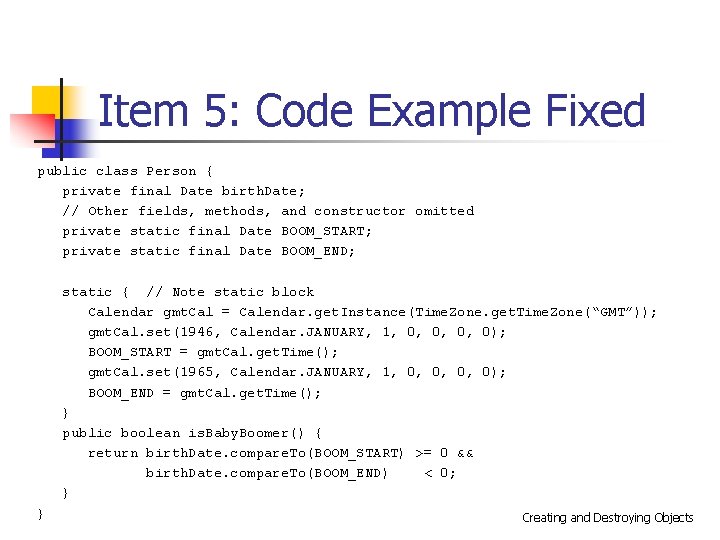
Item 5: Code Example Fixed public class Person { private final Date birth. Date; // Other fields, methods, and constructor omitted private static final Date BOOM_START; private static final Date BOOM_END; static { // Note static block Calendar gmt. Cal = Calendar. get. Instance(Time. Zone. get. Time. Zone(“GMT”)); gmt. Cal. set(1946, Calendar. JANUARY, 1, 0, 0); BOOM_START = gmt. Cal. get. Time(); gmt. Cal. set(1965, Calendar. JANUARY, 1, 0, 0); BOOM_END = gmt. Cal. get. Time(); } public boolean is. Baby. Boomer() { return birth. Date. compare. To(BOOM_START) >= 0 && birth. Date. compare. To(BOOM_END) < 0; } } Creating and Destroying Objects
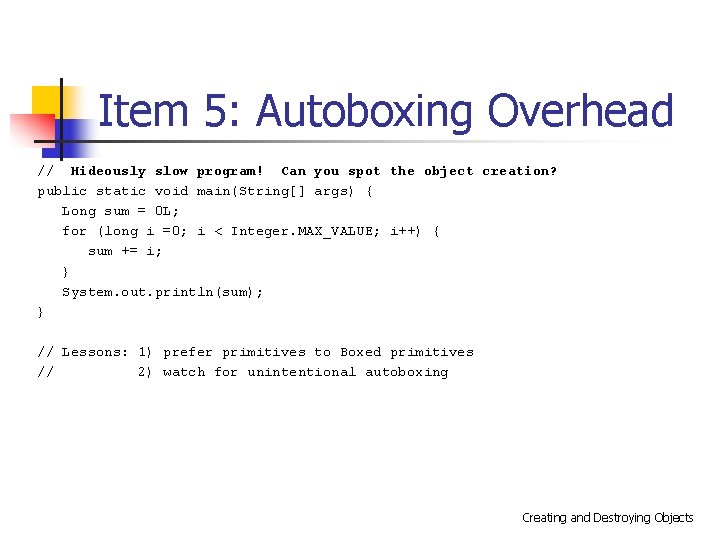
Item 5: Autoboxing Overhead // Hideously slow program! Can you spot the object creation? public static void main(String[] args) { Long sum = 0 L; for (long i =0; i < Integer. MAX_VALUE; i++) { sum += i; } System. out. println(sum); } // Lessons: 1) prefer primitives to Boxed primitives // 2) watch for unintentional autoboxing Creating and Destroying Objects
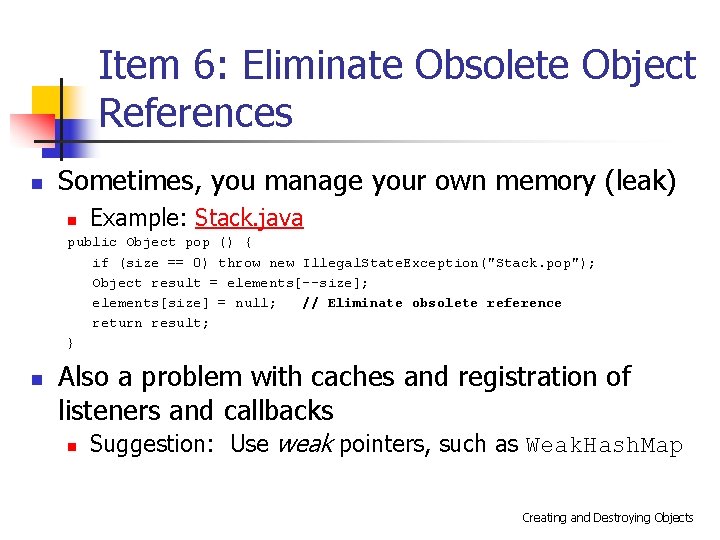
Item 6: Eliminate Obsolete Object References n Sometimes, you manage your own memory (leak) n Example: Stack. java public Object pop () { if (size == 0) throw new Illegal. State. Exception("Stack. pop"); Object result = elements[--size]; elements[size] = null; // Eliminate obsolete reference return result; } n Also a problem with caches and registration of listeners and callbacks n Suggestion: Use weak pointers, such as Weak. Hash. Map Creating and Destroying Objects
Item 7: Avoid Finalizers n finalize() is a method in the Object class n n Finalizers: unpredictable, dangerous, unnecessary! n n What the garbage collector may call when cleaning up an unused object They are NOT the analog of C++ destructors There is no guarantee a finalizer will ever be called Finalizers have severe performance penalties Instead, provide explicit termination methods n Sometimes requires “finalizer chaining” Creating and Destroying Objects
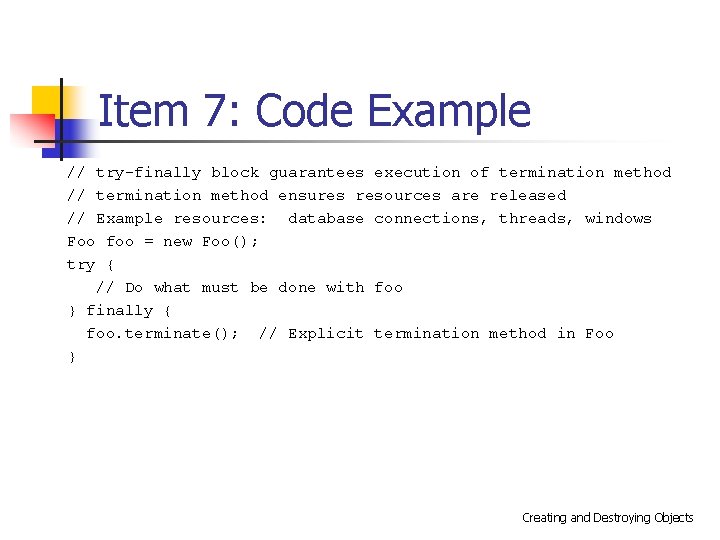
Item 7: Code Example // try-finally block guarantees execution of termination method // termination method ensures resources are released // Example resources: database connections, threads, windows Foo foo = new Foo(); try { // Do what must be done with foo } finally { foo. terminate(); // Explicit termination method in Foo } Creating and Destroying Objects
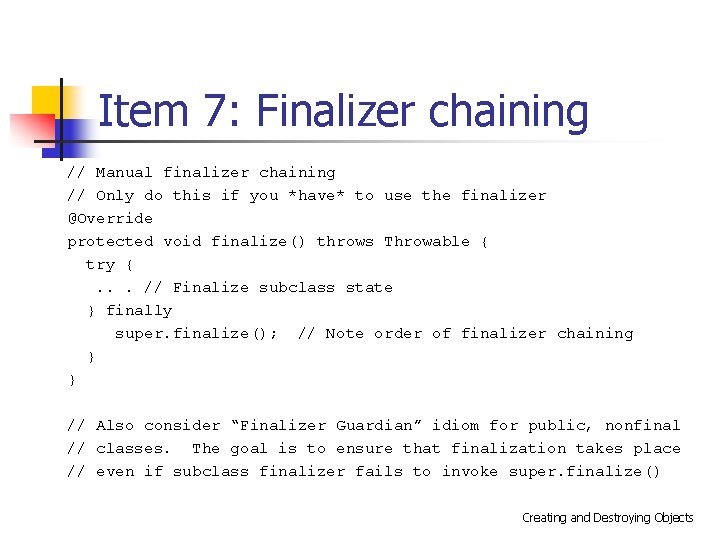
Item 7: Finalizer chaining // Manual finalizer chaining // Only do this if you *have* to use the finalizer @Override protected void finalize() throws Throwable { try {. . . // Finalize subclass state } finally super. finalize(); // Note order of finalizer chaining } } // Also consider “Finalizer Guardian” idiom for public, nonfinal // classes. The goal is to ensure that finalization takes place // even if subclass finalizer fails to invoke super. finalize() Creating and Destroying Objects
- Slides: 23