
Effective Implementation of School Counseling Programs How Far



- Slides: 52
Effective Implementation of School Counseling Programs: How Far Down the Road Have We Come? School Counselor Circle Manila, Philippines November 14, 2013 Carol Dahir, Ed. D. Professor, School Counseling Department New York Institute of Technology caroldahir@aol. com cdahir@nyit. edu C. Dahir, 11/13
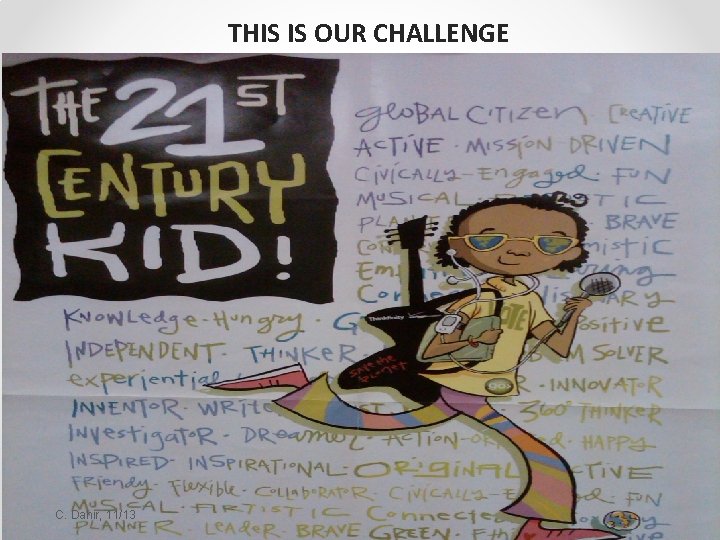
THIS IS OUR CHALLENGE C. Dahir, 11/13
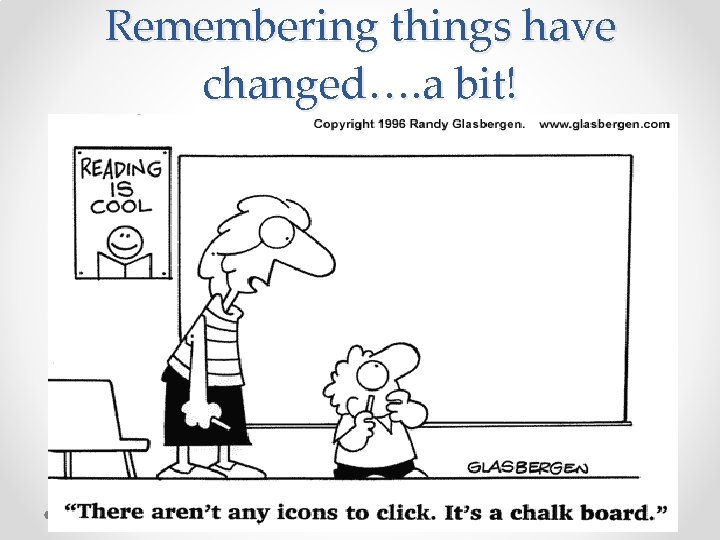
Remembering things have changed…. a bit! C. Dahir, 11/13
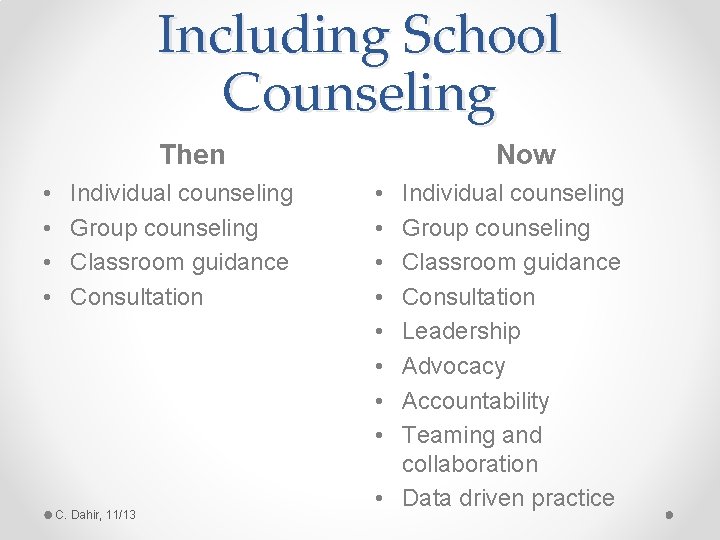
Including School Counseling Then • • Individual counseling Group counseling Classroom guidance Consultation C. Dahir, 11/13 Now • • Individual counseling Group counseling Classroom guidance Consultation Leadership Advocacy Accountability Teaming and collaboration • Data driven practice
What’s Next? C. Dahir, 11/13
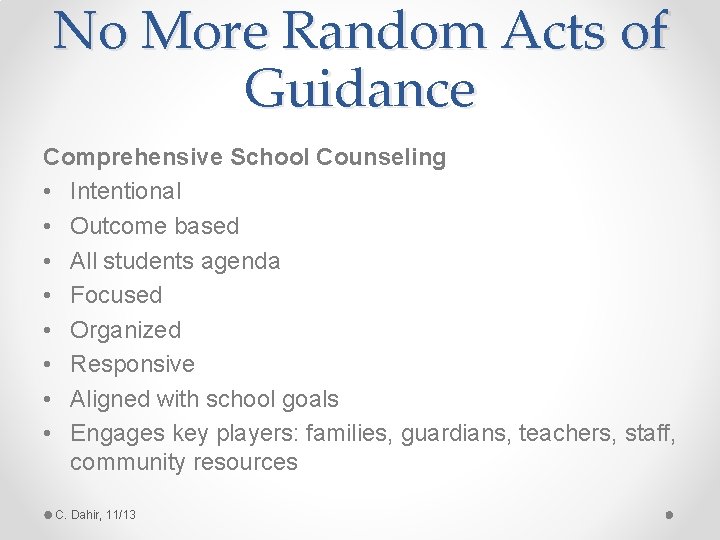
No More Random Acts of Guidance Comprehensive School Counseling • Intentional • Outcome based • All students agenda • Focused • Organized • Responsive • Aligned with school goals • Engages key players: families, guardians, teachers, staff, community resources C. Dahir, 11/13
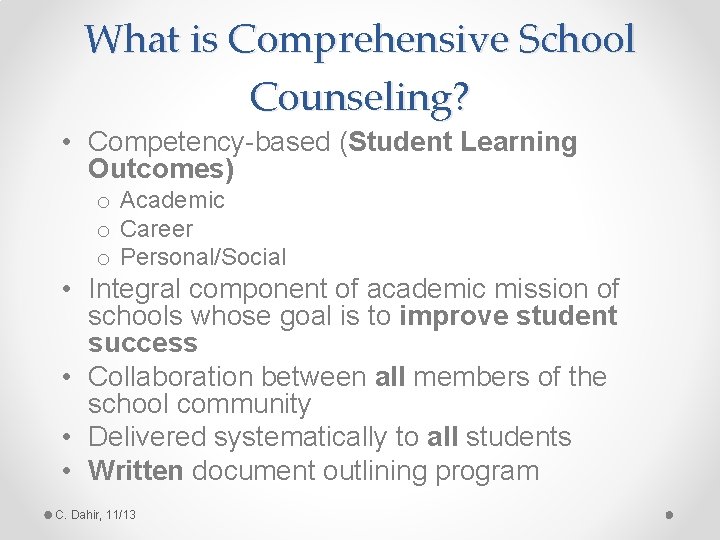
What is Comprehensive School Counseling? • Competency-based (Student Learning Outcomes) o Academic o Career o Personal/Social • Integral component of academic mission of schools whose goal is to improve student success • Collaboration between all members of the school community • Delivered systematically to all students • Written document outlining program C. Dahir, 11/13
Why Bother? If ignore this, will it go away? Just leave me alone with my kids! Do we really need this? What difference does any of this make? C. Dahir, 11/13
This Is Our Future C. Dahir, 11/13
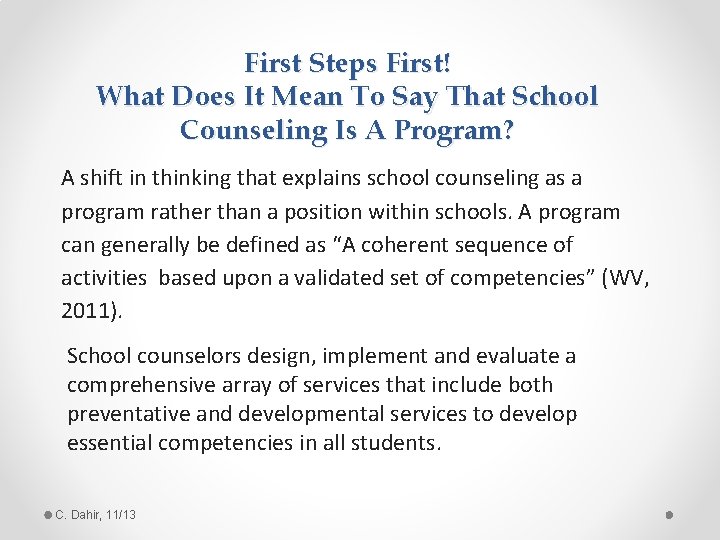
First Steps First! What Does It Mean To Say That School Counseling Is A Program? A shift in thinking that explains school counseling as a program rather than a position within schools. A program can generally be defined as “A coherent sequence of activities based upon a validated set of competencies” (WV, 2011). School counselors design, implement and evaluate a comprehensive array of services that include both preventative and developmental services to develop essential competencies in all students. C. Dahir, 11/13
Program Evaluation? The program must also be evaluated to ensure that desired student learning outcomes (SLOs) are achieved. Professional standards that generally describe necessary student competencies or student learner outcomes (e. g. Philippine National Standards) and the particular needs of students in a given school are used to design the SLO’s. C. Dahir, 11/13
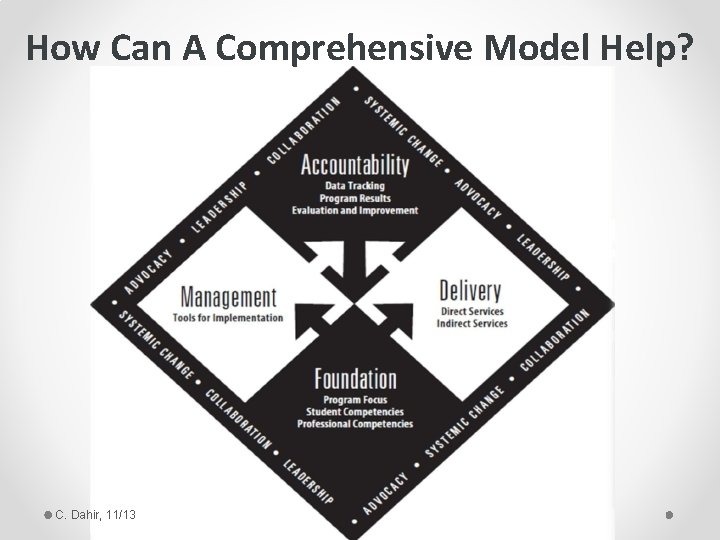
How Can A Comprehensive Model Help? C. Dahir, 11/13
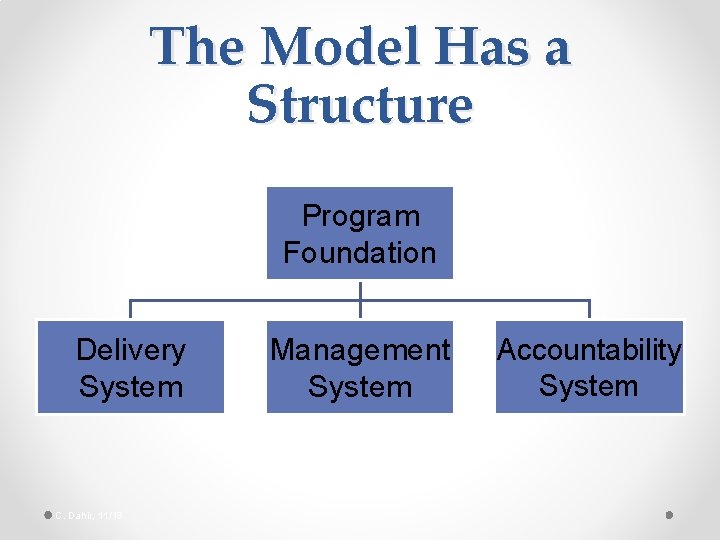
The Model Has a Structure Program Foundation Delivery System C. Dahir, 11/13 Management System Accountability System
What Does the Structure Practice Look Like? C. Dahir, 11/13
Program Foundation The Philippine National Standards for School Counseling Programs organized into three domains: o Academic development o Career development o Personal/social development C. Dahir, 11/13
Academic Development Standard A. Students will acquire the attitudes, knowledge and skills that contribute to effective learning in school and across the life span. Standard B. Students will complete school with the academic preparation essential to choose from a wide range of substantial post-secondary/post-college options Standard C. Students will understand the relationship of academics to the world of work, and to life at home and in the community. C. Dahir, 11/13
Career Development Standard A. Students will acquire the skills to investigate the world of work in relation to knowledge of self and to make informed career decisions. Standard B. Students will employ strategies to achieve future career success and satisfaction. Standard C. Students understand the relationship between personal qualities, education, training, and the world of work. C. Dahir, 11/13
Personal-Social Development Standard A. Students will acquire the attitudes, knowledge and interpersonal skills to help them understand respect self and others. Standard B. Students will make decisions, set goals and take necessary action to achieve goals. Standard C. Students will understand safety and survival skills. Standard D. society. C. Dahir, 11/13 Students will understand their role in
How will you establish your priorities? • ACADEMIC • CAREER • PERSONAL-SOCIAL Student Development C. Dahir, 11/13
Delivery System DELIVERING with INTENTION MAPPING: Identifying what we do and finding gaps Standards, Competencies, Activities, School Improvement Goals, and Outcomes! C. Dahir, 11/13
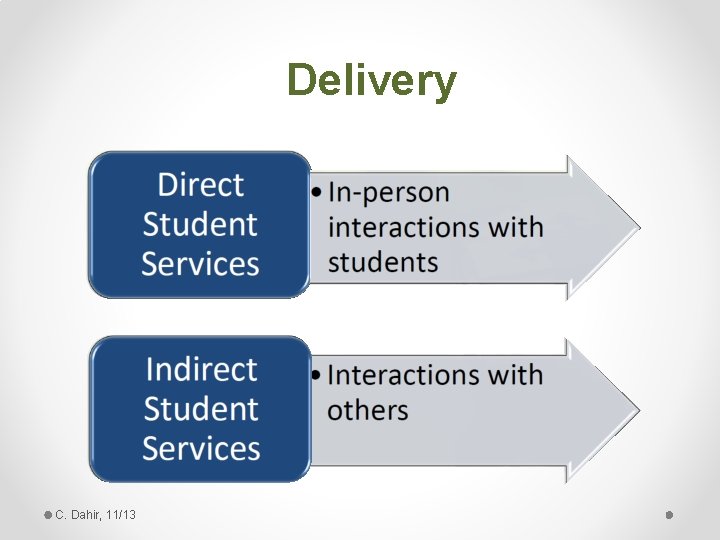
Delivery C. Dahir, 11/13
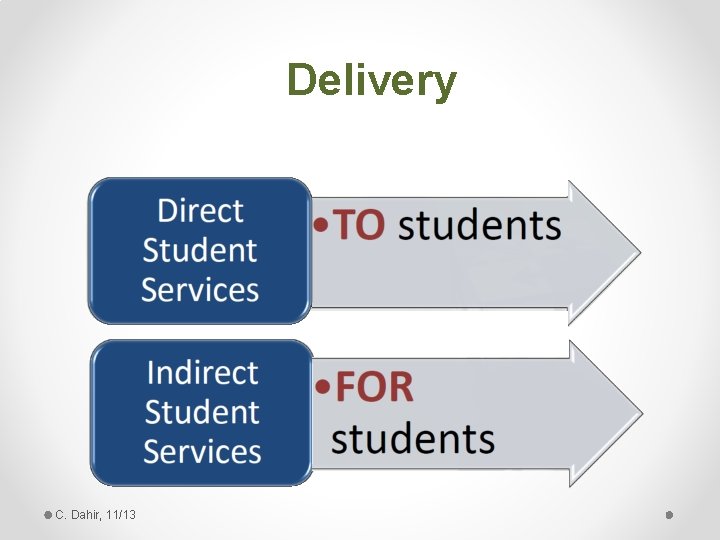
Delivery C. Dahir, 11/13
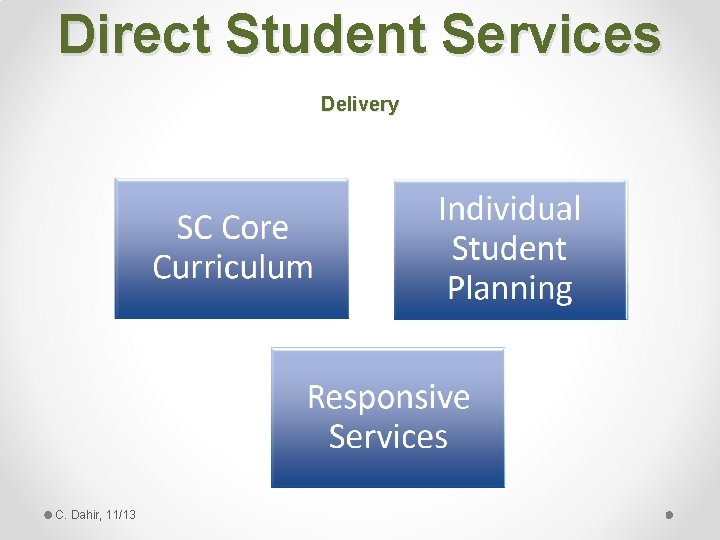
Direct Student Services Delivery C. Dahir, 11/13
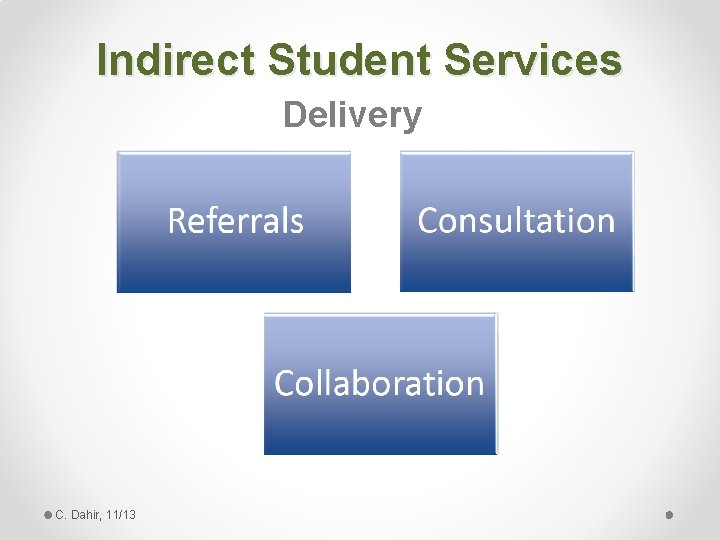
Indirect Student Services Delivery C. Dahir, 11/13
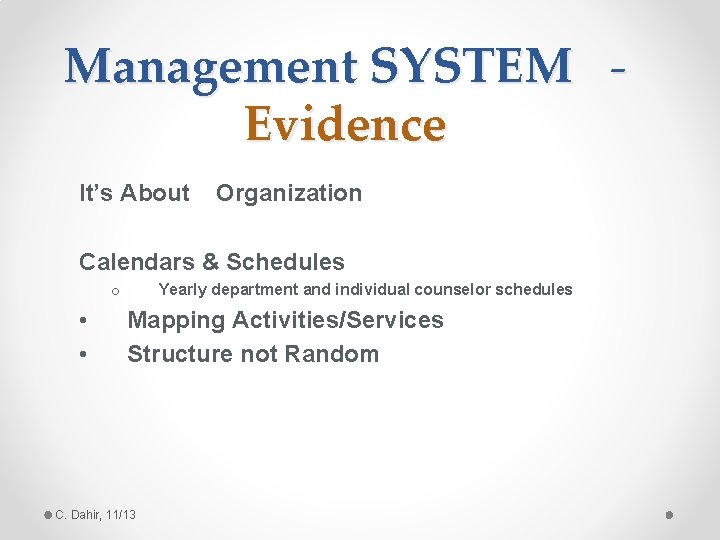
Management SYSTEM Evidence It’s About Organization Calendars & Schedules Yearly department and individual counselor schedules o • • Mapping Activities/Services Structure not Random C. Dahir, 11/13
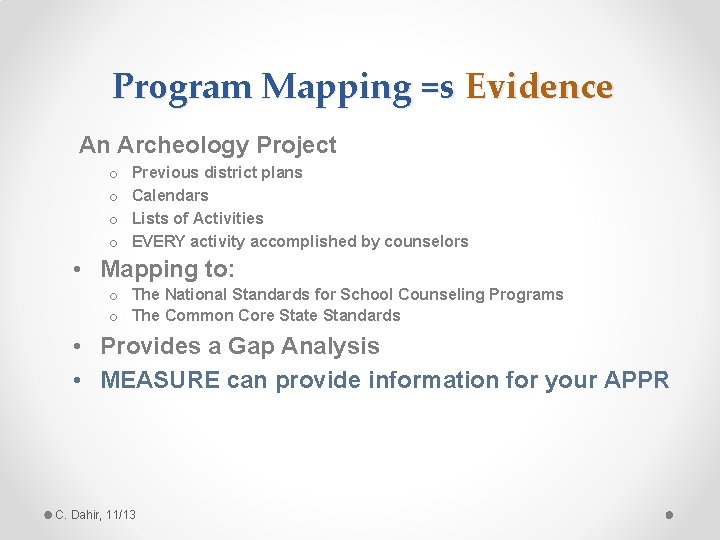
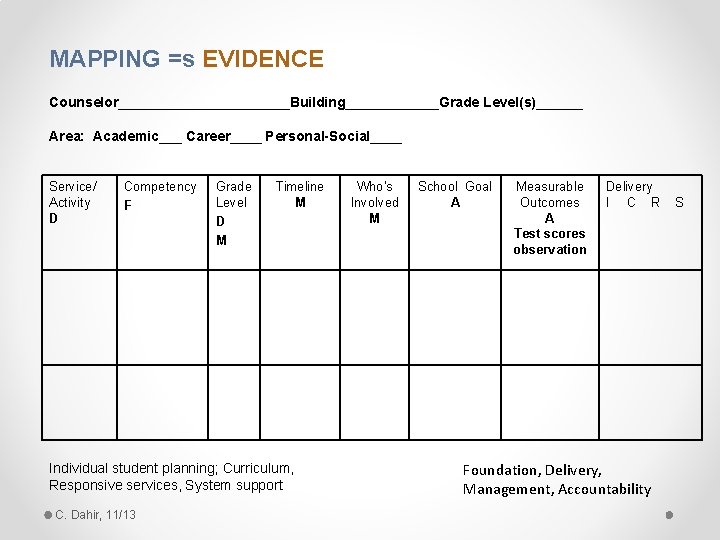
Program Mapping =s Evidence An Archeology Project o o Previous district plans Calendars Lists of Activities EVERY activity accomplished by counselors • Mapping to: o The National Standards for School Counseling Programs o The Common Core State Standards • Provides a Gap Analysis • MEASURE can provide information for your APPR C. Dahir, 11/13
MAPPING =s EVIDENCE Counselor___________Building______Grade Level(s)______ Area: Academic___ Career____ Personal-Social____ Service/ Activity D Competency F Grade Level D M Timeline M Individual student planning; Curriculum, Responsive services, System support C. Dahir, 11/13 Who’s Involved M School Goal A Measurable Outcomes A Test scores observation Delivery I C R Foundation, Delivery, Management, Accountability S
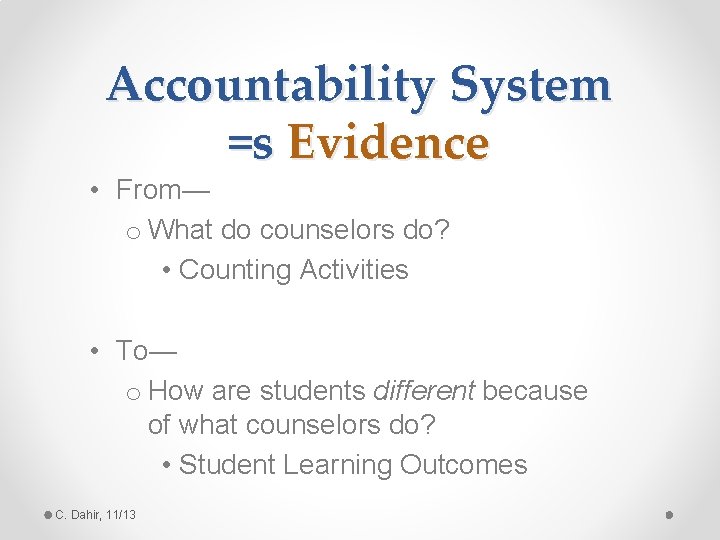
Accountability System =s Evidence • From— o What do counselors do? • Counting Activities • To— o How are students different because of what counselors do? • Student Learning Outcomes C. Dahir, 11/13
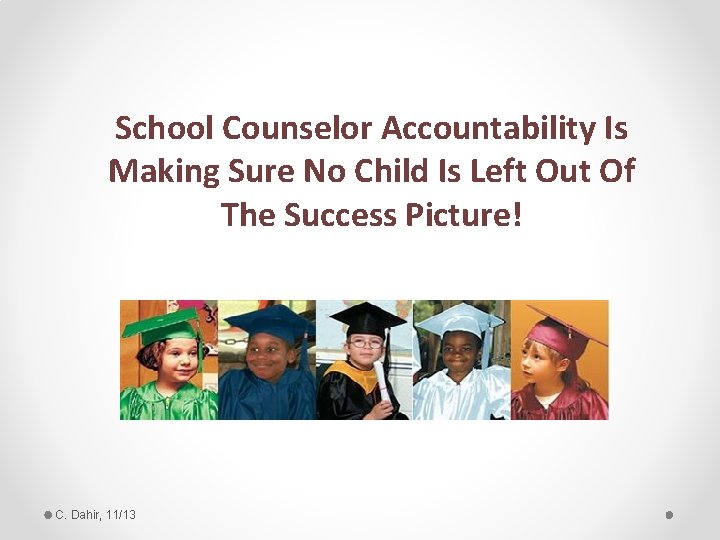
School Counselor Accountability Is Making Sure No Child Is Left Out Of The Success Picture! C. Dahir, 11/13
Accountability § Shows that school counselors intentionally and purposely act to “close the gap” and “raise the bar” § Focuses activities on student achievement § Demonstrates commitment to school improvement § Highlights school counselors’ skills § Shows Evidence C. Dahir, 11/13
In this Day and age, your supervisors/principals think If it can’t be measured…. it’s not important! C. Dahir, 11/13
MEASURE is ……… an accountability model for school counselors to identify and positively impact the critical data elements that are the important barometers of student success. MEASURE can provide information for the APPR (when required) C. Dahir, 11/13
MEASURE stands for: Mission, Elements, Analyze, Stakeholders-Unite, Results, and Educate C. Dahir, 11/13
Mission - Connect to the Mission of School When school counselors focus their efforts on the mission of school improvement they widen educational opportunities for every student and can positively impact student achievement C. Dahir, 11/13
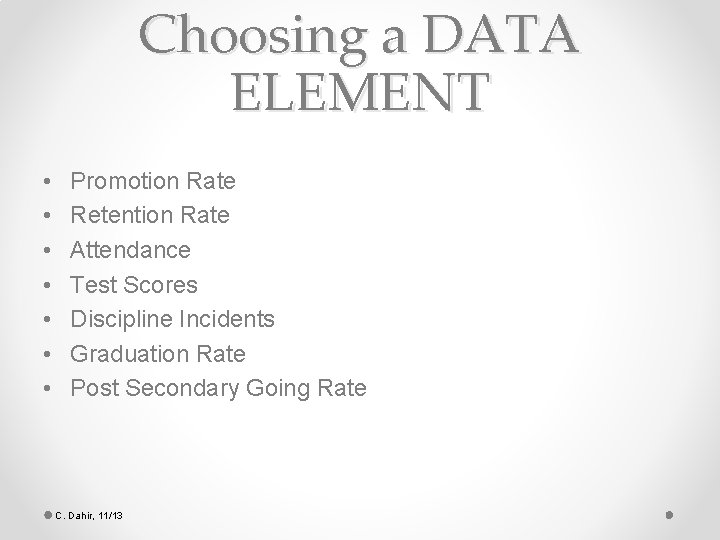
Choosing a DATA ELEMENT • • Promotion Rate Retention Rate Attendance Test Scores Discipline Incidents Graduation Rate Post Secondary Going Rate C. Dahir, 11/13
Elements - Identify Critical Data Elements Your school's success is measured by results, which are those critical data elements that are important to the internal and external stakeholders. How are these goals connected to your school’s report card? C. Dahir, 11/13
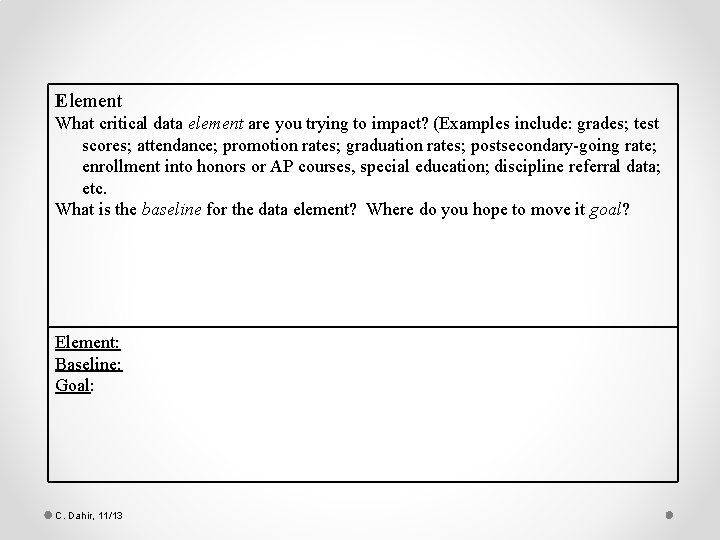
Element What critical data element are you trying to impact? (Examples include: grades; test scores; attendance; promotion rates; graduation rates; postsecondary-going rate; enrollment into honors or AP courses, special education; discipline referral data; etc. What is the baseline for the data element? Where do you hope to move it goal? Element: Baseline: Goal: C. Dahir, 11/13
STEP 3: ANALYZE Identify the sources of data you want to analyze. Identify the problem areas. Look at your baseline to set your goals. C. Dahir, 11/13
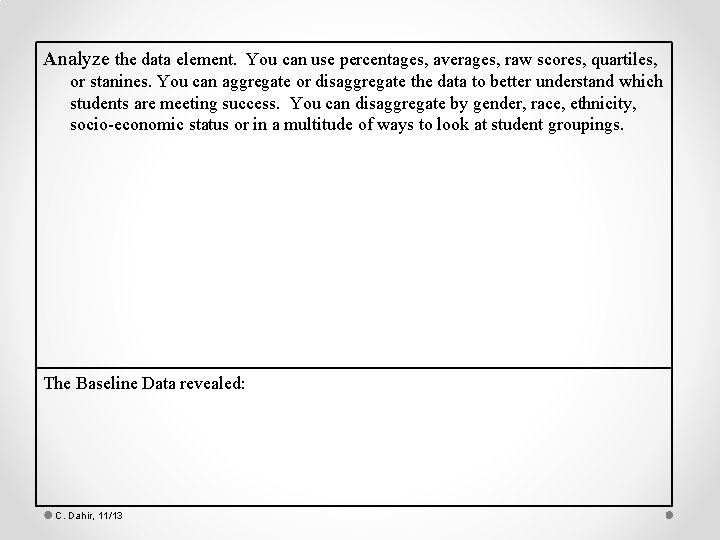
Analyze the data element. You can use percentages, averages, raw scores, quartiles, or stanines. You can aggregate or disaggregate the data to better understand which students are meeting success. You can disaggregate by gender, race, ethnicity, socio-economic status or in a multitude of ways to look at student groupings. The Baseline Data revealed: C. Dahir, 11/13
Stakeholders-Unite To Take Action How do we work together to move this data and improve student achievement? C. Dahir, 11/13
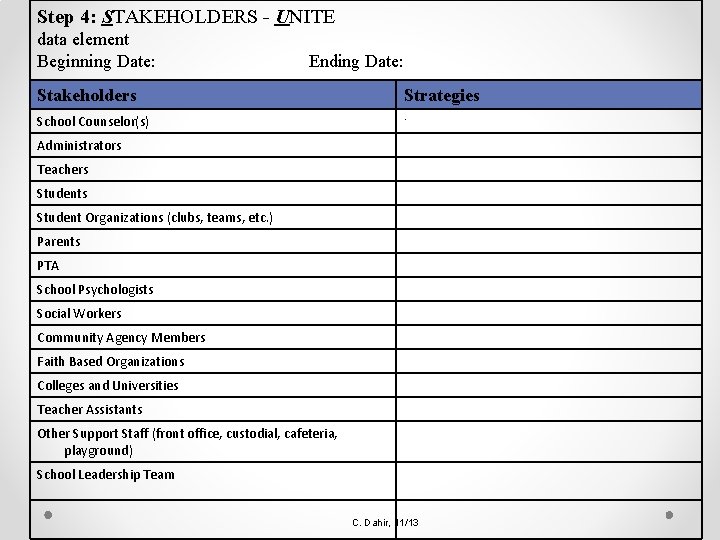
Step 4: STAKEHOLDERS - UNITE data element Beginning Date: Ending Date: Stakeholders Strategies School Counselor(s) . Administrators Teachers Student Organizations (clubs, teams, etc. ) Parents PTA School Psychologists Social Workers Community Agency Members Faith Based Organizations Colleges and Universities Teacher Assistants Other Support Staff (front office, custodial, cafeteria, playground) School Leadership Team C. Dahir, 11/13
Step: 5 Results: then re-analyze and revise your plan at the end of the school year. C. Dahir, 11/13 We Did It!
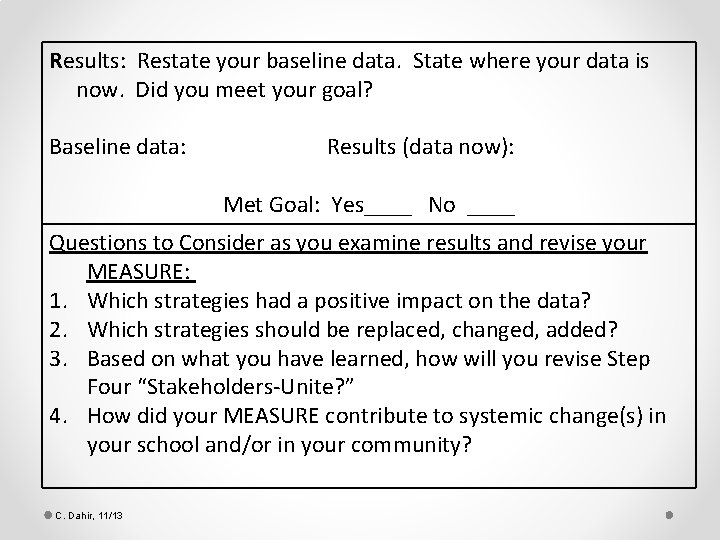
Results: Restate your baseline data. State where your data is now. Did you meet your goal? Baseline data: Results (data now): Met Goal: Yes____ No ____ Questions to Consider as you examine results and revise your MEASURE: 1. Which strategies had a positive impact on the data? 2. Which strategies should be replaced, changed, added? 3. Based on what you have learned, how will you revise Step Four “Stakeholders-Unite? ” 4. How did your MEASURE contribute to systemic change(s) in your school and/or in your community? C. Dahir, 11/13
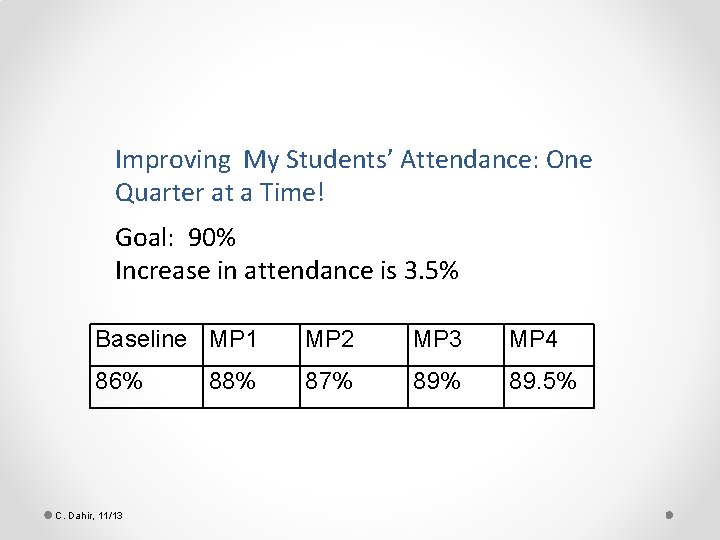
Improving My Students’ Attendance: One Quarter at a Time! Goal: 90% Increase in attendance is 3. 5% Baseline MP 1 MP 2 MP 3 MP 4 86% 87% 89. 5% C. Dahir, 11/13 88%
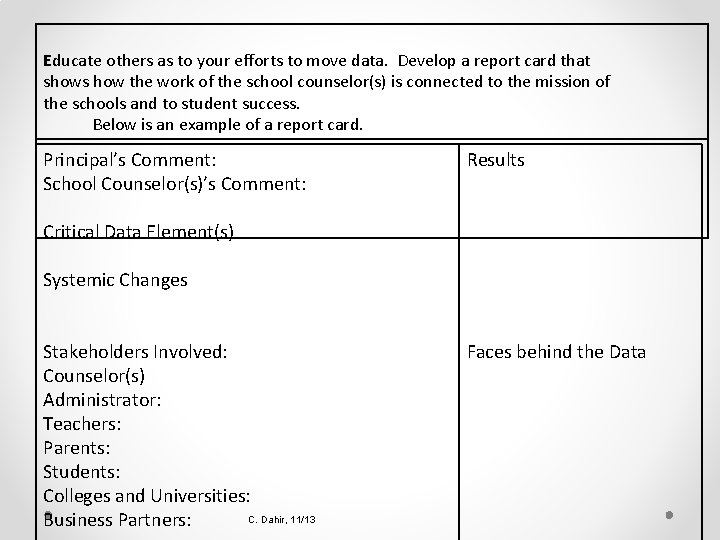
Educate others as to your efforts to move data. Develop a report card that shows how the work of the school counselor(s) is connected to the mission of the schools and to student success. Below is an example of a report card. Principal’s Comment: School Counselor(s)’s Comment: Results Critical Data Element(s) Systemic Changes Stakeholders Involved: Counselor(s) Administrator: Teachers: Parents: Students: Colleges and Universities: C. Dahir, 11/13 Business Partners: Faces behind the Data
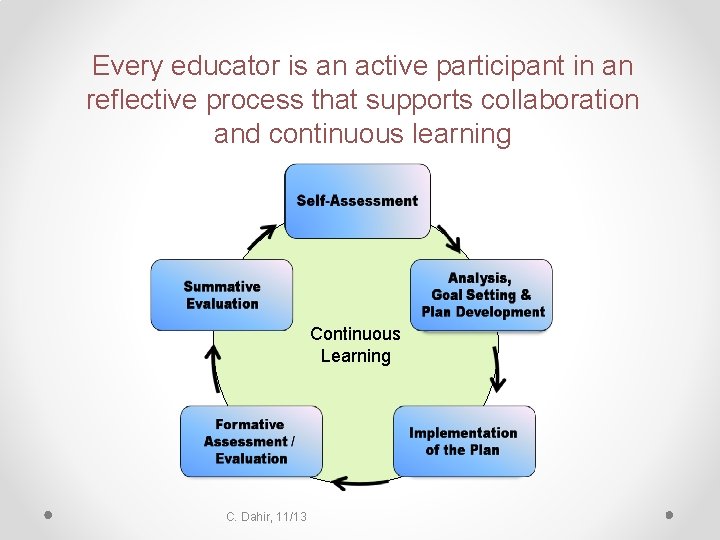
Every educator is an active participant in an reflective process that supports collaboration and continuous learning Continuous Learning C. Dahir, 11/13
A Comprehensive Structure Puts It All Together o o o School-based Issues National Standards Student Competencies (SLOs) Practices-Services-Activities Critical Data Elements Results and Accountability The process to show the impact of. C. Dahir, our 11/13 work on student achievement!
School Counseling What do you consider good practice? How will you show your contributions make a difference in student success? C. Dahir, 11/13
Implications What Makes Sense? Brainstorm What is Missing? NO ONE SAID IT WOULD BE EASY……. but it will be worth it for our students! C. Dahir, 11/13
Plan Your Next Steps TOGETHER WE CAN! C. Dahir, 11/13
WEB RESOURCES � Education Trust www. edtrust. org � National Center for Educational Statistics http: //nces. ed. gov/ (student's classroom) �ASCA www. schoolcounselor. org � Tools for School Improvement http: //www. annenberginstitute. org/Tools � Post Secondary Education www. postsecondary. org � EZ Analzye ttp: //www. ezanalyze. com/download/instructions. htm � College Board National Center for School Counselor Advocacy www. collegeboard. org C. Dahir, 11/13
Resources • ASCA National Model for Comprehensive School Counseling - 3 rd edition (2012) • The Philippine National Standards for School Counseling Programs (2011) • Stone, C. & Dahir, C. (2011). School counselor accountability: A MEASURE of student success. Cengage/Pearson C. Dahir, 11/13