
Effective Identification of FailureInducing Changes A Hybrid Approach
Effective Identification of Failure-Inducing Changes: A Hybrid Approach Sai Zhang, Yu Lin, Zhongxian Gu, Jianjun Zhao PASTE 2008
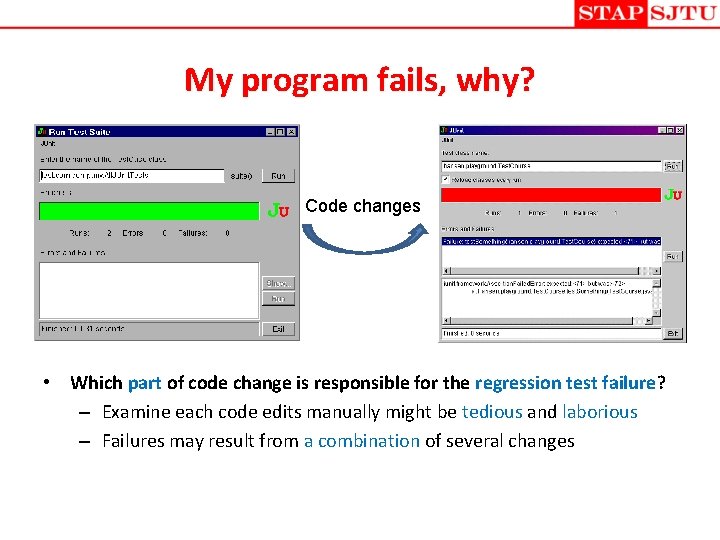
My program fails, why? Code changes • Which part of code change is responsible for the regression test failure? – Examine each code edits manually might be tedious and laborious – Failures may result from a combination of several changes
![Identify failure-inducing changes • Delta debugging [Zeller ESEC/FSE’ 99] – A promising approach to](http://slidetodoc.com/presentation_image/a92ad1a605673771447d8aa88b7e91c4/image-3.jpg "Identify failure-inducing changes • Delta debugging [Zeller ESEC/FSE’ 99] – A promising approach to")
Identify failure-inducing changes • Delta debugging [Zeller ESEC/FSE’ 99] – A promising approach to isolate faulty changes – It constructs intermediate program versions repeatedly to narrow down the change set • Can we develop more effective techniques? – Integrate the strength of both static analyses and dynamic testing, to fast narrow down the change set – Goal: A complementary general approach to original debugging algorithm (not restricted to one specific programming language)
Outline • Background – Delta debugging – Improvement room • Our hybrid approach – – Prune out irrelevant changes Rank suspicious change Construct valid intermediate version Explore changes hierarchically • Experiment evaluation • Related work • Conclusion
Outline • Background – Delta debugging – Improvement room • Our hybrid approach – – Prune out irrelevant changes Rank suspicious change Construct valid intermediate version Explore changes hierarchically • Experiment evaluation • Related work • Conclusion

Background • Delta debugging – Originally proposed by Zeller in ESEC/FSE’ 99 – Aim to isolate failure-inducing changes and simplify failed test input • Basic idea – Divide source changes into a set of configurations – Apply each subset of configurations to the original program – Correlate the testing result to find out the minimum faulty change set
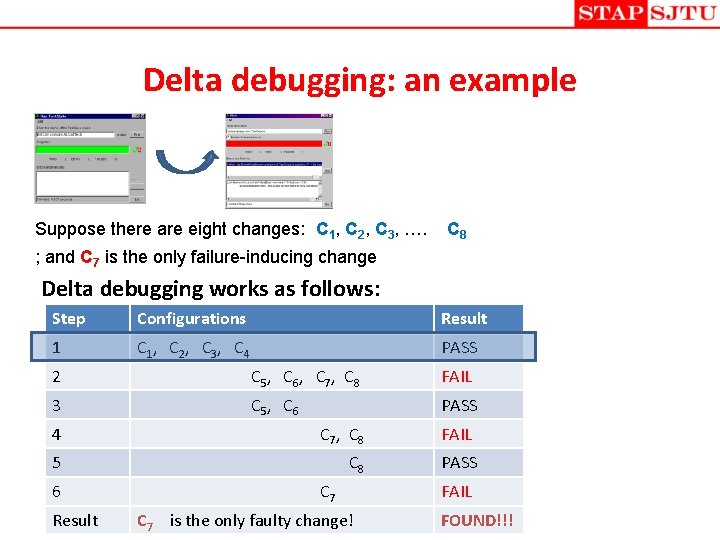
Delta debugging: an example Suppose there are eight changes: C 1, C 2, C 3, …. C 8 ; and C 7 is the only failure-inducing change Delta debugging works as follows: Step Configurations Result 1 C 1, C 2, C 3, C 4 PASS 2 C 5, C 6, C 7, C 8 FAIL 3 C 5, C 6 PASS 4 C 7, C 8 5 C 8 6 Result C 7 is the only faulty change! FAIL PASS FAIL FOUND!!!
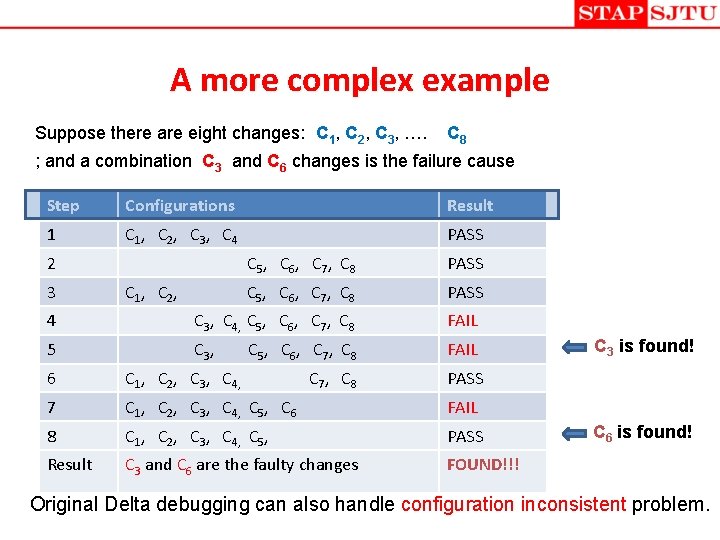
A more complex example Suppose there are eight changes: C 1, C 2, C 3, …. C 8 ; and a combination C 3 and C 6 changes is the failure cause Step Configurations Result 1 C 1, C 2, C 3, C 4 PASS 2 3 C 1, C 2, C 5, C 6, C 7, C 8 PASS 4 C 3, C 4, C 5, C 6, C 7, C 8 FAIL 5 C 3, FAIL C 5, C 6, C 7, C 8 6 C 1, C 2, C 3, C 4, C 7, C 8 7 C 1, C 2, C 3, C 4, C 5, C 6 FAIL 8 C 1, C 2, C 3, C 4, C 5, PASS Result C 3 and C 6 are the faulty changes FOUND!!! C 3 is found! PASS C 6 is found! Original Delta debugging can also handle configuration inconsistent problem.
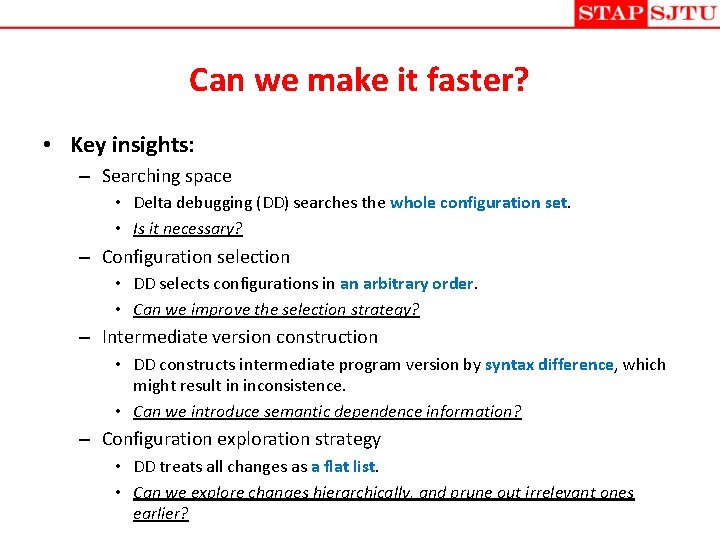
Can we make it faster? • Key insights: – Searching space • Delta debugging (DD) searches the whole configuration set. • Is it necessary? – Configuration selection • DD selects configurations in an arbitrary order. • Can we improve the selection strategy? – Intermediate version construction • DD constructs intermediate program version by syntax difference, which might result in inconsistence. • Can we introduce semantic dependence information? – Configuration exploration strategy • DD treats all changes as a flat list. • Can we explore changes hierarchically, and prune out irrelevant ones earlier?
Outline • Background – Delta debugging – Improvement room • Our hybrid approach – – Prune out irrelevant changes Rank suspicious change Construct valid intermediate version Explore changes hierarchically • Experiment evaluation • Related work • Conclusion
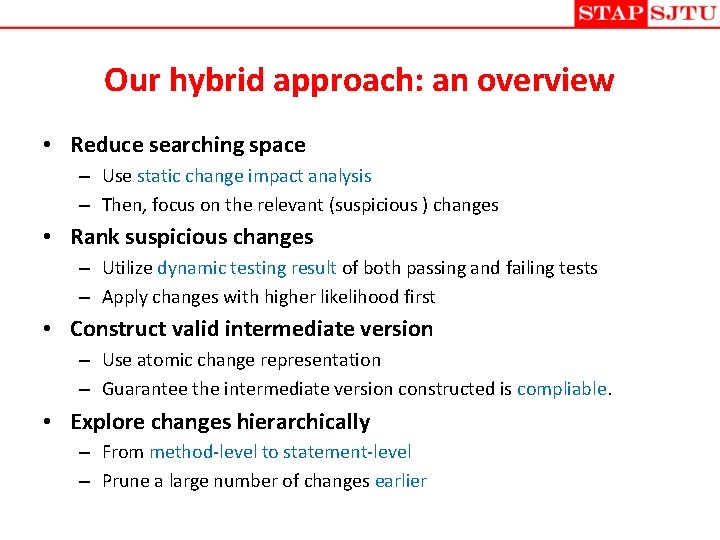
Our hybrid approach: an overview • Reduce searching space – Use static change impact analysis – Then, focus on the relevant (suspicious ) changes • Rank suspicious changes – Utilize dynamic testing result of both passing and failing tests – Apply changes with higher likelihood first • Construct valid intermediate version – Use atomic change representation – Guarantee the intermediate version constructed is compliable. • Explore changes hierarchically – From method-level to statement-level – Prune a large number of changes earlier
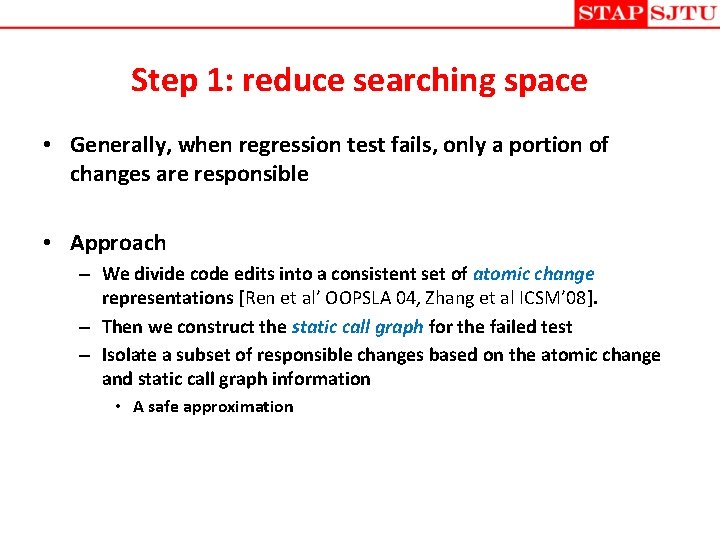
Step 1: reduce searching space • Generally, when regression test fails, only a portion of changes are responsible • Approach – We divide code edits into a consistent set of atomic change representations [Ren et al’ OOPSLA 04, Zhang et al ICSM’ 08]. – Then we construct the static call graph for the failed test – Isolate a subset of responsible changes based on the atomic change and static call graph information • A safe approximation
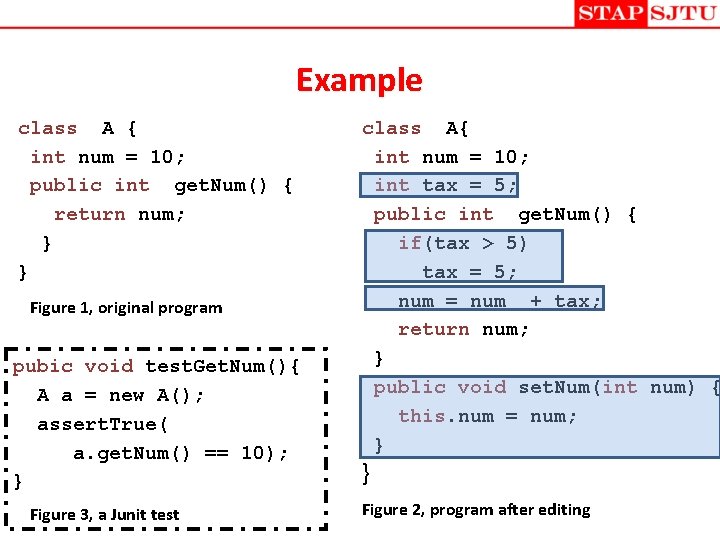
Example class A { int num = 10; public int get. Num() { return num; } } Figure 1, original program pubic void test. Get. Num(){ A a = new A(); assert. True( a. get. Num() == 10); } Figure 3, a Junit test class A{ int num = 10; int tax = 5; public int get. Num() { if(tax > 5) tax = 5; num = num + tax; return num; } public void set. Num(int num) { this. num = num; } } Figure 2, program after editing
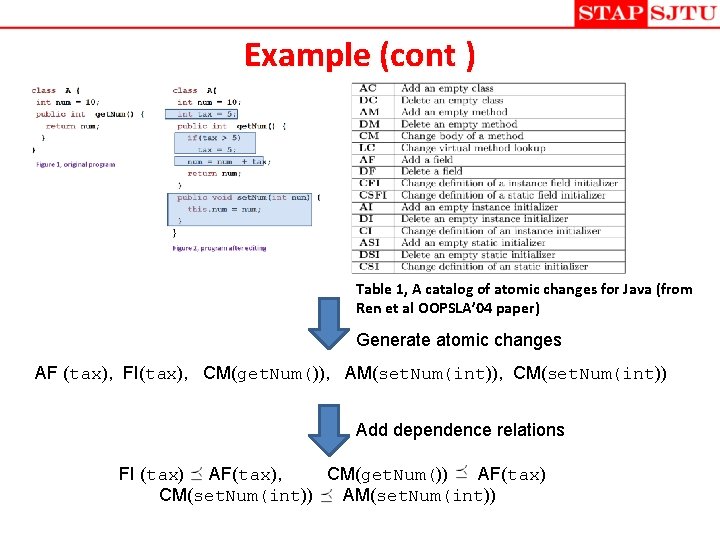
Example (cont ) Table 1, A catalog of atomic changes for Java (from Ren et al OOPSLA’ 04 paper) Generate atomic changes AF (tax), FI(tax), CM(get. Num()), AM(set. Num(int)), CM(set. Num(int)) Add dependence relations FI (tax) AF(tax), CM(get. Num()) AF(tax) CM(set. Num(int)) AM(set. Num(int))
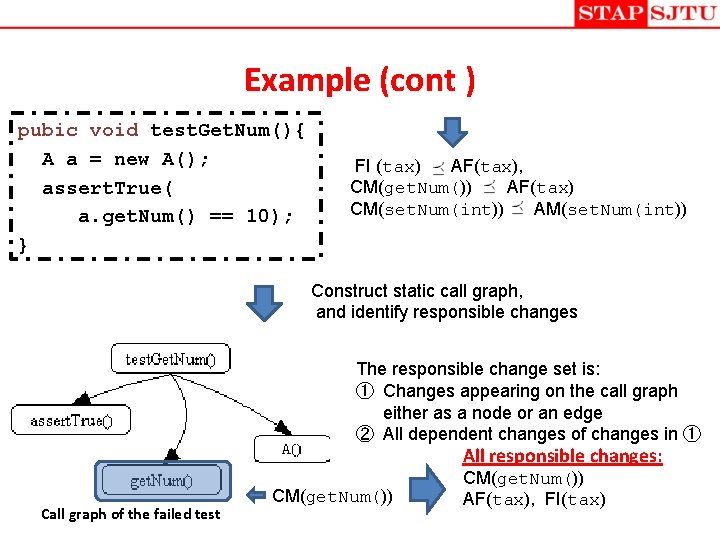
Example (cont ) pubic void test. Get. Num(){ A a = new A(); assert. True( a. get. Num() == 10); } FI (tax) AF(tax), CM(get. Num()) AF(tax) CM(set. Num(int)) AM(set. Num(int)) Construct static call graph, and identify responsible changes The responsible change set is: ① Changes appearing on the call graph either as a node or an edge ② All dependent changes of changes in ① All responsible changes: Call graph of the failed test CM(get. Num()) AF(tax), FI(tax)
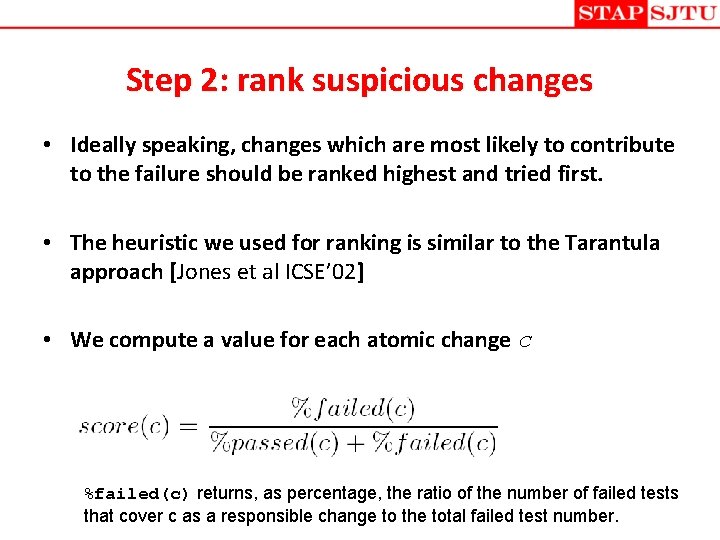
Step 2: rank suspicious changes • Ideally speaking, changes which are most likely to contribute to the failure should be ranked highest and tried first. • The heuristic we used for ranking is similar to the Tarantula approach [Jones et al ICSE’ 02] • We compute a value for each atomic change c %failed(c) returns, as percentage, the ratio of the number of failed tests that cover c as a responsible change to the total failed test number.
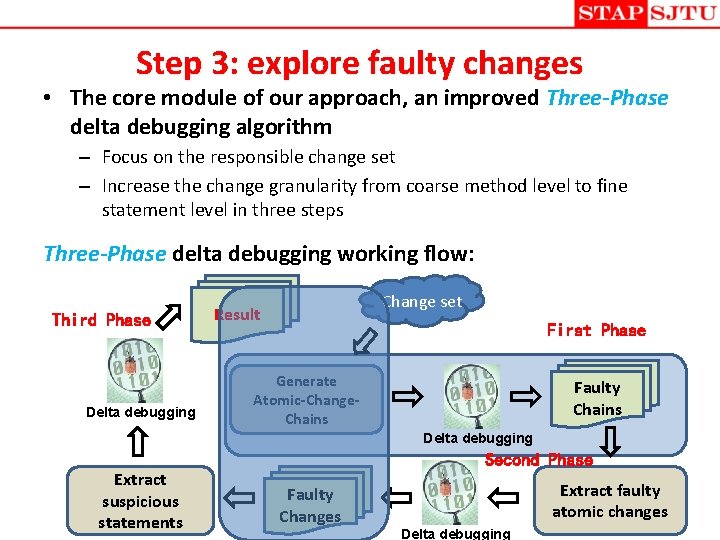
Step 3: explore faulty changes • The core module of our approach, an improved Three-Phase delta debugging algorithm – Focus on the responsible change set – Increase the change granularity from coarse method level to fine statement level in three steps Three-Phase delta debugging working flow: Third Phase Delta debugging Change set Result First Phase Generate Atomic-Change. Chains Faulty Chains Delta debugging Extract suspicious statements Second Phase Faulty Changes Extract faulty atomic changes Delta debugging
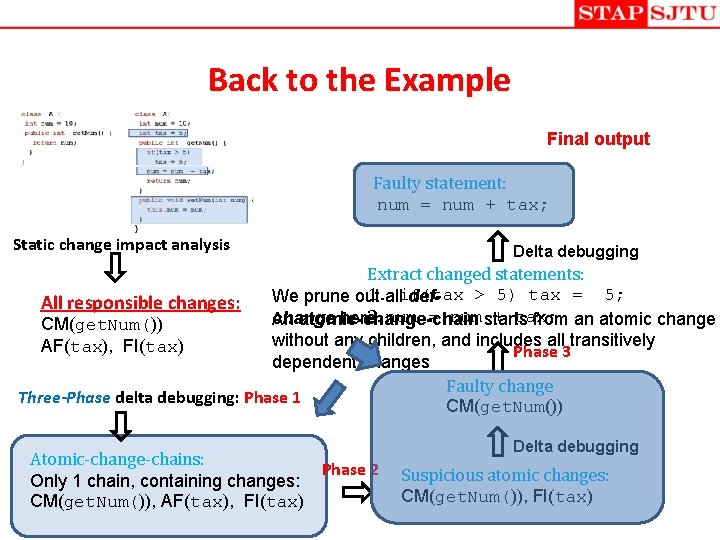
Back to the Example Final output Faulty statement: num = num + tax; Static change impact analysis Delta debugging Extract changed statements: 1. allif(tax > 5) tax = 5; We prune out def. All responsible changes: + tax; change here 2. num = num starts An atomic-change-chain from an atomic change CM(get. Num()) without any children, and includes all transitively AF(tax), FI(tax) Phase 3 dependent changes Faulty change Three-Phase delta debugging: Phase 1 CM(get. Num()) Atomic-change-chains: Phase 2 Only 1 chain, containing changes: CM(get. Num()), AF(tax), FI(tax) Delta debugging Suspicious atomic changes: CM(get. Num()), FI(tax)
Other technical issue • The correctness of intermediate program version – The dependence between atomic changes guarantee the correctness of intermediate version in phase 1 and 2 [Ren et al OOPSLA’ 04] – However, in phase 3, the configurations could be inconsistent as the original delta debugging
Outline • Background – Delta debugging – Improvement room • Our hybrid approach – – Prune out irrelevant changes Rank suspicious change Construct valid intermediate version Explore changes hierarchically • Experiment evaluation • Related work • Conclusion
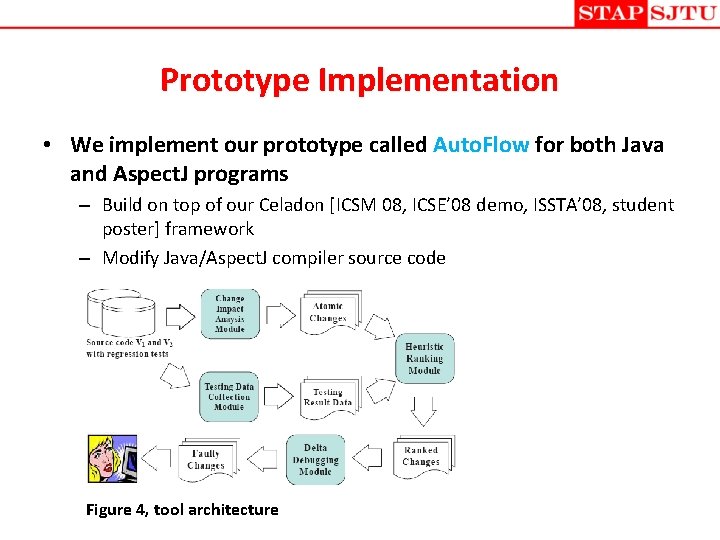
Prototype Implementation • We implement our prototype called Auto. Flow for both Java and Aspect. J programs – Build on top of our Celadon [ICSM 08, ICSE’ 08 demo, ISSTA’ 08, student poster] framework – Modify Java/Aspect. J compiler source code Figure 4, tool architecture
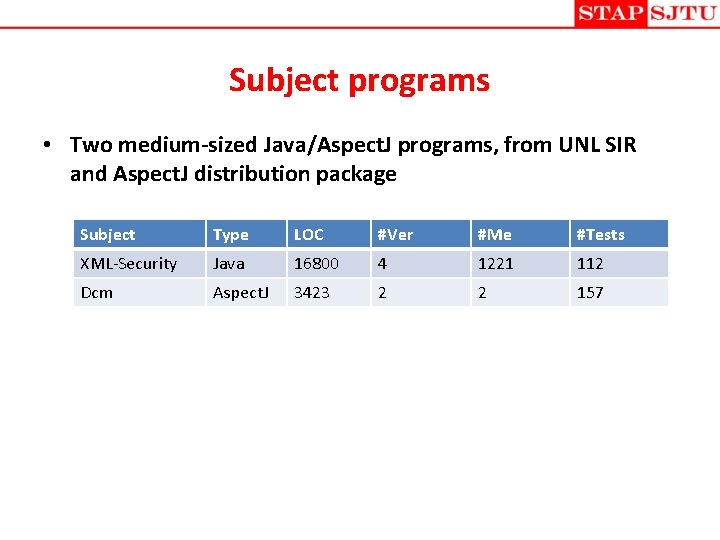
Subject programs • Two medium-sized Java/Aspect. J programs, from UNL SIR and Aspect. J distribution package Subject Type LOC #Ver #Me #Tests XML-Security Java 16800 4 1221 112 Dcm Aspect. J 3423 2 2 157
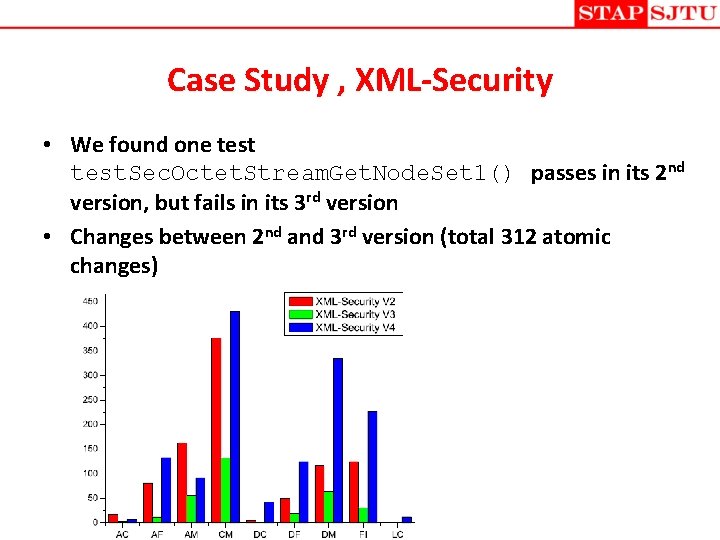
Case Study , XML-Security • We found one test. Sec. Octet. Stream. Get. Node. Set 1() passes in its 2 nd version, but fails in its 3 rd version • Changes between 2 nd and 3 rd version (total 312 atomic changes)
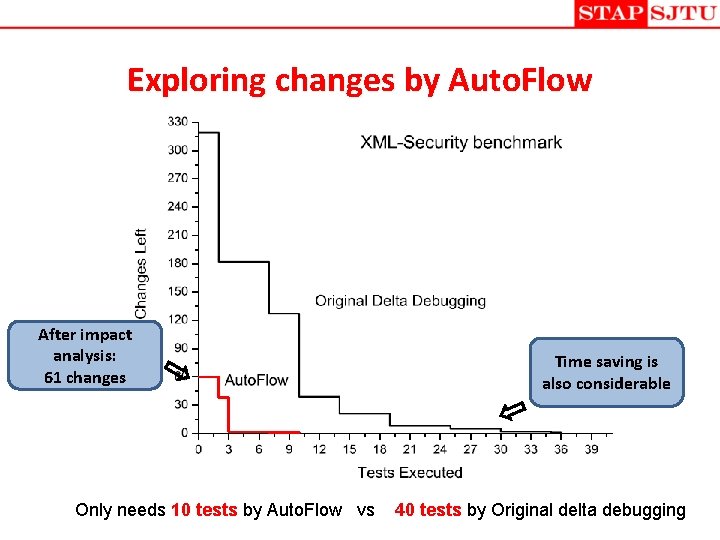
Exploring changes by Auto. Flow After impact analysis: 61 changes Only needs 10 tests by Auto. Flow vs Time saving is also considerable 40 tests by Original delta debugging
Outline • Background – Delta debugging – Improvement room • Our hybrid approach – – Prune out irrelevant changes Rank suspicious change Construct valid intermediate version Explore changes hierarchically • Experiment evaluation • Related work • Conclusion
Related Work • Delta debugging and its applications – Zeller ESEC/FSE’ 99, FSE’ 02, ICSE’ 04, ISSTA’ 05 – Misherghi ICSE’ 06 • Change impact analysis and its applications – Ryder et al PASTE’ 01, Ren et al OOPSLA’ 04 – Ren et al TSE’ 06, Chesley et al ICSM’ 05, Max FSE’ 06 • Fault localization techniques (closely related) – Jones ICSE’ 02, Ren et al ISSTA’ 07, Jeffery et al ISSTA’ 08
Outline • Background – Delta debugging – Improvement room • Our hybrid approach – – Prune out irrelevant changes Rank suspicious change Construct valid intermediate version Explore changes hierarchically • Experiment evaluation • Related work • Conclusion
Conclusion • We present a hybrid approach to effectively identify failureinducing changes (requires 4 X less tests) • Implement the tool and present two case studies • We recommend our approach to be an integrated part of the delta debugging technique; when a regression test fails: – Remove unrelated changes first – Rank suspicious change, and – Explore code edits from coarse-grained to fine-grained level
Future Directions • Eliminate searching space – Using more precise impact analysis approaches, such as dynamic slicing, Execution-After information • Perform more experiment evaluations • Investigate the correlations between change impact analysis and heuristic ranking • Long term plan – Explore how to incorporate static/statistical analysis techniques into debugging tasks – Combine testing and verification for effective/scalable fault localization
- Slides: 29