
EFFECTIVE GRADING AND MINIMAL MARKING Presented by Writing
EFFECTIVE GRADING AND MINIMAL MARKING Presented by Writing Across the Curriculum Fellows Laura Malhotra and Alicia Andrzejewski
Workshop Goals ■ Discussion and redefinition of grading practices ■ Advance planning and resources for the grading process ■ Strategies for effective grading and saving time while marking

Myth “Students’ writing will improve in direct proportion to the amount of time their teachers spend on their papers. ” (Hairston 2002)
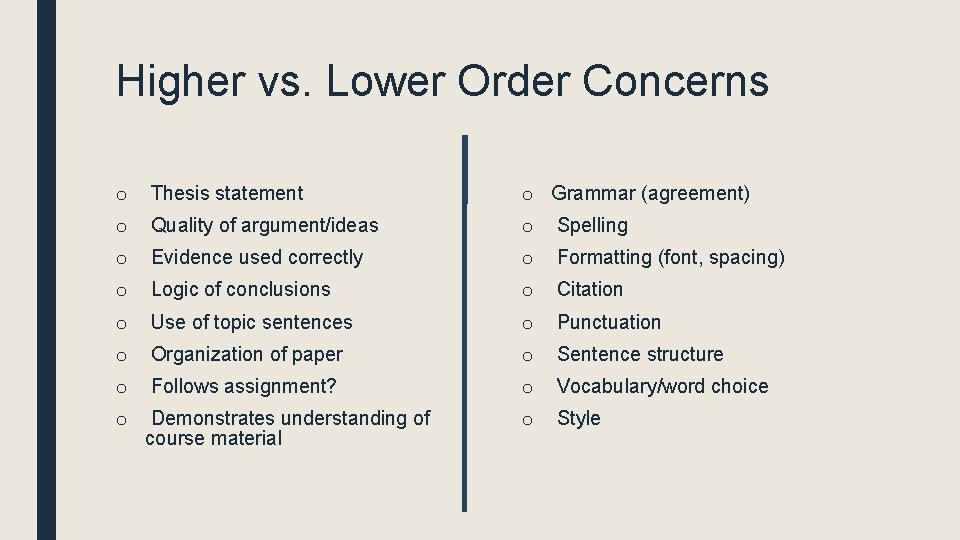
Higher vs. Lower Order Concerns o Thesis statement o Grammar (agreement) o Quality of argument/ideas o Spelling o Evidence used correctly o Formatting (font, spacing) o Logic of conclusions o Citation o Use of topic sentences o Punctuation o Organization of paper o Sentence structure o Follows assignment? o Vocabulary/word choice o Demonstrates understanding of course material o Style
Activity Read the text provided on pg. 1 – 2 of your handout and mark it with these orders in mind
Discussion ■ What did you look for while grading? ■ Which higher order concerns did you prioritize? ■ Which *one* lower order concern would you choose to point out to the student?
Build on WAC Principles ■ Scaffolding – Low stakes and high stakes assignments – Practice of concepts and techniques ■ Grading philosophies – Spend more time on higher order concerns for a better endproduct – The more students feel comfortable with course content, the better they write ■ Assignment goals – Set your expectations clearly – Rubrics that are adapted to reflect higher order concerns
Lay the Foundation ■ Before you hand out assignment: – Design effective assignments – Establish clear grading criteria ■ After you hand out the assignment: – Hold a class discussion about the paper (option: brainstorming session) – Meet with students (one-on-one or in groups) – Show examples of past students' work – Conduct peer reviews
Strategy for Grading Preparation: the Possibilities of Peer Review – In class – As homework – General concepts and techniques – Thesis statement – First draft – Low stakes – Higher stakes
Instructor Feedback: General Themes ■ Coach vs. judge ■ Encourage student autonomy ■ Every mistake isn’t serious ■ Recognize that students interpret most feedback from instructors as criticism ■ Frame comments in a forwardlooking way
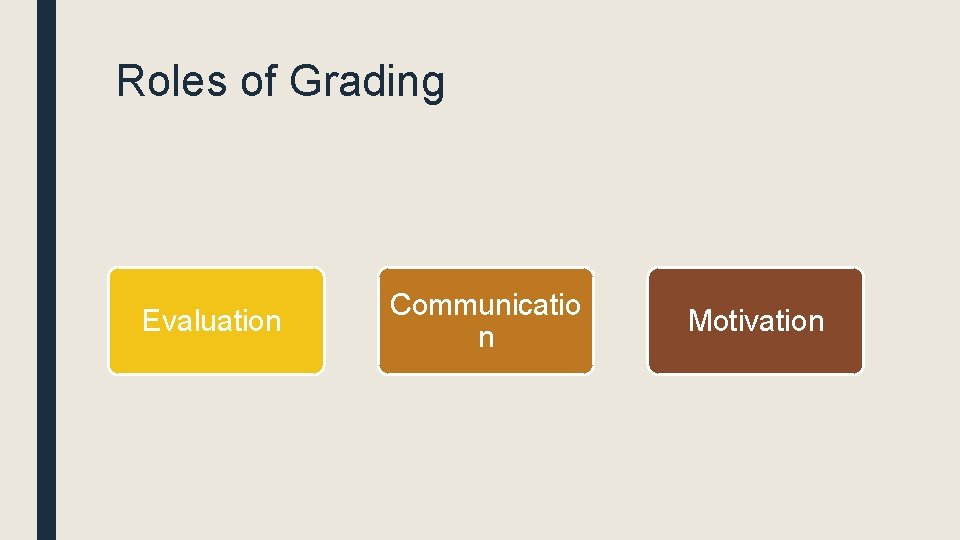
Roles of Grading Evaluation Communicatio n Motivation
Minimal Marking ■ Supports students in improving their writing ■ Gives students concrete ways to fix what has been marked ■ Encourages student accountability for the quality of their writing ■ Saves time!
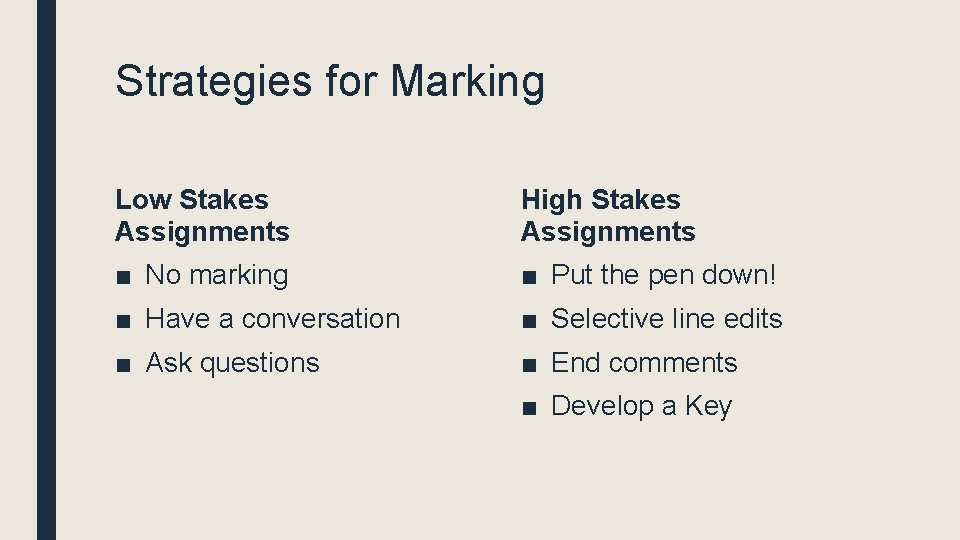
Strategies for Marking Low Stakes Assignments High Stakes Assignments ■ No marking ■ Put the pen down! ■ Have a conversation ■ Selective line edits ■ Ask questions ■ End comments ■ Develop a Key
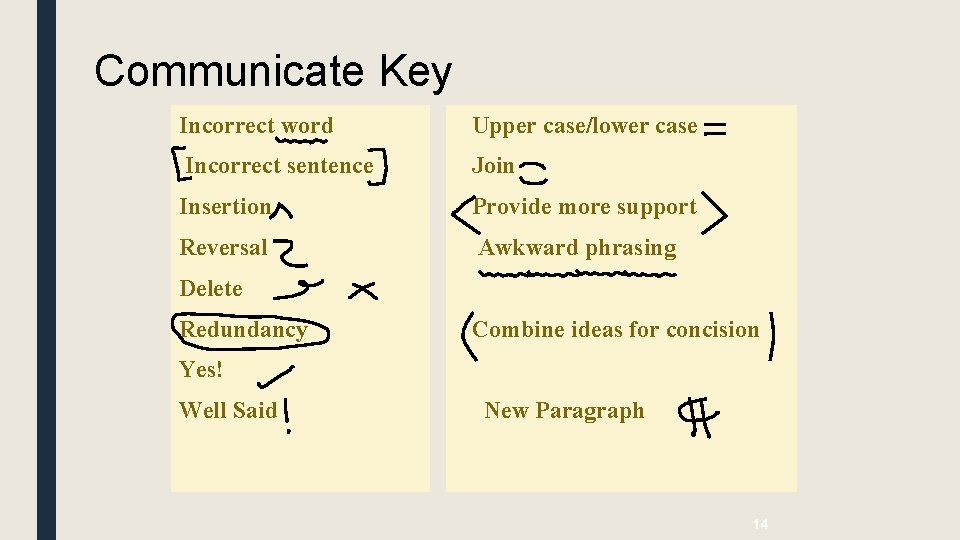
Communicate Key Incorrect word Upper case/lower case Incorrect sentence Join Insertion Provide more support Reversal Awkward phrasing Delete Redundancy Combine ideas for concision Yes! Well Said New Paragraph 14
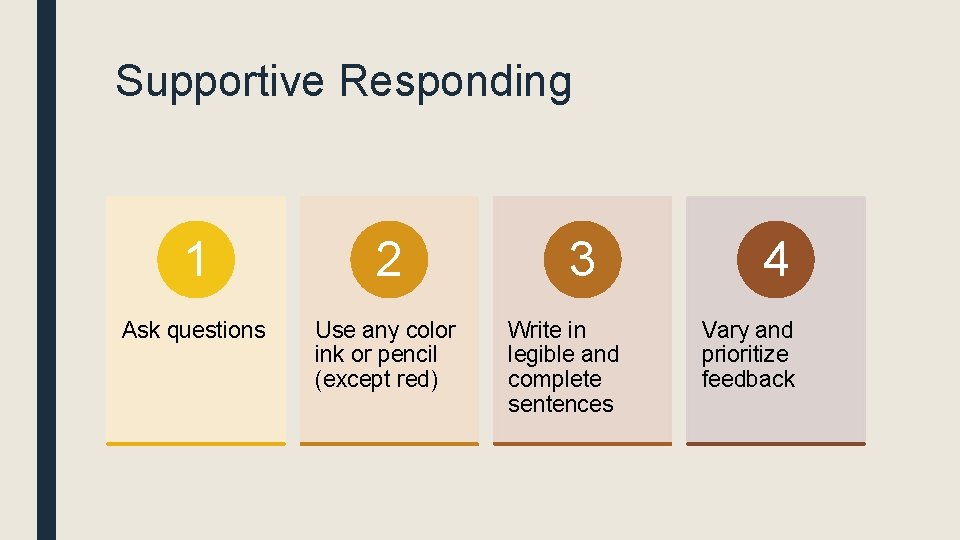
Supportive Responding 1 2 Ask questions Use any color ink or pencil (except red) 3 Write in legible and complete sentences 4 Vary and prioritize feedback

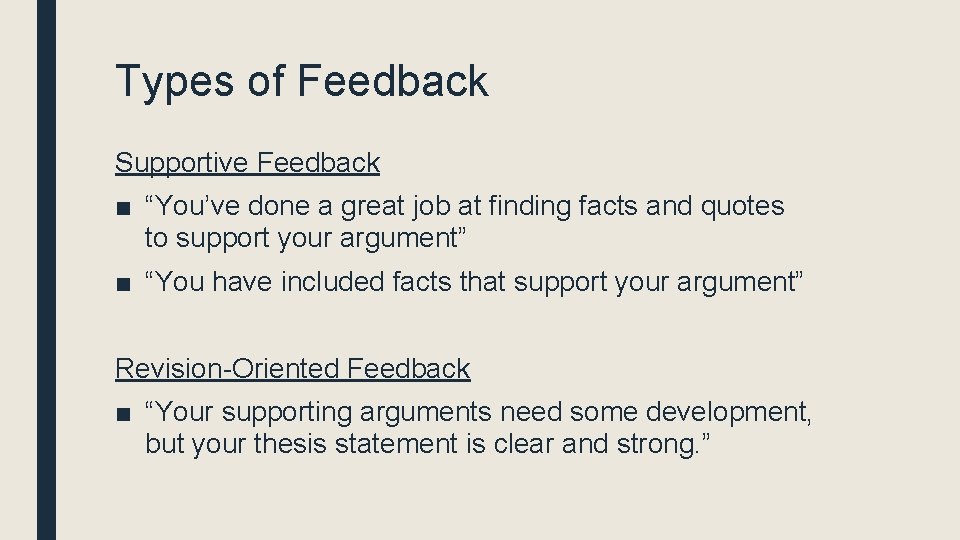
Types of Feedback Supportive Feedback ■ “You’ve done a great job at finding facts and quotes to support your argument” ■ “You have included facts that support your argument” Revision-Oriented Feedback ■ “Your supporting arguments need some development, but your thesis statement is clear and strong. ”
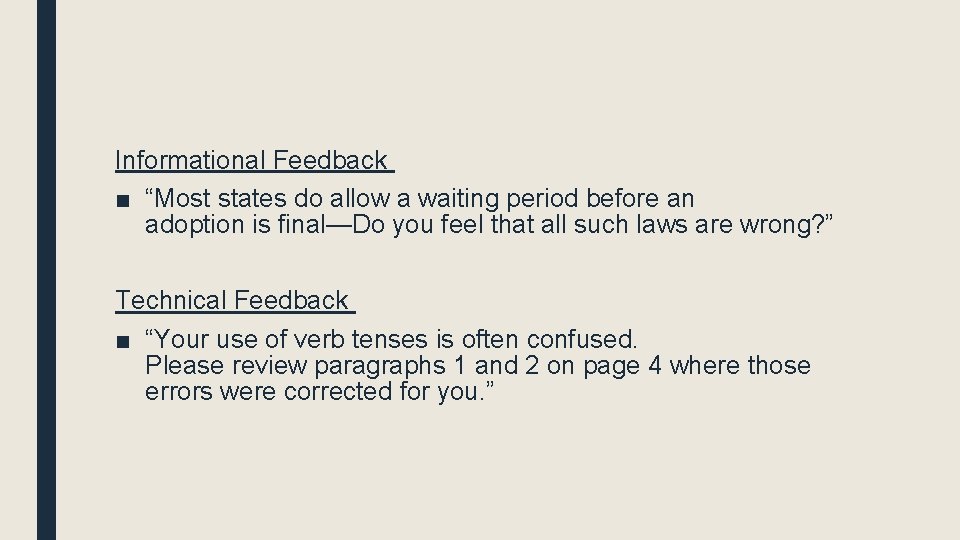
Informational Feedback ■ “Most states do allow a waiting period before an adoption is final—Do you feel that all such laws are wrong? ” Technical Feedback ■ “Your use of verb tenses is often confused. Please review paragraphs 1 and 2 on page 4 where those errors were corrected for you. ”
Plan ahead Conclusion Plan ahead Consider the conversation r Mark minimally and supportively
References ■ Bean, John C. Engaging Ideas. 2 nd edition. San Francisco: Jossey-Bass, 2011. ■ Elbow, Peter. “High Stakes and Low Stakes in Assigning and Responding to Writing. ” In Writing to Learn: Strategies for Assigning and Responding to Writing in the Disciplines, ed. Mary Deane Sorcinelli and Peter Elbow. San Francisco: Jossey-Bass, 1997. ■ Harris, Muriel. “The Overgraded Paper: Another Case of More is Less. ” In How to Handle the Paper Load, ed. Gene Stanford, 91 -94. Urbana, IL: National Council of Teachers of English, 1979. ■ Sommers, Nancy. Responding to Student Writing. College. Composition and Communication. (33)(2). 1982. p. 148 -156. ■ Walk, Kerry. “Teaching with Writing: A Guide for Faculty and Graduate Students. ” Princeton Writing Program: 30 -40.
- Slides: 20