
Effective Facilitation Skills Going from Good to Great
- Slides: 26
Effective Facilitation Skills: Going from Good to Great AFP Partners’ Meeting July 19, 2016 Arzum Ciloglu, MPH, Dr. PH Arzum. Ciloglu@jhu. edu
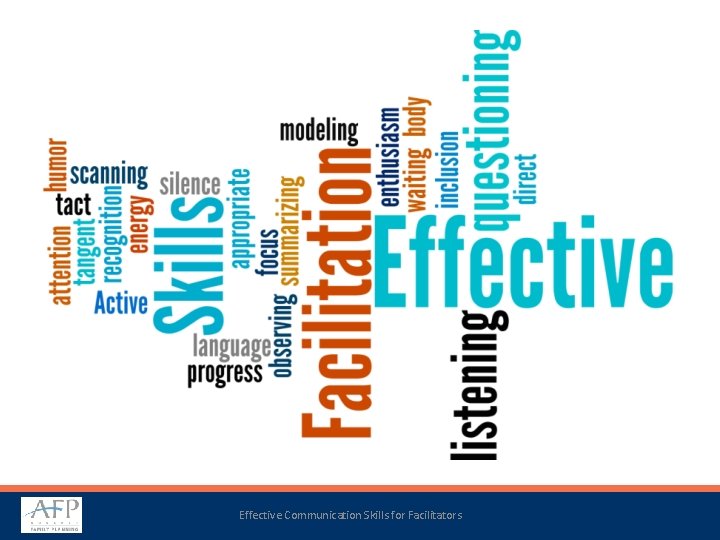
Effective Communication Skills for Facilitators
Modeling • Practice behavior that you want reflected back to you • Try to be non‐ judgmental • Watch your nonverbal messages • Remember to have some fun **Adapted from: http: //www. ilj. org/publications/docs/Facilitation_Skills_Developin g_Facilitative_Leadership. pdf
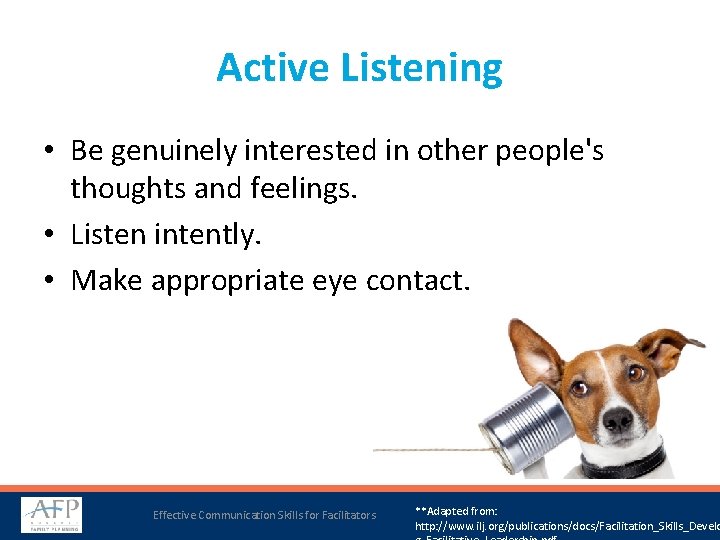
Active Listening • Be genuinely interested in other people's thoughts and feelings. • Listen intently. • Make appropriate eye contact. Effective Communication Skills for Facilitators **Adapted from: http: //www. ilj. org/publications/docs/Facilitation_Skills_Develo
Summarizing • Use paraphrasing as a method of clarifying. • Check your perceptions with the group. • It is very important to summarize at the end of key parts of the agenda and at the end of meetings. **Adapted from: http: //www. ilj. org/publications/docs/Facilitation_Skills_Developi g_Facilitative_Leadership. pdf
Focusing attention and pacing • Keep the group on the topic and focused, • Use care to limit or reduce repetition. • Stay on track! • Except…when is it ok to go off on a tangent? **Adapted from: http: //www. ilj. org/publications/docs/Facilitation_Skills_Develop
Recognizing progress • "Nice job!” • “We covered a lot of ground in a short time” • “That’s a great SMART objective” **Adapted from: http: //www. ilj. org/publications/docs/Facilitation_Skills_Developin g_Facilitative_Leadership. pdf
Scanning/Observing • Nurture full participation from the group. • Watch nonverbal cues in the form of ‐ body movements ‐ facial expressions ‐ gestures • Take a break, change the pace, change the topic, etc. **Adapted from: http: //www. ilj. org/publications/docs/Facilitation_Skills_Developin g_Facilitative_Leadership. pdf
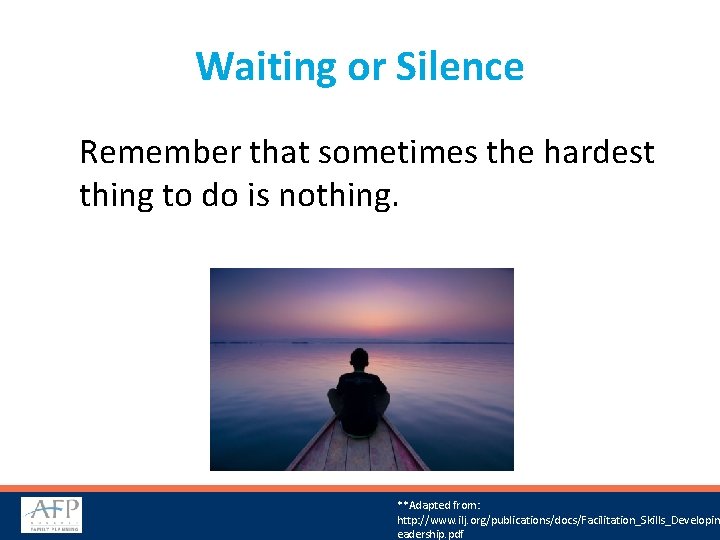
Waiting or Silence Remember that sometimes the hardest thing to do is nothing. **Adapted from: http: //www. ilj. org/publications/docs/Facilitation_Skills_Developin eadership. pdf
Questioning • Ask for examples, share personal experiences • Relate to other topics • Types of questions—open, closed, reflective, probing • How to use questioning – Ask questions of entire group – Target question to specific participant – State question, pause, then direct question Effective Communication Skills for Facilitators
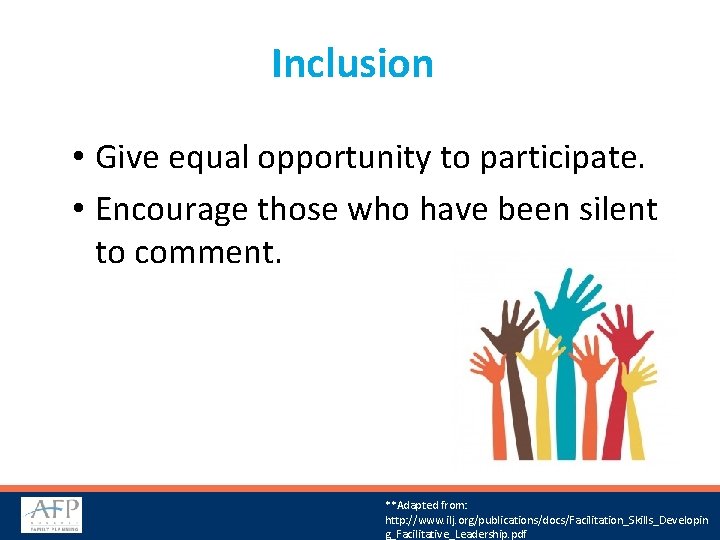
Inclusion • Give equal opportunity to participate. • Encourage those who have been silent to comment. **Adapted from: http: //www. ilj. org/publications/docs/Facilitation_Skills_Developin g_Facilitative_Leadership. pdf
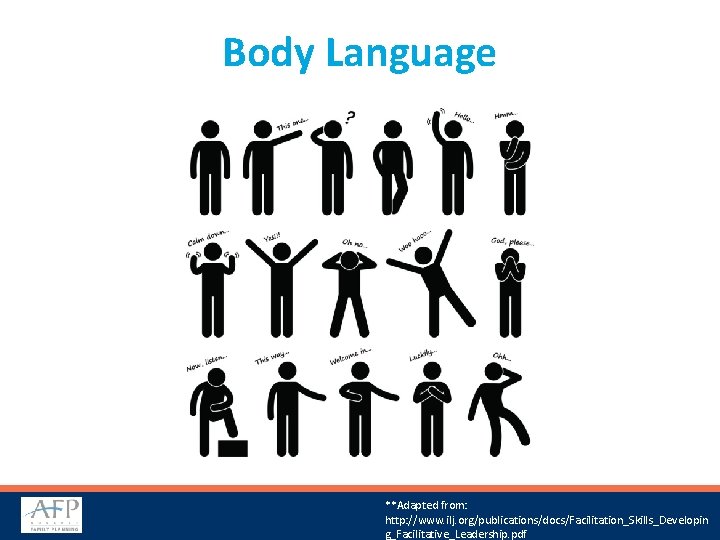
Body Language **Adapted from: http: //www. ilj. org/publications/docs/Facilitation_Skills_Developin g_Facilitative_Leadership. pdf
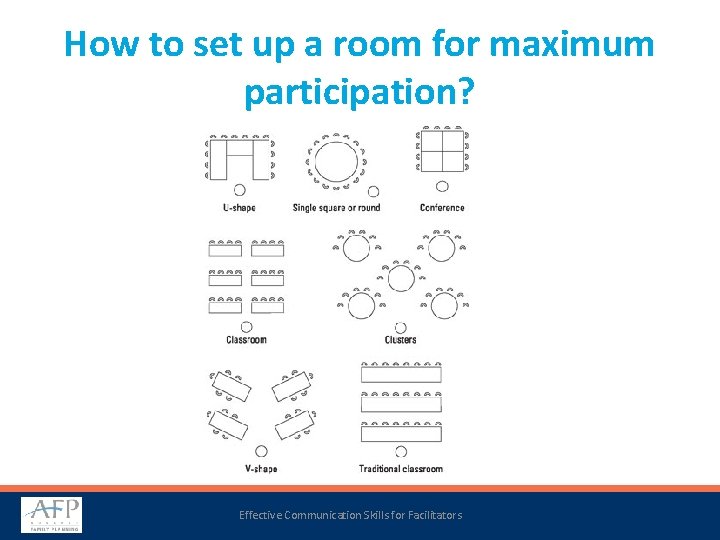
How to set up a room for maximum participation? Effective Communication Skills for Facilitators
Handling Difficult Team Members • Goal is to reduce, alter, or eliminate the member's undesirable behaviors – without hurting his or her self-esteem or capability to contribute • Never verbally scold or embarrass the individual in front of the group or even privately
Techniques for Handling Problems • Be direct, but tactful • Talk with the person candidly about the behavior in private • Use the team's informal leadersthose
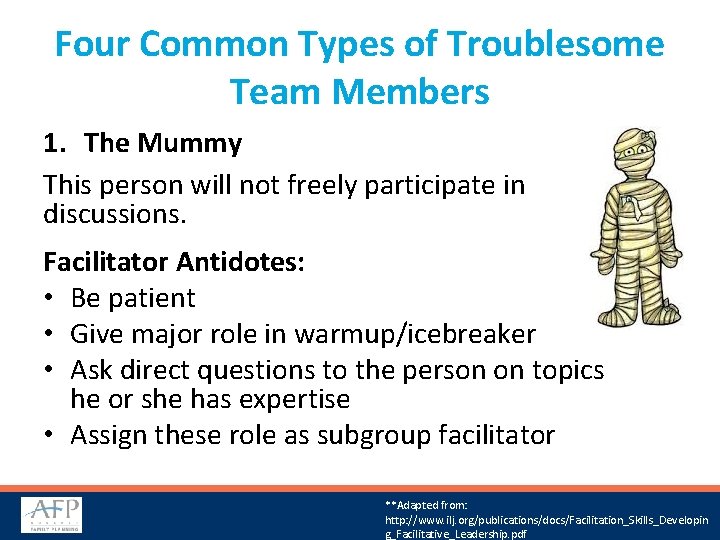
Four Common Types of Troublesome Team Members 1. The Mummy This person will not freely participate in discussions. Facilitator Antidotes: • Be patient • Give major role in warmup/icebreaker • Ask direct questions to the person on topics he or she has expertise • Assign these role as subgroup facilitator **Adapted from: http: //www. ilj. org/publications/docs/Facilitation_Skills_Developin g_Facilitative_Leadership. pdf
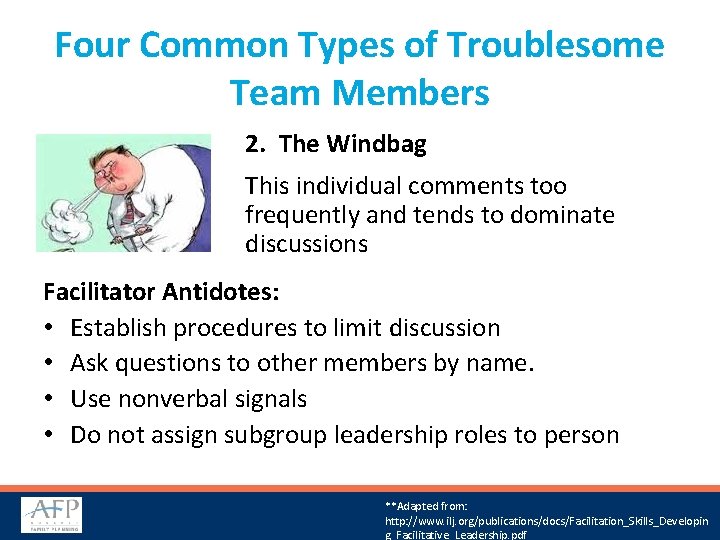
Four Common Types of Troublesome Team Members 2. The Windbag This individual comments too frequently and tends to dominate discussions Facilitator Antidotes: • Establish procedures to limit discussion • Ask questions to other members by name. • Use nonverbal signals • Do not assign subgroup leadership roles to person **Adapted from: http: //www. ilj. org/publications/docs/Facilitation_Skills_Developin g_Facilitative_Leadership. pdf
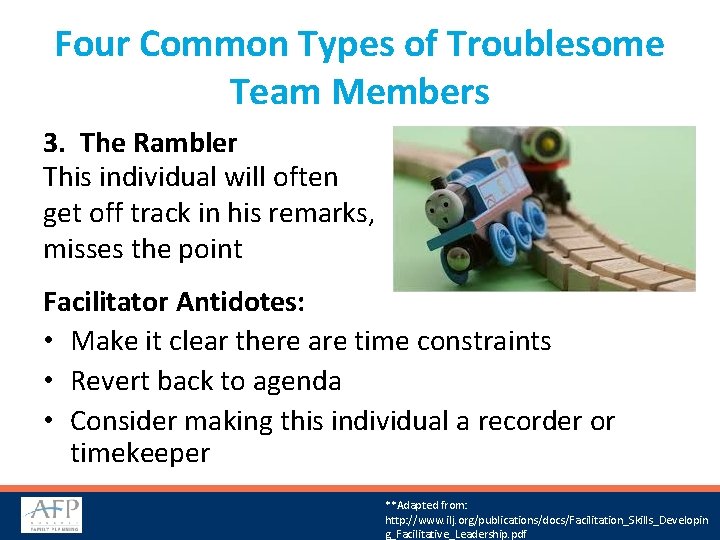
Four Common Types of Troublesome Team Members 3. The Rambler This individual will often get off track in his remarks, misses the point Facilitator Antidotes: • Make it clear there are time constraints • Revert back to agenda • Consider making this individual a recorder or timekeeper **Adapted from: http: //www. ilj. org/publications/docs/Facilitation_Skills_Developin g_Facilitative_Leadership. pdf
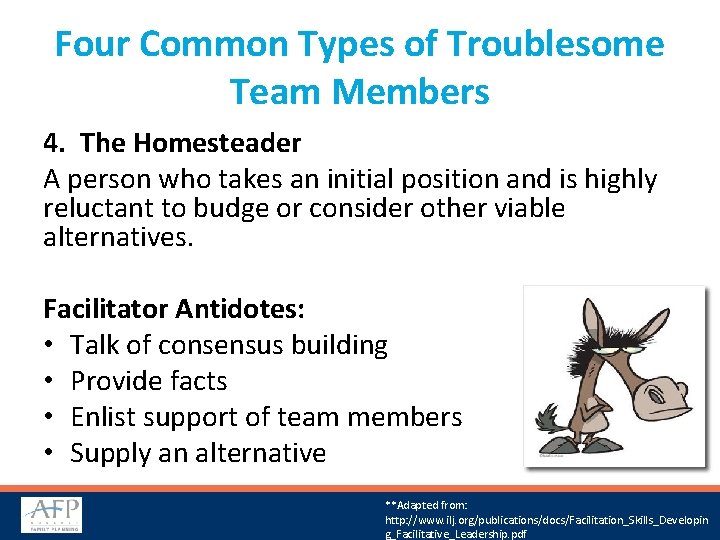
Four Common Types of Troublesome Team Members 4. The Homesteader A person who takes an initial position and is highly reluctant to budge or consider other viable alternatives. Facilitator Antidotes: • Talk of consensus building • Provide facts • Enlist support of team members • Supply an alternative **Adapted from: http: //www. ilj. org/publications/docs/Facilitation_Skills_Developin g_Facilitative_Leadership. pdf
Buzz Groups What would I do if: 1. 2. 3. 4. One group member seems to do most of the talking? An individual is silent for a long period of time? Someone in the team "puts down" another member? Group seems to want to reach a decision, but appears unable to? 5. Someone comes late 6. Group members are excessively polite and unwilling to confront each other’s ideas? **Adapted from: http: //www. ilj. org/publications/docs/Facilitation_Skills_Developin
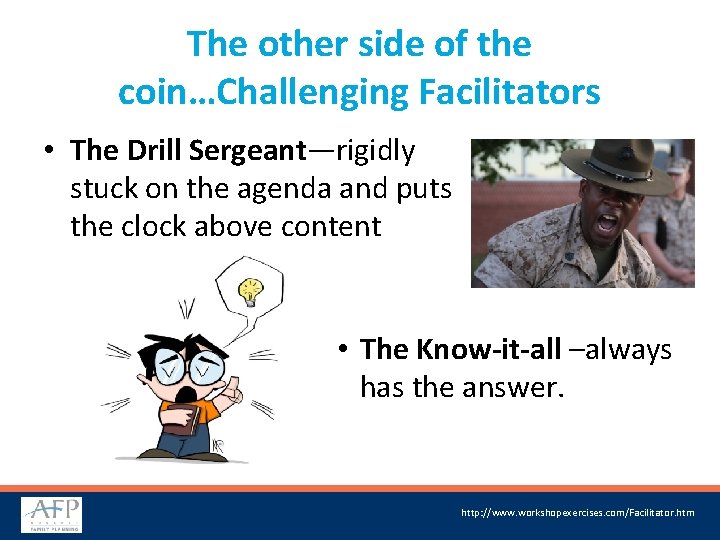
The other side of the coin…Challenging Facilitators • The Drill Sergeant—rigidly stuck on the agenda and puts the clock above content • The Know-it-all –always has the answer. http: //www. workshopexercises. com/Facilitator. htm
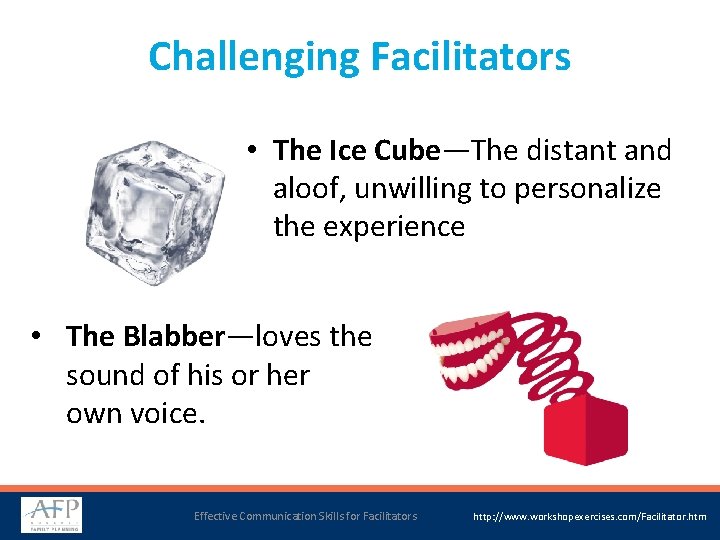
Challenging Facilitators • The Ice Cube—The distant and aloof, unwilling to personalize the experience • The Blabber—loves the sound of his or her own voice. Effective Communication Skills for Facilitators http: //www. workshopexercises. com/Facilitator. htm
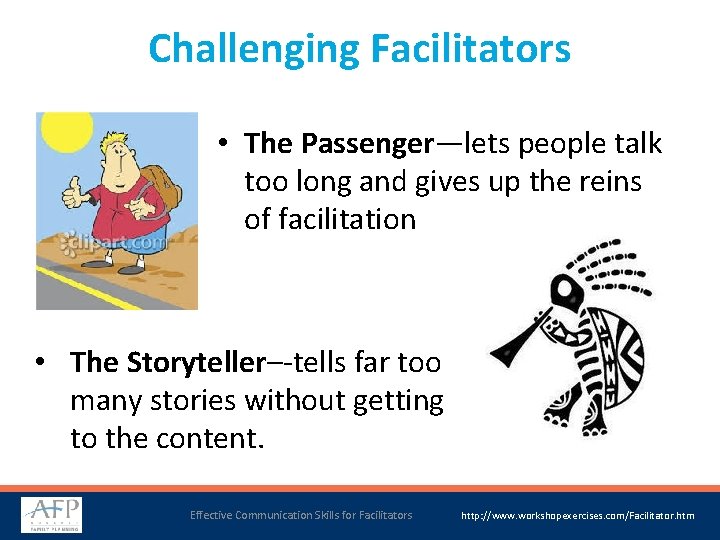
Challenging Facilitators • The Passenger—lets people talk too long and gives up the reins of facilitation • The Storyteller–‐tells far too many stories without getting to the content. Effective Communication Skills for Facilitators http: //www. workshopexercises. com/Facilitator. htm
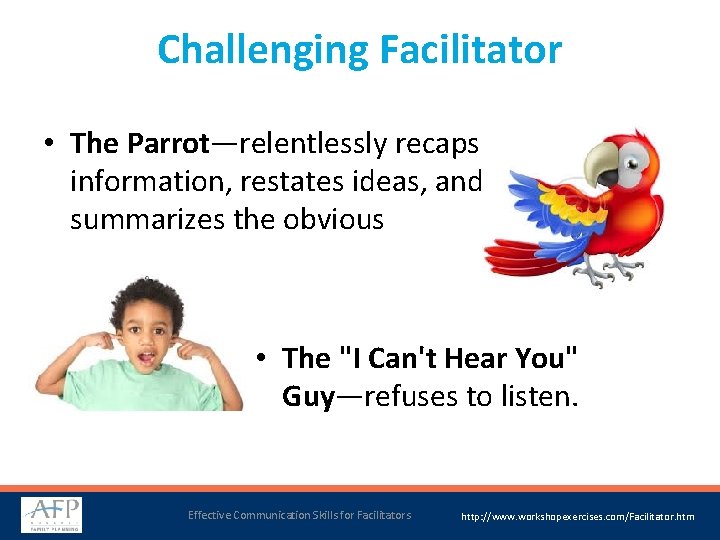
Challenging Facilitator • The Parrot—relentlessly recaps information, restates ideas, and summarizes the obvious • The "I Can't Hear You" Guy—refuses to listen. Effective Communication Skills for Facilitators http: //www. workshopexercises. com/Facilitator. htm
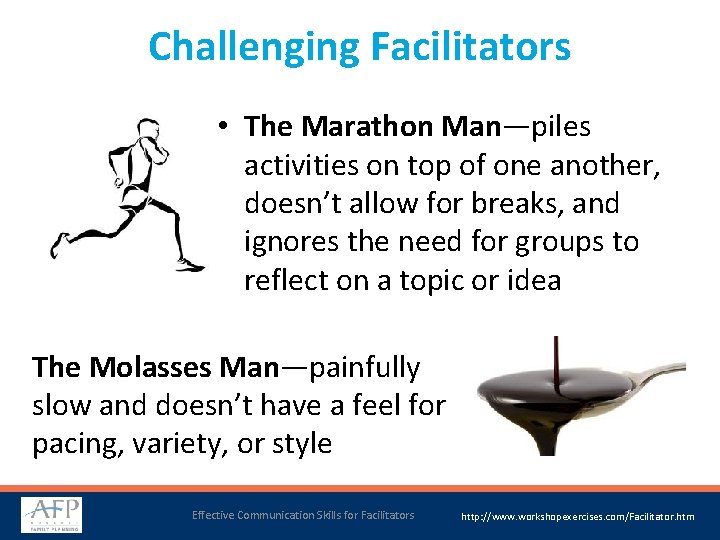
Challenging Facilitators • The Marathon Man—piles activities on top of one another, doesn’t allow for breaks, and ignores the need for groups to reflect on a topic or idea The Molasses Man—painfully slow and doesn’t have a feel for pacing, variety, or style Effective Communication Skills for Facilitators http: //www. workshopexercises. com/Facilitator. htm
Food for Thought • Do we see ourselves, or anyone we know, in any of these examples? • Have there been times when we’ve been a “challenging facilitator”? • How can we improve? Effective Communication Skills for Facilitators http: //www. workshopexercises. com/Facilitator. htm