
Effective Communication Verbal Communication Active Listening How do
Effective Communication Verbal Communication
Active Listening • How do you know when someone is listening to you? • How does it feel when someone ‘acts’ like they are listening to you? • Active listening is a HABIT • Active listening and multi-tasking are CONTRADICTORY • Do you give your “full and undivided attention”?
Common Communication Errors • Finishing others’ sentences • Preparing our response before someone is done speaking • Multi-tasking while listening • Filtering content or meaning based on the speaker • Speaking for others (we…)
Today’s Communication World More = Less More Communication Options… Internet, email, voicemail, telephone, fax, pagers, cell phones, etc. Leave us LESS TIME and ATTENTION to give to conversations, important information, necessary tasks, etc.
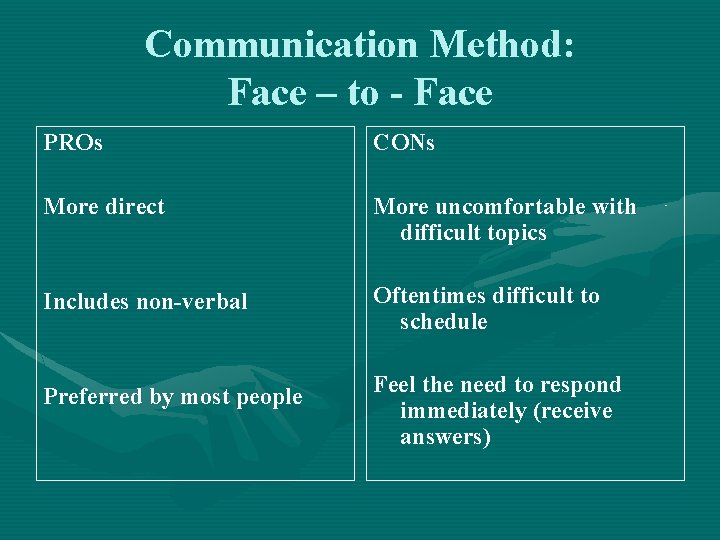
Communication Method: Face – to - Face PROs CONs More direct More uncomfortable with difficult topics Includes non-verbal Oftentimes difficult to schedule Preferred by most people Feel the need to respond immediately (receive answers)
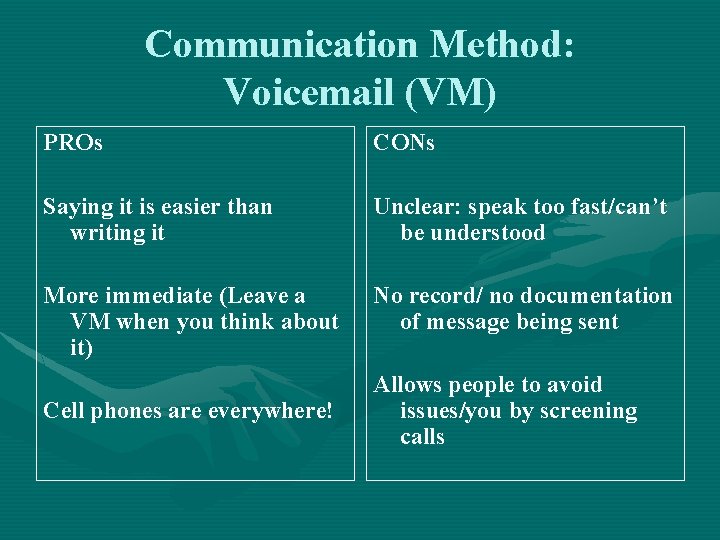
Communication Method: Voicemail (VM) PROs CONs Saying it is easier than writing it Unclear: speak too fast/can’t be understood More immediate (Leave a VM when you think about it) No record/ no documentation of message being sent Cell phones are everywhere! Allows people to avoid issues/you by screening calls
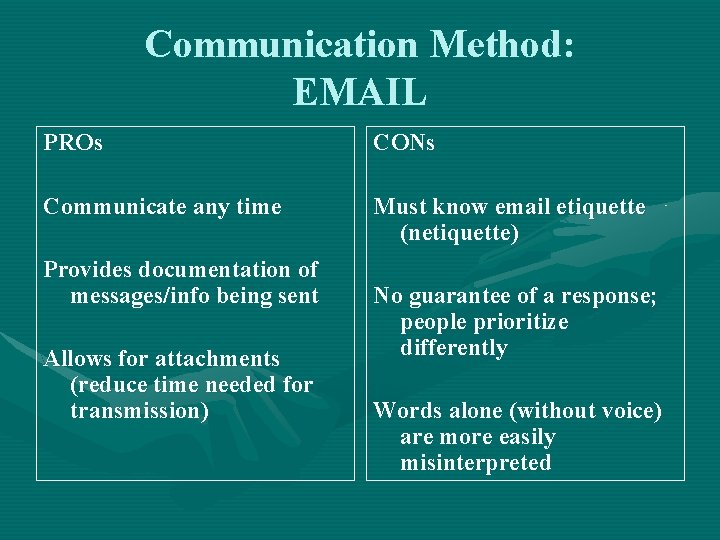
Communication Method: EMAIL PROs CONs Communicate any time Must know email etiquette (netiquette) Provides documentation of messages/info being sent Allows for attachments (reduce time needed for transmission) No guarantee of a response; people prioritize differently Words alone (without voice) are more easily misinterpreted
Nonverbal Communication • “Actions speak louder than words” • Body language can be interpreted many different ways • Facial clues – smile, frown, raised eyebrow • Eye movement – signals your attention
Postures and Gestures What do the following imply? • Tapping fingers • Arms crossed • Nodding • Leaning towards speaker • Looking around • Placing your head on your hand • Placing your hand over your mouth
- Slides: 9