
EFFECTIVE COMMUNICATION UWB 10202 Meeting Introduction An essential
![EFFECTIVE COMMUNICATION [UWB 10202] Meeting](https://slidetodoc.com/presentation_image_h2/b58a2232118eab979eaebb4e0386d115/image-1.jpg "EFFECTIVE COMMUNICATION [UWB 10202] Meeting")
EFFECTIVE COMMUNICATION [UWB 10202] Meeting

Introduction An essential form of communication Properly planned and conducted, meetings are forum where information is shared, problems are solved and decisions are made in a democratic way In a successful meeting, the members participate actively At the end of a meeting, the morale of the members is improved
Definition Any kind of purposeful coming together of people to carry out the business of the company such as communications, planning, setting policy, making decisions or motivating the work force We meet because people holding different jobs have to cooperate to get a specific task done “…the knowledge and experience needed in a specific situation are not available in one head, but have to be pieced together out of the knowledge and experience of several people. ” (Drucker, P. )

Types Formal Informal • Annual General Meetings • Discussions • Extra Ordinary Meeting • Committee Meetings • Dialogues • Brainstorming
Purpose The person calling a meeting should have a clear purpose and one/two objectives The purpose of the meeting would normally be: - to disseminate information - to announce about plans and programmes - to introduce new members of the staff
Objectives Obtaining consensus and enthusiastic support of the members Integrating new members into the organization Fostering group spirit (esprit de corps) among the members Appraising members by the management Motivating members to achieve certain ends / objectives of the organization
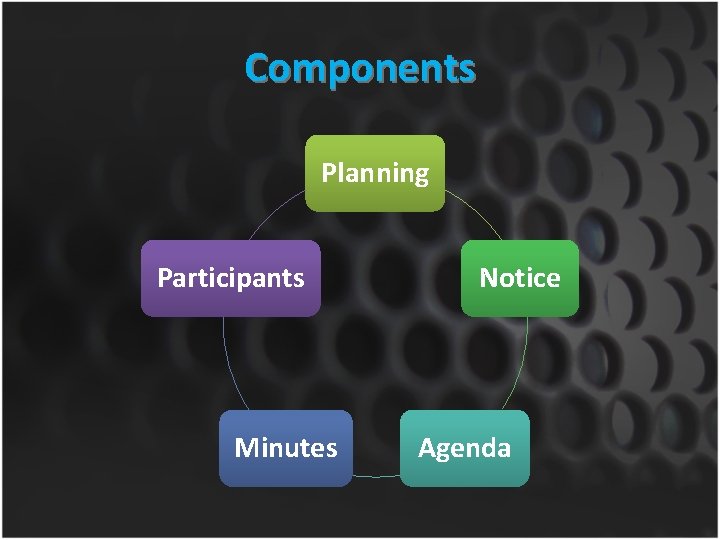
Components Planning Participants Minutes Notice Agenda
Convening a Meeting The chairperson discusses with the secretary before the latter sends out the notice of meeting Minutes of the previous meeting should be included with the notice, if the minutes have not been dispatched earlier The notice of meeting should contain the agenda of the meeting
Convening a Meeting (Con’t) Participants should be invited to attend a meeting if: - they have direct responsibility or authority over the topic of discussion - they have the relevant information required - they have the responsibility to resolve the problem at hand or to implement the group’s discussions

Conducting Meetings Call the meeting to order as scheduled other matters to be dealt with on the agenda Opening address by the chairperson with a statement about the purpose/objectives matters arising (from the minutes of the previous meeting) Introduce new members (if any) adopting/confirming minutes of the previous meeting (if any) Summing up and closing address by the chairperson, reinforcing the purpose of the meeting Fixing the date, time and venue of the next meeting (if appropriate)
Types of Leaders in a Meeting Autocratic / Dictatorial The leader or chairperson regards himself as more knowledgeable than others, dominating meeting with mostly one-way communication, from himself Democratic The leader regards everyone as having a role to play and valuable contributions to make in achieving the objective of the meeting, encourages individual participation and seeks feedback
Types of Leaders in a Meeting (Con’t) Laissez faire The leader allows free discussion without control and direction to give the impression that he is ‘democratic’ and fair to all The ‘Invisible’ Leader The leader provides an agenda, makes friends with the group early in the meeting, keeping opening remarks short, encourages participation, listens attentively, watches the time, clarifies, solicits feedback, channels conflict and follows up
Role of the Participants Prepares his report well if he is required to present one, using visual aids (if appropriate) Goes straight to the point of whatever he has to say Listens actively and attentively and gives feedback when required Accepts tasks assigned Helps the chairperson to accomplish the objectives of the meeting
Follow Up on Meetings To make a meeting effective and to achieve the objectives of the meeting, there should be follow up: a) Sum up the accomplishments of the meeting - summarize what has been accomplished in the meeting and what remains to be done - it is for the information of superiors and also the subordinates to be informed of decisions
Follow Up on Meetings (Con’t) b) Review and distribute the minutes - review to check any errors and omissions - secretary sends them out ideally within a week c) Give feedback to meeting participants - compliment presenters who did a good job - show interest in points raised - follow up on questions asked

Notice of Meeting The notice of meeting should reach the members at least a few days ahead to get the members prepared The notice should contain the following info: a) Date, time and venue of meeting b) Purpose of meeting c) Meeting agenda d) Attach minutes of the previous meeting
Notice of Meeting (Con’t) To avoid over-stretching the meeting, it is advisable to state the duration or time limit for each item on the agenda Specify on the agenda, members or persons who will speak or present reports and state the time allocated

Agenda The meeting agenda should be arranged as follows: (i) The chairman’s opening address (ii) Confirmation of minutes of the previous meeting (iii) Matters arising (iv) Agenda (v) Other matters (vi) Closing

Minutes of Meeting The minutes should record: - important matters discussed in the meeting - decisions made - follow-up actions required A draft of the minutes should be forwarded to the chairman for approval not later than 3 days after the meeting The approved minutes should be distributed to all members not later than a week after the meeting
Minutes of Meeting (Con’t) The format should follow the agenda Names of members present at the meeting should be arranged according to their seniority Minutes of meeting should be concise, precise and clear Every item discussed and recorded should be followed by notes indicating any further action required or for information only
- Slides: 20