
EFFECTIVE COMMUNICATION Skit Breakdown Lets analyze some of
EFFECTIVE COMMUNICATION
Skit Breakdown � Let’s analyze some of the things we noticed with the group skits that were presented… � How do you think the situations in each skit could have changed by simply having the correct matching verbal and non verbal communications? Why is it important for these two communication forms to match? If you were a child who saw and heard two different messages what might some of your responses be? � �
TIME TO THINK: Complete the following resolutions (on your own paper): From now on, when I am speaking, I am going to follow these 3 practices: 1. When I greet a parent who is late picking up their child, I am going to show my feelings by the following non-verbal actions… 2. Above all, when it comes to communication, I am going to…. . 3. Is communication mostly Verbal ______ or Non-Verbal ______ ? (Check one )
Practice � � � Break into groups of two. Have one person tell a 2 minute story and the other person listen. The listener will then share the storytellers story.
Assessing Communication Skills: � Use the communication inventory to evaluate your communication skills. � On a sheet of paper, write the number of each statement and respond with Never, Sometimes, Almost always or Always. � Reflect on your responses and think about how you will change your Never and Sometimes responses into Almost Always or Always responses. Make a list of strategies that will help you to improve your communication skills.
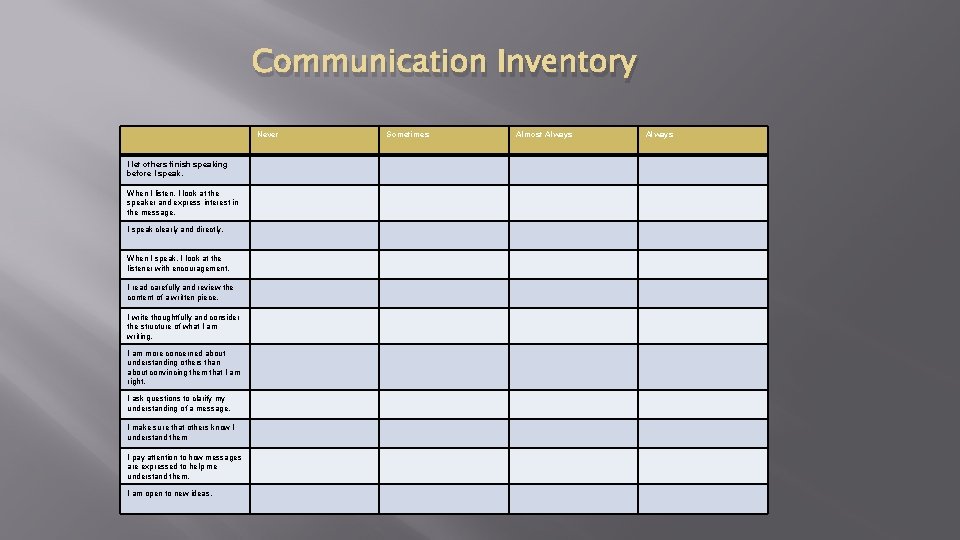
Communication Inventory Never I let others finish speaking before I speak. When I listen, I look at the speaker and express interest in the message. I speak clearly and directly. When I speak, I look at the listener with encouragement. I read carefully and review the content of a written piece. I write thoughtfully and consider the structure of what I am writing. I am more concerned about understanding others than about convincing them that I am right. I ask questions to clarify my understanding of a message. I make sure that others know I understand them I pay attention to how messages are expressed to help me understand them. I am open to new ideas. Sometimes Almost Always
Active Listening Strategies � Now list some strategies that will help you to improve your communication skills. Active Listening Strategies � � � � � Keep an open mind. Listen, do not talk. Be alert. Show interest. Take notes. Listen critically. Give feedback. Listen with empathy Think about how can you turn your NEVER into ALMOST ALWAYS or ALWAYS?
“I” Statements: � � � Incorporating the use of “I” statements is a critical component of healthy communication with children. “I” statements allow a parent or child to express exactly what they are feeling. For example, “I am upset that you did not make the bed” or “I am wishful mom that we can go to the park after we do the dishes”. The use of “I” instead of “You” diffuses any potential anger and calms a ‘hot’ situation.
Key Question “You Message” Example: You’re so stupid!—You never do anything right. “I Statement” Example: I would like to show you how I set the table. Let’s try it together. Read the following statements and change the “You message” into an “I message” : 1. You have no right being in that part of the home so get out immediately. 2. You never take me anywhere fun. 3. You are nothing but trouble. 4. You don’t have a mind in that body of yours.
Key Question 1. 2. 3. 4. Create a smart ideas brainstorm describing yourself as a communicator in school, with friends, with your kids or at your job. Describe how you communicate verbally or non-verbally. Do you communicate your messages effectively? Explain. Give 3 reasons why effective communication is important at school and with your family.
- Slides: 10