
Effective Communication Instruction Japanese Junior High Schools Presented


![Why is it Effective? ØEducational - John Holt Research on Adolescent/School Psychology “[Many teachers]](https://slidetodoc.com/presentation_image/c2f197d5666b488c1493771dae2c254f/image-11.jpg "Why is it Effective? ØEducational - John Holt Research on Adolescent/School Psychology “[Many teachers]")
- Slides: 12
Effective Communication Instruction Japanese Junior High Schools Presented at the 2013 Exposing English Education in Gunma Elementary and Secondary Schools JALT Conference Appeared as part of 2013 Gunma SDC Overcoming the ‘Silent’ Phase of Learning presentation by Amy Russo & Asako Morito Terry Dassow
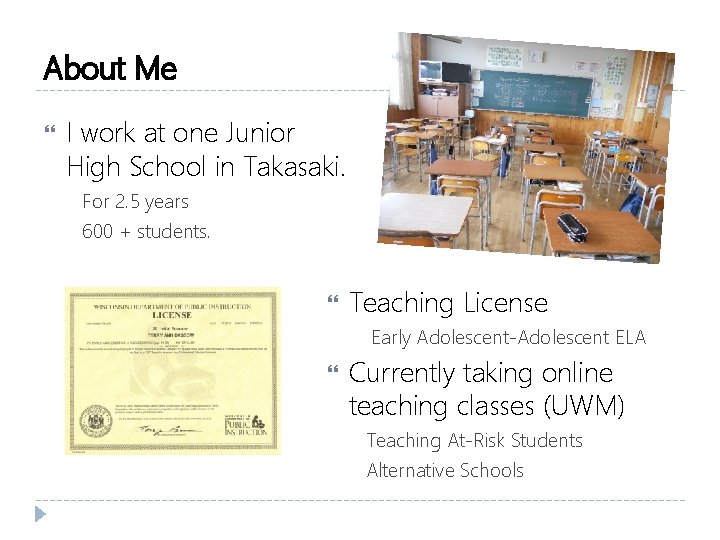
About Me I work at one Junior High School in Takasaki. For 2. 5 years 600 + students. Teaching License Early Adolescent-Adolescent ELA Currently taking online teaching classes (UWM) Teaching At-Risk Students Alternative Schools
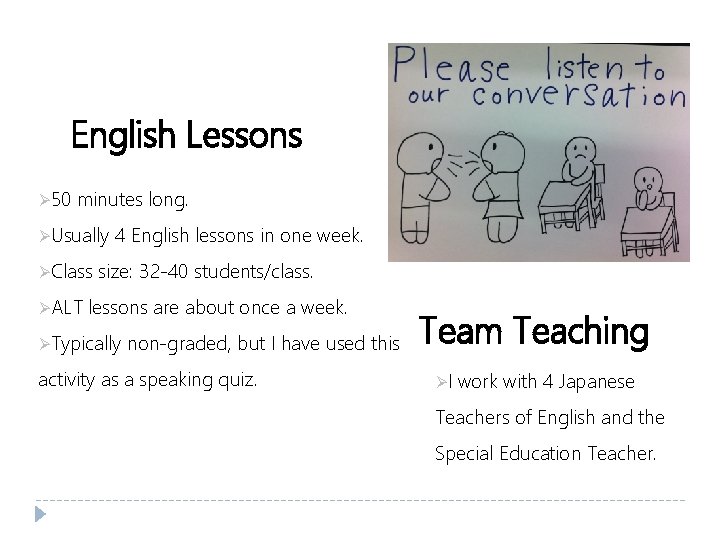
English Lessons Ø 50 minutes long. ØUsually ØClass ØALT 4 English lessons in one week. size: 32 -40 students/class. lessons are about once a week. ØTypically non-graded, but I have used this activity as a speaking quiz. Team Teaching ØI work with 4 Japanese Teachers of English and the Special Education Teacher.
My “Typical” Lesson Structure ØWarm up ØStudents do a word test or recite sentences from memory. ØPlay Bingo or criss-cross ØJTEs perhaps skip this step. Ø 15 -20 ØJTE minute activity decided by the ALT leads. ØStudents repeat the new words and sentences from the textbook. ØTeachers give notes on grammar points, on the translation of the textbook passage, or go through the answers of a worksheet.
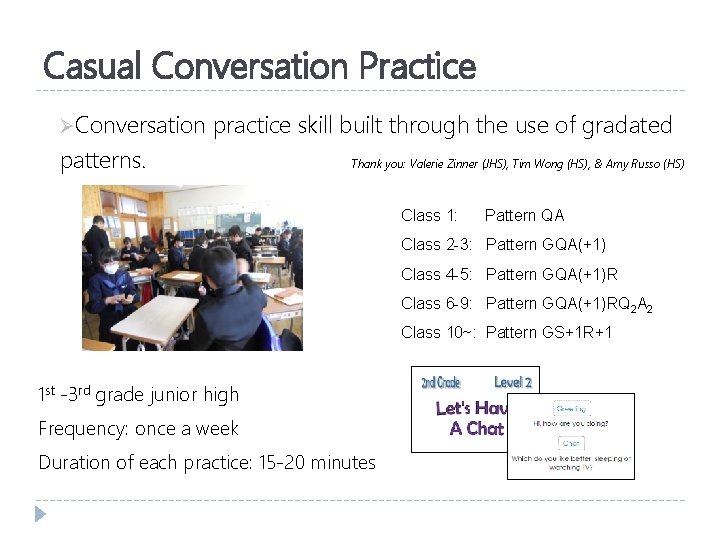
Casual Conversation Practice ØConversation practice skill built through the use of gradated patterns. Thank you: Valerie Zinner (JHS), Tim Wong (HS), & Amy Russo (HS) Class 1: Pattern QA Class 2 -3: Pattern GQA(+1) Class 4 -5: Pattern GQA(+1)R Class 6 -9: Pattern GQA(+1)RQ 2 A 2 Class 10~: Pattern GS+1 R+1 1 st -3 rd grade junior high Frequency: once a week Duration of each practice: 15 -20 minutes
Why is it Effective? ØEducational Research on Healthy Development 5. Caring school climate—School provides a caring, encouraging environment. 15. Positive peer influence—Young person’s best friends model responsible behavior. 16. High expectations—Both parent(s) and teachers encourage the young person to do well. 22. School Engagement—Young person is actively engaged in learning. 26. Caring—Young person places high value on helping other people. 33. Interpersonal Competence—Young person has empathy, sensitivity, and friendship Search Institute. (2006). 40 developmental assets for adolescents (ages 12 -18). Retrieved from: http: //public. health. oregon. gov/Healthy. People. Families/Youth/ Adolescent. Growth. Development/Documents/40 Assets. List. pdf skills.
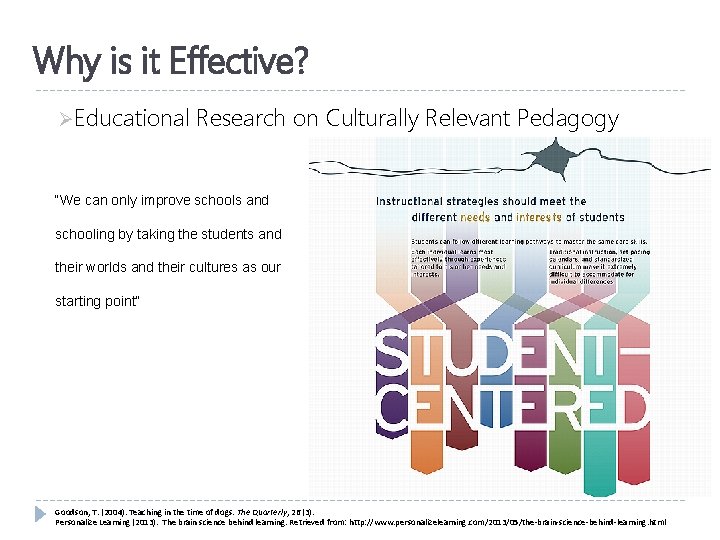
Why is it Effective? ØEducational Research on Culturally Relevant Pedagogy “We can only improve schools and schooling by taking the students and their worlds and their cultures as our starting point” Goodson, T. (2004). Teaching in the time of dogs. The Quarterly, 26 (3). Personalize Learning (2013). The brain science behind learning. Retrieved from: http: //www. personalizelearning. com/2013/05/the-brain-science-behind-learning. html
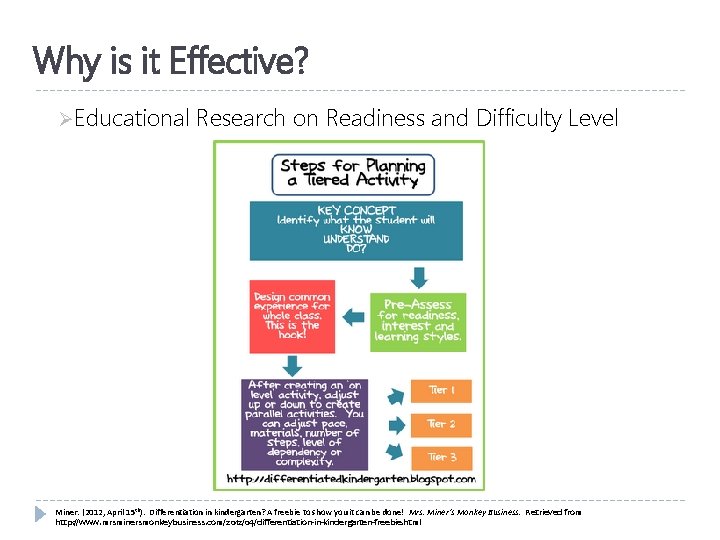
Why is it Effective? ØEducational Research on Readiness and Difficulty Level Miner. (2012, April 15 th). Differentiation in kindergarten? A freebie to show you it can be done! Mrs. Miner’s Monkey Business. Retrieved from http: //www. mrsminersmonkeybusiness. com/2012/04/differentiation-in-kindergarten-freebie. html
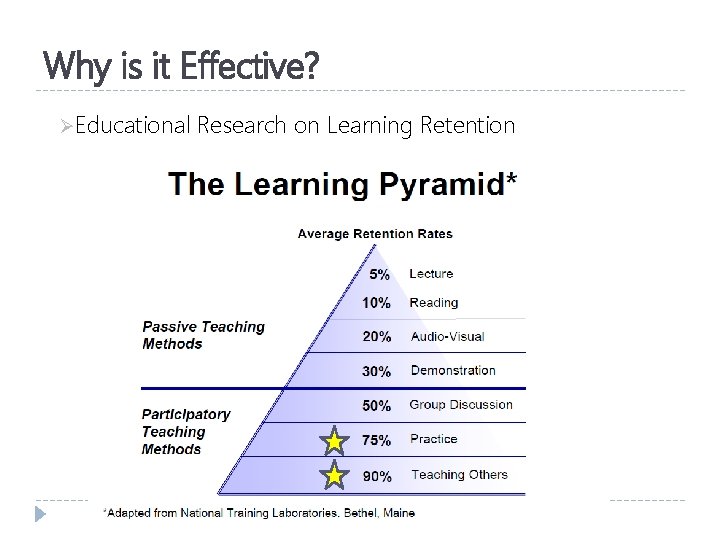
Why is it Effective? ØEducational Research on Learning Retention
Why is it Effective? ØEducational Research on Learning Retention Kuhlmann, T. (2007, October 30 th). How to get your learners to remember more. Articulate Network. Retrieved from http: //www. articulate. com/ rapid-elearning/how-to-get-your-learners-to-remember-more/
Why is it Effective? ØEducational - John Holt Research on Adolescent/School Psychology “[Many teachers] still cling stubbornly to the idea that the only good answer is a yes answer. This, of course, is the result of the miseducation in which "right answers" are the only ones that pay off. They have not learned how to learn from a mistake, or even that learning from mistakes is possible “(p. 34). " Practice you do for yourself, to get better at something you want or need to do. Drill you do for other people, perhaps so they can check up on you to make sure you know what you are supposed to, perhaps only so they can keep you busy” (p. 118). “the way we use it [the mind] determines how we can use it. If we use it badly long enough, it will become less and less possible to use it well. If we use it well, the possibility grows that we may use it even better. […] The brain, as an organ, may have far more flexibility and recuperative powers than we realize” (p. 77). Holt, J. (1964). How children fail. Retrieved from: http: //www. schoolofeducators. com/wp-content/uploads/2011/12/HOW-CHILDREN-FAIL-JOHN-HOLT. pdf (Original work published 1964)
For PDF and MSWord versions of the conversation topic cards: Check out my co-authored website at: http: //altscene. wordpress. com Some of my materials are available on Teachers Pay Teachers http: //www. teacherspayteachers. com/Store/Rockin-The-Alt-Scene