
EFFECTIVE COMMUNICATION IN PRESENTATION DEFINITION Effective communication is
- Slides: 10
EFFECTIVE COMMUNICATION IN PRESENTATION
DEFINITION �Effective communication is defined as verbal speech or other methods of relaying information that get a point across. v. An example of effective communication is when you talk in clear and simple terms. v. An example of effective communication is when the person who you are talking to listens actively, absorbs your point and understands it.
WHAT TO DO… The material of the presentation should be concise, to the point and tell an interesting story. � Voice - how you say it is as important as what you say � Body language - a subject in its own right and something about which much has been written and said. In essence, your body movements express what your attitudes and thoughts really are. � Appearance - first impressions influence the audience's attitudes. Dress appropriately for the occasion.
PREPARATION �Prepare the structure of the talk carefully and logically. �State the objectives and the main points. �Write out the first draft of presentation and review it. Check the story is consistent and flows smoothly. �Never read from a script. Prepare cue cards which have key words and phrase on them. �Rehearse the presentation - to ourselves at first and then in front of some colleagues.
MAKING THE PRESENTATION � Greet the audience (for example, 'Good morning, ladies and gentlemen'), and tell them who you are. then: � tell the audience what you are going to tell them, � then tell them at the end what you have told them. � Keep to the time allowed and short. Better than over-run. � Stick to the plan for the presentation. � Unless explicitly told not to, leave time for discussion. � At the end of the presentation ask if there any questions.
DELIVERY � Speak clearly. Don't shout or whisper. � Don't rush, or talk deliberately slowly. Be natural. � Deliberately pause at key points. � Avoid jokes - always disastrous unless a natural expert � Use your hands to emphasise points but don't indulge in to much hand waving. � Look at the audience as much as possible, but don't fix on an individual - it can be intimidating. � Don't face the display screen behind you and talk to it. � Other annoying habits include: � Standing in a position where you obscure the screen. � Avoid moving about too much. � Keep an eye on the audience's body language. Know when to stop and also when to cut out a piece of the presentation.
VISUAL AIDS �Visual aids significantly improve the interest of a presentation. �Example of visual aids: ~Overhead projection transparencies (OHPs) 35 mm slides ~Computer projection (Powerpoint, applications such as Excel, etc) ~Video, and film, ~Flip~chart or blackboard - possibly used as a 'scratch-pad' to expand on a point
�Finally . . . , Enjoy yourself. The audience will be on OUR side and want to hear what WE have to say!
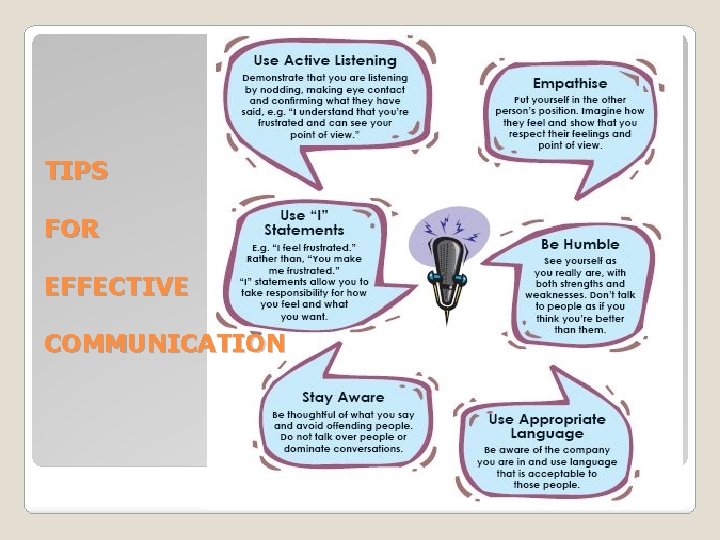
TIPS FOR EFFECTIVE COMMUNICATION