
Effective Communication for Disability Professionals Linda Sullivan MA
Effective Communication for Disability Professionals Linda Sullivan, MA Paul Harwell, MA Harvard University Division of Continuing Education
Purpose and Objectives • Most of our work hinges on communication, but how often do we reflect on how we communicate or how effectively we communicate? • Objectives: • Learn about the principles of effective communication (Grice’s Maxims) • Learn about communication style, and how it influences your work with students and campus community • Learn about communication under pressure 2 Sullivan & Harwell AHEAD 2019 Do not copy without permission
Communication by definition • Communication: “ 1. a process by which information is exchanged between individuals through a common system of symbols, sings, or behavior, also exchange of information 2. personal rapport” – Merriam-Webster • Effective: “ 1. producing a decided, decisive, or desired effect” – Merriam-Webster • Effective Communication: Successful delivery of intended message wherein all parties assign similar meanings. 3 Sullivan & Harwell AHEAD 2019 Do not copy without permission
Regulated Communication • Informal, practical understanding of communication • Legally defined communication • • • 4 Section 504 104. 44 ADA Title III IDEA DCL “Interactive process” Sullivan & Harwell AHEAD 2019 Do not copy without permission
Group Activity 5 Sullivan & Harwell AHEAD 2019 Do not copy without permission
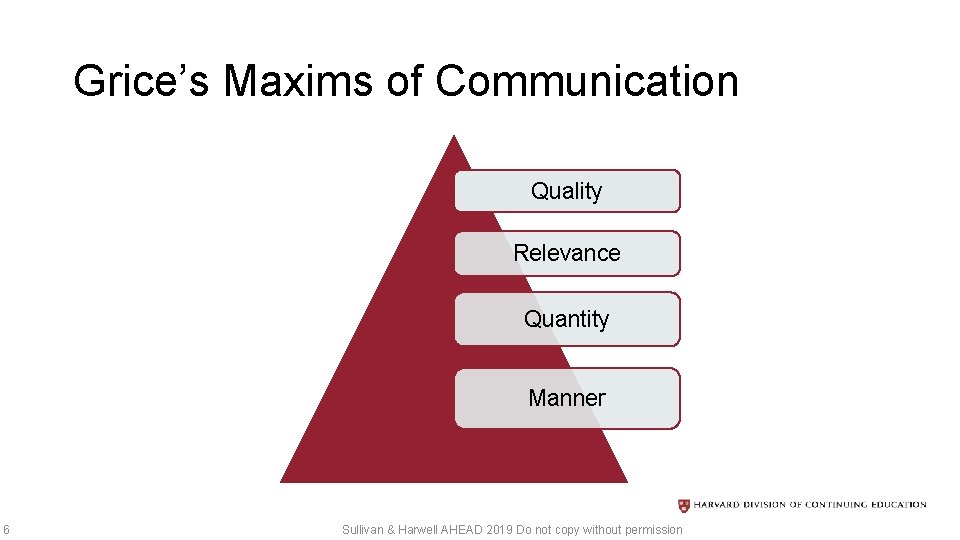
Grice’s Maxims of Communication Quality Relevance Quantity Manner 6 Sullivan & Harwell AHEAD 2019 Do not copy without permission
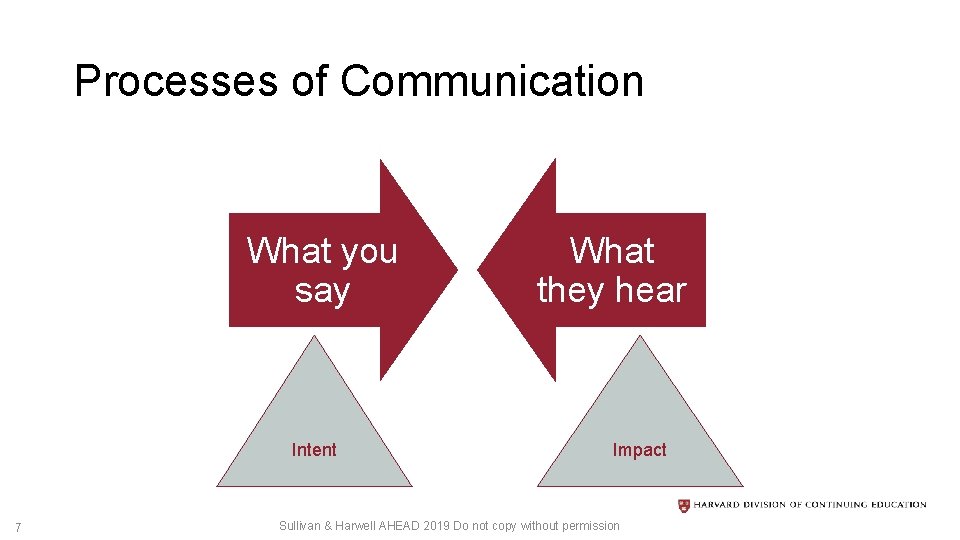
Processes of Communication What you say Intent 7 What they hear Impact Sullivan & Harwell AHEAD 2019 Do not copy without permission
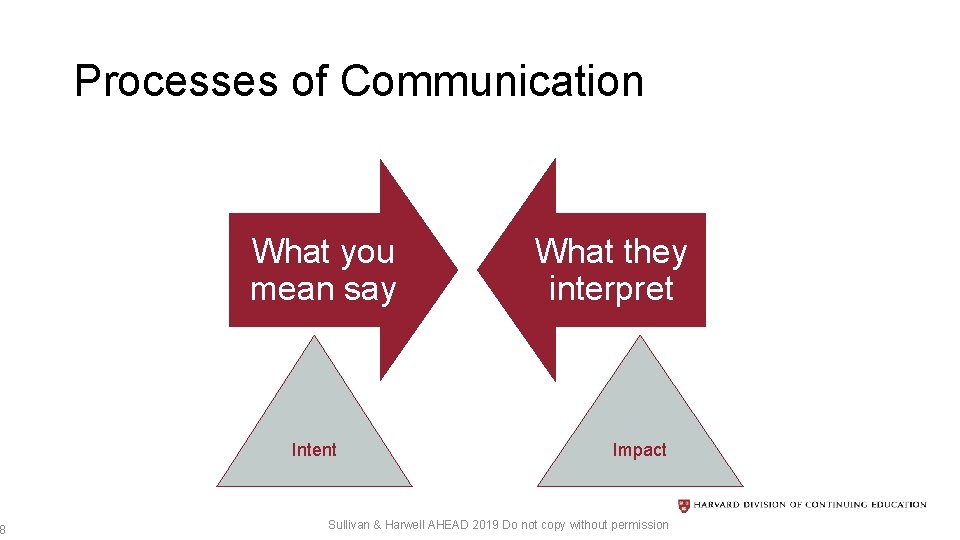
8 Processes of Communication What you mean say Intent What they interpret Impact Sullivan & Harwell AHEAD 2019 Do not copy without permission
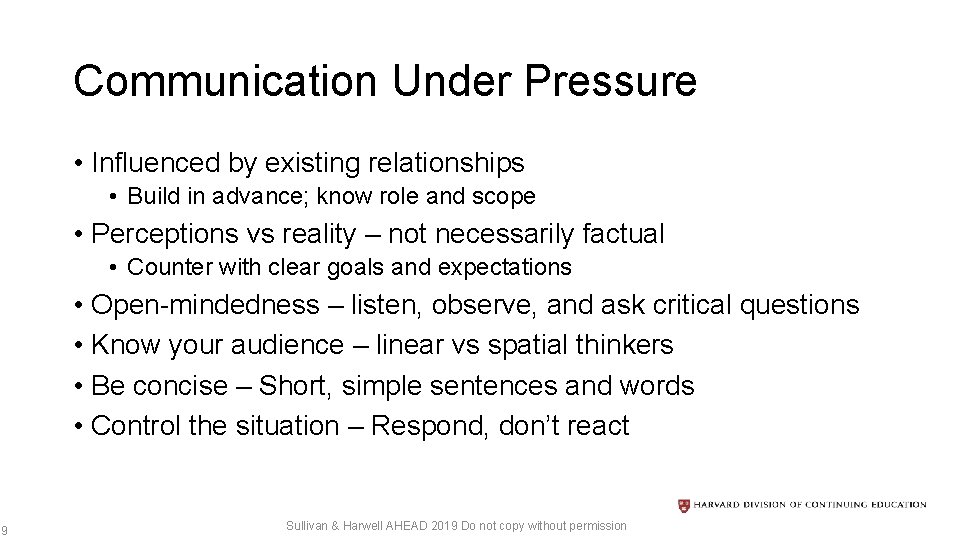
Communication Under Pressure • Influenced by existing relationships • Build in advance; know role and scope • Perceptions vs reality – not necessarily factual • Counter with clear goals and expectations • Open-mindedness – listen, observe, and ask critical questions • Know your audience – linear vs spatial thinkers • Be concise – Short, simple sentences and words • Control the situation – Respond, don’t react 9 Sullivan & Harwell AHEAD 2019 Do not copy without permission
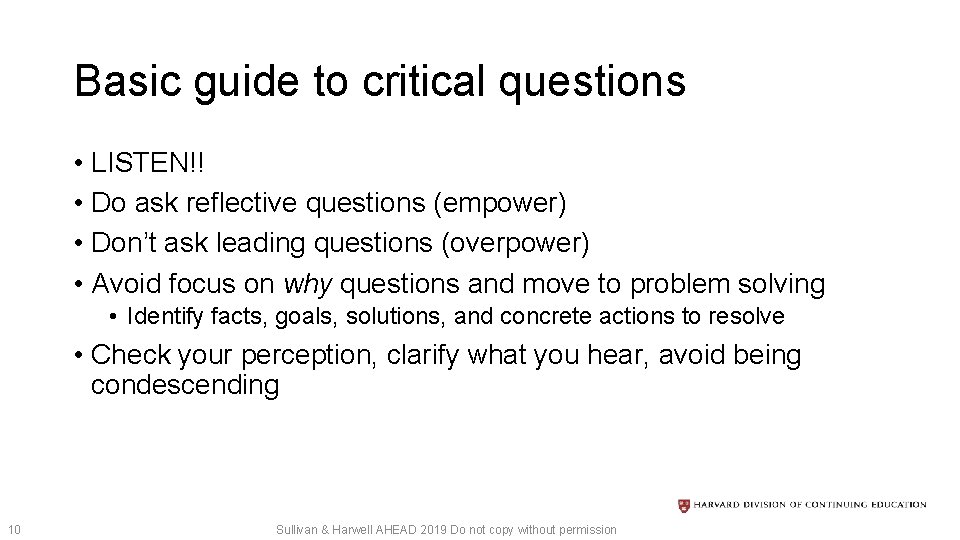
Basic guide to critical questions • LISTEN!! • Do ask reflective questions (empower) • Don’t ask leading questions (overpower) • Avoid focus on why questions and move to problem solving • Identify facts, goals, solutions, and concrete actions to resolve • Check your perception, clarify what you hear, avoid being condescending 10 Sullivan & Harwell AHEAD 2019 Do not copy without permission
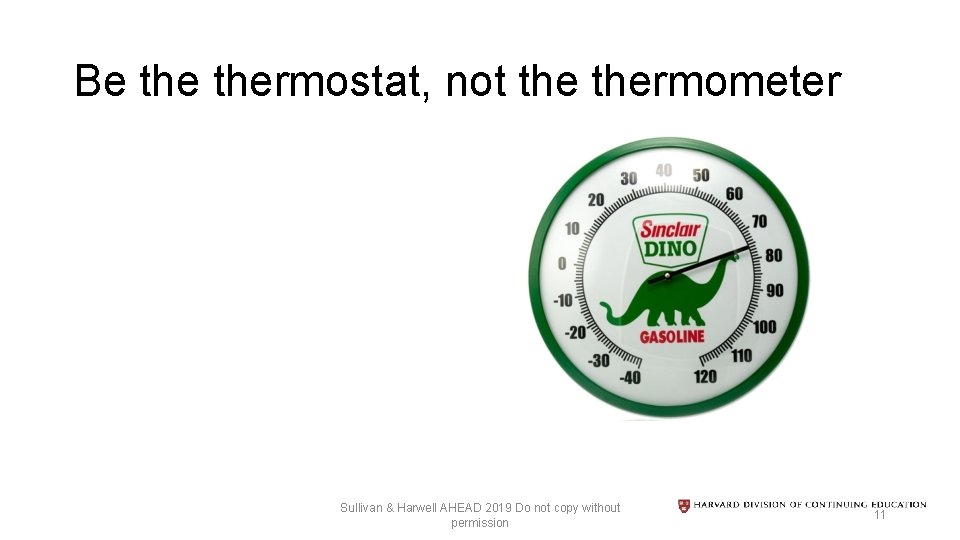
Be thermostat, not thermometer Sullivan & Harwell AHEAD 2019 Do not copy without permission 11
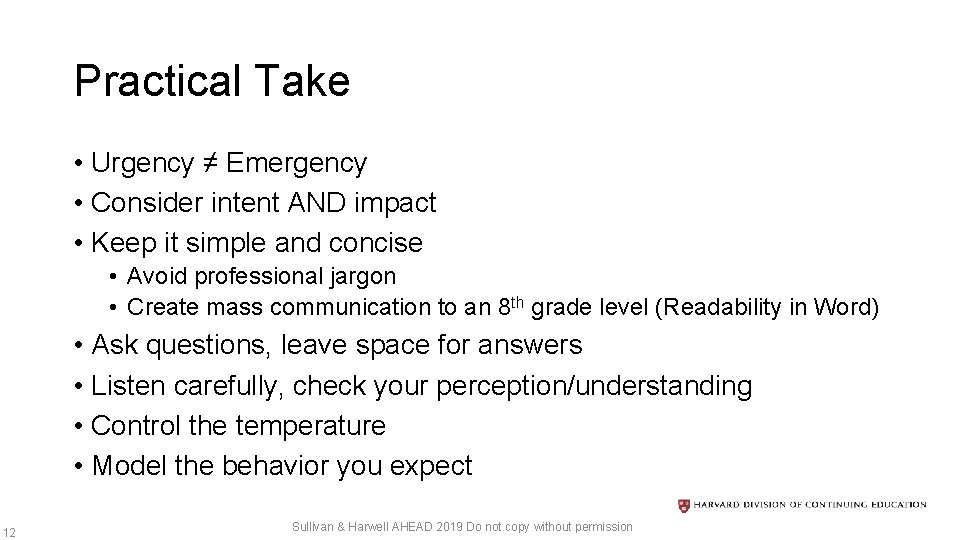
Practical Take • Urgency ≠ Emergency • Consider intent AND impact • Keep it simple and concise • Avoid professional jargon • Create mass communication to an 8 th grade level (Readability in Word) • Ask questions, leave space for answers • Listen carefully, check your perception/understanding • Control the temperature • Model the behavior you expect 12 Sullivan & Harwell AHEAD 2019 Do not copy without permission
Discussion Thank you for joining us! Please complete your survey. 13 Sullivan & Harwell AHEAD 2019 Do not copy without permission
- Slides: 13