
Effective Communication Credential of Competency Standard 6 Language
- Slides: 60
Effective Communication Credential of Competency Standard # 6: Language Pennsylvania Training and Technical Assistance Network (Pa. TTAN) October 16, 2008
Pennsylvania’s Commitment to Least Restrictive Environment (LRE) Recognizing that the placement decision is an Individualized Education Program (IEP) team decision, our goal for each child is to ensure IEP teams begin with the general education setting with the use of Supplementary Aids and Services before considering a more restrictive environment.
District, IU, Preschool Agency Policy Your local district’s policies regarding paraeducator job descriptions, duties, and responsibilities provide the final word!
Agenda • Effective communication • With adults in school • In the community • With students • Resolving conflict in the work setting • Working with students who have communication or language disorders
Learner Outcomes Participants will: • Describe basic elements of communication • List strategies for communicating effectively with adults and students. • Describe specific ways to respond to difficult people and situations within the work setting. • Describe the types of communication and language difficulties that students with disabilities may experience in school. • Learn strategies to support students who have challenges with communication or language.
How do you communicate? • With a partner or your table group, brainstorm ways in which you communicate throughout a typical day. • Jot down your ideas • We will share out
What is Communication? Communication is a process by which information is exchanged between individuals through a common system of symbols, signs or behavior.
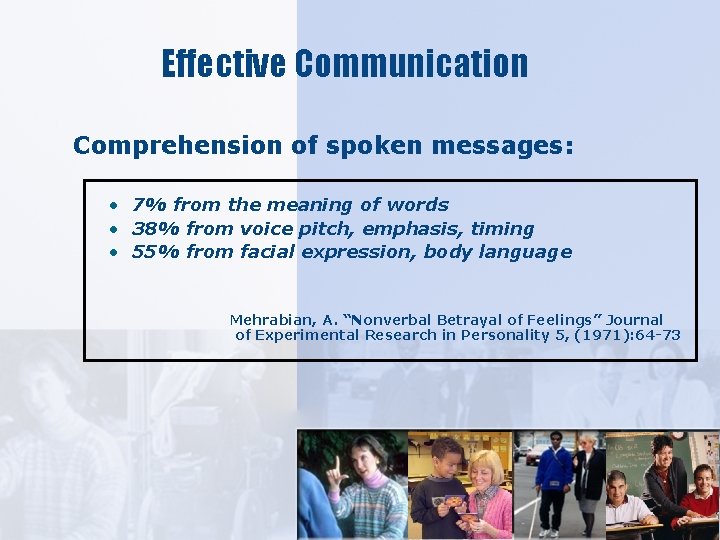
Effective Communication Comprehension of spoken messages: • 7% from the meaning of words • 38% from voice pitch, emphasis, timing • 55% from facial expression, body language Mehrabian, A. “Nonverbal Betrayal of Feelings” Journal of Experimental Research in Personality 5, (1971): 64 -73
Effective Communication Four possibilities: Speaker: says what he means A student says, “This assignment looks really hard and I don’t think I can do it”. Speaker: says something other than what he means A students says, “This is a dumb assignment and I’m not going to do it”.
Effective Communication Four possibilities: • Listener: may not accurately hear what is said The teacher may feel that this student is lazy and just does not want to make the effort to complete the assignment. • Listener: accurately hears what is said The teacher understands that the student needs extra help with the assignment.
Activity – How well do you communicate? • Take the Communication Skills Inventory from your handouts. • Read each item and circle the number that best describes how well you use each skill. • After you are through, choose 1 or 2 skills you would like to improve.
Effective Communication As members of the education team, good communication and problem-solving skills are essential • To your job success and satisfaction • To support student success
Effective Communication With Adults In School Styles of Communication • Passive / Non-assertive • Aggressive • Positive / Assertive
Effective Communication With Adults In School Use effective communication strategies • Active listener • Be aware of “filters” • Use “people first” language
Effective Communication With Adults In School Communicate in a professional manner • Report objectively • Recognize roles and authority • Follow communication policies • Respect others’ perspectives
Effective Communication with Adults and the Community Maintaining Confidentiality
Effective Communication with Adults and the Community Family Educational Rights and Privacy Act (FERPA) 1974 • Paraprofessionals may have access to student: • Testing results • Behavior plans • Ability levels • Family information • Paraprofessionals must: • maintain students’ privacy, giving out student information according to district policy
Activity - Confidentiality- Do or Don’t? • Work with a partner • Read over the confidentiality worksheet • Mark each statement as Do or Don’t
Confidentiality - Do or Don’t? • You tell a parent of one of your students that the reason the child’s P. T. has been out is because she had a miscarriage. She’ll make up the sessions when she returns. • You are asked by a student’s stepfather to let you know if the child’s father acts “funny” in any way when he comes to pick up the child. The mother and he are worried the father may be drinking – again – and are concerned for the boy’s safety.
Confidentiality - Do or Don’t? • Before leaving for your two-week honeymoon, you lock students’ files in your desk drawer. • A general education teacher who taught Reilly two years ago asks you how Reilly is doing in math. She struggled in his class, and he wanted to know if her math aptitude had improved.
Confidentiality - Do or Don’t? • You are at a school baseball game as a spectator. A mother of one of your students tells you she was considering putting her daughter on ADD medicine. She knows her neighbor recently started her son, Brandon, (who is also your class) on it. “Off the record, do you see a big improvement in his behavior in school? ” You tell her, “Yes, he’s definitely benefitted from it. ”
Confidentiality - Do or Don’t? • When questioned about a student’s disability by a substitute teacher filling in for the day, you provide specific information on the child and the teacher’s notes concerning his behavior.
Effective Communication With Students • • • Treat students with respect Give clear directions Use humor, not sarcasm Look for opportunities to praise students Tell students what it is they did right! Be genuine
Resolving Conflict in the Work Setting • Dealing with Negativity and Difficult People • Resolving Conflict
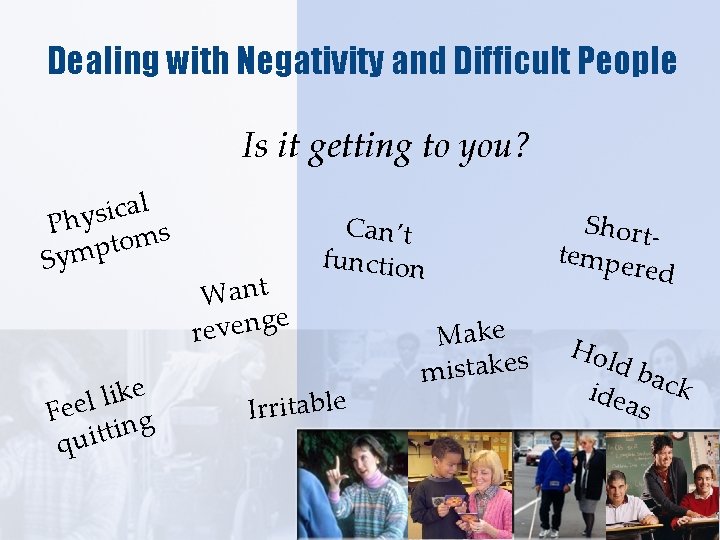
Dealing with Negativity and Difficult People Is it getting to you? al c i s y Ph s m o t Symp e k i l l Fee ng i t t i u q Want e g n e v e r Can’t function Irritable Make mistakes Shorttempe red Hol d ba idea ck s
Dealing with Negativity and Difficult People What you can do about negativity • Get specific • Let it go • Choose to be positive
Dealing with Negativity and Difficult People What you can do about verbal assault • Do not argue • Silent refocus • Respond in a professional manner • Caring comeback • Write it down
Activity - Resolving Conflict How do you respond to conflict? • Think of your work setting and people with whom you occasionally may have conflict • Place a check in the box next to each statement on the form that best describes how you respond when conflicts arise
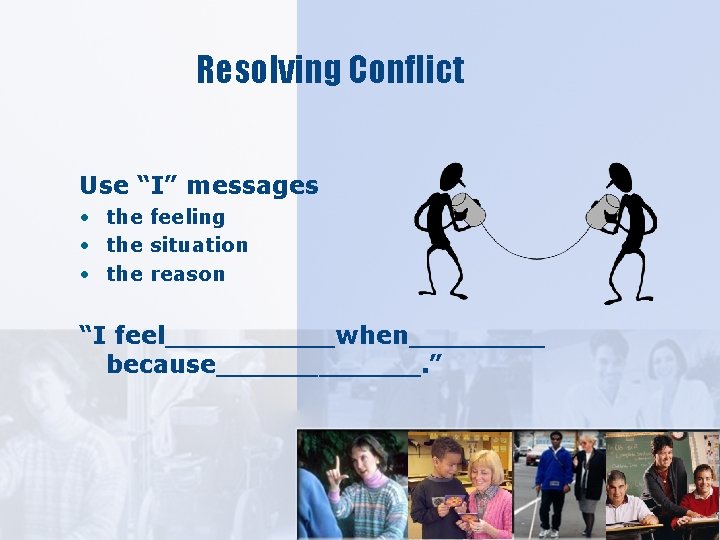
Resolving Conflict Use “I” messages • the feeling • the situation • the reason “I feel_____when____ because______. ”
Resolving Conflict “I” Message Scenario: You are allotted a ½ hour duty-free lunch each day. Your partner teacher takes lunch first and then you go to lunch. Lately, the teacher has been stretching it and arriving back to class 5 or 10 minutes late. You must escort students to their general education class directly following your lunch so you must be on time. You are being shorted on your lunch time.
Resolving Conflict • • Find a good time to talk Listen carefully, speak carefully Take the time to get at the real problem Focus on what you can do to solve the conflict • Take action and evaluate the situation over time
Working with students who have communication disorders
A communication disorder is: “An impairment in the ability to receive, send, process, and comprehend concepts, or verbal, nonverbal, and graphic symbol systems. ” www. asha. org
Who has communication disorders? • Students who receive special education may have communication disorders. • Impairments range from mild to severe
What types of speech and language disorders affect school-age children? • • • Speech sound disorders Language disorders Cognitive-communication disorders Stuttering (fluency) disorders Voice disorders
Working with students who have communication disorders General Strategies
Strategy # 1 Model appropriate speech and language use
Strategy # 2 Expand the student’s language
Strategy # 3 Create language extensions
Strategy # 4 Use parallel talk
Strategy # 5 If the child stutters. . .
Strategy # 6 Use gestures
Strategy # 7 When the student uses augmentative and alternative communication (AAC)…
Strategy # 8 Emphasize quantity rather than quality
Strategy # 9 Encourage curiosity about words
Strategy # 10 Use conversational repair
Strategy # 11 Use scripts
Strategy # 12 Use visuals
Working With Students Who Have Communication Disorders What would you do if…?
Scenario # 1 You are working with Rosario, a student with cerebral palsy. Rosario uses a Touch Talker to communicate. Ms. Brown is teaching a lesson in geography. She asks if anyone knows the name of the Pennsylvania state capital. Rosario would like to give the answer. What do you do?
Scenario # 1 1. Raise your hand tell Ms. Brown that Rosario would like to give the answer. 2. Start typing the answer for Rosario on her Touch Talker. 3. Tell Rosario she can try another time.
Scenario # 2 You are working with Chance, a student who has difficulty initiating conversation. The students sitting near Chance are discussing baseball. He wants to join in. What do you do?
Scenario # 2 1. Tell the students sitting nearby how much you love the Phillies. 2. Tell Chance he needs to speak up. 3. Whisper a conversational starter to Chance, “Hey I saw the Phillies play…” and encourage him to move closer to the other students.
Scenario # 3 You are working with Ashley a student who has multiple articulation errors. She is currently working on the /s/ and /ch/ sounds. On the cafeteria line, she wants to order a sandwich. What do you do?
Scenario # 3 1. Tell the cafeteria staff Ashley wants to order a sandwich. 2. Practice the /s/ and /ch/ sounds in the word “sandwich” with Ashley before she gets on the cafeteria line. 3. Let Ashley ask repeatedly for a sandwich even though the cafeteria staff cannot understand her.
Scenario # 4 You are working with Kareem a student with autism. It is the end of the day and time to get on the bus to go home. Kareem begins to exhibit anxiety as he is putting on his coat. What do you do?
Scenario # 4 1. Ignore Kareem’s screaming and put him on the bus. 2. Tell Kareem everything is fine and he should stop screaming. 3. Before the end of the school day, review Kareem’s script, “Now it’s time to go on the bus” with him.
In summary, communication disorders: • • Impact language, speech or hearing Range from mild to severe Can be developmental or acquired Can be a primary disability or secondary to another disability • There are many strategies to use to support student success with communication
Learner Outcomes Participants will: • Describe basic elements of communication • List strategies for communicating effectively with adults and students. • Describe specific ways to respond to difficult people and situations within the work setting. • Describe the types of communication and language difficulties that students with disabilities may experience in school. • Learn strategies to support students who have challenges with communication or language.
Bureau of Special Education Pennsylvania Training and Technical Assistance Network Edward G. Rendell Governor Gerald L. Zahorchak, D. Ed. Secretary Diane Castelbuono, Deputy Secretary Office of Elementary and Secondary Education John J. Tommasini, Director Bureau of Special Education Contact Information: Name of Consultant, Email address www. pattan. net