
EFFECTIVE COMMUNICATION Communication the lubricant of organizations Communicating
EFFECTIVE COMMUNICATION
Communication § “the lubricant of organizations…”
Communicating: Vital aspect of management The art of being able to structure and transmit a message in a way that another can easily understand and/or accept
Types of Communication § Verbal § Oral § Written § E-mail § Nonverbal § Expression § Expressive behaviors § Body language
Communication Distinctions § Formal/Informal § Official/unofficial information exchange § Vertical/horizontal § Superior-subordinate/peers § Personal/impersonal § Situation of mutual influence/exchange without mutual influence § Instrumental/expressive § Necessary for job/nonjob information transmission

Sender-Receiver Model: Each single communication 5 steps § message formation § message encoding § message transmission § message reception § message decoding PATHWAY BETWEEN 2 PEOPLE- INTERACTION OCCURS
PERCEPTION AND INTERPRETATION FORM FILTERS FOR MESSAGES Creates potential for communication breakdown: Result=miscommunication USE SIMPLICITY, CLARITY, APPROPRIATE TIMING, RELEVANCE, ADAPTATION TO CIRCUMSTANCES, AND CREDIBILITY
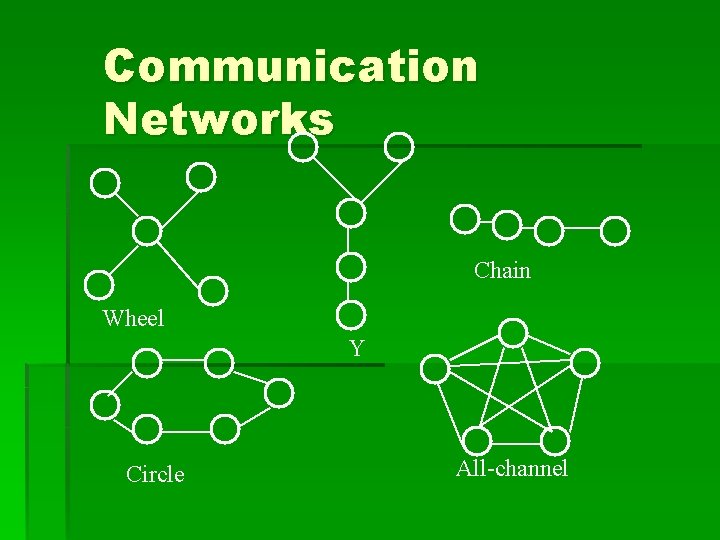
Communication Networks Chain Wheel Y Circle All-channel
Effectiveness of Communication § Related to timing § Related to choice of channel § Related to message structure § Related to delivery style § Related to mode
NURSING AND HEALTH CARE COMMUNICATION IS COMPLICATED BY JARGON!
FEEDBACK - Related to communication - Related to morale - Sequelae of delegation
FEEDBACK AND CRITICISM § Both constructive/negative criticism exist § Use feedback constructively to improve individual and team productivity and performance § Affects morale, motivation and team cohesiveness § Leader directed feedback is powerful tool in shaping behavior of team as team
Four Types of Feedback § Clarifying § restating instructions, making sure there is no confusion § Interpretive § involves making observation of the team’s behavior § Judgmental § involves drawing conclusion in form of value judgment § Personal reaction § gives information about your personal feelings
Communication Strategy: Responding to Criticism § Ask for more information § Agree with the critic § Use listening skills to guide the critic toward the real problem source
CONSTRUCTIVE CRITICISM § Not focused on blame § Not person’s characteristic, attack, defamation of character § Focused on an analysis of the problem § Positive critiquing includes: § BALANCING THE POSITIVES AND NEGATIVES § POINTING OUT PROBLEMS AND SOLUTION OPTIONS
Appearance and behavior combine to add to the total communication
ORGANIZATION COMMUNICATION § Group dynamics § Multiple people, influence, personalities, politics § Types of information transmission, flow of formal and informal information
Six Areas of Organizational Communication Problems § Accessibility of information § Communication channels § Clarity of messages § Span of control § Flow control/communication load § Individual communicators
SPECIFIC COMMUNICATION PROBLEM AREAS § Verbal abuse § Sexual harassment
Communication Styles § Passive § Aggressive § Passive-aggressive § Assertive
Communication Intervention Techniques § Assertive communication § Shift your focus § Create a positive open attitude § State your perception § Establish mutual goals § Use of “I” messages § Incorporate balance § Include strengths, review contributions § Solicit feedback
- Slides: 21