
Effective Communication 5 n Some methods of communication

- Slides: 6
Effective Communication 5 n. Some methods of communication are more appropriate for certain tasks. Usually, you will be told what to do, but sometimes you may have to make up your own mind. n When deciding what method to use, think about the following aspects: n
Do you need a response immediately? Talking to someone face to face or over the phone means that you are both communicating at the same time. n This allows the person you are communicating with to respond immediately to what you are saying n Communicating verbally is often very quick and effective. n Using written communication can take longer to get a response. n
Do you need a permanent record? n Written forms of communication provide a record of what has been said. n This is a benefit if you need to refer back to what has been said. n There is usually no record of verbal communication. n It might be difficult to remember the details of a conversation you had a few weeks or months ago.
Who are you communicating with and why? n In the workplace you will need to communicate with a range of people both inside and outside the office. n On some occasions you will need a formal method of communicating. n On others a more informal method will be appropriate.
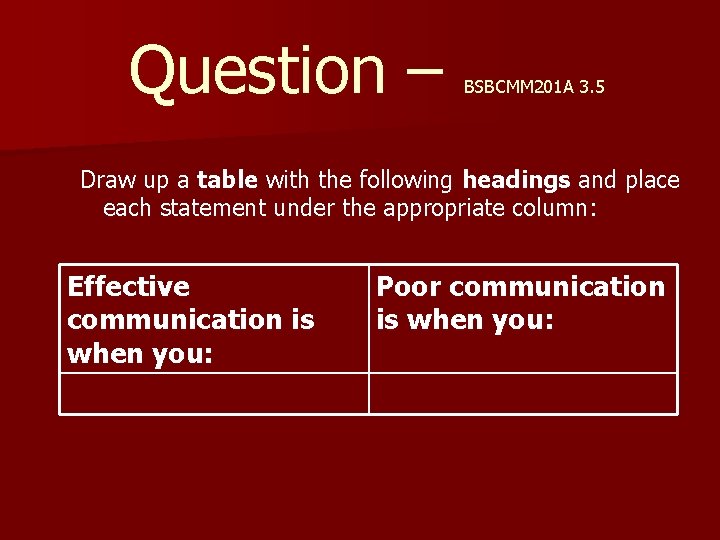
Question – BSBCMM 201 A 3. 5 Draw up a table with the following headings and place each statement under the appropriate column: Effective communication is when you: Poor communication is when you:
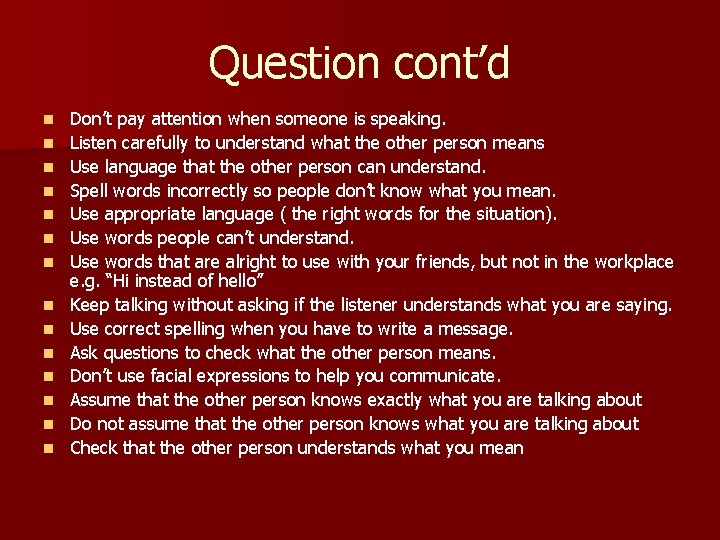
Question cont’d n n n n Don’t pay attention when someone is speaking. Listen carefully to understand what the other person means Use language that the other person can understand. Spell words incorrectly so people don’t know what you mean. Use appropriate language ( the right words for the situation). Use words people can’t understand. Use words that are alright to use with your friends, but not in the workplace e. g. “Hi instead of hello” Keep talking without asking if the listener understands what you are saying. Use correct spelling when you have to write a message. Ask questions to check what the other person means. Don’t use facial expressions to help you communicate. Assume that the other person knows exactly what you are talking about Do not assume that the other person knows what you are talking about Check that the other person understands what you mean